Lafayette 2
See main node
Marie-Joseph Paul Yves Roch Gilbert du Motier de La Fayette, Marquis de La Fayette[a] (6 September 1757 – 20 May 1834), known in the United States as Lafayette (/ˌlɑːfiːˈɛt, ˌlæf-/,[2] French: [lafajɛt]), was a French aristocrat, freemason, and military officer who fought in the American Revolutionary War, commanding American troops in several battles, including the siege of Yorktown. After returning to France, he was a key figure in the French Revolution of 1789 and the July Revolution of 1830. He has been considered a national hero in both countries.
Lafayette was born into a wealthy land-owning family in Chavaniac in the province of Auvergne in south central France. He followed the family's martial tradition and was commissioned an officer at age 13. He became convinced that the American revolutionary cause was noble, and he traveled to the New World seeking glory in it. He was made a major general at age 19, but he was initially not given American troops to command.
He was wounded during the Battle of Brandywine but still managed to organize an orderly retreat, and he served with distinction in the Battle of Rhode Island. In the middle of the war, he sailed for home to lobby for an increase in French support. He returned to America in 1780 and was given senior positions in the Continental Army. In 1781, troops under his command in Virginia blocked forces led by Cornwallis until other American and French forces could position themselves for the decisive siege of Yorktown.
Lafayette returned to France and was appointed to the Assembly of Notables in 1787, convened in response to the fiscal crisis. He was elected a member of the Estates General of 1789, where representatives met from the three traditional orders of French society: the clergy, the nobility, and the commoners.
After the National Constituent Assembly was formed, he helped to write the Declaration of the Rights of Man and of the Citizen with Thomas Jefferson's assistance. This document was inspired by the United States Declaration of Independence, which was authored primarily by Jefferson, and invoked natural law to establish basic principles of the democratic nation-state.
He also advocated the end of slavery, in keeping with the philosophy of natural rights. After the storming of the Bastille, he was appointed commander-in-chief of France's National Guard and tried to steer a middle course through the years of revolution. In August 1792, radical factions ordered his arrest, and he fled to the Austrian Netherlands. He was captured by Austrian troops and spent more than five years in prison.
Lafayette returned to France after Napoleon Bonaparte secured his release in 1797, though he refused to participate in Napoleon's government. After the Bourbon Restoration of 1814, he became a liberal member of the Chamber of Deputies, a position which he held for most of the remainder of his life.
In 1824, President James Monroe invited him to the United States as the nation's guest, where he visited all 24 states in the union and met a rapturous reception. During France's July Revolution of 1830, he declined an offer to become the French dictator. Instead, he supported Louis-Philippe as king, but turned against him when the monarch became autocratic. He died on 20 May 1834 and is buried in Picpus Cemetery in Paris, under soil from Bunker Hill. He is sometimes known as "The Hero of the Two Worlds" for his accomplishments in the service of both France and the United States.
- Early life
- Departure from France
- American Revolution
- Hero of two worlds
- French Revolution
- Prisoner
- Retreat from politics
- Bourbon restoration
- Grand tour of the United States
- Revolution of 1830
- Final years and death
- Beliefs
- Assessment
- See also
- Notes
- References
- Works cited
- Further reading
Early life
Further information: House of La Fayette
Lafayette was born on 6 September 1757 to Michel Louis Christophe Roch Gilbert Paulette du Motier, Marquis de La Fayette, colonel of grenadiers, and Marie Louise Jolie de La Rivière, at the château de Chavaniac, in Chavaniac-Lafayette, near Le Puy-en-Velay, in the province of Auvergne (now Haute-Loire).[3]

Lafayette's birthplace in Chavaniac, Auvergne
Lafayette's wife, Marie Adrienne Francoise
Lafayette's lineage was likely one of the oldest and most distinguished in Auvergne and, perhaps, in all of France. Males of the Lafayette family enjoyed a reputation for courage and chivalry and were noted for their contempt for danger.[4] One of Lafayette's early ancestors, Gilbert de Lafayette III, a Marshal of France, had been a companion-at-arms of Joan of Arc's army during the siege of Orléans in 1429. According to legend, another ancestor acquired the crown of thorns during the Sixth Crusade.[5]
His non-Lafayette ancestors are also notable; his great-grandfather (his mother's maternal grandfather) was the Comte de La Rivière, until his death in 1770 commander of the Mousquetaires du Roi, or "Black Musketeers", King Louis XV's personal horse guard.[6] Lafayette's paternal uncle Jacques-Roch died on 18 January 1734 while fighting the Austrians at Milan in the War of the Polish Succession; upon his death, the title of marquis passed to his brother Michel.[7]
Lafayette's father likewise died on the battlefield. On 1 August 1759, Michel de Lafayette was struck by a cannonball while fighting a British-led coalition at the Battle of Minden in Westphalia.[8] Lafayette became marquis and Lord of Chavaniac, but the estate went to his mother.[8] Perhaps devastated by the loss of her husband, she went to live in Paris with her father and grandfather,[6] leaving Lafayette to be raised in Chavaniac-Lafayette by his paternal grandmother, Mme de Chavaniac, who had brought the château into the family with her dowry.[7]
In 1768, when Lafayette was 11, he was summoned to Paris to live with his mother and great-grandfather at the comte's apartments in Luxembourg Palace. The boy was sent to school at the Collège du Plessis, part of the University of Paris, and it was decided that he would carry on the family martial tradition.[9] The comte, the boy's great-grandfather, enrolled the boy in a program to train future Musketeers.[10] Lafayette's mother and grandfather died, on 3 and 24 April 1770 respectively, leaving Lafayette an income of 25,000 livres. Upon the death of an uncle, the 12-year-old Lafayette inherited a handsome yearly income of 120,000 livres.[8]
In May 1771, aged less than 14, Lafayette was commissioned an officer in the Musketeers, with the rank of sous-lieutenant. His duties, which included marching in military parades and presenting himself to King Louis, were mostly ceremonial and he continued his studies as usual.[11]
At this time, Jean-Paul-François de Noailles, Duc d'Ayen was looking to marry off some of his five daughters. The young Lafayette, aged 14, seemed a good match for his 12-year-old daughter, Marie Adrienne Françoise, and the duc spoke to the boy's guardian (Lafayette's uncle, the new comte) to negotiate a deal.[12] However, the arranged marriage was opposed by the duc's wife, who felt the couple, and especially her daughter, were too young.
The matter was settled by agreeing not to mention the marriage plans for two years, during which time the two spouses-to-be would meet from time to time in casual settings and get to know each other better.[13] The scheme worked; the two fell in love, and were happy together from the time of their marriage in 1774 until her death in 1807.[14]
Departure from France
Finding a cause
Statue of Lafayette in front of the Governor Palace in Metz, where he decided to join the American cause
After the marriage contract was signed in 1773, Lafayette lived with his young wife in his father-in-law's house in Versailles. He continued his education, both at the riding school of Versailles (his fellow students included the future Charles X) and at the prestigious Académie de Versailles. He was given a commission as a lieutenant in the Noailles Dragoons in April 1773,[15] the transfer from the royal regiment being done at the request of Lafayette's father-in-law.[16]
In 1775, Lafayette took part in his unit's annual training in Metz, where he met Charles-François de Broglie, Marquis de Ruffec, the Army of the East's commander. At dinner, both men discussed the ongoing revolt against British rule by Britain's North American colonies. One historiographical perspective suggests that the marquis was disposed to hate the British for killing his father, and felt that a British defeat would diminish that nation's stature internationally.[17] Another notes that the marquis had recently become a Freemason, and talk of the rebellion "fired his chivalric—and now Masonic—imagination with descriptions of Americans as 'people fighting for liberty'".[18]

1879 Alonzo Chappel print of Lafayette (center) being introduced by Baron Johann de Kalb (left) to Silas Deane
In September 1775, when Lafayette turned 18, he returned to Paris and received the captaincy in the Dragoons he had been promised as a wedding present. In December, his first child, Henriette, was born. During these months, Lafayette became convinced that the American Revolution reflected his own beliefs,[19] saying "My heart was dedicated."[20]
The year 1776 saw delicate negotiations between American agents, including Silas Deane, and Louis XVI and his foreign minister, Comte Charles de Vergennes. The king and his minister hoped that by supplying the Americans with arms and officers, they might restore French influence in North America, and exact revenge against Britain for the loss in the Seven Years' War. When Lafayette heard that French officers were being sent to America, he demanded to be among them. He met Deane, and gained inclusion despite his youth. On 7 December 1776, Deane enlisted Lafayette as a major general.[21]
The plan to send French officers (as well as other aid) to America came to nothing when the British heard of it and threatened war. Lafayette's father-in-law, de Noailles, scolded the young man and told him to go to London and visit the Marquis de Noailles, the ambassador to Britain and Lafayette's uncle by marriage, which he did in February 1777. In the interim, he did not abandon his plans to go to America. Lafayette was presented to George III, and spent three weeks in London society. On his return to France, he went into hiding from his father-in-law (and superior officer), writing to him that he was planning to go to America. De Noailles was furious, and convinced Louis to issue a decree forbidding French officers from serving in America, specifically naming Lafayette. Vergennes may have persuaded the king to order Lafayette's arrest, though this is uncertain.[22]
Departure for America

Plaza Lafayette in Pauillac, where Victoire set sail to Pasaia on 25 March 1777
Plaque at Pasaia in the Basque Country, Spain commemorating La Fayette's departure in 1777
Lafayette learned that the Continental Congress lacked funds for his voyage, so he bought the sailing ship Victoire with his own money[23] for 112,000 pounds.[24] He journeyed to Bordeaux, where Victoire was being prepared for her trip, and he sent word asking for information on his family's reaction. The response threw him into emotional turmoil, including letters from his wife and other relatives.
Soon after departure, he ordered the ship turned around and returned to Bordeaux, to the frustration of the officers traveling with him. The army commander there ordered Lafayette to report to his father-in-law's regiment in Marseilles. De Broglie hoped to become a military and political leader in America, and he met Lafayette in Bordeaux and convinced him that the government actually wanted him to go. This was not true, though there was considerable public support for Lafayette in Paris, where the American cause was popular. Lafayette wanted to believe it, and pretended to comply with the order to report to Marseilles, going only a few kilometres east before turning around and returning to his ship. Victoire set sail out of Pauillac on the shores of the Gironde on 25 March 1777.
However, Lafayette was not onboard in order to avoid being identified by English spies and the king of France; the vessel moored in Pasaia on the Basque coast, and was supplied with 5,000 rifles and ammunition from the factories in Gipuzkoa. He joined the Victoire, departing to America on 26 April 1777.[25][26] The two-month journey to the New World was marked by seasickness and boredom.[27] The ship's captain Lebourcier[24] intended to stop in the West Indies to sell cargo, but Lafayette was fearful of arrest, so he bought the cargo to avoid docking at the islands.[28] He landed on North Island near Georgetown, South Carolina on 13 June 1777.[29][30]
American Revolution
Main articles: Franco-American alliance and France in the American Revolutionary War
On arrival, Lafayette met Major Benjamin Huger, a wealthy landowner, with whom he stayed for two weeks before going to Philadelphia. The Second Continental Congress had been overwhelmed by French officers recruited by Deane, many of whom could not speak English or lacked military experience.
Lafayette had learned some English en route (he became fluent within a year of his arrival), and his Masonic membership opened many doors in Philadelphia. After Lafayette offered to serve without pay, Congress commissioned him a major general on 31 July 1777.[31][32] Lafayette's advocates included the recently arrived American envoy to France, Benjamin Franklin, who by letter urged Congress to accommodate the young Frenchman.[33]
[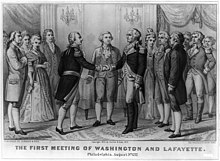
The Marquis de Lafayette first meets George Washington on 5 August 1777. By Currier and Ives.
General George Washington, commander in chief of the Continental Army, came to Philadelphia to brief Congress on military affairs. Lafayette met him at a dinner on 5 August 1777; according to Leepson, "the two men bonded almost immediately."[34] Washington was impressed by the young man's enthusiasm and was inclined to think well of a fellow Mason; Lafayette was simply in awe of the commanding general.[34]
General Washington took the Frenchman to view his military camp; when Washington expressed embarrassment at its state and that of the troops, Lafayette responded, "I am here to learn, not to teach."[35] He became a member of Washington's staff, although confusion existed regarding his status. Congress regarded his commission as honorary, while he considered himself a full-fledged commander who would be given control of a division when Washington deemed him prepared.[36] Washington told Lafayette that a division would not be possible as he was of foreign birth, but that he would be happy to hold him in confidence as "friend and father".[37]
Brandywine, Valley Forge, and Albany
Further information: Battle of Brandywine and Valley Forge

Lafayette wounded at the battle of Brandywine
Lafayette's first battle was at Brandywine on 11 September 1777.[38] The British commanding general, General Sir William Howe, planned to take Philadelphia by moving troops south by ship to Chesapeake Bay (rather than the heavily defended Delaware Bay) and bringing them overland to the rebel capital.[39] After the British outflanked the Americans, Washington sent Lafayette to join General John Sullivan.
Upon his arrival, Lafayette went with the Third Pennsylvania Brigade, under Brigadier Thomas Conway, and attempted to rally the unit to face the attack. The British and Hessian forces continued to advance with their superior forces, and Lafayette was shot in the leg. During the American retreat, Lafayette rallied the troops, allowing a more orderly pullback, before being treated for his wound.[40] After the battle, Washington cited him for "bravery and military ardour" and recommended him for the command of a division in a letter to Congress, which was hastily evacuating, as the British took Philadelphia later that month.[29]
Lafayette returned to the field in November after two months of recuperation in the Moravian settlement of Bethlehem, and received command of the division previously led by Major General Adam Stephen.[41] He assisted General Nathanael Greene in reconnaissance of British positions in New Jersey; with 300 soldiers, he defeated a numerically superior Hessian force in Gloucester, on 24 November 1777.[42]

John Ward Dunsmore's 1907 depiction of Lafayette (right) and Washington at Valley Forge
Lafayette stayed at Washington's encampment at Valley Forge in the winter of 1777–78, and shared the hardship of his troops.[43] There, the Board of War, led by Horatio Gates, asked Lafayette to prepare an invasion of Quebec from Albany, New York. When Lafayette arrived in Albany, he found too few men to mount an invasion. He wrote to Washington of the situation, and made plans to return to Valley Forge. Before departing, he recruited the Oneida tribe to the American side. The Oneida referred to Lafayette as Kayewla (fearsome horseman).[29] In Valley Forge, he criticized the board's decision to attempt an invasion of Quebec in winter. The Continental Congress agreed, and Gates left the board.[44] Meanwhile, treaties signed by America and France were made public in March 1778, and France formally recognized American independence.[5]
Barren Hill, Monmouth, and Rhode Island
Further information: Battle of Barren Hill, Battle of Monmouth, and Battle of Rhode Island
....
Second voyage to America
On his return, Lafayette found the American cause at a low ebb, rocked by several military defeats, especially in the south.[58] Lafayette was greeted in Boston with enthusiasm, seen as "a knight in shining armor from the chivalric past, come to save the nation".[59] He journeyed southwest and on 10 May 1780 had a joyous reunion with Washington at Morristown, New Jersey. The general and his officers were delighted to hear that the large French force promised to Lafayette would be coming to their aid.[60]
Washington, aware of Lafayette's popularity, had him write (with Alexander Hamilton to correct his spelling) to state officials to urge them to provide more troops and provisions to the Continental Army.[61] This bore fruit in the coming months, as Lafayette awaited the arrival of the French fleet.[62] However, when the fleet arrived, there were fewer men and supplies than expected, and Rochambeau decided to wait for reinforcements before seeking battle with the British. This was unsatisfactory to Lafayette, who proposed a grandiose schemes for the taking of New York City and other areas, and Rochambeau briefly refused to receive Lafayette until the young man apologized. Washington counseled the marquis to be patient.[63]
That summer Washington placed Lafayette in charge of a division of troops. The marquis spent lavishly on his command, which patrolled Northern New Jersey and adjacent New York State. Lafayette saw no significant action, and in November, Washington disbanded the division, sending the soldiers back to their state regiments. The war continued badly for the Americans, with most battles in the south going against them, and General Benedict Arnold abandoning them for the British side.[64]
Lafayette spent the first part of the winter of 1780–81 in Philadelphia, where the American Philosophical Society elected him its first foreign member. Congress asked him to return to France to lobby for more men and supplies, but Lafayette refused, sending letters instead.[65]
After the Continental victory at the Battle of Cowpens in South Carolina in January 1781, Washington ordered Lafayette to re-form his force in Philadelphia and go south to Virginia to link up with troops commanded by Baron von Steuben. The combined force was to try to trap British forces commanded by Benedict Arnold, with French ships preventing his escape by sea. If Lafayette was successful, Arnold was to be summarily hanged.
British command of the seas prevented the plan, though Lafayette and a small part of his force (the rest left behind in Annapolis) was able to reach von Steuben in Yorktown, Virginia. Von Steuben sent a plan to Washington, proposing to use land forces and French ships to trap the main British force under Lord Cornwallis. When he received no new orders from Washington, Lafayette began to move his troops north toward Philadelphia, only to be ordered to Virginia to assume military command there.
An outraged Lafayette assumed he was being abandoned in a backwater while decisive battles took place elsewhere, and objected to his orders in vain. He also sent letters to the Chevalier de la Luzerne, French ambassador in Philadelphia, describing how ill-supplied his troops were. As Lafayette hoped, la Luzerne sent his letter on to France with a recommendation of massive French aid, which, after being approved by the king, would play a crucial part in the battles to come. Washington, fearing a letter might be captured by the British, could not tell Lafayette that he planned to trap Cornwallis in a decisive campaign.[66]
Virginia and Yorktown
Further information: Yorktown campaign and Siege of Yorktown....
Hero of two worlds
Yorktown was the last major land battle of the American Revolution, but the British still held several major port cities. Lafayette wanted to lead expeditions to capture them, but Washington felt that he would be more useful seeking additional naval support from France. Congress appointed him its advisor to America's envoys in Europe, Benjamin Franklin in Paris, John Jay in Madrid, and John Adams in The Hague, instructing them "to communicate and agree on everything with him". Congress also sent Louis XVI an official letter of commendation on the marquis's behalf.[73]
Lafayette left Boston for France on 18 December 1781 where he was welcomed as a hero, and he was received at the Palace of Versailles on 22 January 1782. He witnessed the birth of his daughter, whom he named Marie-Antoinette Virginie upon Thomas Jefferson's recommendation.[74][75] He was promoted to maréchal de camp, skipping numerous ranks,[76] and he was made a Knight of the Order of Saint Louis. He worked on a combined French and Spanish expedition against the British West Indies in 1782, as no formal peace treaty had yet been signed. The Treaty of Paris was signed between Great Britain and the United States in 1783, which made the expedition unnecessary; Lafayette took part in those negotiations.[77][78]
Lafayette worked with Jefferson to establish trade agreements between the United States and France which aimed to reduce America's debt to France.[79] He joined the French abolitionist group Society of the Friends of the Blacks which advocated the end of the slave trade and equal rights for free blacks. He urged the emancipation of slaves and their establishment as tenant farmers in a 1783 letter to Washington, who was a slave owner.[80] Washington declined to free his slaves, though he expressed interest in the young man's ideas, and Lafayette purchased a plantation in French Guiana to house the project.[81]...
French Revolution
Assembly of Notables and Estates-General
Main articles: Assembly of Notables and Estates-General of 1789

"Declaration of the Rights of Man and of the Citizen", proposed to the Estates-General by Lafayette
On 29 December 1786, King Louis XVI called an Assembly of Notables, in response to France's fiscal crisis. The king appointed Lafayette to the body, which convened on 22 February 1787.[93] In speeches, Lafayette decried those with connections at court who had profited from advance knowledge of government land purchases; he advocated reform.[94] He called for a "truly national assembly", which represented the whole of France.[95] Instead, the king chose to summon an Estates General, to convene in 1789. Lafayette was elected as a representative of the nobility (the Second Estate) from Riom.[96] The Estates General, traditionally, cast one vote for each of the three Estates: clergy, nobility, and commons, meaning the much larger commons was generally outvoted.[97]
The Estates General convened on 5 May 1789; debate began on whether the delegates should vote by head or by Estate. If by Estate, then the nobility and clergy would be able to outvote the commons; if by head, then the larger Third Estate could dominate. Before the meeting, as a member of the "Committee of Thirty", Lafayette agitated for voting by head, rather than estate.[98] He could not get a majority of his own Estate to agree, but the clergy was willing to join with the commons, and on the 17th, the group declared itself the National Assembly.[99] The loyalist response was to lock out the group, including Lafayette, while those who had not supported the Assembly met inside.
This action led to the Tennis Court Oath, where the excluded members swore not to separate until a constitution was established.[100] The Assembly continued to meet, and on 11 July 1789, Lafayette presented a draft of the "Declaration of the Rights of Man and of the Citizen" to the Assembly, written by himself in consultation with Jefferson.[101] The next day, after the dismissal of Finance Minister Jacques Necker (who was seen as a reformer), lawyer Camille Desmoulins assembled between 700 and 1000 armed insurgents. The king had the royal army under the duc de Broglie surround Paris.[102] On 14 July, the fortress known as the Bastille was stormed by the insurgents.[103]
National Guard, Versailles, and Day of Daggers

Lafayette at the balcony of Versailles with Marie Antoinette

Lafayette's saber as general of the Garde nationale, on display at the Musée de l'Armée, Paris
On 15 July, Lafayette was acclaimed commander-in-chief of the Parisian National Guard, an armed force established to maintain order under the control of the Assembly military service as well as policing, traffic control, sanitization, lighting, among other matters of local administration.[104][105][106]
Lafayette proposed the name and the symbol of the group: a blue, white, and red cockade. This combined the red and blue colors of the city of Paris with the royal white, and originated the French tricolor.[101][103] He faced a difficult task as head of the Guard; the king and many loyalists considered him and his supporters to be little better than revolutionaries, whereas many commoners felt that he was helping the king to keep power via this position.
The National Assembly approved the Declaration on 26 August,[107] but the king rejected it on 2 October.[108] Three days later, a Parisian crowd led by women fishmongers marched to Versailles in response to the scarcity of bread. Members of the National Guard followed the march, with Lafayette reluctantly leading them.
At Versailles, the king accepted the Assembly's votes on the Declaration, but refused requests to go to Paris, and the crowd broke into the palace at dawn. Lafayette took the royal family onto the palace balcony and attempted to restore order,[109][110] but the crowd insisted that the king and his family move to Paris and the Tuileries Palace.[111][112] The king came onto the balcony and the crowd started chanting "Vive le Roi!" Marie Antoinette then appeared with her children, but she was told to send the children back in. She returned alone and people shouted to shoot her, but she stood her ground and no one opened fire. Lafayette kissed her hand, leading to cheers from the crowd.[113][114]
...
Grand tour of the United States
Main article: Visit of the Marquis de Lafayette to the United States
[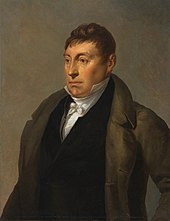
Lafayette in 1825
President James Monroe and Congress invited Lafayette to visit the United States in 1824, in part to celebrate the nation's upcoming 50th anniversary.[30] Monroe intended to have Lafayette travel on an American warship, but Lafayette felt that having such a vessel as transport was undemocratic and booked passage on the merchant packet *Cadmus*. Louis XVIII did not approve of the trip and had troops disperse the crowd that gathered at Le Havre to see him off.[176]
Lafayette arrived at New York on 15 August 1824, accompanied by his son Georges Washington and his secretary Auguste Levasseur. He was greeted by a group of Revolutionary War veterans who had fought alongside him many years before. New York erupted for four continuous days and nights of celebration. He then departed for what he thought would be a restful trip to Boston but instead found the route lined by cheering citizens, with welcomes organized in every town along the way. According to Unger, "It was a mystical experience they would relate to their heirs through generations to come. Lafayette had materialized from a distant age, the last leader and hero at the nation's defining moment. They knew they and the world would never see his kind again."[177]
New York, Boston, and Philadelphia did their best to outdo each other in the celebrations honoring Lafayette. Philadelphia renovated the Old State House (today Independence Hall) which might otherwise have been torn down, because they needed a location for a reception for him. Until that point, it had not been usual in the United States to build monuments, but Lafayette's visit set off a wave of construction—usually with him laying the cornerstone himself, in his capacity as mason. The arts benefited by his visit, as well, as many cities commissioned portraits for their civic buildings, and the likenesses were seen on innumerable souvenirs. Lafayette had intended to visit only the original 13 states during a four-month visit, but the stay stretched to 16 months as he visited all 24 states.[178]...
See also
 France portal
 Biography portal
 American Revolutionary War portal
 United States portal
 North America portal
- List of places named for the Marquis de Lafayette
- LaFayette Motors
- *Hermione* (2014), a replica of the *Hermione* of 1779, currently in service
- Hero of Two Worlds: The Marquis de Lafayette in the Age of Revolution, a 2021 biography
Wikipedia
Knowledge Web Content (see main node)
ACHIEVEMENT(S): Lafayette helped America achieve independence
NICKNAME/ALIAS: also spelled La Fayette
DATE/PLACE OF BIRTH: 6 September 1757, at Chavaniac, France
DATE/PLACE/AGE AT DEATH: 20 May 1834, in Paris, France. Aged 76
DISCIPLINE: Military. Politics. FIELD: Soldier
LANGUAGE: French and English
PARENTS: Michel Louis Roch Gilbert du Motier, Marquis de La Fayette
(1732-59) and Julie de la Riviere (d. 1770), married 1755
SIBLINGS: None
SPOUSE: Adrienne de Noailles, married 1774
CHILDREN: Henriette (b. 1775), Anastasie (b. 1777), Georges Washington (b.
1779), Virginie (b. 1782)
EDUCATION: Tutored by the Abbe Fayon, 1763-68; College du Plessis, 1768-71;
Academie de Versailles, 1771-
MAJOR WORK: 'Memoires, correspondence, et manuscripts', 6 vols., 1837-38
LIFE AND TIMES:
Destined for a military career, in 1771 Lafayette entered the Academie de Versailles, the most exclusive military school in France, and the following year a contract was arranged betrothing him to Marie Adrienne Francoise de Noailles, the daughter of the Duc d'Ayen and granddaughter of the Duc de Noailles.
This marriage (which took place in 1774) brought Lafayette into one of the most influential families in France, and a month later, with the accession of Louis XVI* to the throne, Lafayette joined the circle of young courtiers around Louis and Marie-Antoinette and was granted a captaincy in the Black Musketeers.
In early 1777 Lafayette's friendship with Franklin* inspired a strong desire to fight for the colonists, especially when promised a major-generalship in the American Army by Deane*, the American agent in Paris.
However, the plan was strongly opposed by the powerful de Noailles family, who feared that a great deal of Lafayette's fortune could disappear abroad, and Louis XVI was persuaded to forbid his departure. As a result, the 19-year-old Lafayette was arrested at
Bordeaux, after the departure of his ship the 'Victoire' for Spain, but escaped and travelled by horse to Los Pasajes in Spain, from where he finally sailed for America on 20 April 1777.
In America he met Washington*, who befriended the young Frenchman. In September 1777 Lafayette first saw action at the Battle of Brandywine in Pennsylvania, during which he received a wound in the leg. Three months later Washington gave him a division of Virginian soldiers.
With the alliance of February 1778 between France and the United States against Great Britain, Lafayette's status was further improved, particularly once war was declared between Britain and France. He asked for and received permission from Washington to return to France to request military aid from Louis XVI, and embarked for France in January 1779.
On his return, Lafayette received a hero's welcome, and once more entered Versailles, where he spent the next few months planning an invasion of England; however, this expedition eventually proved impossible, and instead he was granted financial and military aid for the American colonists.
He left for America with a 6,000-man expeditionary force early the following year, arriving at Marblehead, Massachusetts in April 1780, and in January 1781 was finally given command of a small army in Virginia. After forcing the British commander Cornwallis* to retreat across Virginia, Lafayette successfully trapped the British at Yorktown in late July.
During the siege that followed, Lafayette was joined by a French fleet - with d'Arblay* as adjutant general - and several additional American divisions, and on 19 October 1781 Cornwallis surrendered, effectively marking the end of the British cause in America.
During 1782 he served as Franklin's aide in France and in Spain during the ensuing negotiations for peace, and he visited the United States again in 1784, during which he was made a citizen of several states.
During the mid-1780s Lafayette emerged as a leader of the liberal French aristocrats and an outspoken advocate of religious toleration and the abolition of the colonial slave trade. In May 1789 Lafayette was elected as a representative of the nobility both to the Estates General finally convened by Louis XVI and then to the revolutionary National Assembly. On 11 July he presented to the Assembly his draft of a Declaration of the Rights of Man and of the Citizen which was revised and adopted, on 27 August.
Meanwhile, on 15 July, the day after the storming of the Bastille, Lafayette was elected commander of the newly-formed National Guard of Paris, with responsibility for maintaining order in the midst of revolution. In October 1789 his troops saved Louis XVI and Queen Marie-Antoinette from the fury of a crowd that invaded Versailles, and then carried the royal family to Paris.
The increasing likelihood of war with Austria meant Lafayette was recalled to military duty in December 1791, when he was given command of the French army at Metz, guarding the northern and western frontiers.
In April 1792 a mob in Paris had decided to march on the Tuileries and dethrone Louis XVI. Lafayette attempted to return with his troops to Paris to restore the King and to dissolve the Assembly. He was declared a traitor by the Assembly. On 19 August 1792 Lafayette deserted his troops and fled to Flanders, where he was arrested by the occupying Austrians, and for the next five years he was held as a prisoner-of-war in various Prussian and Austrian prisons.
In 1797 Napoleon* arranged Lafayette's release and in 1799 he returned to France, where he lived in retirement at his wife's estate at Lagrange - where, among others, the American author Fenimore Cooper* visited regularly..
In 1815 he again became a parliamentary representative, and during most of the reign of Louis XVIII (1814-24) served as a liberal member of the Chamber of Deputies. He revisited the United States in 1824-25, accompanied by the reformer and author Frances Wright*, on the invitation of Congress.
He returned to France to represent Meaux in the Chamber from 1825 to 1834, when he was visited by another American, the reformer Robert Dale Owen*. In the July Revolution of 1830 he served once more as commander of the National Guard in opposition to the reactionary Charles X, who was deposed. Lafayette retired six months later.
ASSESSMENT: A French aristocrat, general, politician and reformer, who fought with the American colonists against the British in the American Revolution, and became an early American hero.
EXTRA CONNECTIONS: Met Buchanan*
He knew US Ambassador George Bancroft*
He knew Catherine Greene*
He was a colleague of Thomas Jefferson*
Gave JQ Adams an alligator that lived in the White House.
ONELINER: Marquis de Lafayette, hero of American War of Independence
BIBLIOGRAPHY:
EB, Colliers Encyclopedia
Buckman, Peter, Lafayette, New York & London: Paddington Press Ltd., 1977
Multimedia:
Sarah Vowell Lafayette in the Somewhat United States
http://www.c-span.org/video/?329001-1/book-discussion-lafayette-somewhat-united-states