Morris, Lewis
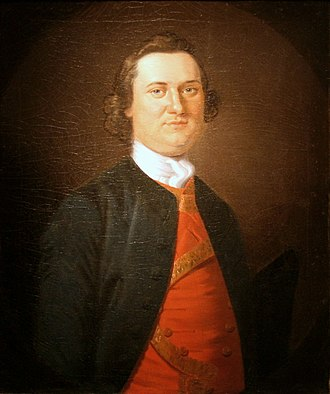
Lewis Morris (April 8, 1726 – January 22, 1798) was an American Founding Father, landowner, and developer from Morrisania, New York, presently part of Bronx County. He signed the U.S. Declaration of Independence as a delegate to the Continental Congress from New York.[1]
Early life and family
Morris was born on April 8, 1726, at his family's estate, Morrisania, presently part of Bronx County, in what was then the Province of New York. He was the third Lewis Morris in the Morris family. He was the son of Lewis Morris (1698–1762) and Katrintje "Catherine" Staats (1697–1731). After his mother died, his father married Sarah Gouverneur (1714–1786).[2] He graduated from Yale College in 1746,[1] and upon his father's death in 1762, he inherited the bulk of the estate.
Morris' father had seven children, including his siblings, Staats Long Morris (1728–1800) and Richard Morris (1730–1810), and his half-siblings, Mary Lawrence, Gouverneur Morris (1752–1816), Isabella, and Catherine. His uncle was Robert Hunter Morris (1700–1764), the governor of Pennsylvania. His cousin by marriage was William Paterson (1745–1806), the governor of New Jersey and father-in-law of Stephen Van Rensselaer, the lieutenant governor of New York, who was the brother of Philip Schuyler Van Rensselaer, mayor of Albany, New York. Anthony Walton White (1750–1803), a Continental Army general, was his cousin through Morris' aunt, Elizabeth Morris (1712–c. 1784).
Family history
His great-grandfather, Richard Morris (died 1672), immigrated to New York through Barbados after being part of Oliver Cromwell's army in the English Civil War of 1648. He purchased the first tract of land in the Bronx that became the basis for the Morrisania manor. Richard and his young wife died, leaving behind an infant son, Lewis Morris (1671–1746). Richard's brother, Colonel Lewis Morris, also of Barbados, came to Morrisania to help manage the estate owned by his infant nephew. Col. Morris and his wife were childless.
When he came of age, Lewis Morris expanded and patented the estate. He married Isabella and went on to serve as the 8th colonial governor of New Jersey.[3] Morris was a popular governor who championed land owning rights for the colonists. Morristown, New Jersey, was named for him.[4][5]
Career
In 1769, he was elected to the New York General Assembly. In 1774, as the Revolution drew near, he resigned from the Admiralty Court.[1]
American Revolution
When active revolution began, he was a member of the New York Provincial Congress, the revolutionary government, from 1775 until 1777. That body, in turn, sent Morris to the Continental Congress for those same years. While in Congress, he was an active supporter of independence and signed the Declaration of Independence in 1776. When warned by his brother Staats Morris, who was a general in the British army, of the consequences that would follow his signing of the rebellious document, Morris stated, "Damn the consequences. Give me the pen."[6]
In 1777, Lewis returned to New York, became a county judge of Westchester County, and was appointed a member of the New York State Senate representing the Southern District, which consisted of Kings, New York, Queens, Richmond, Suffolk and Westchester counties. He served in the 1st New York State Legislature, which began on September 9, 1777, until the end of the 4th Legislature, on July 1, 1781.[1]
His eldest three sons served during the Revolutionary War and had distinguished military careers.
Post-Revolution
Beginning on July 1, 1783, he returned to the New York State Senate and served in the 7th Legislature through to the end of the 13th Legislature, ending on June 30, 1790.[1] In 1788, when the New York convention met to ratify the U.S. Constitution, he was one of the delegates. Morris was a Federalist presidential elector in the 1796 election and cast his votes for John Adams and Thomas Pinckney.
In 1784, Morris was elected an honorary member of the New York Society of the Cincinnati. On May 1 of the same year, he was appointed to the first Board of Regents of the University of the State of New York and served until his death,[1] when he was replaced by Simeon De Witt.[7]
Personal life
 Mary Walton Morris, portrait by John Wollaston
 Old Morrisania
On September 24, 1749, Lewis married Mary Walton (1727–1794), a member of a well-known merchant family. Maria was the daughter of Jacob Walton and Maria (née Beekman) Walton.[8] They had ten children:[9]
- Catherine Morris (1751–1835), who married Thomas Lawrence (1744–1823).[9]
- Mary Morris (1752–1776).[9]
- Col. Lewis V. Morris (1754–1824), who married Ann B. Elliott (1762–1848), sister-in-law of Congressman Daniel Huger. Morris was a graduate of Princeton University in 1774. He was an officer in the Revolution under the command of General Nathanael Greene.
- Gen. Jacob Morris (1755–1844), who married Mary Cox (1758–1827) (Morris, New York is named after him).[11]
- Sarah Morris (born 1757), who died young.[9]
- Lt. William Walton Morris (1760–1832), aide-de-camp to General Anthony Wayne who married Sarah Carpender.[8]
- Helena Magdalena Morris (1762–1840), who married John Rutherfurd (1760–1840), a Senator from New Jersey[9]
- James Morris (1764–1827), who married Helen Van Cortlandt (1768–1812), daughter of Augustus Van Cortlandt and granddaughter of Frederick Van Cortlandt.[9]
- Capt. Staats Morris (1765–1826), who married Everarda van Braam Houckgeest (1765–1816), the daughter of Andreas van Braam Houckgeest and Baroness Catharina C.G. van Reeds van Oudtshoorn.[12]
- Capt. Richard Valentine Morris (1768–1815), who married Anne Walton (1773–1858)[9]
After the war, Morris had to rebuild the family estate, which had been looted and burned by the British when they occupied New York. In 1790, he offered the land, now part of the South Bronx neighborhood of Morrisania, as the site of the U.S. capital. He died on the estate and is buried in the family vault beneath St. Ann's Church in the Bronx.[13]
Descendants
Through his eldest son, Lewis V. Morris, he was grandfather to Lewis Morris (1785–1863) and Sabina Elliott Morris (1789–1857). Lewis Morris (b. 1785) was the father of Charles Manigault Morris (1820–1895), a Confederate officer. Sabina married her first cousin, Robert Walter Rutherfurd (1788–1852), the son of John Rutherfurd and Helena Morris, and was the mother of Lewis Morris Rutherfurd (1816–1892), a pioneering astrophotographer who took the first telescopic photographs of the moon and sun, as well as many stars and planets.
Through his son, Staats Morris, his great-grandson was Daniel François van Braam Morris (b. 1840), a Dutchman and governor of Celebes in the Dutch East Indies. A great-granddaughter of his grandfather, Lewis Morris, named Mary Antill was married to Gerritt G. Lansing, himself a brother of Congressman John Lansing. John Lansing's daughter, Sarah, was married to Edward Livingston, a great-grandson of Philip Livingston.
In popular culture
Lewis Morris is portrayed by Ronald Kross in the 1969 Broadway musical 1776 and by Howard Caine in the 1972 film.
Although Morris was chairman of the New York delegation to the Second Continental Congress, he abstained ("courteously") on every vote, claiming that the New York Provincial Congress never gave Morris explicit instructions on anything. However, when George Washington noted in a dispatch that Morris's estates were destroyed by the British, but his family was taken to safety in Connecticut, Morris abandons his lack of instructions and moves to sign the Declaration.
Extra Connections: Three of his sons served in the Reavoltionary war. Col. Lewis V. Morris (1754–1824) was a graduate of Princeton University in 1774. He was an officer in the Revolution under the command of General Nathanael Greene. His wife Catherine boosted morale, even at Valley Forge, and helped invent the Cotton Gin.
See also
American Connections
LEWIS MORRIS (NY) was fifty. Although he probably
didn't say, "Damn the consequences, give me the pen," when he signed,
Morris risked more than did most of his colleagues. Upper-crust lord of
the manor of Morrisania, rich, charismatic, Yale, son of the New Jersey
governor, Morris could have stayed at home and sat it out. He chose not
to and in consequence suffered the consequences. Morrisania was looted
(by both sides) and most of his one thousand acres of woodland were
destroyed.
Morris's successful career in the militia was mirrored by that of his
eldest son, Lewis Jr., who did so well in the Carolinas campaign that he
made bird colonel and became aide-de-camp to Gen. Nathanael Greene.
Whose wife, Catherine , went everywhere with the general (living in
tents, on battlefields) and tickled everybody's fancy with her flirty
ways (she even wore pants to go riding). Good-looking and witty, she was
very friendly with Washington, Lafayette, and Hamilton, to name but the
cream.
Alas, her husband had used all his own money to buy army supplies, so
after the war straitened circumstances obliged the couple to settle down
on the Savannah rice plantation provided by a grateful Georgia. By 1795
the general was dead, Catherine's lodger Eli Whitney had invented his
cotton gin, and the two of them were in business. Things went wrong:
patent infringement, lawsuits, and workshop fires. Looking for funds to
back the gin, Catherine put up the plantation as collateral for shares
in the Great Yazoo Land Scam, one of the greatest in American history.
In 1795 the Georgia legislature sold 35 million acres of western Georgia
to the Yazoo Company for one-and-a-half cents an acre. When it was
discovered that all but one of the Georgia legislators (and a few
newspaper editors) had had their palms greased to keep matters quiet,
all hell broke loose and the legislation was repealed---as always in
these things, too late for the investors.
The basic Yazoo idea had been kick-started back in 1789 by the governor
of Georgia, Edward Telfair, when he illegally gave away millions of
western acres to friends and colleagues. Telfair (who, no surprise, was
instrumental in pushing through the Eleventh Amendment, limiting the
extent of the federal judiciary) did well enough over the years to
commission a fancy Greek Revival mansion, built in 1819 by itinerant
Brit architect William Jay.
Jay had worked in London till the previous year and now introduced
Savannah to what was known as the Regency Style: large square house,
curving staircases, Doric column porticoes, and cast-iron balconies.
Just this side of vulgar. And just the style for Julia Scarbrough,
multilingual, sophisticated wife of hubby William, who, because of the
couple's extravagant lifestyle, was known in Savannah as the "Merchant
Prince." Julia's dinners (or, as she referred to them, "blowouts") were
famous all-night affairs.
On May 12 the Scarbrough house hosted a blowout for President Monroe, in
town for a joyride on Scarbrough's new toy, the SS Savannah.
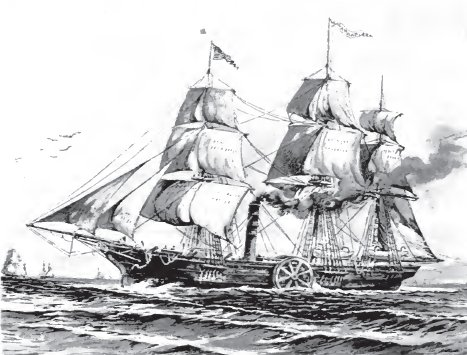
Soon to be forgotten as the first-ever transatlantic steamship. Too far
ahead of her time. On May 22 she headed off (not full) for New York and
then onward to Liverpool, St. Petersburg, Kronstadt, and Stockholm.
Then, disconsolately (and still almost empty), back home.
Then to Washington, D.C. By which time Scarbrough's company was being wound up
and the Savannah was in the hands of a buyer, who took the
engines out and ran her on sail. But at least the Savannah
made the reputation of her engine-maker, Stephen Vail of the Speedwell
Works in Morristown, New Jersey.
One day in 1836 Stephen's son Alfred Vail came back from college in New York
enthusing about crazy experiments by an art professor named Sam Morse,
who needed technical know-how and money to develop a gizmo that would
send instant messages along a wire. Stephen Vail provided two thousand
dollars and the top floor of the Speedwell factory. Where Alfred and an
apprentice made Morse's machine. There were peremptory letters (and rare
visits) from the self-important Morse himself.
Alfred Vail is one of communication technology's great unknowns, because
it was almost certainly he who invented the telegraph fingerkey and what
is now called the "Morse" Code. In 1838 at Speedwell the first message
flashed along the wire. Not the dramatic 1844 "What hath God Wrought"
Morse would use to amaze Congress but something a little more humdrum
that Alfred thought up: "A patient waiter is no loser." Later on,
Morse's family made sure Alfred was written out of the official history.
Alfred Vail's cousin, Theodore N. Vail, became the first president of American Telephone & Telegraph.
Vail's apprentice William Baxter went on to become the inventor of the
Baxter portable steam engine. The regular, two-horsepower version was
the size of a stove and weighed 1,280 pounds. Linked by a system of
belts, wheels, cranks, and gears, it'd turn any machinery. By 1874
thousands were in use all over the country. If a bit of the engine broke
it was interchangeable with an identical replacement part. Just like a
Colt revolver, which in 1868 was manufactured (as was Baxter's stove) at
the Colt Armory in Hartford, Connecticut.
Where the same year Samuel Colt also began turning out large numbers of the new terror weapon invented by a doctor from North Carolina. Who thought it would reduce the number of soldiers needed in battle and cut down on the number of casualties. The
doc was right, but only in a manner of speaking, since the Gatling machine gun
killed more men than had ever been possible before. When its
crank-operated, six-rotating-barrel, automatic firing and reloading
mechanism went into action, the Gatling spat out between 200 and 350
rounds a minute. To devastating effect.
On July 17, 1863, Gatling guns were purportedly used to overawe New York anti-draft rioters.[33]^ Two were brought by a Pennsylvania National Guard unit from Philadelphia to use against strikers in Pittsburgh.
Gatling guns were famously not used at the Battle of the Little Bighorn, also known as "Custer's Last Stand," when General George Armstrong Custer chose not to bring Gatling guns with his main force.
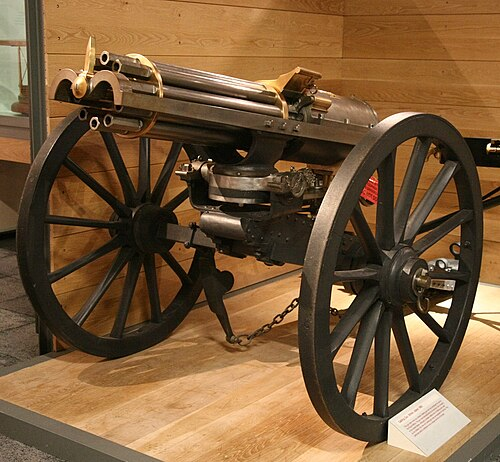
The gun was immortalized in Henry Newbolt's stiff-upper-lip poem about
British troops in the Sudan, outnumbered by a horde of natives ("the
Gatling's jammed, chaps!") but bravely rallying to their old-school
cricket call: "Play up, play up, and play the game."
Newbolt had earlier achieved instant fame with every Victorian patriot's fave: "Drake's
Drum" (about how Sir Francis Drake would return from the grave if ever
needed to save the country from invasion). Newbolt became a major
do-gooder, serving on committees, getting a knighthood and a heap of
honorary degrees. In spite of the fact that he ran a ménage à trois with
his wife and her cousin (Newbolt kept a diary: twelve nights a month
with each woman). Then he upped the ante to quatre by adding
Lady Glenconnor to the group. People knew, but kept it quiet. Victorian
morals.
In 1914 Newbolt found himself summoned to a government meeting run by
Charles Masterman. Who had had a nondescript career as a bureaucrat,
then a brief period in the cabinet, and was now the new chief of the War
Propaganda Bureau tasked with "getting the world in accord with British
policy" (aka persuading the United States into World War I). Masterman's
meeting was like a roll call of Eng. Lit.: Rudyard Kipling, John
Galsworthy, H. G. Wells, Conan Doyle, Thomas Hardy, G. K. Chesterton,
John Masefield, Arnold Bennett, Ford Madox Ford, and John Buchan. The
name of the game was, as Masterman explained, to write books and
pamphlets about how Britain would win the war and how dreadful the
beastly Germans were. By June 1915 there were over 2 million texts in
fifteen languages and a movie: Britain Prepared.
The War Propaganda Bureau had been formed to promote Britain's interests during the war and maintain public opinion in favour of the war. He subsequently became Controller of Wireless and Cables at the Foreign Office. His poems about the war include "The War Films", printed on the leader page of The Times on 14 October 1916, which seeks to temper the shock effect on cinema audiences of footage of the Battle of the Somme.
One other member of the group had (according to the London
Times) made "astonishingly accurate prophecies" of the war.
This was Hilaire Belloc: French navy, Oxford, farming, walking across
America following (and in Napa, California, marrying) his sweetheart,
Elodie, made his literary name with The Bad Child's Book of
Beasts. Belloc's output was prolific and varied: history,
satire, criticism, and above all travel books about his walks (e.g.,
northern France to Rome). Belloc also had a sly sense of humor. ("When I
am dead I hope it's said, 'His sins were scarlet, but his books were
read.'") His early life in left-wing politics was colored by the outrage
he journalistically expressed about crooked share-dealing between
cabinet ministers and especially by future prime minister Lloyd George.
In 1911 the British government had decided to open a chain of
state-owned radio stations throughout the British Empire and the
postmaster general awarded the deal to the Marconi Company. So far, no
problem. But later Belloc discovered that the contract had been kept
secret until March 1912, during which time the share price mysteriously
jumped four times. Belloc revealed (in his mag Eye Witness)
that the British attorney general had bought shares just after the
secret contract was signed and then immediately sold them to Lloyd
George. Other members of the cabinet had made similarly sneaky buys and
sells.
Guglielmo Marconi himself was entirely unconnected with all this. By now
he was an international science star and Nobel winner. In 1923 he joined the
Italian Fascist Party, married an aristo, and was made an Italian
marquis. In 1930 he became first president and founder-member of
Mussolini's Italian Academy, with its sixty selected intellectuals
chosen to give the Fascists spurious respectability. One reluctant (and
politically inactive) founding member was a promising young prof. of
physics, Enrico Fermi.
In the early 1930s Fermi shot neutrons at the entire Periodic Table of
Elements and succeeded in splitting the uranium atom. For this he got
the Nobel and in 1938 (with some relief) left Fascist Italy for a job in
the United States. On December 2, 1942, in the squash courts under the
University of Chicago's Stagg Field, Fermi took his neutron-shooting
work an astounding step further. As described on the plaque, in his
"atomic pile" Fermi achieved "the first self-sustaining chain reaction
and...the controlled release of nuclear power."
From Chicago Fermi went to Los Alamos, New Mexico, as chief of the
advanced physics department. In 1945 the end product of his work was
dropped on Hiroshima.
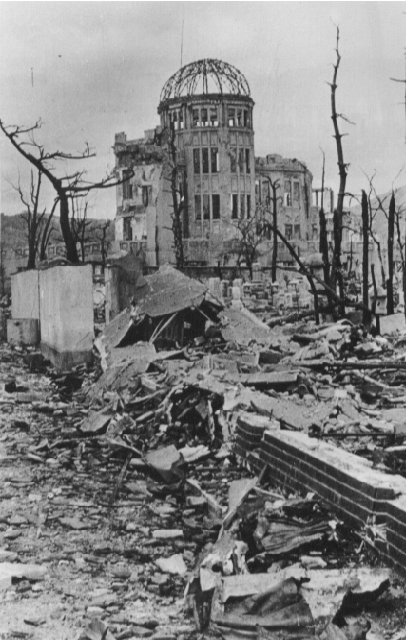
In 1974 as recognition of Fermi's work the U.S.
National Accelerator Laboratory was renamed "Fermilab."
In 2004 Fermilab's list of twenty-year service award recipients included
LEWIS MORRIS.