Bruno
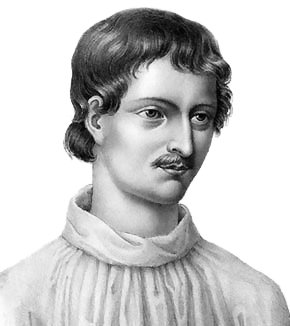
Nickname/Alias: born: Filippo Bruno
Achievements: Radical Catholic thinker
Born: 1548; Nola (Naples), Italy
Died: February 17, 1600; Rome, Italy (Aged 52)
Field & Discipline: Philosophy; Philosopher
Language: Italian
Father: Juano Bruno
Mother: Fraulissa Savolino
Siblings: Unknown
Spouse: None
Children: None
Education: Studium Generale, Naples; Private tutor
Major Work:
"Dialoghi Italiani"
"160 Articles"
"On Threefold Minimum and Measure"
"On the Monad, Number, and Figure"
"On the Immeasurable and Innumerable"
Life & Times:
In 1565, Bruno entered the monastery of San Domenico in Naples, where he was given the name Giordano. While a seminarian, he developed a system of mnemonics (memory aids) that so impressed the leaders of his Order that he was summoned to Rome in 1571 to elaborate on it. He was ordained in Naples in 1572, but shocked his superiors by discarding all religious images except his crucifix.
His free thinking led him to be accused of defending the Arianism heresy that claimed Christ was not divine. He fled to Dominican headquarters in Rome, where he hoped to find understanding, but was indicted for reading forbidden texts by the humanist scholar [read forbidden] Erasmus*. Bruno deserted the Order and went to Noli, near Genoa, where he took a job teaching astronomy and grammar.
After only a few months in Noli, Bruno grew restless and began a long trek through northern Italy, arriving eventually in Geneva, Switzerland, where in 1578, he alienated the Calvinists there by criticizing a local professor of philosophy. He was arrested, excommunicated, but then pardoned. He then went to Toulouse, France, where he lectured in astronomy and philosophy.
By 1581, he was in Paris giving lectures that caught the attention of French king, Henry III. Fascinated by Bruno's mnemonic system, the King appointed him lecturer at the College de France. While in Paris, Bruno published three works on mnemonics and a play, "The Torch Bearer", which portrayed contemporary society in Naples and the corruption that existed in universities and monasteries.
In 1583, Bruno went to England with a letter of introduction from Henry III to French ambassador Michel de Castelnau. But his controversial reputation had preceded him. The British ambassador in Paris wrote a letter to [spied on by] Francis Walsingham*, the English spymaster, warning him of Bruno's arrival.
In the summer of 1583, likely on the invitation of the Chancellor of Oxford University, Bruno began lecturing at Oxford. But the conservative Aristotelian establishment was hostile to his presentation of Copernicus's new theory of the Earth moving around a stationary Sun, and they made it clear he was no longer welcome. He returned to London, where he met [met] Sidney* and [met] Fulke Greville*.
Between 1584 and 1585, Bruno wrote his "Italian Dialogues", six works on philosophy and ethics in which he set out his theories about the nature of the universe. Two of the volumes were dedicated to Sidney.
It is generally thought that Elizabeth’s doctor, [known to] William Gilbert* became familiar with Bruno's work, and Gilbert’s book, "On the Magnet" (1600), brought Bruno's theories to the notice of [known to] Galileo*. [known to] Kepler* is said to have criticized Galileo for not acknowledging his debt to Bruno in "The Starry Messenger".
Bruno's ideas were revolutionary for the time. He believed the universe was infinite and made up of different solar systems. He denied [opposed theory of] Aristotle’s* division between the heavens (of heavenly material and therefore not open to scientific investigation) and the Earth.
In Bruno's view, the universe, of which man was a part, was composed of matter which constantly renewed itself. He believed that matter could transform itself and continue as matter despite its changes, which were brought about from within, not from external agencies. He used the terms "atoms" and "monads" for the minimum quantity of matter, which was itself a center of energy. (The term "monad" was a philosophical rather than material concept, but anticipated German philosopher [anticipated] Gottfried Leibniz's* concept of monads.)
In 1585, Bruno returned to Paris, but his ideas were considered too radical and he felt obliged to leave. He visited various university cities in Germany, lecturing and expounding his theories, all the while advocating religious tolerance and freedom of discussion. But he found resistance at every turn and was excommunicated by the Lutheran church.
Giovanni Mocenigo, another statesman who hoped to benefit from Bruno's mnemonic theories, invited him to Venice in 1591. Bruno tentatively accepted, but had another mission first. He stopped off in Padua University, where he hoped for the chair of mathematics. Instead he got a job lecturing privately to German students and in his spare time wrote "Lectures on Geometry" and "Art of Deformation."
But it eventually became clear he was not in line for a professorship, and he carried on to Venice, where he became Mocenigo's guest. He conducted philosophical discussions with liberal-minded Venetians who shared his views on tolerance and free discussion. But Mocenigo began to get impatient, complaining that Bruno's mnemonic lessons were going too slowly. When Bruno announced he was going to Frankfurt to get a new work published, Mocenigo betrayed him to the Venetian Inquisition.
The Roman Inquisition demanded Bruno's extradition and in January, 1593, he was sent to Rome and imprisoned. His trial lasted seven years. Bruno argued that he was not attacking theology, and that his views were not incompatible with Christianity, but when he was asked to recant, he refused.
Pope Clement VII branded him a heretic and he was sentenced to death. At his sentencing, he said: "Perhaps your fear in passing judgment on me is greater than mine in receiving it". He was burned at stake in Rome in 1600.
Extra Connections: He was attacked by [attacked by] Mersenne*
Assessment: Through his cosmological theories influenced the development of science and philosophy in the 17th century.
Oneliner: Giordano Bruno, major Renaissance heretic
Bibliography:
- Paterson, Antoinette Mann, The Infinite Worlds of Giordano Bruno, Charles C Thomas, Springfield, Illinois, 1970.
- Singer, Dorothea Waley, Giordano Bruno, His Life and Thought, Constable and Company Ltd., London, 1950.