Beatles
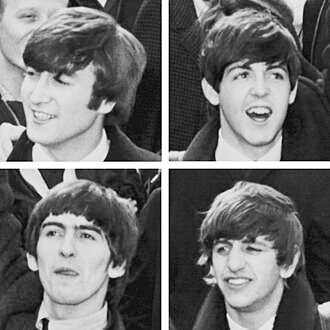
The Beatles were an English rock band formed in Liverpool in 1960, comprising John Lennon, Paul McCartney, George Harrison, and Ringo Starr. They are regarded as the most influential band of all time[1] and were integral to the development of 1960s counterculture and the recognition of popular music as an art form.[2]
Rooted in skiffle, beat, and 1950s rock 'n' roll, their sound incorporated elements of classical music and traditional pop in innovative ways. The band also explored music styles ranging from folk and Indian music to psychedelia and hard rock. As pioneers in recording, songwriting, and artistic presentation, the Beatles revolutionised many aspects of the music industry and were often publicised as leaders of the era's youth and sociocultural movements.[3]
Led by primary songwriters Lennon and McCartney, the Beatles evolved from Lennon's previous group, the Quarrymen, and built their reputation by playing clubs in Liverpool and Hamburg over three years from 1960, initially with Stuart Sutcliffe playing bass. The core trio of Lennon, McCartney, and Harrison, together since 1958, went through a succession of drummers, including Pete Best, before inviting Starr to join them in 1962.
Manager Brian Epstein moulded them into a professional act, and producer George Martin guided and developed their recordings, greatly expanding their domestic success after signing with EMI Records and achieving their first hit, "Love Me Do", in late 1962. As their popularity grew into the intense fan frenzy dubbed "Beatlemania", the band acquired the nickname "the Fab Four". Epstein, Martin or another member of the band's entourage were sometimes informally referred to as a "fifth Beatle".
By early 1964, the Beatles were international stars and had achieved unprecedented levels of critical and commercial success. They became a leading force in Britain's cultural resurgence, ushering in the British Invasion of the United States pop market. They soon made their film debut with A Hard Day's Night (1964). A growing desire to refine their studio efforts, coupled with the challenging nature of their concert tours, led to the band's retirement from live performances in 1966. During this time, they produced records of greater sophistication, including the albums Rubber Soul (1965), Revolver (1966), and Sgt. Pepper's Lonely Hearts Club Band (1967).
They also enjoyed further commercial success with The Beatles (also known as "the White Album", 1968) and Abbey Road (1969). The success of these records heralded the album era, as albums became the dominant form of record consumption over singles. These records also increased public interest in psychedelic drugs and Eastern spirituality and furthered advancements in electronic music, album art, and music videos. In 1968, they founded Apple Corps, a multi-armed multimedia corporation that continues to oversee projects related to the band's legacy. After the group's break-up in 1970, all principal former members enjoyed success as solo artists, and some partial reunions have occurred. Lennon was murdered in 1980, and Harrison died of lung cancer in 2001. McCartney and Starr remain musically active.
The Beatles are the best-selling music act of all time, with estimated sales of 600 million units worldwide.[4][5] They are the most successful act in the history of the US Billboard charts,[6] holding the record for most number-one albums on the UK Albums Chart (15), most number-one hits on the US *Billboard* Hot 100 chart (20), and most singles sold in the UK (21.9 million). The band received many accolades, including seven Grammy Awards, four Brit Awards, an Academy Award (for Best Original Song Score for the 1970 documentary film Let It Be), and fifteen Ivor Novello Awards. They were inducted into the Rock and Roll Hall of Fame in 1988, and each principal member was individually inducted between 1994 and 2015. In 2004 and 2011, the group topped Rolling Stone's lists of the greatest artists in history. Time magazine named them among the 20th century's 100 most important people.
- History
- Musical style and development
- Legacy
- Awards and achievements
- Personnel
- Discography
- Song catalogue
- Selected filmography
- Concert tours
- See also
- Notes
- References
- Further reading
- External links
History
| History of the Beatles |
|---|
1956–1963: formation
The Quarrymen and name changes
Main article: The Quarrymen
In November 1956, sixteen-year-old John Lennon formed a skiffle group with several friends from Quarry Bank High School in Liverpool. They briefly called themselves the Blackjacks, before changing their name to the Quarrymen after discovering that another local group were already using the name.[7] Fifteen-year-old Paul McCartney met Lennon on 6 July 1957, and joined as a rhythm guitarist shortly after.[8] In February 1958, McCartney invited his friend George Harrison, then aged fifteen, to watch the band. Harrison auditioned for Lennon, impressing him with his playing, but Lennon initially thought Harrison was too young. After a month's persistence, during a second meeting (arranged by McCartney), Harrison performed the lead guitar part of the instrumental song "Raunchy" on the upper deck of a Liverpool bus,[9] and they enlisted him as lead guitarist.[10][11]
By January 1959, Lennon's Quarry Bank friends had left the group, and he began his studies at the Liverpool College of Art.[12] The three guitarists, billing themselves as Johnny and the Moondogs,[13] were playing rock and roll whenever they could find a drummer.[14] Lennon's art school friend Stuart Sutcliffe, who had just sold one of his paintings and was persuaded to purchase a bass guitar with the proceeds, joined in January 1960. He suggested changing the band's name to Beatals, as a tribute to Buddy Holly and the Crickets.[15][16] They used this name until May, when they became the Silver Beetles, before undertaking a brief tour of Scotland as the backing group for pop singer and fellow Liverpudlian Johnny Gentle. By early July, they had refashioned themselves as the Silver Beatles, and by the middle of August simply the Beatles.[17]
Early residencies and UK popularity
Allan Williams, the Beatles' unofficial manager, arranged a residency for them in Hamburg. They auditioned and hired drummer Pete Best in mid-August 1960. The band, now a five-piece, departed Liverpool for Hamburg four days later, contracted to club owner Bruno Koschmider for what would be a 3+1⁄2-month residency.[18] Beatles historian Mark Lewisohn writes: "They pulled into Hamburg at dusk on 17 August, the time when the red-light area comes to life ... flashing neon lights screamed out the various entertainment on offer, while scantily clad women sat unabashed in shop windows waiting for business opportunities."[19]
...
irst visit to the United States and the British Invasion
Main article: British Invasion
EMI's American subsidiary, Capitol Records, hindered the Beatles' releases in the United States for more than a year by initially declining to issue their music, including their first three singles. Concurrent negotiations with the independent US label Vee-Jay led to the release of some, but not all, of the songs in 1963.[85] Vee-Jay finished preparation for the album Introducing... The Beatles, comprising most of the songs of Parlophone's Please Please Me, but a management shake-up led to the album not being released.[nb 3] After it emerged that the label did not report royalties on their sales, the licence that Vee-Jay had signed with EMI was voided.[87] A new licence was granted to the Swan label for the single "She Loves You". The record received some airplay in the Tidewater area of Virginia from Gene Loving of radio station WGH and was featured on the "Rate-a-Record" segment of American Bandstand, but it failed to catch on nationally.[88]
 The Beatles arriving at John F. Kennedy International Airport, 7 February 1964.
Epstein brought a demo copy of "I Want to Hold Your Hand" to Capitol's Brown Meggs, who signed the band and arranged for a $40,000 US marketing campaign. American chart success began after disc jockey Carroll James of AM radio station WWDC, in Washington, DC, obtained a copy of the British single "I Want to Hold Your Hand" in mid-December 1963 and began playing it on-air.[89] Taped copies of the song soon circulated among other radio stations throughout the US. This caused an increase in demand, leading Capitol to bring forward the release of "I Want to Hold Your Hand" by three weeks.[90] Issued on 26 December, with the band's previously scheduled debut there just weeks away, "I Want to Hold Your Hand" sold a million copies, becoming a number-one hit in the US by mid-January.[91] In its wake Vee-Jay released Introducing... The Beatles[92] along with Capitol's debut album, Meet the Beatles!, while Swan reactivated production of "She Loves You".[93]
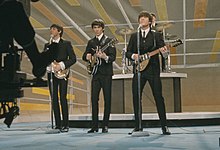 ]()The Beatles performing on The Ed Sullivan Show, February 1964.
On 7 February 1964, the Beatles departed from Heathrow with an estimated 4,000 fans waving and screaming as the aircraft took off.[94] Upon landing at New York's John F. Kennedy Airport, an uproarious crowd estimated at 3,000 greeted them.[95] They gave their first live US television performance two days later on The Ed Sullivan Show, watched by approximately 73 million viewers in over 23 million households,[96] or 34 per cent of the American population. Biographer Jonathan Gould writes that, according to the Nielsen rating service, it was "the largest audience that had ever been recorded for an American television program".[97]
The next morning, the Beatles awoke to a largely negative critical consensus in the US,[98] but a day later at their first US concert, Beatlemania erupted at the Washington Coliseum.[99] Back in New York the following day, the Beatles met with another strong reception during two shows at Carnegie Hall.[96] The band flew to Florida, where they appeared on The Ed Sullivan Show a second time, again before 70 million viewers, before returning to the UK on 22 February.[100]
The Beatles' first visit to the US took place when the nation was still mourning the assassination of President John F. Kennedy the previous November.[101] Commentators often suggest that for many, particularly the young, the Beatles' performances reignited the sense of excitement and possibility that momentarily faded in the wake of the assassination, and helped pave the way for the revolutionary social changes to come later in the decade.[102] Their hairstyle, unusually long for the era and mocked by many adults,[16] became an emblem of rebellion to the burgeoning youth culture.[103]
The group's popularity generated unprecedented interest in British music, and many other UK acts subsequently made their American debuts, successfully touring over the next three years in what was termed the British Invasion.[104] The Beatles' success in the US opened the door for a successive string of British beat groups and pop acts such as the Dave Clark Five, the Animals, Petula Clark, the Kinks, and the Rolling Stones to achieve success in America.[105] During the week of 4 April 1964, the Beatles held twelve positions on the *Billboard* Hot 100 singles chart, including the top five.[106][nb 4]
A Hard Day's Night
Main article: A Hard Day's Night (film)
Capitol Records' lack of interest throughout 1963 did not go unnoticed, and a competitor, United Artists Records, encouraged its film division to offer the Beatles a three-motion-picture deal, primarily for the commercial potential of the soundtracks in the US.[108] Directed by Richard Lester, A Hard Day's Night involved the band for six weeks in March–April 1964 as they played themselves in a musical comedy.[109] The film premiered in London and New York in July and August, respectively, and was an international success, with some critics drawing a comparison with the Marx Brothers.[110]
...
1964 world tour, meeting Bob Dylan, and stand on civil rights
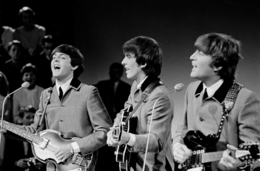 McCartney, Harrison and Lennon performing on Dutch TV in 1964.
Touring internationally in June and July, the Beatles staged 37 shows over 27 days in Denmark, the Netherlands, Hong Kong, Australia and New Zealand.[114][nb 6] In August and September, they returned to the US, with a 30-concert tour of 23 cities.[116] Generating intense interest once again, the month-long tour attracted between 10,000 and 20,000 fans to each 30-minute performance in cities from San Francisco to New York.[116]
In August, journalist Al Aronowitz arranged for the Beatles to meet Bob Dylan**.[117] Visiting the band in their New York hotel suite, Dylan introduced them to cannabis.[118] Gould points out the musical and cultural significance of this meeting, before which the musicians' respective fanbases were "perceived as inhabiting two separate subcultural worlds": Dylan's audience of "college kids with artistic or intellectual leanings, a dawning political and social idealism, and a mildly bohemian style" contrasted with their fans, "veritable 'teenyboppers' – kids in high school or grade school whose lives were totally wrapped up in the commercialised popular culture of television, radio, pop records, fan magazines, and teen fashion. To many of Dylan's followers in the folk music scene, the Beatles were seen as idolaters, not idealists."[119]
Within six months of the meeting, according to Gould, "Lennon would be making records on which he openly imitated Dylan's nasal drone, brittle strum, and introspective vocal persona"; and six months after that, Dylan began performing with a backing band and electric instrumentation, and "dressed in the height of Mod fashion".[120] As a result, Gould continues, the traditional division between folk and rock enthusiasts "nearly evaporated", as the Beatles' fans began to mature in their outlook and Dylan's audience embraced the new, youth-driven pop culture.[120]
During the 1964 US tour, the group were confronted with racial segregation in the country at the time.[121][122] When informed that the venue for their 11 September concert, the Gator Bowl in Jacksonville, Florida, was segregated, the Beatles said they would refuse to perform unless the audience was integrated.[123][121][122] Lennon stated: "We never play to segregated audiences and we aren't going to start now ... I'd sooner lose our appearance money."[121] City officials relented and agreed to allow an integrated show.[121] The group also cancelled their reservations at the whites-only Hotel George Washington in Jacksonville.[122] For their subsequent US tours in 1965 and 1966, the Beatles included clauses in contracts stipulating that shows be integrated.[122][124]
Beatles for Sale, Help! and Rubber Soul
...
Controversy erupted in June 1965 when Queen Elizabeth II appointed all four Beatles Members of the Order of the British Empire (MBE) after Prime Minister Harold Wilson nominated them for the award.[134] In protest – the honour was at that time primarily bestowed upon military veterans and civic leaders – some conservative MBE recipients returned their insignia.[135]
...
As preparations were made for a tour of the US, the Beatles knew that their music would hardly be heard. Having originally used Vox AC30 amplifiers**, they later acquired more powerful 100-watt amplifiers, specially designed for them by Vox, as they moved into larger venues in 1964; however, these were still inadequate. Struggling to compete with the volume of sound generated by screaming fans, the band had grown increasingly bored with the routine of performing live.[188] Recognising that their shows were no longer about the music, they decided to make the August tour their last.[189]
The band performed none of their new songs on the tour.[190] In Chris Ingham's description, they were very much "studio creations ... and there was no way a four-piece rock 'n' roll group could do them justice, particularly through the desensitising wall of the fans' screams. 'Live Beatles' and 'Studio Beatles' had become entirely different beasts."[191] The band's concert at San Francisco's Candlestick Park on 29 August was their last commercial concert.[192] It marked the end of four years dominated by almost non-stop touring that included over 1,400 concert appearances internationally.[193]
1966–1970: studio years
Sgt. Pepper's Lonely Hearts Club Band
Main article: Sgt. Pepper's Lonely Hearts Club Band
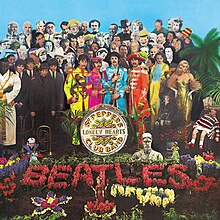 Front cover of Sgt. Pepper's Lonely Hearts Club Band, "the most famous cover of any music album, and one of the most imitated images in the world"[194]
Freed from the burden of touring, the Beatles embraced an increasingly experimental approach as they recorded Sgt. Pepper's Lonely Hearts Club Band, beginning in late November 1966.[195] According to engineer Geoff Emerick, the album's recording took over 700 hours.[196] He recalled the band's insistence "that everything on Sgt. Pepper had to be different. We had microphones right down in the bells of brass instruments and headphones turned into microphones attached to violins. We used giant primitive oscillators to vary the speed of instruments and vocals and we had tapes chopped to pieces and stuck together upside down and the wrong way around."[197] Parts of "A Day in the Life" featured a 40-piece orchestra.[197] The sessions initially yielded the non-album double A-side single "Strawberry Fields Forever"/"Penny Lane" in February 1967;[198] the Sgt. Pepper LP followed with a rush-release in May.[199] The musical complexity of the records, created using relatively primitive four-track recording technology, astounded contemporary artists.[194] Among music critics, acclaim for the album was virtually universal.[200] Gould writes:
...
Magical Mystery Tour and Yellow Submarine
Main articles: Magical Mystery Tour (film) and Yellow Submarine (film)
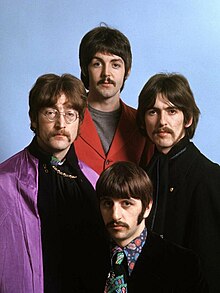 ](The Beatles in 1967; clockwise from left: Lennon, McCartney, Harrison and Starr.
Two Beatles film projects were conceived within weeks of completing Sgt. Pepper: Magical Mystery Tour, a one-hour television film, and Yellow Submarine, an animated feature-length film produced by United Artists.[214] The group began recording music for the former in late April 1967, but the project then lay dormant as they focused on recording songs for the latter.[215] On 25 June, the Beatles performed their forthcoming single "All You Need Is Love" to an estimated 350 million viewers on Our World, the first live global television link.[216]
Released a week later, during the Summer of Love, the song was adopted as a flower power anthem.[217] The Beatles' use of psychedelic drugs was at its height during that summer.[218] In July and August, the group pursued interests related to similar utopian-based ideology, including a week-long investigation into the possibility of starting an island-based commune off the coast of Greece.[219][220]
On 24 August, the group were introduced to Maharishi Mahesh Yogi in London. The next day, they travelled to Bangor for his Transcendental Meditation retreat. On 27 August, their manager's assistant, Peter Brown, phoned to inform them that Epstein had died.[221] The coroner ruled the death an accidental carbitol overdose, although it was widely rumoured to be a suicide.[222][nb 9] His death left the group disoriented and fearful about the future.[224] Lennon recalled: "We collapsed. I knew that we were in trouble then. I didn't really have any misconceptions about our ability to do anything other than play music, and I was scared. I thought, 'We've fuckin' had it now.'"[225] Harrison's then-wife Pattie Boyd remembered that "Paul and George were in complete shock. I don't think it could have been worse if they had heard that their own fathers had dropped dead."[226] During a band meeting in September, McCartney recommended that the band proceed with Magical Mystery Tour.[215]
...
Influences
The Beatles' earliest influences include Elvis Presley, Carl Perkins, Little Richard, Chuck Berry and Gene Vincent.[385][386] During the Beatles' co-residency with Little Richard at the Star-Club in Hamburg, from April to May 1962, he advised them on the proper technique for performing his songs.[387] Of Presley, Lennon said, "Nothing really affected me until I heard Elvis. If there hadn't been Elvis, there would not have been the Beatles."[388] Chuck Berry was particularly influential in terms of songwriting and lyrics. Lennon noted, "He was well advanced of his time lyric-wise. We all owe a lot to him."[389] Other early influences include Buddy Holly, Eddie Cochran, Roy Orbison,[390] the Everly Brothers[391] and Jerry Lee Lewis.[392]
The Beatles continued to absorb influences long after their initial success, often finding new musical and lyrical avenues by listening to their contemporaries, including Bob Dylan, Smokey Robinson and the Miracles, the Who, Frank Zappa, the Lovin' Spoonful, the Byrds and the Beach Boys**, whose 1966 album Pet Sounds amazed and inspired McCartney.[393][394][395][396][397] Referring to the Beach Boys' creative leader, Martin later stated: "No one made a greater impact on the Beatles than Brian [Wilson]."[398] Ravi Shankar, with whom Harrison studied for six weeks in India in late 1966, had a significant effect on his musical development during the band's later years.[399]
...
List of images on the cover of *Sgt. Pepper's Lonely Hearts Club Band*
The cover collage includes 57 photographs and nine waxworks.[262] Author Ian Inglis views the tableau "as a guidebook to the cultural topography of the decade" that conveyed the increasing democratisation of society whereby "traditional barriers between 'high' and 'low' culture were being eroded",[262] while Case cites it as the most explicit demonstration of pop culture's "continuity with the avant-gardes of yesteryear".[263][nb 20] The final grouping included composer Karlheinz Stockhausen, along with singers such as Bob Dylan and Bobby Breen; film stars Marlon Brando, Tyrone Power, Tony Curtis, Marlene Dietrich, Mae West and Marilyn Monroe; artist Aubrey Beardsley; boxer Sonny Liston and footballer Albert Stubbins.
Also included were comedians Stan Laurel and Oliver Hardy; writers H.G. Wells, Oscar Wilde, Lewis Carroll, and Dylan Thomas; and the philosophers and scientists Karl Marx, Albert Einstein, Sigmund Freud and Carl Jung.[262] Harrison chose the Self-Realization Fellowship gurus Mahavatar Babaji, Lahiri Mahasaya, Sri Yukteswar and Paramahansa Yogananda.[264] The Rolling Stones are represented by a doll wearing a shirt emblazoned with a message of welcome to the band.[263][265]
Fearing controversy, EMI rejected Lennon's request for images of Adolf Hitler and Jesus Christ and Harrison's for Mahatma Gandhi.[70] When McCartney was asked why the Beatles did not include Elvis Presley among the musical artists, he replied: "Elvis was too important and too far above the rest even to mention.
Sandbox (extensive)