De Vigny
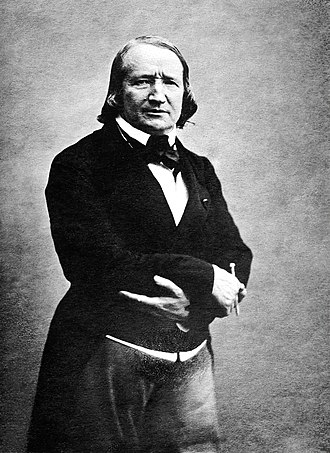
Name: Alfred de Vigny
Achievements: French Romantic poet
Born: March 27, 1797; Loches, Indre-et-Loire, France
Died: September 17, 1863; Paris. Aged 66
Field & Discipline: Art; Literature; Poet
Language: French
Father: Count Leon Pierre de Vigny (army officer)
Mother: Marie Jeanne Amelie de Baraudin
Siblings: 3 brothers, all died in infancy
Spouse: None
Children: None
Education: Pension Hix, Paris; Lycee Bonaparte, Paris
Major Work:
“Journal d’un Poete”
Life & Times:
De Vigny entered military service in 1814, at the same time that the “Maison du Roi” had been hastily assembled as a bodyguard for the new King Louis XVIII, who left Paris in the evening of 19 March 1814, about 3 weeks after Napoleon had escaped from Elba.
After his restoration in 1815, Louis abolished the Maison du Roi, and de Vigny joined the Fifth regiment of the Guard, spending the next six years garrisoned outside Paris, where he became part of the Romantic literary set and made many contacts including [a pal of] Hugo* and [a pal of] Alexandre Dumas pere*.
De Vigny also attended Charles Nodier's receptions at the Arsenal - a gloomy building where young poets such as [a pal of] Lamartine* and Hugo read their poems.
In 1822, his work “Poemes” was published, and was considered a mature work for a man of only 25. The following year, Louis XVIII, in solidarity with the Spanish monarchy, sent a force into Spain to help quell a popular uprising. De Vigny ended up in Pau, the principal town in the Pyrenees, where he mixed with a colony of English expatriates, one of whom was Sir Hugh Mills Bunbury who had a beautiful, but not intellectual, daughter, Lydia. Lydia and de Vigny fell in love and this time, de Vigny's mother gave them her blessing, despite fact that Lydia was a Protestant and a foreigner.
Sir Hugh was not too happy about the match. Nevertheless, in February 1825, the marriage took place, at the Protestant chapel in Pau and, subsequently, to please de Vigny’s Catholic mother, in the Madeleine in Paris.
In 1824, de Vigny published “Eloa, ou la Soeur des Anges,” a work with trong philosophical overtones, later emulated by Alphonse de Lamartine and Victor Hugo. Two years later he published an enlarged edition of his 1822 “Poemes,” titled “Poemes antiques et modernes.”
This contained the poem “Moise,” which created quite a stir in literary circles as "a dazzling prelude to Romantic claims of divine mission and prophetic gift.” It made de Vigny one of the foremost poets of the Romantic Movement.
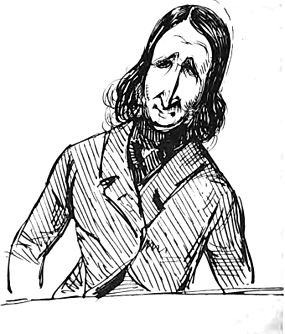
Sketch of Alfred de Vigny, by Prosper Mérimée.
His next major work, in 1826, was an historical novel:”Cinq-Mars,” heavily influenced by the writings of [influenced by] Sir Walter Scott*. This was closely followed by a translation of Othello.
In 1827, out of the army, de Vigny spent most of his time at Nodier's evening receptions in the company of Lamartine, Hugo, [a pal of] de Musset*, [a pal of] Delacroix* and Dumas pere.
In 1832, de Vigny published “Stello,” a triptych of novelettes, followed the next year by a play: “Chatterton,” considered to be the epitome of French romantic drama.
In 1838, the de Vigny’s traveled to England, where they stay for six months engaged in an unsuccessful lawsuit against Lydia’s step-family, after Sir Hugh died and bequeathed his fortune to the children of his second wife.
During their stay de Vigny sometimes stayed at the London home of a music critic, Henry Fothergill Chorley and during these visits met luminaries such as [met] Thackeray*, [met] Carlyle*, [met] Felix Mendelssohn*,[met] Liszt* and [met] Disraeli*
Over the next six years he turned his efforts to becoming elected to the French Academy and, in 1845, finally succeeded on his seventh attempt. Now aged 48, de Vigny settled into semi-retirement.
Eventually, de Vigny and Lydia settled into their country home for the last 25 years of his life. On 16th of September 1863 he died.
Extra Connections: Knew composer [a pal of] Berlioz*
He joined [a follower of] Enfantin*’s Saint-Simonian church
He met [met] Andersen*, [met] Sand*, [met] Merimee* and [met] Chopin*
During 1835 Vigny produced a drama titled Chatterton, based on the life of Thomas Chatterton, an English poet who committed suicide while young, with Marie Dorval acting as Kitty Bell. Chatterton is considered to be one of the best of the French romantic dramas and is still performed regularly.
Vigny considered himself a philosopher as well as a literary author; he was, for example, one of the first French writers to take a serious interest in Buddhism.
Assessment: His “Journal d'un Poete” is one of the greatest intellectual diaries ever written.
Oneliner: Alfred de Vigny, major French Romantic poet
Bibliography:
- Whitridge, Arnold; Alfred de Vigny; OUP, New York, Inc., 1933.