Owen, Robert
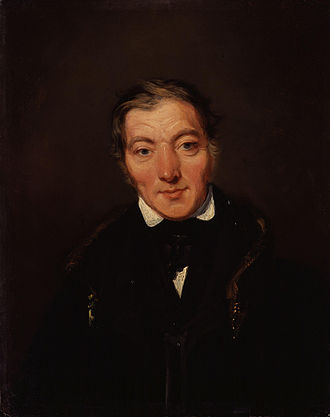
Achievements: Commune at New Harmony, Indiana
Born: May 14, 1771; Newtown, Montgomeryshire, Wales
Died: November 17, 1858; Newtown, Montgomeryshire, Wales (Aged 87)
Field & Discipline: Manufacturing; Textile Industry; Social Reformer
Language: English; Welsh
Father: Robert Owen
Mother: Anne Williams
Siblings: Six siblings
Spouse: Anne Caroline Dale (eldest daughter of David Dale, married 1799)
Children: Anne (d. 1830); Caroline (d. 1831);Robert Dale (1801-77); Daniel Dale; David Dale; William; Jane; Mary (d. 1832)
Education: Newton Primary School, 1774-80
Major Work:
“A New View of Society; or, Essays on the Principle of the Formation of the Human Character: (1813)
Life & Times:
In 1793, at the age of 22, Owen (a successful cotton-mill manager) was invited to join the Manchester Literary and Philosophical Society, where he soon became acquainted with many notable men, including the poet [met] Coleridge* and the chemist [met] Dalton*. As an active member of the Society, Owen participated in debates and presented papers on "the improvement of the cotton industry, the utility of learning, universal happiness and industrialisation, and social influences on belief".
In 1796, now known for his interest in social reform, Owen was then asked to join the committee of the newly-formed Manchester Board of Health, as a representative of the cotton industry. In 1794-95, Owen resigned from this position in to become a partner the manager of the Chorlton Twist Company, superintending the construction of new mills at Chorlton, near Manchester. Frequently in Glasgow, Scotland on business, he met Anne Caroline Dale, daughter of [married daughter of] Dale*, the proprietor with [knew] Arkwright* of mills at New Lanark on the River Clyde.
Owen offered to buy the New Lanark cotton-mills and manufacturing village for £60,000, to be paid in 20 annual instalments. Dale grew to like Owen during these negotiations, and eventually agreed to the marriage, which took place in 1799. In the same year Owen and his partners bought the New Lanark mills and shortly afterwards he moved to New Lanark with his young wife. Owen decided to modernize the mill and improve both the working and social conditions of his 1,500-2,000 workers, 500 of which were children from the poorhouses and charities of Edinburgh and Glasgow. In the late 18th century, mill owners were responsible for feeding, clothing, housing and educating their apprentices, but very few did so adequately. Safety standards were virtually non-existent and many children were killed or maimed at work.
With his great social conscience and belief, influenced in part by the socialist ideas of the English political writer [influenced by] Godwin* and by the educational ideas of the French philosophers [influenced by] Helvetius* and [influenced by] Rousseau* concerning the overriding importance of environment and education to human development, at New Lanark Owen improved housing, sanitation, working conditions and machinery, rewarded temperance, cleanliness, thrift, hard work and honesty, refused to employ children under 12 (children were then employed from the age of 6 for 13 hours a day), and opened discount shops for the workers and schools for their children.
Although he faced resistance from his workers, he eventually succeeded in winning them over to his ideas, and in 1813 he published the important pamphlet, “A New View of Society,” in which he outlined his vision of the ideal community - a system run on a co-operative basis involving both factories and agriculture - and described the principles on which his system of educational philanthropy was based. Having at an early age lost all belief in religion, Owen was convinced that character was formed by circumstances and environment, and that people were not responsible for their actions and should be educated and molded at the earliest age possible along lines of goodness and decency.
To this end, in 1816 he opened the first infant school in Great Britain at New Lanark (which he named an Institute for the Formation of Character), which included the world's first day-nursery and playground. This idea led to the development of the [conceived of] kindergarten*. He also hosted evening lectures and concerts for the workers in the first ever attempt at adult education.
Meanwhile the cost of Owen's model community at the mills caused disagreement with his partners, and in 1813 he bought them out, founding a new company in which, among others, the legal reformer [collaborated with] Jeremy Bentham* held shares. Over the next few years, Owen's work became internationally famous, and New Lanark became a place of a place of pilgrimage statesmen, royalty, and social reformers including William [visited by] William Wilberforce*, [visited by] Malthus*, and [visited by] James Mill*.
In 1815 Owen proposed removing the tax on cotton and raising the age of employment to 10, limiting the working day to 10 hours until the age of 18, providing half-time education until 12, and introducing a system of factory inspection. The eventual result was the Factory Act (1819): without the inspectorate, increasing the minimum working age to 9, and reducing working hours to 12 hours per day (but only for those aged under 16), but restricting these meagre measures to cotton mills only.
Disillusioned with politics, in 1817 in a series of public lectures, pamphlets and letters to newspapers, Owen returned to social reform on a local level when, in response to the economic depression caused by the end of the Napoleonic Wars (1815) which resulted in mass unemployment, widespread poverty and riots, he proposed the formation of communities run on a co-operative basis. At first he attracted some influential supporters, including [supported by] Rowland Hill*, but his outspoken anti-religious views damaged his chances.
In 1818, to drum up more support, Owen made an extensive European tour, travelling to Paris with the Swiss physicist [knew] Pictet* and the French anatomist [knew] Cuvier* and meeting [knew] Laplace* and [knew] Alexander von Humboldt*, before moving on to Switzerland, where he visited [knew] Pestalozzi's* school at Yverdun.
On his return, Owen was asked to prepare a report for the County of Lanark on his ideas for model communities. This report, submitted in 1820, aroused considerable interest, and an influential committee was formed to consider his plans, which included the economist [knew] Ricardo*. Eventually it was suggested that funds should be raised for an experimental community, although by this time he had his critics, including [criticized by] Cobbett*, and the committee did not support his plans for widespread social reform. Owen became increasingly frustrated at slow progress, and in 1824, when he heard that a settlement named Harmony, in Indiana, was for sale, he sailed for America to inspect the 30,000 acre estate, believing that the New World might provide the right environment experimental co-operative community. Harmony proved ideally suited to his needs, with agricultural land, small industries and community buildings, so Owen and his partner the Scottish philanthropist [partner was] Maclure*, bought it for $125,000.
Owen's ideas had been well received in America, and shortly after his arrival he was invited to speak to Congress. He travelled widely, inviting people to join the New Harmony community (which he left in the care of his son, William) which was based entirely on co-operation, with an excellent school run on Pestalozzian principles by [hired] Neef*.
But differences about the form of government and the role of religion soon appeared, and eventually the community split into independent but co-operative factions. By 1828 it was clear that Owen's New Harmony model co-operative community experiment had failed, and in June of that year he handed over the estate to his sons,[son was] David Dale Owen* and [son was] Robert Dale Owen*, and returned to in 1829 Britain via Mexico, where he had been asked to help establish a large colony in Texas (then part of Mexico) and where he met the revolutionary general [met] Santa Anna*.
Throughout the 1830s Owen's activities and doctrines greatly stimulated the development of the British Co-operative Movement (1844) and helped to bring about more humane labor legislation. From 1834 Owen concentrated on giving public lectures (influencing, among many others, [influenced] O'Connor*, [influenced] John Stuart Mill*) and the production of a new weekly journal, 'The New Moral World', which promoted his educational, moral, rationalist, and marriage-reform ideas until 1841. He also wrote 'Revolution in Mind and Practice'. At the age of 82 he became a spiritualist, and died six years later.
Extra Connections: His work influenced that of [influenced] Marx*. He knew [knew] Charles Macintosh*. [hired] Engels* wrote articles for him. Met [met] steamboat builder Fulton* and [met] Charles Darwin*
Assessment: A pioneer in the field of workers’ rights.
Oneliner: Robert Owen, major English social reformer
Bibliography:
- Dictionary of National Biography.
- Encyclopedia Britannica.
- Collier's New Encyclopedia.
- Cole, Margaret, Robert Owen of New Lanark, London: Batchworth Press, 1953.