Lister 2
Joseph Lister, 1st Baron Lister, OM, PC, FRS, FRCS (5 April 1827 – 10 February 1912[1]) was a British surgeon, medical scientist, experimental pathologist and a pioneer of antiseptic surgery[2] and preventative medicine.[1] Joseph Lister revolutionised the craft of surgery in the same manner that John Hunter revolutionised the science of surgery.[3]
From a technical viewpoint, Lister was not an exceptional surgeon,[2] but his research into bacteriology and infection in wounds raised his operative technique to a new plane where his observations, deductions and practices revolutionised surgery throughout the world.[4]
Lister's contribution to the fields of physiology, pathology and surgery were four-fold. He promoted the principle of antiseptic surgical care and wound management while working as a surgeon at the Glasgow Royal Infirmary by successfully introducing phenol (then known as carbolic acid) to sterilise surgical instruments, the patient's skin, sutures, the surgeon's hands and the ward. Secondly he researched the role of inflammation and tissue perfusion on the healing of wounds. Thirdly, he advanced diagnostic science by the microscopic analysis of specimens. Fourthly, he devised elegant strategies to increase the chances of survival after surgery. However, his most important contribution was recognising the key principle that underlay the change in surgical practice, namely converting a chance observation into a meaningful application of the scientific principles proposed by Louis Pasteur[5] This was relating Pasteur's germ theory of fermentation[a] to the origin of putrefaction in wounds.[7]
Lister's work led to a reduction in post-operative infections and made surgery safer for patients, distinguishing him as the "father of modern surgery".[8]
Early life
Lister was born to a prosperous, educated Quaker family in the village of Upton, then near but now in London,[9] England. He was the fourth child and second son of four sons and three daughters[10] born to gentleman scientist and wine merchant Joseph Jackson Lister and school assistant Isabella Lister née Harris.[11][12] On 14 July 1818, the couple were married in a ceremony in Ackworth, West Yorkshire.[13]
Lister's paternal great-great-grandfather, Thomas Lister, was the last of several generations of farmers who lived in Bingley in West Yorkshire.[14] Lister joined the Society of Friends as a young man and passed his beliefs on to his son, Joseph Lister.[14] He moved to London in 1720 to open a tobacconist [14] in Aldersgate Street in the City of London.[15] His son, John Lister, was born there. Lister's grandfather's was apprenticed to a watchmaker, Isaac Rogers,[16] in 1752 and followed that trade on his own account in Bell Alley, Lombard Street from 1759 to 1766. He then took over his father's tobacco business,[14] but gave it up in 1769 in favour of working at his father-in-law Stephen Jackson's business as a wine-merchant at No 28 Old Wine and Brandy Values on Lothbury Street, opposite Tokenhouse Yard.[17]
His father was a pioneer in the design of achromatic object lenses for use in compound microscopes[9] He spent 30 years perfecting the microscope, and in the process, discovered the Law of Aplanatic Foci,[18] building a microscope where the image point of one lens coincided with the focal point of another.[9] Up until that point, the best higher magnification lenses produced an excessive secondary aberration known as a coma, which interfered with normal use.[9] It was considered a major advance that elevated histology into an independent science.[19] By 1832, Lister's work had built a reputation sufficient to enable his being elected to the Royal Society.[20][21] His mother, Isabella, was the youngest daughter of master mariner Anthony Harris.[22] Isabella worked at the Ackworth School, a Quaker school for the poor, assisting her widowed mother who was the superintendent of the school.[22]
Parents

Isabella Harris ca. 1839

Joseph Jackson Lister
The eldest daughter of the couple was Mary Lister. On 21 August 1851, she married the barrister Rickman Godlee[23] of Lincoln's Inn and the Middle Temple, who belonged to the Friends meeting house in Plaistow.[24] The couple had six children. Their second child was Rickman Godlee, a neurosurgeon, who became Professor of Clinical Surgery at the University College Hospital.[23] and surgeon to Queen Victoria. He became Lister's biographer in 1917.[23] The eldest son of Joseph and Isabella Lister was John Lister, who died of a painful brain tumour.[25]
With John's death, Joseph became the heir of the family.[25] The couple's second daughter was Isabella Sophia Lister, who married the Irish Quaker Thomas Pim[26] in 1848. Lister's other brother was William Henry Lister, who died after a long illness.[10] The youngest son of the couple was Arthur Lister, a wine merchant, botanist and lifelong Quaker, who studied Mycetozoa. He worked alongside his daughter Gulielma Lister to produce the standard monograph on Mycetozoa. By 1898, Lister's work had built a reputation sufficient to enable his being elected to the Royal Society.[27] Gulielma Lister, a talented artist later updated the standard monograph with colour drawings. Her work built a reputation sufficient to enable her to be elected a fellow of the Linnean Society in 1904, becoming its vice-president in 1929.[28] The couple's last child was Jane Lister; she married Smith Harrison, a wholesale tea merchant, who was marrying for a second time.[29]
After their marriage, the Listers lived at 5 Tokenhouse Yard in Central London for three years until 1822, where they ran a port wine business in partnership with Thomas Barton Beck.[30] Beck was the grandfather of the professor of surgery and proponent of the germ theory of disease, Marcus Beck,[31] who would later promote Lister's discoveries in his fight to introduce antiseptics.[32] In 1822, Lister's family moved to Stoke Newington.[33] In 1826, the family moved to Upton House, a long low Queen Anne style mansion[33] that came with 69 acres of land.[34] It had been rebuilt in 1731, to suit the style of the period.[35]...
School
As a child, Lister had a stammer and this was possibly the reason was educated at home until he was eleven.[36] Lister then attended Benjamin Abbott's Isaac Brown Academy, a private[37] Quaker school in Hitchin in Hertfordshire.[38] When Lister was thirteen,[36] he attended Grove House School in Tottenham, also a private Quaker School[38] to study mathematics, natural science, and languages. His father was insistent that Lister received a good grounding in French and German, in the knowledge he would learn Latin at school.[39] From an early age, Lister was strongly encouraged by his father.[9] and would talk about his father's great influence later in life, particularly in encouraging him in his study of natural history.[36] Lister interest in natural history led him to collect and dissect small animals, fish and osteology, that were examined using his father's microscope[20] and then be drawn using the camera lucida technique that his father had explained to him,[31] or sketched.[38] His father's interests in microscopical research, developed in Lister the determination to become a surgeon[20] and prepared him for a life of scientific research.[9] None of Lister's relatives were in the medical profession. According to Godlee, the decision to become a physician seemed to be an entirely spontaneous decision.[40]
In 1843 his father decided to send him to university. As Lister was unable to attend either University of Oxford or the University of Cambridge owing to the religious tests that effectively barred him, [9] he decided to apply to the non-sectarian University College London Medical School (UCL), one of only a few institutions in Great Britain that accepted Quakers at that time.[41] Lister took the public examination in the junior class of botany; a required course that would enable him to matriculate.[42] Lister left school in the spring of 1844, when he was seventeen.[38]
University
In 1844, just before Listers seventeenth birthday, he moved to an apartment at 28 London Road that he shared with Edward Palmer, who was also a Quaker.[43] Between 1844 and 1845, Lister continued his pre-matriculation studies, on Greek, Latin and natural philosophy.[44] In the Latin and Greek classes, he won a "Certificate of Honour".[45] For the experimental natural philosophy class, Lister won first prize and was awarded a copy of Charles Hutton's "Recreations in Mathematics and Natural Philosophy".[44]
Although his father wanted him to continue his general education,[46] the university had demanded since 1837, that each student obtain a Bachelor of Arts (BA) degree before commencing medical training. [47] Lister matriculated in August 1845, initially studying for a BA in classics.[48] Between 1845 and 1846, Lister studied the mathematics of natural philosophy, mathematics and Greek earning a "Certificate of Honour" in each class.[45] Between 1846 and 1847, Lister studied both anatomy and atomic theory (chemistry) and won a prize for his essay.[45] On 21 December 1846, Lister and Palmer attended Robert Liston's famous operation where ether was applied by Lister's classmate, William Squire to anaesthetise a patient for the first time.[49][50] On 23 December 1847, Lister and Palmer moved to 2 Bedford place and were joined by John Hodgkin, the nephew of Thomas Hodgkin who discovered Hodgkin lymphoma.[51] Lister and Hodgkin had been school friends beforehand.[48]
In December 1847, Lister graduated with a degree of Bachelor of Arts 1st division, with a distinction in classics and botany.[9] While he was studying, Lister suffered from a mild bout of smallpox, a year after his elder brother died of the disease.[9] The bereavement combined with the stress of his classes led to a nervous breakdown[b][9] in March 1848.[53] Lister decided to take a long holiday[37] to recuperate and this delayed the start of his studies.[37] In late April 1848, Lister visited the Isle of Man with Hodgkin and by 7 June 1848 he was visiting Ilfracombe.[54]
At the end of June, Lister accepted an invitation to stay in home of Thoman Pim, a Dublin Quaker. Using it as his base, Lister travelled throughout Ireland.[55] On 1 July 1848, Lister received a letter full of warmth and love from his father where his last meeting was "...sunshine after a refreshing shower, following a time of cloud" and advised him to "cherish a pious cheerful spirit, open to see and to enjoy the bounties and the beauties spread around us :—not to give way to turning thy thoughts upon thyself nor even at present to dwell long on serious things".[37] From 22 July 1848, for almost a year, the record is blank.[56]
Medical student[]
Lister registered as a medical student in the winter of 1849.[48] During his studies, Lister was active in the University Debating Society and the Hospital Medical Society.[31] In the autumn of 1849, he returned to college, bearing a gift of a microscope from his father.[50] After completing courses in anatomy, physiology and surgery, he was awarded "Certificate of Honour's", winning the silver medal in anatomy and physiology and a gold medal in botany.[42]
His main lecturers were John Lindley professor of botany, Thomas Graham professor of chemistry, Robert Edmond Grant professor of comparative anatomy, George Viner Ellis professor of anatomy and William Benjamin Carpenter professor of medical jurisprudence.[37] Although Lister often spoke highly about Lindley and Graham in his writings, it was Wharton Jones professor of ophthalmic medicine and surgery and William Sharpey professor of physiology, who exercised the greatest influence on Lister.[37] As a student, Lister was greatly attracted by Dr. Sharpey's lectures, which inspired in him a love of experimental physiology and histology that never left him.[57]
Wharton Jones was praised by Thomas Henry Huxley for the method and quality of his physiology lectures.[37] As a clinical scientist working in physiological sciences, he was foremost in the number of discoveries he made.[37] He was also considered a brilliant ophthalmic surgeon, his main field.[37] He conducted research into the circulation of the blood and phenomena of inflammation that was carried out on the frog's web and the bat's wing, and no doubt suggested this method of research to Lister.[37]
Sharpey was called the father of modern physiology as he was the first to give a series of lectures on the subject.[37] Prior to that the field has been considered part of anatomy. [37] Sharpey studied at Edinburgh university, then went to Paris to study clinical surgery under the French anatomist Guillaume Dupuytren and operative surgery under Jacques Lisfranc de St. Martin. It was in Paris that Sharpey met Syme and became life-long friends.[37] After moving to Edinburgh, he taught anatomy with Allen Thomson as his physiological colleague. He left Edinburgh in 1836, in order to become the first Professor of Physiology at University College, London[37] ...
C#### linical instruction[]
[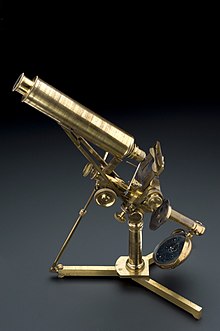 ](
The microscope given to Lister in 1849 by his father J.J. Lister who designed it. This is the third in a set of three built by James Smith. It is an Achromatic microscope with compound automatic objective and graduated automatic objective [58]
Before he qualified for his degree, Lister had to complete two years of clinical instruction,[47] beginning his residency at University College Hospital in October 1850.[59] He began as an intern and then house physician to Walter Hayle Walshe.[31] professor of pathological anatomy and author of 1846 study, The Nature and Treatment of Cancer.[60] Lister continued his run of academic excellence in 1850 by being awarded "Certificates of Honours" and winning two gold medals in anatomy and silver medals in surgery and medicine.[42]
Then in his second year in 1851, Lister became first a dresser in January 1851[61] then a house surgeon to John Eric Erichsen in May 1851.[50] Erichsen was professor of surgery[8] and author of the 1853 Science and Art of Surgery[62] described as one of the most celebrated textbooks on surgery in English.[61] The book went through many editions, of which Marcus Beck edited the eighth and ninth editions, adding Lister's antiseptic techniques and Pasteur and Robert Koch's germ theory.[63] His first case notes were recorded on 5 February 1951. As a dresser, his immediate boss was Henry Thompson who recalled "..a shy Quaker...I remember that he had a better microscope than any man in the college".[59]
Lister had only just begun working in his role as dresser to Erichsen in January 1851, when there was an epidemic of erysipelas in the male ward.[64] An infected patient who came from an Islington workhouse was left in Erichsen's surgical ward for two hours.[64] The hospital had been free of infection but within days there were twelve cases of infection and four deaths.[64] In his notebook, Lister stated that the disease was a form of surgical fever, and particularly noted that recent surgical patients were infected the worst, but those with older operations with suppurating wounds, 'mostly escaped'.[64]
It was while Lister worked for Erichsen, that his interest in the healing of wounds began.[8] Erichsen was a miasmist who thought the wounds were infected from miasma's that came from the wound itself and caused a noxious form of "bad air" that spread to other patients in the war.[8] Erichsen believed that 7 patients with an infected wound had led to saturation of the ward with "bad air" that spread to cause gangrene.[8] However, Lister took a more rational approach, seeing that some wounds when they were debrided and cleaned, would sometimes heal. He believed that something in the wound itself was at fault.[8]
When he became a house surgeon, Lister had patients put in his charge.[61] For the first time, he came into contact face-to-face with the various forms of blood-poisoning diseases like pyaemia[65] and hospital gangrene, the disease that rots living tissue with a remarkable rapidity.[61] While examining the excision of the elbow of a little boy during the autopsy, who had died of pyaemia, Lister noticed that a thick yellow-pus was present at the seat of the humerus bone, and that distended the brachial and axillary veins.[66] He also noticed the pus advanced in the reverse direction along the veins, bypassing the valves in the veins.[66] He also found suppuration in a knee-joint and multiple abscesses in the lungs.[66] Lister knew that Charles-Emmanuel Sédillot had discovered that multiple abscesses in the lungs were caused by introducing pus into the veins of an animal but at the time couldn't explain the facts but believed the pus in the organs had a metastatic origin.[66] On 2 October 1900, during The Huxley Lecture, Lister described how his interest in the germ theory of disease and how it applied to surgery, began with his investigation into the death of the little boy.[67]
There was an epidemic of gangrene during his surgeoncy. The method to effect a recovery was to chloroform the patient, scrape the soft slough off and burn the necrotic flesh away with mercury pernitrate [61] Occasionally the treatment would be success but if a grey film appeared at the edge of the wound, then it presaged death.[61] In one patient, the treatment was repeated several times due to it failing, resulting in Erichsen amputating the limb, which healed fine.[68] The evidence that Lister recognised was that disease was a "local poison" and probably parasitic in nature.[68] He examined the diseased tissues under his microscope. He saw peculiar objects that he could not identify, as he had no frame of reference to draw conclusions from the observations.[61] In his notebook he recorded:
I imagined they might be the materies morbi in the form of some kind of fungus.[c]
Lister wrote two papers on the epidemics, both were lost. The first paper was on Hospital gangrene [50] and the second was on the use of the Microscope. They were read to the Student Medical Society at UCL.[50]
Lister's first operation[]
On 26 June 2013, medical historian Ruth Richardson and orthopaedic surgeon Bryan Rhodes published a paper in which they described their discovery of Lister's first operation, made while both were researching his career.[50] At 1 pm on 27 June 1851, Lister was a second-year medical student and working at a casualty ward in Gower Street, conducted his first operation. The operation was on Julia Sullivan, a mother of eight grown children. She had been stabbed in the abdomen by her husband, a drunk and ne'er-do-well, who was taken into custody.[69] On 15 September 1851, Lister was called as a witness to his trial at the Old Bailey.[69] His testimony helped convict the husband, who was transported to Australia for 20 years.[69]
Lister found the woman with a coil of intestine about eight inches across, consisting about a yard of the small intestines, that were damaged in two places, protruding from her lower abdomen. The abdomen itself contained three open wounds.[50] After cleaning the intestines with blood-warm water, Lister was unable to place them back into the body, so he took the decision to extend the cut.[50] They were then placed back in the body, the wounds sewn shut and the abdomen sutured.[50] The patient was administered opium to induce constipation, to enable the intestines to recover. Sulivan recovered her health.[50] It was a full decade before his first public operation in the Glasgow Infirmary.[50]
This operation was missed by historians.[50] Liverpool consultant surgeon John Shepherd, in his essay on Lister, Joseph Lister and abdominal surgery, written in 1968,[70] failed to mention the operation, instead starting his dates from the 1860s onwards. He apparently was unaware of what Lister accomplished.[50]
Microscope experiments 1852
...
With his medical education completed, Sharpey advised Lister to spend a month at the medical practice of his lifelong friend James Syme in Edinburgh and then visit medical schools in Europe for a longer period for training.[84] Sharpey himself had been taught first in Edinburgh and later Paris. Sharpey had met Syme, a teacher of clinical surgery, who was widely considered the best surgeon in the United Kingdom[85] while he was in Paris.[86] Sharpey had gone north to Edinburgh in 1818,[87] along with many other surgeons since, due to the influence of John Hunter. [85] Hunter had taught Edward Jenner who is seen as the first surgeon to take a scientific approach to the study of medicine, that was known as the Hunterian method[88]
Hunter was an early advocate for careful investigation and experimentation,[89] using the techniques of pathology and physiology to give himself a better understanding of healing than many of his colleagues.[85] For example, his 1794 paper, A treatise on the blood, inflammation and gun-shot wounds[89] was the first systematic study of swelling,[85] discovering that inflammation was common to all diseases.[90] Due to Hunter, surgery was raised from a job then practiced by hobbyists or amateurs into a true scientific profession.[85] As the Scottish universities taught medicine and surgery from a scientific viewpoint, surgeons who wished to emulate those techniques travelled north for training.[91]
Scottish universities had several other features that distinguished them from the medical universities in the south.[92] They were inexpensive and didn't require religious admissions tests, attracting the most scientifically progressive students in Britain.[92] The most important differentiator, was that medical schools in Scotland had evolved from a scholarly tradition, where English medical schools relied on hospitals and practice.[92] Experimental science had no practitioners at English medical schools and while Edinburgh University medical school was large and active at the time, southern medical schools were generally moribund, their laboratory space and teaching materials being inadequate.[92] English medical schools tended to view surgery as manual labour, not a respectable calling for a gentleman academic.[92]
Surgical profession 1854[]
Before Lister's studies of surgery, many people believed that chemical damage from exposure to "bad air", or miasma, was responsible for infections in wounds.[93] Hospital wards were occasionally aired out at midday as a precaution against the spread of infection via miasma, but facilities for washing hands or a patient's wounds were not available. A surgeon was not required to wash his hands before seeing a patient; in the absence of any theory of bacterial infection, such practices were not considered necessary. Despite the work of Ignaz Semmelweis and Oliver Wendell Holmes Sr., hospitals practised surgery under unsanitary conditions. Surgeons of the time referred to the "good old surgical stink" and took pride in the stains on their unwashed operating gowns as a display of their experience.[94] ...
Contributions to physiology and pathology 1853–1859[]
While he was in Edinburgh, Lister conducted a series of physiological and pathological experiments between the years 1853 and 1859.[131] His approach was rigorous and meticulous in both measurement and description.[131] Lister was clearly aware of the latest advances of physiological research in France, Germany, and other European countries[9] and maintained an on-going discussion of his observations and results with other leading physicians in his peer group including Albert von Kölliker, Wilhelm von Wittich, Theodor Schwann, and Rudolf Virchow[131] and ensured he correctly cited their work.
Lister's primary instrument of research was his microscope and his primary research material were frogs. Before his honeymoon, the couple had visited his uncle's house in Kinross.[132] Lister had taken his microscope and captured several frogs, intending to use them in the study of inflammation, but they escaped.[132] When he returned from his honeymoon, he used frogs captured from Duddingston Loch in his experiments.[133] Lister carried out his experiments in his laboratory and in the veterinary college abattoir on animals that were either dead or when they were chloroformed. If Lister was using a frog they were pithed, to deprive them of sensation.[134] He also used bats, sheep, cats, rabbits, oxen and horses in his experiments.[134] Lister was tireless in his pursuit of knowledge and this is illustrated by Thomas Annandale, his assistant who stated:
"I confess that on more than one occasion our patience was a little tried by the long hours were thus engaged, and more particularly when the dinner hour was many hours overdue, but no one could work with Mr. Lister without imbibing some of his enthusiasm"[135]
These experiments resulted in the publication of eleven papers between 1857 and 1859.[131] They included the study of the nervous control of arteries, the earliest stages of inflammation, the early stages of coagulation, the structure of nerve fibres, and the study of the nervous control of the gut with reference to sympathetic nerves.[131] He continued the experiments for three years, until he was appointed to a position at the University of Glasgow.[136]
1855 Beginning of inflammation research[]
In a letter dated 16 September 1855, Lister recorded the beginnings of his research into inflammation, six weeks before his lectures were to begin.[137] Inflammation was the subject that would preoccupy him for the rest of his life.[138] Later in life, Lister stated that he considered his research into the nature of inflammation to be an "essential preliminary" to his conception of the antiseptic principle and insisted these early findings be included in any memorial volume of his work.[139] In 1905, when he was seventy eight years old, he wrote,
"If my works are read when I am gone, these will be the ones most highly thought of"[140]
Inflammation is defined by four symptoms, heat, redness, swelling and pain.[138] For surgeons prior to Lister, this meant the arrival of suppuration or putrefaction, meaning local or general infection.[141] As the germ theory of disease had not been discovered, infection as a concept didn't exist.[141] However, Lister knew that the phenomena of the slowing of the blood through the capillaries seemed to precede inflammation.[141] Joseph Jackson Lister had written a paper with Thomas Hodgkin that described how blood cells behaved prior to a clot, i.e. specifically how the concave cells fitted themselves together into stacks.[141] Lister knew that to observe the next step, it was important that the tissue remain alive so the blood vessels could be observed through the microscope.[141]
In September 1855, Lister first experiment was on the artery of a frog viewed under his microscope, which was subjected to a water droplet of differing temperatures, to determine the early stage of inflammation.[142][143] He initially applied a water droplet at 80 °F (27 °C) which caused the artery to contract for a second and the flow ceased, then dilated and the area turned red and the flow of blood increased.[144] He progressively increased the temperature until it was 200 °F (93 °C). The blood slowed down then coagulated.[144] He continued the experiment on the wing of chloroformed bat to widen his research focus.[145] Lister concluded that the contraction of the vessels lead to the exclusion of blood cells from the capillaries, not their arrest and blood serum continued to flow. This was his first independent discovery.[120]
....
Pasteur[]
[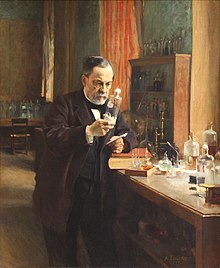 ]
Louis Pasteur in his laboratory
In the spring of 1865,[241] Thomas Anderson,[242] the chemistry professor at Glasgow drew Lister's attention to the latest research of the French chemist Louis Pasteur,[243] who had discovered living things that caused fermentation and putrefaction.[244] Lister wasn't the only surgeon who was interested in Pasteur's research.[245] Thomas Spencer Wells, who was Queen Victoria surgeon had emphasised the significance of Pasteur's work at a meeting of the British Medical Association in 1864,[246] stating "[By] applying the knowledge for which we are indebted to Pasteur of the presence in the atmosphere of organic germs … it is easy to understand that some germs find their most appropriate nutriment in the secretions from wounds, or in pus, and that they so modify it as to convert it into a poison when absorbed". However, Wells didn't have an experiment to demonstrate the germ theory and was unable to put it into practice.[247]
At that time, Lister was not a wide reader of continental literature[243] nor of chemical literature, but eventually five of the papers that Pasteur published between 1857 and 1863 would directly influence his work on antiseptics.[248] The first of two papers that Anderson recommended to Lister was Sur les corpuscules organisés qui existent dans l'atmosphère, examen de la doctrine des générations spontanées 1861 (On the organized particles that exist in the atmosphere, examination of the doctrine of spontaneous generations).[249] In this paper, Pasteur diproved the theory of spontaneous generation by proving the hypothesis that life in boiled infusions arose from spores.[250] He also proved that particles in the air could be cultivated; and if they were introduced from the air, into a sterile liquid, they would reappear and multiply in the liquid.[248] The second paper that Lister read that day was Pasteur's magnum opus, titled Examen du rôle attribué au gaz oxygène atmosphérique dans la destruction des matières animales et végétales après la mort 1863 (Examination of the role attributed to atmospheric oxygen gas in the destruction of animal and plant matter after death).[251] that appeared in the journal Comptes rendus hebdomadaires of the French Academy of Sciences on 29 June 1863.[252] The paper concluded that fermentation, putrefaction and slow combustion destroyed organic matter and these were necessary processes for life to exist.[250] Pasteur learned that slow combustion was related to the anaerobic conditions that were present if microorganisms were present.[250]
The first paper that piqued Lister's interest was the Mémoire sur la fermentation appelée lactique (Extrait par l'auteur) (Memoir on the so-called lactic acid fermentation (Extracted by the author)) published in 1857.[253]
The second paper was the Memoire sur la Fermentation Alcoolique (Memoir on Alcoholic Fermentation) that was published in Annales de chimie et de physique in 1860.[254] Pasteur described the living beings, microorganisms in yeast, Saccharomyces cerevisiae that were responsible for the effervescent change that leads to fermentation.[250]
The third paper by Pasteur was the Animalcules infusoires vivant sans gaz oxygène libre et déterminant des fermentations, (Animal Infusoria Living in the Absence of Free Oxygen and their fermentations)[255] The paper that was presented in 1861, was seminal in enabling Lister to understand Sepsis,[250] where the bodies response to infections leads to injury in the tissue and organs. Pasteur's research led him to believe the ferment that produced Butyric acid was a microbe that lived in the absence of oxygen.[250]
Pasteur's experiments influenced Lister development of antiseptics in six different ways.[256] Firstly he discovered that fermentation and putrefaction was caused by microbial metabolism; that microbes were abundant in the atmosphere and that each microbes produced a specific type of fermentation.[256] The fourth way was the discovery that some microbes derived oxygen from the air, known as aerobic organisms; others known as "anaerobic organisms" absorbed the gas metabolically; that organic or vegetable material, collected as a sterile manner neither fermented nor putrified and lastly, that the theory of spontaneous generation was fallacious.[256]
The discovery was serendipitous, as he read them during the time that he was struggling to control post-surgical infections.[257] Lister was one of the few surgeons who was able to accept Pasteur's conclusions without question. He accepted them as a simple explanation for a problem he had long experienced.[258][242] He was now convinced that infection and suppuration of wounds must be due to entry into the wound of minute living airborne creatures.[242] He recognised that contamination was the vector for infection, realising from the first that the surgeons hands, dressings and instruments would also be contaminated.[242]
However, Pasteur's work could only confirm the view, which Lister had always expressed that contamination came from the air. Lister didn't realise that it was not the air but the vast number of different microbial life that was responsible.[242] As Lister's work at that time was derived directly from Pasteur's work, Lister probably thought that infection of the wound was due to a single organism. He had no conception, nor indeed did anybody else of the vast number of types of germs that existed in nature.[259] The realisation that occurred after reading the papers, spurred him to determine how the hands, dressings and instruments he used could be rid of these ubiquitous organisms and how the wound could be cleared of them.[259....
Phenol
In 1834, Friedlieb Ferdinand Runge discovered phenol, also known as carbolic acid, which he derived in an impure form from coal tar.[262] At that time, there was uncertainty between the substance of creosote – a chemical that had been used as a preservative on wood used for railway sleeper and ships since it protected the wood from rotting – and carbolic acid.[263] Upon hearing that creosote had been used for treating sewage[264] in Carlisle, Lister obtained a sample from Anderson.[265] Known as "German creosote", it was thick, smelly tarry substance.[266]
Lister's earliest experiments in antiseptic treatment were directed at treating compound fractures.[267]
...
Despite suffering a stroke, he still came into the public light from time to time. He had for several years been a Surgeon Extraordinary to Queen Victoria, and from March 1900 was appointed the Serjeant Surgeon to the Queen,[343] thus becoming the senior surgeon in the Medical Household of the Royal Household of the sovereign. After her death the following year, he was re-appointed as such to her successor, King Edward VII.[344]
On 24 June 1902, with a 10-day history of appendicitis with a distinct mass on the right lower quadrant, Edward was operated on by Sir Frederick Treves two days before his scheduled coronation.[345] Like all internal surgery at the time, the appendectomy needed by the King still posed an extremely high risk of death by post-operational infection, and surgeons did not dare operate without consulting Britain's leading surgical authority.[346] Lister obligingly advised them in the latest antiseptic surgical methods (which they followed to the letter), and the King survived, later telling Lister, "I know that if it had not been for you and your work, I wouldn't be sitting here today."[347]
In 1903, Lister left London to live in the coastal village of Walmer at Park House.[36]
Death[]
Lord Lister died on 10 February 1912 at his country home at the age of 84.[348] The first part of Lister's funeral was a large public service held at Westminster Abbey, which took place at 1.30pm on 16 February 1912.[349] His body was moved from his house and taken to The Chapel of St. Faith and a wreath of orchids and lilies was placed by the German ambassador Count Paul Wolff Metternich on behalf of the German Emperor Wilhelm II.[349]
Before the start of the service, Frederick Bridge played the music of Henry Purcell, the funeral march by Chopin and Beethoven's Tres Aequili.[349] The body was then placed on a high catafalque, where his Order of Merit, Prussian Pour le Mérite and Grand Cross of the Order of the Dannebrog were placed.[349] It was then borne by several pallbearers including John William Strutt, Archibald Primrose, Rupert Guinness, Archibald Geikie, Donald MacAlister, Watson Cheyne, Godlee and Francis Mitchell Caird[349] where the catafalque was conveyed to Hampstead Cemetery in London,[348] reaching it at 4pm.[349]
Lister's body was then buried in a plot in the south-east corner of central chapel, attended by a small group of his family and friends. Many tributes from learned societies all over the world were published in The Times on that day.[349] A memorial service was held in St Giles' Cathedral in Edinburgh on the same day.[349] Glasgow University held a memorial service in Bute Hall on 15 February 1912.[349]
A marble medallion of Lister was placed in the north transept of Westminster Abbey, that sits alongside four other noted men of science, Darwin, Stokes, Adams, and Watt.[348]...
Knowledge Web Content (see main node)
Name: Joseph Lister
Nickname/Alias: Sir Joseph Lister, Baronet (1883-97); 1st Baron Lister of
Lyme Regis
Achievements: 19th-century British surgeon who introduced the concept of
antiseptic surgery, and was a pioneer of preventive medicine.
Born: April 5, 1827; Upton House, Upton, Essex, England
Died: February 10, 1912; Walmer, Kent, England. Aged 84
Field & Discipline: Science; Medicine; Surgeon
Language: English
Father: Joseph Jackson Lister (1786-1869)
Mother: Isabella Harris (d. 1864)
Siblings: Three brothers; three sisters
Spouse: Agnes Syme (m. 1856; d. 1893)
Children: None
Education: Hitchin Primary School; Grove House, Tottenham (to 1844); University College, London (1844-52)
Major Work:
"On the Antiseptic Principle in the Practice of Surgery" (1867)
Life & Times:
While working on the wards of University College Hospital, London as a house surgeon, Lister began studying the muscles of the iris, and in his first published paper: "Observations on the Contractile Tissue of the Iris" (1853), confirmed the recent discovery by the Swiss anatomist Rudolph Albert von Kolliker that there exist tiny muscles, called smooth muscles, in some parts of the body including the iris which (unlike the so-called striped muscles, which can be worked voluntarily) act involuntarily, and that in the eye two distinct layers of smooth muscle control pupil dilation (one reducing and one enlarging the size of the pupil).
Later the same year, Lister then published his second paper, "Observations on the Muscular Tissue of the Skin", dealing mainly with involuntary muscles of the scalp (responsible for making hair stand on end from cold or fear).
In 1855, Lister became a Fellow of the Royal College of Surgeons of Scotland, and in October 1856 was promoted to assistant surgeon and lecturer in surgery at the Royal Infirmary.
In 1857 Lister found that when an irritant such as hot water enlarged capillaries, when sufficiently heated they failed to return to their normal size and instead filled up with blood corpuscles, which became sticky and clotted (i.e. coagulated). This eventually became known as inflammation, occurring when the body suffers a wound.
For this pioneering work he was elected a fellow of the [member of] Royal Society* in 1860. Lister moved to Glasgow in 1860, where he spent the first year teaching. In August 1861 he was then appointed surgeon at the New Surgical Hospital of the Glasgow Royal Infirmary, where he was placed in charge of wards in the new surgical block, which had been built in the hope that "hospital disease" (post-operative sepsis) could be reduced.
At that time nearly half the patients who underwent major surgery died as a result of post-operative septic infection, and there was a division of opinion between those who believed it was the result of "hospitalism" (i.e. that the disease was present in the old hospitals themselves) and those who believed with [opposed theory of] Liebig* that sepsis was a kind of combustion caused by exposing moist body tissues to oxygen. Lister began investigating the healing of wounds in the wards and under the microscope, and in the early 1860s he suggested that wound sepsis is a form of decomposition and that it might be caused by a "pollen-like dust".
In 1865 he learned of the work of the French bacteriologist [influenced by] Pasteur*, who in several recent papers had claimed that putrefaction, fermentation and sepsis were caused by living micro-organisms carried on airborne dust particles which could be avoided by filtration, heat, and other means.
Lister established a regime of surgical cleanliness in which during and after surgery the wound was protected as much as possible from potential infection from the air. A year earlier, in 1864, he learned that [used] carbolic* acid (phenol) - a substance first derived from coal tar 30 years earlier by the German chemist [followed work of] Runge* - was being used to treat sewage in Carlisle, and that fields irrigated with the final effluent were cleared of a parasite that was causing disease in cattle.
Also aware that carbolic acid, in the form of [work related to] creosote*, had been used for many years to prevent the wood of railway sleepers from rotting, in March 1865 Lister first obtained a sample of crude liquefied "German creosote" from a colleague at Glasgow, Dr. Thomas Anderson, which he used (unsuccessfully) in the treatment of a compound fracture of the leg. He then replaced this impure carbolic acid with the less irritating crystalline carbolic acid, which dissolved readily in organic fluids like olive oil or linseed oil.
Between August 1865 and April 1867, Lister developed an antiseptic technique using six basic steps: as much as possible of the clotted blood was squeezed from the wound; the wound was swabbed out with crude carbolic; carbolic-soaked lint was applied directly to it; a cover of thin tin was put over the dressing and taped on; absorbent wool was packed around the wound and splinted into place; and the tin was lifted and fresh carbolic painted on the lint when redressing was necessary.
Lister used this procedure to cleanse the wounds and soak the dressings of eleven patients with compound fractures of limbs, of which nine recovered - seven of which had injuries which, in normal circumstances, would have meant that it would have been necessary to amputate the affected limb, but through Lister's treatment all seven survived with limbs intact.
Convinced he had found an effective antiseptic, in March and April 1867 Lister published in 'The Lancet' his famous paper detailing these case histories plus his treatment of several abscesses entitled "On a New Method of Treating Compound Fracture, Abscess, etc., With Observations on the Conditions of Suppuration".
From December 1866, Lister had also begun to treat surgical wounds with carbolic acid dissolved in paraffin or linseed oil and mixed with ordinary whiting to make a putty, using muslin as a dressing with a thin layer of rubber (produced by [used material from] Charles Macintosh*) on top to protect the wound like a scab from air or fluid.
1869, Lister became professor of clinical surgery at Edinburgh, where he remained for the next seven years (treating, among many others, the young poet [treated] Henley*).
His belief in atmospheric bacteria as the principal source of wound contamination led him in 1871 to introduce the carbolic spray into the operating theatre. During the 1870s, he tested various types of sprays and atomizers (beginning with a hand spray developed for dispensing anaesthetic invented in 1866 by [modified invention of] Benjamin Richardson*).
In 1875, Lister made a tour of the leading surgical centres in Germany, and in 1876 travelled to America, where he met the great American physician [met] Holmes*.
He accepted the offer of the chair of clinical surgery at King's College Hospital, London in 1877, continued his studies in histology and bacteriology, and became interested in the work of the German bacteriologist [influenced by] Koch*on wound infections. Koch showed that chemical measures were less effective for sterilizing surgical instruments and dressings than heat.
From this point German surgeons began to practise "aseptic" surgery, keeping wounds free from micro-organisms by using only sterilized instruments and materials. Lister immediately realized the extreme value of Koch's work and adopted many of his findings.
Lister received many awards and honors for his work during his lifetime.
Extra Connections: The use of antiseptic sprays may have inspired [possibly inspired carburettor of] Maybach* to design the carburettor.
Was a friend of [a pal of] Virchow* and [a pal of] Robert Louis Stevenson*
He influenced the work of [influenced] Esmarch* and [influenced] Thiersch*
He knew [knew] William Adams*
Assessment: More fortunate than many pioneers, Lister saw the almost universal acceptance of his principle during his working life.
Oneliner: Joseph Lister, who introduced first antisepsis
Bibliography:
- Dictionary of National Biography.
- Dictionary of Scientific Biography.
- Encyclopedia Britannica.
- Fisher, Richard B., Joseph Lister, 1827-1912, London, 1977.