SS Great Eastern
See main node
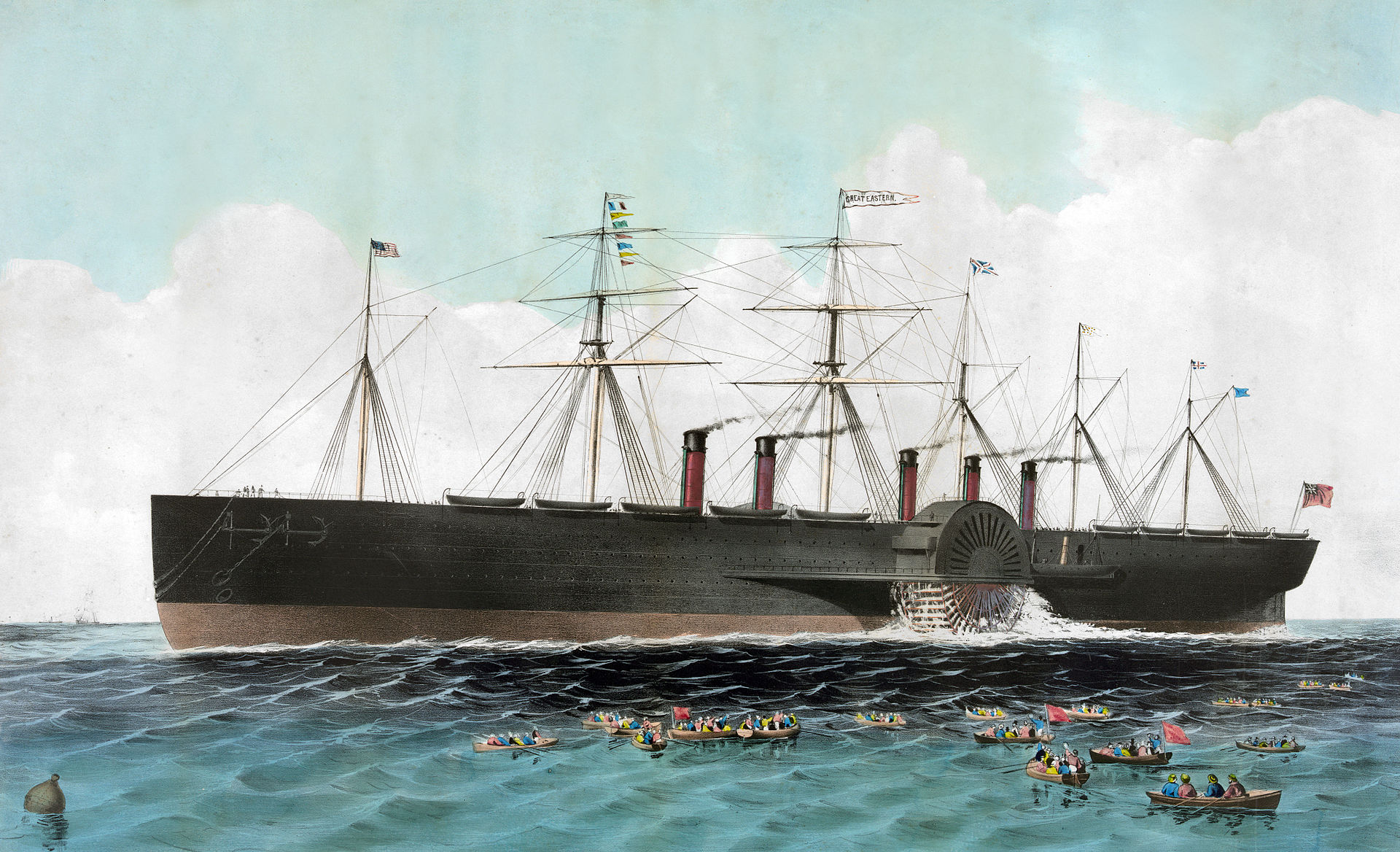
SS Great Eastern was an iron sailing steam ship designed by Isambard Kingdom Brunel, and built by J. Scott Russell & Co. at Millwall on the River Thames, London. She was by far the largest ship ever built at the time of her 1858 launch, and had the capacity to carry 4,000 passengers from England to Australia without refuelling. Her length of 692 feet (211 m) was only surpassed in 1899 by the 705-foot (215 m) 17,274-gross-ton RMS *Oceanic*, and her gross tonnage of 18,915 was only surpassed in 1901 by the 701-foot (214 m) 21,035-gross-ton RMS *Celtic*. With five funnels (later reduced to four), she was one of a very few vessels to ever sport that number, sharing her number of five with the Russian cruiser *Askold* – though several warships, including HMS *Viking*, and several French cruisers of the pre-dreadnought era had six.
Brunel knew her affectionately as the "Great Babe". He died in 1859 shortly after her ill-fated maiden voyage, during which she was damaged by an explosion. After repairs, she plied for several years as a passenger liner between Britain and North America before being converted to a cable-laying ship and laying the first lasting transatlantic telegraph cable in 1866.[4] Finishing her life as a floating music hall and advertising hoarding (for the famous department store Lewis's) in Liverpool, she was broken up in 1889.
Contents
- 1 History
- 2 Gallery
- 3 Gallery
- 4 See also
- 5 References
- 6 Further reading
- 7 External links
History
Concept

The famousRobert Howlett photo of Isambard Kingdom Brunel against the launching chains of Great Eastern at Millwall in 1857.
After his success in pioneering steam travel to North America with *Great Western* and *Great Britain*, Brunel turned his attention to longer voyages as far as Australia and realised the potential of a ship that could travel round the world without the need of refuelling.[5]
On 25 March 1852, Brunel made a sketch of a steamship in his diary and wrote beneath it: "Say 600 ft x 65 ft x 30 ft" (180 m x 20 m x 9.1 m). These measurements were six times larger by volume than any ship afloat; such a large vessel would benefit from economies of scale and would be both fast and economical, requiring fewer crew than the equivalent tonnage made up of smaller ships. Brunel realised that the ship would need more than one propulsion system; since twin screws were still very much experimental, he settled on a combination of a single screw and paddle wheels, with auxiliary sail power. Using paddle wheels meant that the ship would be able to reach Calcutta, where the Hooghly River was too shallow for screws.
Brunel showed his idea to John Scott Russell, an experienced naval architect and ship builder whom he had first met at the Great Exhibition. Scott Russell examined Brunel's plan and made his own calculations as to the ship's feasibility. He calculated that it would have a displacement of 20,000 tons and would require 8,500 horsepower (6,300 kW) to achieve 14 knots (26 km/h), but believed it was possible. At Scott Russell's suggestion, they approached the directors of the Eastern Steam Navigation Company.
...
1854–1859: Construction to maiden voyage
Construction

Sectional plan of *Great Eastern*
Although Brunel had estimated the cost of building the ship at £500,000, Scott Russell offered a very low tender of £377,200: £275,200 for the hull, £60,000 for the screw engines and boilers, and £42,000 for the paddle engines and boilers. Scott Russell even offered to reduce the tender to £258,000 if an order for a sister ship was placed at the same time. Brunel accepted Scott Russell's tender in May 1853, without questioning it; Scott Russell was a highly skilled shipbuilder and Brunel would accept an estimate from such an esteemed colleague without question.
In the spring of 1854 work could at last begin. The first problem to arise was where the ship was to be built. Scott Russell's contract stipulated that it was to be built in a dock, but Russell quoted a price of £8–10,000 to build the necessary dock and so this part of the scheme was abandoned, partly due to the cost and also to the difficulty of finding a suitable site for the dock. The idea of a normal stern first launch was also rejected because of the great length of the vessel, also because to provide the right launch angle the bow of the ship would have to be raised 40 feet (12 m) in the air. Eventually it was decided to build the ship sideways to the river and use a mechanical slip designed by Brunel for the launch. Later the mechanical design was dropped on the grounds of cost, although the sideways plan remained.
Having decided on a sideways launch, a suitable site had to be found, as Scott Russell's Millwall, London, yard was too small. The adjacent yard belonging to David Napier was empty, available and suitable, so it was leased and a railway line constructed between the two yards for moving materials. The site of the launch is still visible on the Isle of Dogs. Part of the slipway has been preserved on the waterfront, while at low tide, more of the slipway can be seen on the Thames foreshore. The remains of the slipways, and other structures associated with the launch of the SS Great Eastern, have recently been surveyed by the Thames Discovery Programme, a community project recording the archaeology of the Thames intertidal zone in London. Brunel's achievements in London are also commemorated in Rotherhithe, at the Brunel Museum
Great Eastern's keel was laid down on 1 May 1854. The hull was an all-iron construction, a double hull of 19 mm (0.75 inch) wrought iron in 0.86 m (2 ft 10 in) plates with ribs every 1.8 m (6 ft). Internally, the hull was divided by two 107 m (350 ft) long, 18 m (60 ft) high, longitudinal bulkheads and further transverse bulkheads dividing the ship into nineteen compartments. Great Eastern was the first ship to incorporate the double-skinned hull, a feature which would not be seen again in a ship for several decades, but which is now compulsory for reasons of safety.
She had sail, paddle and screw propulsion. The paddle-wheels were 17 m (56 ft) in diameter and the four-bladed screw-propeller was 7.3 m (24 ft) across. The power came from four steam engines for the paddles and an additional engine for the propeller. Total power was estimated at 6 MW (8,000 hp).
She also had six masts (said to be named after the days of a week – Monday being the fore mast and Saturday the spanker mast), providing space for 1,686 square metres (18,150 sq ft) of sails (7 gaff and max. 9 (usually 4) square sails), rigged similar to a topsail schooner with a main gaff sail (fore-and-aft sail) on each mast, one "jib" on the fore mast and three square sails on masts no. 2 and no. 3 (Tuesday & Wednesday); for a time mast no. 4 was also fitted with three yards. In later years, some of the yards were removed. According to some sources[who?] she would have carried 5,435 square metres (58,500 sq ft). This amount of canvas is obviously too much for seven fore-and-aft sails and max. 9 square sails. This (larger) figure of sail area lies only a few square metres below that the famous Flying P-Liner Preussen carried – with her five full-rigged masts of 30 square sails and a lot of stay sails. Setting sails turned out to be unusable at the same time as the paddles and screw were under steam, because the hot exhaust from the five (later four) funnels would set them on fire. Her maximum speed was 24 km/h (13 knots).
Scott Russell bankruptcy
At the beginning of February 1856 Brunel advised the Eastern Company that they should take possession of the ship to avoid it being seized by Scott Russell's creditors. This caused Scott Russell's bankers to refuse to honour his cheques and foreclose on his assets and on 4 February Scott Russell suspended all payments to his creditors and dismissed all his workmen a week later.
Russell's creditors met on 12 February and it was revealed that Russell had liabilities of £122,940 and assets of £100,353. It was decided that his existing contracts would be allowed to be completed and the business would be liquidated. He issued a statement to the Board of the Eastern Company in which he repudiated his contract and effectively handed the uncompleted ship back to them. When the situation was reviewed it was found that three-quarters of the work on the hull had not been completed and that there was a deficit of 1,200 tons between the amount of iron supplied and that used on the ship.
Brunel meanwhile wrote to John Yates and instructed him to negotiate with Scott Russell for the lease of his yard and equipment. Yates replied that Scott Russell had mortgaged the yard to his banker and that any negotiation would have to be with the bank, who after weeks of wrangling agreed to lease the yard and equipment until 12 August 1857.
The Eastern Company began the task of completing the ship. Work recommenced in May and took longer than expected to complete. Brunel reported in June 1857 that once the screw, screw shaft and sternpost had been installed the ship would be ready for launching. However, the launch ways and cradles would not be ready in time since the contract for their construction had only been placed in January 1857. Under pressure from all sides, the lease of the shipyard costing £1,000 a month, and against his better judgement, Brunel agreed to launch the ship on 3 November 1857 to catch the high tide.
Launch

[Great Eastern before launch in 1858]
Brunel had hoped to conduct the launch with a minimum of publicity but many thousands of spectators had heard of it and occupied vantage points all round the yard. He was also dismayed to discover that the Eastern Company's directors had sold 3,000 tickets for spectators to enter the shipyard.
As he was preparing for the launch some of the directors joined him on the rostrum with a list of names for the ship. On being asked which he preferred, Brunel replied "Call her Tom Thumb if you like". At 12:30 pm Henrietta (daughter of a major fundraiser for the ship,Henry Thomas Hope christened the ship Leviathan much to everyone's surprise since she was commonly known as Great Eastern; her name subsequently changed back to Great Eastern in July 1858.
The launch, however, failed,[7] as the steam winches and manual capstans used to haul the ship towards the water were not up to the job. Brunel made another attempt on the 19th and again on the 28th, this time using hydraulic rams to move the ship, but these too proved inadequate. The ship was finally launched sideways at 1:42pm on 31 January 1858, using more powerful hydraulic rams supplied by the then-new Tangye company of Birmingham, the association with such a famous project giving a useful fillip to the fledgling company.[8]
She was 211 m (692 ft) long, 25 m (83 ft) wide, with a draft of 6.1 m (20 ft) unloaded and 9.1 m (30 ft) fully laden, and displaced 32,000 tons fully loaded. In comparison, SSPersia, launched in 1856, was 119 m (390 ft) long with a 14 m (45 ft) beam.
Suez Canal concerns
In 1857, during the planning of the Suez Canal, it was thought that Great Eastern would not be able to traverse it, since she had a draft of 28 ft (8.5 m) and it was expected that the canal would be excavated to a depth of 26 ft (7.9 m).[9] In any event, when the canal was opened to shipping in 1869, Great Eastern was no longer in passenger service.
http://en.wikipedia.org/wiki/SS_Great_Eastern
MultimediaHow the Victorians Wired the World
History of Transatlantic Cable: How to Connect the World Population