Darwin, Erasmus
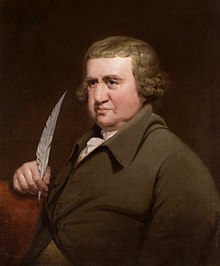
Achievements: Adaptation to environment
Born: December 12, 1731; Elston Hall, Nottinghamshire, England
Died: April 18, 1802; Derby, England (Aged 70)
Field & Discipline: Medicine; Physician
Language: English
Father: Robert Darwin
Mother: Unknown
Siblings: 3 brothers, 1 sister
Spouse: 1) Mary Howard; 2) Mrs. (Given name unknown) Chandos-Pole
Children: by Howard: Charles; Erasmus; Robert. by Mrs. Chandos-Pole: Seven
Education: Chesterfield School, Derbyshire; St. John's College, Cambridge University; Edinburgh University
Major Works:
"Zoonomia or the Laws of Organic Life"
"The Botanic Garden"
"The Temple of Nature or the Origin of Society"
Life & Times:
After studying medicine at Cambridge and Edinburgh, Darwin, at 25, opened a medical office in Nottingham, which failed, then another at Lichfield, which succeeded. Hearing of his reputation, George III invited him to be his personal physician, but Darwin declined, saying he was not interested in moving to London.
In 1760, Darwin became close friends with [a pal of] Boulton*, a Birmingham manufacturer who shared his interest in science and technology. Darwin also wrote poetry, much of it on his way to visiting patients. He invented a carriage specially fitted so he could read and write while travelling.
In 1762, he gave a series of lectures on anatomy, using the body of a recently hanged man. His advertisements said he would keep lecturing as long as the body could be preserved. In 1766, while looking for botanical specimens in the Lincolnshire countryside, he met visiting French philosopher [a pal of] Rousseau*, with whom he formed a lasting friendship. He also entertained [entertained] Dr. Johnson* in his home.
In the 1770s, Darwin formed the philosophical group, the Lunar Society, so-called because it met once a month at the full moon (the idea was that with a full moon, members could see their way home). Membership included Boulton, [club member with] Watt*, [club member with] Joseph Priestley*, [club member with] Wedgwood* (whose granddaughter married Darwin's famous grandson [grandson was] Charles Darwin*) and Samuel Galton, the Quaker grandfather of [related to] Galton* (whose mother was Darwin's daughter, Violetta).
In 1778, Darwin created a botanical garden on land he bought near Lichfield. Now a widower, he fell in love with the wife of Col. Chandos-Pole. After the Colonel's death in 1780, he married her. The new Mrs. Darwin did not care for Lichfield, and they moved to Derby, where Darwin wrote two works of verse on philosophical inquiry: "The Botanic Garden" and "The Temple of Nature or the Origin of Society".
Darwin's major work, "Zoonamia, or the Laws of Organic Life" (1794-96), presented his theory of evolution, in which he argued that all organisms descended from a single ancestor, and that during their development, they modified and transformed themselves in the same way that domesticated animals and plants had been modified and transformed by man. He believed that species changed by making physiological adjustments in response to their environment, and that these changes were passed on to the next generation.
This view was also held by French naturalist [shared view of] Buffon* and later for a time by English philosopher [shared view of] Spencer*. Darwin also believed that disease and susceptibility to disease could be hereditary. Although Darwin did not produce an explanation for his observations, he was the first to point them out. He also proposed that competitive and selective processes are involved in change. "Zoonamia" was translated into several European languages and a pirated edition was printed in America.
Extra Connections: Knew [knew] Wilkinson*
Influenced [influenced] Mary Shelley*
Was a fan of [a fan of] Schweppe*
Assessment: Darwin was a prominent member of the skeptical materialists of the 18th century whose belief in evolution became part of a scientific discussion that led to his grandson Charles Darwin's seminal work.
Oneliner: Erasmus Darwin, scientist and father of Charles Darwin
Bibliography:
- Hassler, Donald M., Erasmus Darwin, Twayne Publishers, Inc., New York, 1973.