Gregory D
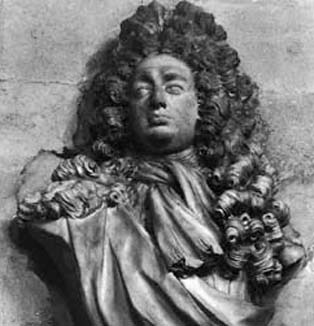
BIRTH: 3 June 1659; Kinnairdie, Banffshire, Scotland
DEATH: 10 October 1708; Maidenhead, Berkshire, Engand
CATEGORY: Mathematics; Science
DISCIPLINE: Geometry; Astronomy, Optics
ASSESSMENT: Gregory was less an originator of scientific ideas than a careful collator of other people’s work, especially that of Newton.
LANGUAGE: English
EDUCATION: Marischal College, Aberdeen; Edinburgh University.
ACHIEVEMENT: He helped to popularize Newton’s work.
MAJOR-WORK: ‘Elements of Astronomical Physics and Geometry’ (1702)
PARENTS: Father: David Gregory; Mother: not noted (one of his two wives)
SPOUSE: Elizabeth Oliphant
SIBLINGS: David, Charles, James and twenty-nine other brothers, sisters, half-brothers and half-sisters.
CHILDREN: David and two other sons; one daughter
DETAILS: David Gregory’s father (David was the eldest) was a successful inventor and businessman who had inherited a Scottish title and lands from his cousin, and probably instilled in his son an interest in mathematic and the sciences.
In 1683, at the time of his graduation from Edinburgh he was elected Professor of Mathematics and gave an inaugural address on geometry.
Gregory was the first academic in Britain to lecture on Newton’s work and persuaded all his scientific friends and colleagues, including William Whiston*, to accept the theory of gravitation. His lectures at Edinburgh covered geodesy, optics and dynamics as well as the various mathematical disciplines.
In 1691 after a falling-out with the university authorities over his radical political views (summoned before a visiting Parliamentary commission he refused to swear the oath of loyalty to the English throne) Gregory left for London.
He met Newton*, who recommended him to the job of Savile Professor of Astronomy at Oxford (Newton referred to him as: ‘…the greatest mathematician in Scotland’). With the added support of Astronomer Royal Flamsteed, Gregory got the chair, and a year later in 1692 was elected to the Royal Society*, although he took no part in its activities apart from a few letters to its journal (one was a failed attempt to solve the ‘Florentine enigma’ set by the Italian mathematician Viviani*, which involved the mathematical analysis of how an imaginary building could be constructed from a half-sphere intersecting with a cylinder; and another in response to the claim by Leibniz* to have arrived at calculus before Newton).
His relationship with Flamsteed took a turn for the worse, over various remarks Gregory made about his work and Flamsteed* was to refer disparagingly to Gregory as a ‘closet astronomer,’ because of the extraordinarily-few observations he ever made.
In 1693 Gregory traveled to Holland to update himself of science there and met Christiaan Huyghens* and others.
In 1695 he published (in Latin) an undergraduate-level textbook-rehash of his old Edinburgh lectures on optics, and in the work suggested the use of multiple simple lenses of different densities as a means of avoiding the problem of chromatic aberration (an idea that would eventually take form as the achromatic lens*). Forty years later an English edition of the work included an appendix by Desaguliers*).
In 1702 came Gregory’s chief work (in Latin): ‘Elements of Astronomical Physics and Geometry.’ It was the first astronomy textbook based on gravitational theory.
A year later Gregory brought out his Greek and Latin edition of Euclid’s works. He then started to collaborate with Halley* (who had earlier opposed his election to the Oxford Professorship) on an edition of the work of the Greek mathematician Apollonius of Perga, but would die before completion.
In 1708, en route to London to visit his children who were sick with smallpox, he complained of illness, and stopped at the Greyhound Inn at Maidenhead (at the time a day’s coach-ride from London).
His friend, the royal physician John Arbuthnot* was called from nearby Windsor Castle, but arrived too late to help.
EXTRA-CONNECTIONS: He was a friend of diarist Samuel Pepys*, and the mathematicians Wallis* and John Collins*
ONELINER: David Gregory, second-rate mathematician and pal of Newton.
BIBLIOGRAPHY:
Dictionary of Scientific Biography
Encyclopedia Britannica
Eagles, Christina M., "David Gregory and Newtonian Science," British Journal for the History of Science, 10 (1977), 216-25.
Eagles, Christina M, The Mathematical Work of David Gregory, 1659-1708, (Edinburgh University Ph.D. thesis, 1977)
Hiscock, W.G., David Gregory, Isaac Newton and their Circle. Extracts from David Gregory's Memoranda 1677-1708, ( Oxford University Press, 1937)
http://es.rice.edu/ES/humsoc/Galileo/Catalog/Files/gregory_dav.html