DuPont, Eleuthere
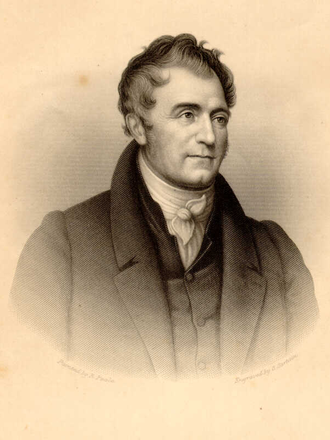
NAME: Du Pont, Eleuthere Irenee
ACHIEVEMENT(S): Founded U.S. gunpowder-manufacturing company, E. I. Du Pont de Nemours & Co., which became DuPont.
NICKNAME/ALIAS: None
DATE/PLACE OF BIRTH: June 24, 1771, Paris, France
DATE/PLACE OF DEATH/AGE AT DEATH: October 31, 1834, Philadelphia, PA.
Aged 63
CATEGORY: Industrialist
FIELD: Business
LANGUAGE: French, English
PARENTS: Pierre Samuel DuPont de Nemours; Nicole Charlotte Marie Louise Le Dee de Raucourt
SIBLINGS: Victor-Marie
SPOUSE: Sophie Madeleine Dalmas
CHILDREN: Victorine; Alfred Victor; Evalina; Sophie; Henry; Eleuthera;
Alexis (an eighth child died before adulthood)
EDUCATION: Private tutors; College Royal, Paris
MAJOR WORK: N/A
LIFE AND TIMES:
At 16, Du Pont was accepted into the French government agency for the manufacture of gunpowder, recommended by an instructor in the agency, the well-known chemist Lavoisier*, a friend of his father's.
In 1792, France was torn by the political upheavals of the French Revolution, and in August, both father and son were among a small group that protected Louis XVI* when a mob stormed the Tuileries.
His father Pierre Samuel DuPont* fled to the countryside, leaving his son to look after the family publishing business.
Du Pont became a member of the pro-Revolution National Guard, and supported the Jacobins, who were radical democrats. His father was arrested in 1794 and was saved from execution only by the fall of Robespierre and the end of the Reign of Terror.
Convinced that France's political situation was too unstable, Du Pont’s father made plans to move to the United States.
Two years later, in 1799, the family sold the publishing house, and the elder Du Pont, his two sons and their families, and some cousins sailed for the United States. The party reached Newport, Rhode Island on January 1, 1800, and made its way to Bergen Point, New Jersey, across the river from New York City.
Before leaving France, the senior Du Pont had the foresight to form a company called Du Pont de Nemours. By selling shares in his future enterprises, he raised 250,000 francs, plus the rents from 56,000 acres in Kentucky that a French-Swiss banker, Jacques Bidermann, had given him in return for shares.
The Du Ponts opened an office in New York City and pondered their future. U.S. statesman Jefferson*, a friend of the elder Du Pont, advised against speculating in land development.
It was Eleuthere Irenee who came up with the idea that was to make the family immensely rich and influential. After some research, he concluded that all American gunpowder was inferior to French gunpowder. Calling upon his experience with gunpowder in France, Du Pont determined that though the saltpeter in American gunpowder was of good quality, the refining process was inefficient and years out of date.
Du Pont realized he could easily produce a superior powder and proposed the idea to the family.
Du Pont, with his brother Victor, returned to France to get the equipment, experienced workers and additional funding for the new venture. In Paris, he met Jacques Bidermann, one of his father's original backers, who was sympathetic to the project, and another of his father's friends, de Stael*, introduced him to her uncle, Louis Necker, whose brother Jacques Necker* was a government minister.
On April 21, 1801, in Paris, the E.I. Du Pont de Nemours & Company* was born. Its manifest was for the "manufacture of military and sporting powder in the United States of America". What made Du Pont's visit to Paris particularly successful was the boundless cooperation of the French government, which saw the venture as a means to break the British monopoly on gunpowder exports to the United States.
Du Pont was given access to secret research at the Essonnes powder works, he was sold the latest processing machinery at cost, and he was given assistance in hiring trained French powder-men for the mill.
After his return to Bergen Point, Du Pont identified a strip of land along the Brandywine River, four miles north of Wilmington, Delaware, where the river fell more than 120 feet in fewer than four miles -- perfect for driving waterwheels.
With the help of U.S. statesman Alexander Hamilton* the plant began operations on May 1, 1804. Thanks to large government orders, endorsed by Jefferson, now president, the mill turned a tidy profit during the first year.
By 1807, profits soared, thanks in large part to Jefferson's embargo on European powder. The elder Du Pont died in 1817, after straining to help put out a fire at the mills. In 1818, an explosion destroyed the original buildings, killing 40 people. Rebuilding took a year, placing the company further in debt.
But the company grew, and as it did, Du Pont's politics became more conservative. He served as a director of the Bank of the United States.
Du Pont left a company that, despite its huge debt of $150,000 at his death in 1834, was the largest gunpowder manufacturer in the United States, and would grow into one of the country's great corporate empires.
ASSESSMENT: Founded in 1802 the well-known and hugely successful gunpowder manufacturing company, E.I. Du Pont de Nemours & Co.
EXTRA CONNECTIONS: None
ONELINER: Eleuthere Du Pont, founder of DuPont
BIBLIOGRAPHY:
EB
Mosley, Leonard, Blood Relations: The Rise and Fall of the Du Ponts of Delaware, London: Hutchinson, 1980 Williams, Kenneth H.,
ANB