Hamilton, Alexander
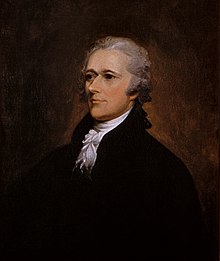
Achievements: First Secretary of the Treasury of the United States.
Born: January 11, 1757; Nevis, British West Indies.
Died: July 12, 1804; New York City (Aged 49)
Field & Discipline: Government & Politics; Economics; Law; Lawyer; Statesman
Language: English; French
Education: King’s College, New York
Major Work: “The Federalist” (1787-88)
Life & Times:
Hamilton’s father emigrated to the British West Indies hoping to make his fortune as a merchant. Unsuccessful in business and estranged from his relatives in Scotland, he abandoned his family in 1766, leaving them destitute.
When Hamilton’s mother died two years later her relatives sent him to work as a clerk for Nicolas Cruger, an importer from New York. Hamilton showed remarkable talent and ambition, attracting the attention of Presbyterian minister Hugh Knox. Knox invited Hamilton to use his library to study and encouraged him to write.
When one of Hamilton’s essays was published in the local paper and received rave reviews, Knox and Cruger raised money to send him to school in the United States, where he studied at a preparatory school in Elizabethtown, New Jersey.
He lived at the home of William Livingston, a member of one of New York’s most powerful families and a friend of Knox. At the Livingston estate, Hamilton met members of the social and political elite of New York, including [knew] Gouverneur Morris* and [knew] Jay*.
Hamilton enrolled at King’s College (now Columbia University) in the fall of 1773. The American independence movement filled him with passion for his newly adopted country and he wrote several pamphlets in support of the cause. Published anonymously, the pamphlets were so impressive that they were attributed to John Jay. In March 1776 Hamilton joined an artillery company as captain.
A year later he was promoted to lieutenant colonel and became an aide-de-camp to [a pal of] Washington*. Hamilton gained Washington’s trust and respect and the two formed a close friendship that would last until Washington’s death in 1799.
While serving at headquarters. Hamilton was often frustrated by the difficulties the army faced in procuring funding from the states. He wrote letters to [corresponded with] Robert Morris*, the superintendent of finance, in which he analyzed the financial weaknesses of the government. In July of 1781 he led a battalion against [fought] Cornwallis* at the siege of Yorktown.
After the war Hamilton settled in New York City with his new wife Elizabeth and practiced law. He was elected to the New York State Assembly in 1786 and joined the state delegation to the Constitutional Convention in Philadelphia in 1787.
Hamilton took a strong nationalist stance at the convention. As a foreigner. he did not have the regional loyalties that led other delegates to resist the formation of a strong central government.
On his return to New York Hamilton embarked on a writing campaign in defense of the proposed Constitution. Together with Jay and James Madison he wrote The Federalist. a series of essays that appeared in newspapers under the pen name Publius. The Federalist is still widely read today for its interpretation of Constitutional powers.
At the ratifying convention in New York. Hamilton was the head of a pro-Constitution minority that also included Jay and [worked with] Robert R Livingston*. His formidable debating powers swayed the opposition, making New York’s ratification of the Constitution a personal victory for Hamilton.
When President Washington chose his first cabinet members in 1789 Madison and Morris recommended Hamilton as secretary of the Treasury. Congress asked Hamilton to come up with a plan to settle the new nation’s debts. He responded with three reports, delivered to Congress in 1790-91.
In Reports on the Public Credit he recommended funding the debt through the issuance of stock certificates and a system of taxation. Report on a National Bank proposed a national bank that would combine public and private funds, creating a shared interest between government and business. Hamilton believed that the United States needed a manufacturing base in order to become a strong nation.
His vision of transforming the economy from agriculture to manufacturing was outlined in his Report on Manufactures, which recommended government support for industry. Hamilton had read The Wealth of Nations by [disagreed with ideas of] Adam Smith* but he did not agree with its [disagreed with theory of] laissez-faire* doctrine. The Report on Manufactures was the only part of his program that was not approved by Congress.
In 1790 Hamilton established the Revenue Cutter Service. which eventually became the [founded] US Coast Guard*.
Hamilton was surprised when his ideas met with resistance from within the cabinet, notably from Secretary of State [opposed by] Jefferson*. A country gentleman who distrusted commerce, Jefferson found little to agree with in Hamilton’s economic program.
Further tensions arose over foreign policy when war broke out between France and England. Hamilton argued that the Revolutionary War alliance with France was no longer valid, while Jefferson claimed it was.
The rift between Hamilton and Jefferson resulted in the formation of political parties. Jefferson and Madison, Hamilton’s former ally, created the Republican Party in opposition to Hamilton’s Federalists. Hamilton was dismayed by this development, which he felt would weaken the government. He left the cabinet in 1795 but continued to wield considerable influence with Washington and other cabinet members. He drafted Washington’s Farewell Address of 1796.
Jefferson ran for President in the election of 1800 with [shot by] Burr* as his running mate. At that time, votes were cast separately for candidates on the same ticket. When Burr received the same number of votes as Jefferson the House of Representatives had to decide the election. The Federalists wanted to throw the election to Burr, but Hamilton convinced them not to.
Hamilton disliked Jefferson but believed him to be a man of principle, a view he did not hold of Burr. Jefferson won the election but Hamilton lost credibility within his party for supporting his political enemy. Burr courted the Federalist vote again in 1804 when he ran for governor of New York. but Hamilton gave his support to Burr’s Republican opponent.
Twice thwarted by Hamilton, and quoting remarks Hamilton allegedly made against his character, Burr demanded satisfaction in the form of a duel. Hamilton was opposed to dueling but felt compelled to accept the challenge. The two men met on July 11 in Weekawken, New Jersey. Hamilton, the former artillery captain. threw away his shot and fell to Burr’s.
He was taken to a friend’s home in New York where he died the next day.
Extra Connections:
Hamilton was lawyer to [lawyer to] Eleuthère Irénée du Pont* and helped him secure the rights to the land in Delaware that would become the site of [helped set up] E.I. du Pont* Company.
He was influenced by the ideas of [influenced by] Hume*
He knew [knew] Catherine Greene*. He was a colleague of Declaration of Independence signer [ was a colleague of Declaration of Independence signer ]George Clymer*, [ was a colleague of Declaration of Independence signer ]John Adams*,
[ was a colleague of Declaration of Independence signer ]George Read*, [ was a colleague of Declaration of Independence signer ]Samuel Chase*, [ was a colleague of Declaration of Independence signer ]Charles Carroll* of Carrollton, [ was a colleague of Declaration of Independence signer ]Richard Henry Lee*, [ was a colleague of Declaration of Independence signer] Lewis Morris*, [ was a colleague of Declaration of Independence signer ]Thomas McKean*, [ was a colleague of Declaration of Independence signer ] Benjamin Franklin*
Assessment: Hamilton is remembered as one of America’s first nationalists. His vision for the nation was one of economic strength and political unity, and went far beyond the loose confederation of states that existed in his day.
Oneliner: Alexander Hamilton. first US Treasury Secretary
Bibliography:
- Brookheiser. Richard. Alexander Hamilton – American. The Free Press. New York. 1999.
- Emery. Noemie. Alexander Hamilton: An Intimate Portrait. G.P. Putnam’s Sons. New York. 1982.
Multimedia:
John Sedgwick War of Two: Alexander Hamilton, Aaron Burr, and the Duel that Stunned the Nation, BookTV talk (video)
Hamilton the Musical: New Yorker article, [LA Times review;](http://www.latimes.com/entertainment/arts/la-ca-cm-hamilton-hip-hop-notebook-20151031-column.html
3/15 based on Ron Chernow's biography
American Artifacts: Museum of American Finance
Father: James Hamilton
Mother: Rachel Faucette Levein
Siblings: James
Spouse: Elizabeth Schuyler Hamilton
Children: Alexander; James Alexander; John Church; Philip; William Stephen; Angelica; Eliza