Necker
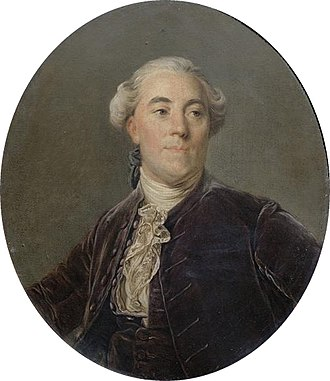
Name: Jacques Necker
Achievements: Director of the French treasury
Born: September 30, 1732; Geneva, Switzerland
Died: April 9, 1804; Coppet, near Geneva (Aged 71)
Field & Discipline: Government; Politics; Finance Minister
Language: French
Father: Charles Frederic Necker
Jeanne-Marie Gautier
Siblings: Louis de Germany
Spouse: Suzanne Curchod
Children: Anne Louise Germaine (later famous novelist Mme. De Stael)
Education: Unknown
Major Work:
Helped finance the American War of Independence
Life & Times:
Necker hoped to become a writer, but his father, a lawyer, disapproved, and got him a job as clerk in the bank of a friend, Isaac Vernet. At 16, Necker was sent to the bank's headquarters in Paris, where he showed a great facility for banking.
Not having any children of his own, Vernet picked Necker and George-Tobie de Thellusson to take over the company when he retired in 1756. The pair formed their own company, Thellusson & Necker, to which Thellusson brought the lion's share of the money, and Necker the greater expertise.
During the Seven Years' War (1756 to 1763), Necker made a fortune by making loans to the treasury, and by speculating on grain. After the war, and particularly between 1769 and 1774, the bank made many loans to the royal government under Louis XV.
In 1764, Necker married Suzanne Curchod, (see [wife was] Mme Necker*) the daughter of a Swiss protestant minister. (Their daughter, Anne Louise Germaine, would become the famous novelist, [daughter was] de Stael.*)
In 1768 Necker was appointed resident Minister for Geneva at Paris, his first public appointment. In the same year, he was also made director of the French East India Company. In 1773 he began a literary career, publishing "Eulogy to J. B. [wrote eulogy of] Colbert*", in praise of King Louis XIV's finance minister. The book took the Academie Francaise prize.
In a treatise in 1775, "Essay on the Legislation on trade in grain” Necker criticized the French free trade policy on corn promoted by French Minister of Finance [attacked ideas of] Turgot*. The paper caused a political sensation, perhaps because it advocated governmental protection for the lower classes against price rises. Because of Necker's paper, and because Necker was a favorite of the monarch's guru, [a favorite of] Maurepas*, [appointed by] Louis XVI* appointed him to run the department of finance, giving him the title Counselor of Finance and Director of the Royal Treasury.
The fairly innocuous titles disguised Necker's real mission, which was to take complete financial control of the kingdom. In 1777, his authority was extended to other spending departments. He is credited with making the administration much more efficient. He eliminated superfluous offices, cut back pensions and gifts given out by the king and queen, reduced the royal households' budgets, cut the profits of the financiers, treasurers and tax collectors who handled royal revenue. Above all he introduced a fairer tax system.
In the difficult financial times of the late 18th century, Necker set about gaining the public's confidence, knowing that the success of his measures would almost uniquely depend on how much the people trusted him. He was successful, and this allowed him to raise loans to support the American Revolution (which may have caused French bankruptcy six years later, triggering the French Revolution.)
Necker's "Compte Rendu” (Accounts) , a comprehensive statement on the French exchequer published in 1781, was a fantastic success. More than 100,000 copies were sold. It was translated into English, Dutch, German, Danish and Italian, and became a source of public finance reference for a generation. On the whole, Necker’s suggestions for moderate fiscal reform received wide public support, but, unsurprisingly, the Court disliked them, and this brought about Necker's eventual downfall and resignation.
In 1781, Necker retired to St. Ouen, a Paris suburb, where he wrote "On the Administration of Finances in France," a work published in 1784. He also wrote “On the Importance of Religious Ideas,” aimed at atheists.
In 1787, attacked for his handling of finances, Necker published an article defending himself. The article angered people in high places and resulted in his exile. However, he was called back a year later when it became clear that he was essential to French financial survival.
The French aristocracy, now awakened to the fiscal realities, agreed to forgo their exemption from tax. Necker and many others thought this would be enough to draw France back from the verge of bankruptcy. But it was not. A session of the States-General was called, and mediated by Necker, who held the confidence of both the Crown and the people.
He set forth an official program of social and constitutional reforms, proposing a two-chamber system of government, similar that of the British Parliament. Many of his ideas were overlooked in the general pandemonium, and others were radically altered by the court reactionaries. A Royal Session was held on June 23, 1789, and less than three weeks later, Necker was dismissed again.
His dismissal contributed to the disturbances in Paris that led to the storming of Bastille on July 20. Necker was recalled yet again, but could not operate in an atmosphere of chaos. Minister [bypassed by] Talleyrand* dictated revolutionary finance over his head, and he was distrusted by both the new National Assembly and the Court. Concluding that he could do nothing to remedy the national deficit, he resigned in September, 1790.
Necker retired to Coppet, Switzerland, where he wrote "On the Necker Administration, by Himself)," published in 1791. In his later years, Necker produced a number of religious writings, and four volumes titled “On the French Revolution," published in 1797 .
Extra Connections: Involved with dramatist/spy [employed] Beaumarchais*
In discussions with U.S. politician [negotiated with] Gouverneur Morris*.
Helped finance development of [financed work of] Argand’s* distillation process.
He knew [knew] Corvisart*
He was a friend of [a pal of] Buffon* and [a pal of] E. DuPont*
He met [met] Adam Smith*
He aided the escape of the Marquis de [aided escape of] Castries*
Assessment: Necker's ability to solve France's enormous financial difficulties were probably overestimated at points during his lifetime, and unduly vilified at others.
Oneliner: Jacques Necker, who financed US War of Independence
Bibliography:
- Harris, Robert D., Necker: reform statesman of the ancien regime, University of California Press. Berkeley/Los Angeles/London. 1979.