Himmler
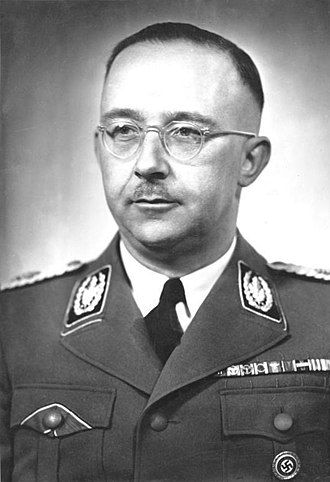
Achievements: Second most powerful man after Hitler in the Third Reich.
Born: October 7, 1900; Munich, Germany
Died: May 23, 1945; Luneburg, Germany (Aged 44)
Field & Discipline: Politics; Military; Administrator
Language: German
Father: Gebhard Himmler
Mother: Anna Maria Heyder
Siblings: Gebhard; Ernst
Spouse: Margarete Boden
Children: Gudrun (adopted); 1 daughter with Margarete Boden; 2 illegitimate children
Education: Munich and Landshut Gymnasia; Munich Technische Hochschule
Life & Times:
Himmler's first contact with the Nazi Party (established in 1920, with [head of Gestapo for] Hitler* as chairman by July, 1921) was in 1923, when he joined the paramilitary, nationalist Reichskriegsflagge under Captain Ernst Rohm.
In November, 1923. he participated in Hitler's abortive Beer Hall Putsch in Munich (after which Hitler was imprisoned for nine months), as standard-bearer at the side of Rohm. The following year, he came to know Nazi official Gregor Strasser, who had just been made co-chairman of the Nationalsozialitsche Deutsche Arbeiterpartei (NSDAP: the "National Socialist German Workers' Party" or Nazi Party). Strasser offered him a position as assistant and secretary in the party.
It was a dream come true for Himmler, whose nationalism, belief in expansionism, and anti-Semitism fitted the job perfectly. By 1925, Himmler had become Strasser's deputy district leader in Bavaria, Swabia, and the Palatinate, and from late 1925 to 1929 he worked as acting propaganda leader for the Nazis, until Hitler put Joseph [worked with] Goebbels* in charge in 1929.
In January, 1929, Hitler appointed Himmler Reichsfuhrer of the SS, Hitler's elite bodyguard, which was nominally under the control of the SA (Storm Troopers), led by Rohm. At this time, the SS was composed of only about 200 men, but under Himmler, it was to become the most powerful organization in the Nazi State.
In 1933, he was made Commander of all political police units throughout Bavaria, at which time he set up the first Nazi concentration camp in Dachau. Initially, Dachau was intended to house political prisoners, but Himmler extended the range to include many other kinds of prisoners.
In September, 1933, Himmler was made Commander of all police units outside Prussia, and in April, 1934, he became head of the Prussian Police and Gestapo (secret state police), even though future Luftwaffe commander [worked with] Goering* was nominally still in charge.
The turning-point in Himmler's career came on June 30, 1934, "The Night of the Long Knives." Himmler and other Nazi officials masterminded an internal party purge that paved the way for the emergence of the SS as an independent organization charged with "safeguarding the … embodiment of the National Socialist idea" and translating the racism of the regime into a dynamic principle of action.
By mid-June 1936, Himmler had succeeded in winning control of the political and criminal police throughout the Third Reich, becoming head of the entire Gestapo in addition to his position as Reichsfuhrer of the SS.
In January, 1937, Himmler declared that the mission of the German people was "the struggle for the extermination of any sub-humans all over the world who are in league against Germany, which is the nucleus of the Nordic race." Himmler envisioned a race of "supermen," of blue-eyed, blond heroes. He dreamed of cultivating an elite according to "the laws of selection," based on the criteria of physiognomy, intelligence, physique, character and spirit.
He established a State-registered human stud farm known as Lebensborn, where young girls selected for their perfect Nordic traits could procreate with SS men with equally perfect traits. In October, 1939, he ordered the entire SS and Gestapo to father as many children as possible.
In October, 1939, Hitler appointed Himmler Reich Commissar for the Strengthening of Germandom. His mission was to bring people of German descent back from outside the Reich and to settle them in the newly-annexed part of Poland. Within a year, Himmler had uprooted and driven eastwards a million Poles and 300,000 Jews. In the first months of the Second World War, Himmler was given more power and more resources. In 1941, after Hitler decided to eliminate European Jewry in the Holocaust, it was Himmler who organized the Polish death camps.
After Germany invaded the Soviet Union in 1941, Himmler was entrusted with the political administration of Russia's conquered territory. His aim was to eliminate the Soviet system. By August, 1943, Himmler had been appointed Minister of the Interior and plenipotentiary for Reich administration, giving him jurisdiction over the courts and the civil service.
By 1944, Himmler had gained control of the intelligence network. After the abortive attempt on Hitler's life on July 20, 1944, the Wehrmacht was obliged to accept him as Commander-in-Chief of the Reserve Army.
In the final year of the War, realizing that Germany was on the verge of collapse, Himmler secretly approached the Allies in early 1945 with terms for peace negotiations. Acting as middle-man was the head of the Swedish Red Cross, [negotiated peace via] Count Folke Bernadotte*.
On his own initiative, Himmler ordered the mass slaughter of the Jews stopped and proposed that the German armies in the West surrender to [offered surrender to] Eisenhower*, but that the German armies in the East continue the war against the Soviet Union, with the approval of the Allies. The offer was rejected by U.S. President Harry S. Truman and [offer rejected by] Churchill*. Learning of Himmler's betrayal, Hitler was enraged, stripped him of all offices, and ordered his arrest.
Following the German surrender in May, 1945, Himmler pretended he was a dead German soldier and tried to escape, but was captured by British troops. Brought to Luneberg, he committed suicide on May 23, 1945 by biting on a cyanide capsule while being interrogated by the British.
Capture and death
 Himmler's corpse after his suicide by cyanide poisoning, May 1945
Rejected by his former comrades and hunted by the Allies, Himmler attempted to go into hiding. He had not made extensive preparations for this, but he carried a forged paybook under the name of Sergeant Heinrich Hizinger. With a small band of companions, he headed south on 11 May to Friedrichskoog, without a final destination in mind. They continued on to Neuhaus, where the group split up. On 21 May, Himmler and two aides were stopped and detained at a checkpoint in Bremervörde set up by former Soviet POWs. Over the following two days, he was moved around to several camps[205] and was brought to the British 31st Civilian Interrogation Camp near Lüneburg, on 23 May.[206] The officials noticed that Himmler's identity papers bore a stamp which British military intelligence had seen being used by fleeing members of the SS.[207]
The duty officer, Captain Thomas Selvester, began a routine interrogation. Himmler admitted who he was, and Selvester had the prisoner searched. Himmler was taken to the headquarters of the Second British Army in Lüneburg, where a doctor conducted a medical exam on him. The doctor attempted to examine the inside of Himmler's mouth, but the prisoner was reluctant to open it and jerked his head away. Himmler then bit into a hidden potassium cyanide pill and collapsed onto the floor. He was dead within 15 minutes,[208][209] despite efforts to expel the poison from his system.[210] Shortly afterward, Himmler's body was buried in an unmarked grave near Lüneburg. The grave's location remains unknown.[211]
Mysticism and symbolism
Main article: Ideology of the SS
 The stylised lightning bolts of the SS insignia were based on the Armanen runes of Guido von List.
Himmler was interested in mysticism and the occult from an early age. He tied this interest into his racist philosophy, looking for proof of Aryan and Nordic racial superiority from ancient times. He promoted a cult of ancestor worship, particularly among members of the SS, as a way to keep the race pure and provide immortality to the nation.
Viewing the SS as an "order" along the lines of the Teutonic Knights, he had them take over the Church of the Teutonic Order in Vienna in 1939. He began the process of replacing Christianity with a new moral code that rejected humanitarianism and challenged the Christian concept of marriage.[212] The Ahnenerbe, a research society founded by Himmler in 1935, searched the globe for proof of the superiority and ancient origins of the Germanic race.[213][214]
All regalia and uniforms of Nazi Germany, particularly those of the SS, used symbolism in their designs. The stylised lightning bolt logo of the SS was chosen in 1932. The logo is a pair of runes from a set of 18 Armanen runes created by Guido von List in 1906. The ancient Sowilō rune originally symbolised the sun, but was renamed "Sieg" (victory) in List's iconography.[215]
Himmler modified a variety of existing customs to emphasise the elitism and central role of the SS; an SS naming ceremony was to replace baptism, marriage ceremonies were to be altered, a separate SS funeral ceremony was to be held in addition to Christian ceremonies, and SS-centric celebrations of the summer and winter solstices were instituted.[216][217] The Totenkopf (death's head) symbol, used by German military units for hundreds of years, had been chosen for the SS by Julius Schreck.[218] Himmler placed particular importance on the death's-head rings; they were never to be sold, and were to be returned to him upon the death of the owner. He interpreted the death's-head symbol to mean solidarity to the cause and a commitment unto death.[219]
Relationship with Hitler
As second in command of the SS and then Reichsführer-SS, Himmler was in regular contact with Hitler to arrange for SS men as bodyguards;[220] Himmler was not involved with Nazi Party policy-making decisions in the years leading up to the seizure of power.[221] From the late 1930s, the SS was independent of the control of other state agencies or government departments, and he reported only to Hitler.[222]
Hitler's leadership style was to give contradictory orders to subordinates and to place them into positions where their duties and responsibilities overlapped with those of others. In this way, Hitler fostered distrust, competition, and infighting among his subordinates to consolidate and maximise his own power. His cabinet never met after 1938, and he discouraged his ministers from meeting independently.[223][224] Hitler typically did not issue written orders, but gave them orally at meetings or in phone conversations; he also had Bormann convey orders.[225] Bormann used his position as Hitler's secretary to control the flow of information and access to Hitler.[226]
Hitler promoted and practised the Führerprinzip. The principle required absolute obedience of all subordinates to their superiors; thus Hitler viewed the government structure as a pyramid, with himself—the infallible leader—at the apex.[227] Accordingly, Himmler placed himself in a position of subservience to Hitler, and was unconditionally obedient to him.[228] However, he—like other top Nazi officials—had aspirations to one day succeed Hitler as leader of the Reich.[229] Himmler considered Speer to be an especially dangerous rival, both in the Reich administration and as a potential successor to Hitler.[230] Speer refused to accept Himmler's offer of the high rank of SS-Oberst-Gruppenführer, as he felt to do so would put him in Himmler's debt and obligate him to allow Himmler a say in armaments production.[231]
Hitler called Himmler's mystical and pseudoreligious interests "nonsense".[232] Himmler was not a member of Hitler's inner circle; the two men were not very close, and rarely saw each other socially.[233][223] Himmler socialised almost exclusively with other members of the SS.[234] His unconditional loyalty and efforts to please Hitler earned him the nickname of der treue Heinrich ("the faithful Heinrich"). In the last days of the war, when it became clear that Hitler planned to die in Berlin, Himmler left his long-time superior to try to save himself.[235]
Extra Connections: He affected [influenced] Heisenberg’s* life.
Assessment: More than any other individual, created the network of state terror by which the Third Reich suppressed all opposition, eliminated internal enemies, and compelled obedience.
Oneliner: Heinrich Himmler, Nazi head of Gestapo
Bibliography:
- Breitman, Richard, The Architect of Genocide: Himmler and the Final Solution, London: Bodley Head, 1991.
- Encyclopedia Britannica.
- Wistrich, Robert S., Who's Who in Nazi Germany, London & New York: Routledge, 1995.