Taine
Full Name: Hippolyte-Adolphe Taine
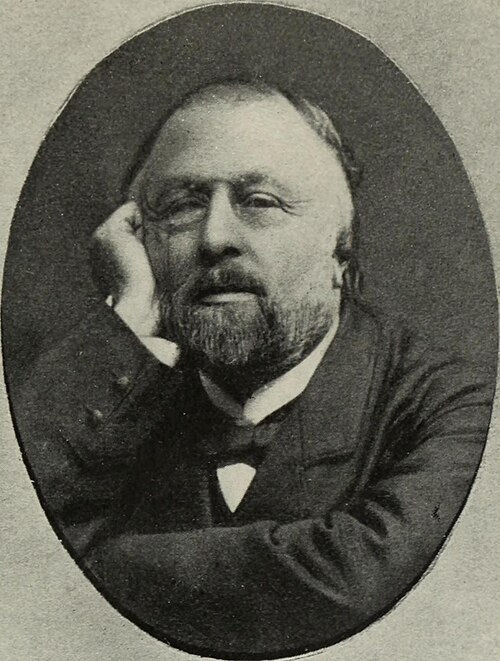
Achievements: Influential naturalist thinker in late 19th century France
Born: April 21, 1828; Vouziers, Ardennes, France
Died: March 5, 1893; Paris, France (Aged 65)
Field & Discipline: Philosophy; Historian; Critic; Writer
Language: French
Father: Jean Baptiste Taine
Mother: Marie Virginie Bezanson
Siblings: Virginie; Sophie
Spouse: Mademoiselle Denuelle
Children: None
Education: College Bourbon, Paris; Ecole Normale, Paris
Life & Times:
In 1848, aged 20, Taine prepared a treatise, "Of Human Destiny", in which he wrote of his loss of religious faith. At the Ecole Normale, he discovered [a fan of] Stendhal* who remained his favourite author. He was already a rational thinker who believed that knowledge must be based on observation, sensory perception and proven hypotheses.
When he then read the philosophy of [influenced by] Hegel*, [influenced by] Kant* and [influenced by] Spinoza*, their metaphysics encouraged him in his search to find a theory which would explain the forces of life and universe.
Despite being the most outstanding student of his year he took the relatively minor post of substitute philosophy teacher at the College of Nevers. He refused to sign an oath of loyalty to [opposed] Napoleon III* after his coup d'etat in 1851, on the grounds that the government had come to power by illegitimate means. This displeased the academic establishment and after a brief period teaching rhetoric at the College of Poitiers, he was transferred to teacher a lower class at Besancon.
Taine was unwilling to accept this demotion and returned to Paris. There, he taught privately, while writing a thesis on the safe subject of [wrote thesis on] La Fontaine*'s ‘Fables,’ for which he received in doctorate in 1853.
He also began to write literary criticism and pursued his scientific interests by attending courses at the Faculty of Medicine, the Sorbonne, and the mental hospital at La Salpetriere.
In 1854, he submitted his prize-winning "Essay on Livy" to the French Academy and, three years later, he angered the academic establishment with "The Nineteenth Century Philosophers", in which he attacked contemporary French thought, mocking it for obscurity and lack of scientific rigour, claiming that it set morality above science and used abstract words without meaning. He even rejected the philosophy of the positivist thinker, [opposed views of] Comte*.
In the concluding chapter of his book, "On Method", Taine outlined his belief that full knowledge is attainable by use of the right method. He maintained that the nature of fundamental forces can be seen in their effects, and that the effects imply the cause. The correct method of finding the nature of the fundamental force therefore involved subjecting facts, not ideas, to objective observation and experiment. This was the materialist approach that was used for studying the natural sciences.
In 1864, the first three volumes of his "History of English Literature" were presented to the French Academy but received no prize. In the preface to this work he restated his view about applying the study of natural science to the arts, declaring that three main facts, race, environment and historical circumstances, determined all human characteristics and behaviour.
In the same year, he travelled abroad to Belgium, Holland, Germany, Italy and England and wrote about his experience and observations. Later that year, he took up the post of Professor of Aesthetics and Art History at the School of Fine Arts in Paris, following the architect [succeeded] Viollet-le-Duc*, in the post.
In the 1860's, he lectured on the ideal in art and the philosophy of art in Italy, the Netherlands and Greece. His basic notion was that when he saw a work of art, he perceived the state of mind that produced it.
In his lectures he considered the factors that constituted a work of art, what were the conditions necessary for the production of great art, how artistic creations should be judged against each other, and if morality should influence artistic judgement. He drew on sculpture, architecture, literature and music as well as paintings for his theories. Taine believed that the environment and the intellectual climate in which the artist existed were the main factors affecting his work. His ideal was Greek art, and his views echoed those of [influenced by] Winckelmann*, whose influence was very strong in France.
In 1865, another collection of his criticisms, "New Critical and Historical Essays", was published. It included essays on [wrote on] Racine*, [wrote on] Balzac*, and Stendhal.
The following year, Taine married Mlle Denuelle, the daughter of an artist. In 1870, he published a very successful treatise about psychology, "On Intelligence", a work he had been researching and planning for over twenty years, and based on his scientific method of observation and experiment, drawing on research he had done in a Paris mental hospital and on his reading from medical journals.
In England, in 1871, Taine lectured at Oxford University on the French authors [lectured on] Corneille* and Racine and received an honorary degree. In the following year he published his impressions of England from earlier visits in "Notes on England". The French defeat by Germany in the war that followed stimulated Taine's interest in historical determinism. He began to work on an historical project, which occupied him for the rest of his life: "The Origins of Contemporary France".
In 1872, he bought a country home in Savoy and spent more and more time there as he became immersed in his work. In 1878, he was accepted by the French Academy on his third attempt and in 1883, he gave up his post at the School of Fine Arts in order to concentrate on his writing.
Between 1878 and 1885, he produced three volumes on the French Revolution which he believed had increased the power of the central authorities and, far from bringing freedom to the people, had resulted in excessive authoritarianism. He did not live to complete his examination of modern France and only one volume of "The Modern Regime" was published in his lifetime, in 1891.
Extra Connections: He had a powerful influence on the [major influence on] naturalism* school of thought.
He was influenced by [influenced by] JJ Ampere*
Was friend of writers [a pal of] Flaubert* and [a pal of] Maupassant*.
Brandes*?
He was an exponent of [exponent of] naturalism*
Assessment: Taine's influence was as a naturalistic, scientific thinker. His application of his philosophy to every aspect of life influenced the development of literature, psychology and history.
Oneliner: Hippolyte Taine, 19th-century French naturalist thinker
Bibliography:
- Weinstein, Leo, Hippolyte Taine, Twayne publishers, Inc., New York, 1972.