Balzac
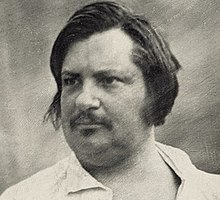
ACHIEVEMENTS: Major French novelist
NICKNAME/ALIAS: None.
DATE AND PLACE OF BIRTH: 20th May 1799, Tours, France.
DATE/PLACE OF DEATH/AGE AT DEATH: 18th August 1850, Paris, France. Aged 51.
DISCIPLINE: Novelist
FIELD: Literature.
LANGUAGE: French.
EDUCATION: College des Oratoriens, Vendome, secondary education in Paris, then University of Paris.
MAJOR WORK: "The Human Comedy" collection.
LIFE AND TIMES:
Balzac’s mother became fascinated by the philosophy of August Swedenborg and was involved with mesmerism and occultism. The family moved to Paris in 1814, and Balzac studied law at the University of Paris. He read Lavater*, the Swiss poet and physiognomist, a mystic who claimed it was possible to divine the soul in the details of the human face. He also studied Cuvier* (the naturalist working on the classification of mammals) who triggered Balzac's conviction that human beings could be classified as social animals.
After giving up the law in 1819, in an effort to earn money, he took a job as tutor to the de Berny children. He was twenty-three years old and soon had begun an affair with their mother, who remained devoted to him for the rest of her life. In 1825, he became a publisher. At the same time he started another of his many relationships, this time with the Duchess of Abrantes, who had asked him to help write her memoirs. By 1828, he was on the verge of bankruptcy and was left with debts that dogged him for the rest of his life. With money from his mother, he bought a small house just outside Paris. Balzac was now anxious to write something more important. Influenced by Sir Walter Scott*, he decided on a historical subject and chose the Brittany Royalist insurrection of 1799. To get the feel of the area, he went to stay in Brittany with General de Pommereul and his wife in their chateau. This resulted in his successful historical novel, "Les Chouans" which was published in 1829, the first novel he published under his own name.
"The Physiology of Marriage", published in the same year and written at speed in response to a publisher's advance, was a satirical essay on fidelity, which was much talked about. Women readers in particular loved it and many of them wrote to him. In 1831, worn out by work and socializing, he went to Tours, where he wrote a fantasy called "La Peau de Chagrin" in which a poor young student buys a magic skin that will grant his wildest desires. The huge response was, in particular, from women, among them the beautiful Marquise de Castries, who introduced him to her friends. He joined her on a trip to Italy. The relationship ended, however, in Geneva, probably when Balzac mistook the situation and made advances.
Another admirer wrote to him from Odessa, at first under a false name. Eveline Hanska was a Polish countess married to a much older Ukrainian landowner. The mystical, fantastic side of "La Peau de Chagrin" strongly appealed to Eveline and she and Balzac started an intense correspondence. In 1833, she finally met him in Switzerland with her husband and Balzac easily charmed them both. Eveline and he agreed to marry when she became free. Thereafter their relationship was conducted mostly through letters, with occasional meetings in Switzerland and Austria. The possibility of marriage with Eveline became the motive for Balzac's long hours of work and he wrote even more compulsively. His novels during 1833 included "Eugenie Grandet", which became a best seller and was translated by Dostoievsky*, "The Country Doctor" and "The Illustrious Gaudissart". His novel "Le Pere Goriot", of 1835, is considered to be one of his best works.
In 1834-35, he wrote "Seraphina", a mystical work, which he dedicated to Eveline Hanska. He wrote short stories, novels, trilogies and between 1832 and 1837, he published three sets of "Droll Stories", written in the sixteenth century style of Rabelais. His extravagant life style continued, and included a dinner party for the composer, Rossini*, for which he had his dining room specially re-decorated. Balzac was now nearing forty and he was exhausting himself. He had three addresses in Paris, all of them watched by creditors. He stayed with the novelist Georges Sand* at Nohant and got her permission to use the story of how the composer Franz Liszt left her for another woman. He wrote the story in his novel "Beatrix". Balzac met Georges Sand many times in Paris in the company of her lover, Chopin*, whose music Balzac disliked.
In 1840, he decided on the title for his grand project of collecting and classifying all his books to present a complete picture of contemporary life. A friend returning from Italy who had been reading Dante’s "Divine Comedy" suggested the title "The Human Comedy". He selected three main categories for his novels, "Analytic Studies", "Philosophical Studies" and "Studies of Manners". The first dealt with the basic laws that direct human life and society, the second explored the imperatives of human behaviour, and the third revealed the effect of those imperatives. The observations he made were sub-divided into six categories of life, provincial, private, Parisian, political, military and country. In all, "The Human Comedy" eventually encompassed 70 novels and more than two thousand characters. Each book stood alone and Balzac used the device of a recurring character, shown in youth, middle and old age, living out his life according to the course dictated by his character, surroundings and circumstances. Proust* used this approach as a model for his own work.
Balzac found a publisher who gave him an advance. Although he had written so much already, the project involved adding four new books a year and a vast number of revisions to those already published. The volume of novels grew and in 1841, his most significant works were "A Shady Business", "The Black Sheep", and "Ursule Mirouet".
In 1842, Balzac heard that Eveline Hanska's husband had died and he thought that they would now marry. Eveline, however, refused him. His health was failing but he continued to produce more books, among them one of his greatest works, "A Harlot High and Low". He continued to meet Eveline and, in 1845, they travelled together in Belgium, Holland and France, but she still held back from commitment.
His last two masterpieces, "Cousin Bette" and "Cousin Pons" were written in 1847. In the autumn of that year he visited Eveline at her estate in Russia and remained there until February 1848. He returned eight months later and stayed until 1850, by which time he was dying. In March 1850, Eveline finally agreed to marry him. After the wedding in Ukraine, they returned to Paris, where Balzac died in August, Hugo* making a speech at his funeral. His work influences many including Baudelaire*, Berlioz*, and Flaubert*
ASSESSMENT: Balzac presented a unique picture of contemporary life and influenced the development of the novel.
EXTRA CONNECTIONS: Knew De Musset*
Met Tallyrand*
Was painted by Cormon*
Admired the work of Samuel Richardson*
Dumas pere* staged his work
Had dinners with Vidoq*
Influenced Stendhal*
In La Peau du Chagrin, he used physiologist Magendie* as a role model
ONELINER: Honore de Balzac, influential French novelist
BIBLIOGRAPHY:
Pritchett, V S,Balzac, Hogarth Press, London, 1992.
PARENTS: Father, Bernard-Francois Balzac, mother, Anne Laure.
SIBLINGS: l sister: Laure.
SPOUSE: Eveline Hanska.
CHILDREN: None.