Lazarus, Emma
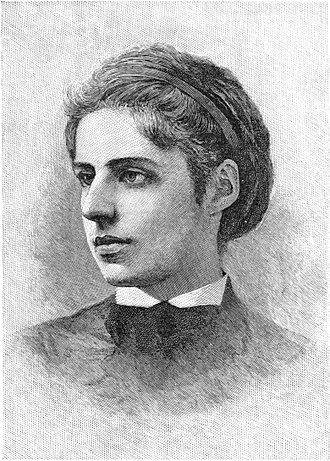
ACHIEVEMENT(S): Statue of Liberty poem
DATE AND PLACE OF BIRTH: July 22, 1849, New York, NY
DATE/PLACE OF DEATH/AGE AT DEATH: November 19, 1887, New York; NY. Aged 38
DISCIPLINE: Poet/Essayist
FIELD: Literature
LANGUAGE: English
EDUCATION: Private tutors
MAJOR WORK: "The New Colossus", dedicated to the Statue of Liberty
LIFE AND TIMES:
Encouraged in her poetry by her father, Lazarus's first volume of verse was privately printed in 1866, when she was 17, and commercially published a year later. In 1868, she met Emerson* and sent him a copy of her book together with some recent poems. Emerson replied encouragingly and the two kept up a correspondence for many years. Lazarus regarded him as a mentor.
In 1871, Lazarus published a second volume of poetry, "Admetus, and Other Poems", which received critical praise in both the United States and England. In 1874, she published her only novel, "Alide: An Episode of Goethe's Life", an adaptation of the German writer's autobiography. This book was also highly praised, in particular by the Russian novelistTurgenev*.
Throughout the 1870’s, still in her 20’s, Lazarus contributed poems to magazines such as "Scribner's", and by 1882, more than 50 of her poems and translations had appeared in mainstream periodicals. In 1876, she finished an intense poetic drama, "The Spagnoletto", which was privately published and never performed. In the 1870’s, Lazarus began to develop an interest in Jewish traditions. She translated many works of the German-Jewish poet Heinrich Heine and the medieval Jewish poets of Spain. She began to study Hebrew, and wrote some poems on Jewish subjects.
Her attitude underwent a dramatic transformation in the early 1880’s when the killing of Alexander II of Russia triggered an outburst of Jewish persecution in Eastern Europe and a mass exodus of Eastern European Jews to the United States. After attending a New York protest rally where former Secretary of State William M. Evarts attacked the Russian pogroms, she began to passionately use her gifts as poet and political essayist to defend the Jewish cause.
Her polemical writing began in April, 1882, after the magazine "Century" published an article by a Russian journalist that attacked Jews and defended the pogroms. Lazarus's outraged response was "Russian Christianity versus Modern Judaism", published in the next edition of "Century". She wrote a second strong piece for "Century" in February, 1883, and a series of 14 essays, called "Epistle to the Hebrews", published in Philip Cowen's "American Hebrew". Anticipating by more than a decade the modern Zionist movement, she advocated a national Jewish homeland in Palestine and urged American Jews to support their Eastern European brethren who were migrating to the United States.
A year earlier, in 1882, the "American Hebrew" had published in serial form Lazarus's blank-verse drama, "The Dance to Death", which described the heroism of the condemned Thuringian Jews of 1349. (Later, Lazarus dedicated the play to English author George Eliot*) Cowen republished the play later that year in a book, "Songs of a Semite", which also included her translations of several ancient Hebrew poems. The book was a popular success.
Convinced it was now time "for actions rather than words", Lazarus visited Russian Jewish refugees on Ward's Island, and became an active member of the Hebrew Immigrant Aid Society, helping new immigrants resettle. Realizing that both agricultural opportunities and vocational training were needed for the Russian Jews pouring into New York, she played a central role in the founding of New York's Hebrew Technical Institute, and, in 1883, formed the Society for the Improvement and Colonization of East European Jews, which disbanded after a year.
In the summer of 1883, Lazarus sailed to Europe to gather support for a Jewish national homeland. She met British politicians, including Balfour*, the leaders of the European Jewish community, as well as Robert Browning*, Henry James* and William Morris*.
Also in 1883 Lazarus was asked to write a poem for a fundraising art auction in aid of the Statue of Liberty* Pedestal Fund. Unwillingly to write to order, Lazarus agreed only when she was reminded of "Russian refugees as recipients of the light of the torch", and the result was the famous sonnet, "The New Colossus", which was engraved on a bronze plaque and fixed to the statue's pedestal in 1903 in her memory. Its concluding lines have become familiar to generations:
"Give me your tired, your poor,
Your huddled masses yearning to breathe free,
The wretched refuse of your teeming shore.
Send these, the homeless, tempest-tost to me,
I lift my lamp beside the golden door!"
In 1885, Lazarus returned to Europe for an extended tour, but it soon became clear she was seriously ill. Returning to New York in July, 1887, she died in November, either of Hodgkin's disease or cancer, at 38.
ASSESSMENT: A decade before Hertzl* coined the word "Zionism", she was calling for a Jewish homeland in Palestine.
She collaborated with Oliphant*
ONELINER: Emma Lazarus, author of the Statue of Liberty poem
EXTRA CONNECTIONS:
The first stimulus for Lazarus's writing was offered by the American Civil War. A collection of her Poems and Translations, verses written between the ages of fourteen and seventeen, appeared in 1867 (New York), and was commended by William Cullen Bryant; It included translations from Friedrich Schiller, Heinrich Heine, Alexandre Dumas, and Victor Hugo.[8][6] Admetus and Other Poems followed in 1871. The title poem was dedicated "To my friend Ralph Waldo Emerson", whose works and personality were exercising an abiding influence upon the poet's intellectual growth.
BIBLIOGRAPHY:
EB
American National Dictionary of Biography
Vogel, Daniel, Emma Lazarus, New York: Twayne Publishers, 1980
PARENTS: Moses Lazarus; Esther Nathan
SIBLINGS: Six, of whom: Josephine (writer and speaker)
SPOUSE: None
CHILDREN: None