Avogadro 2
See main node
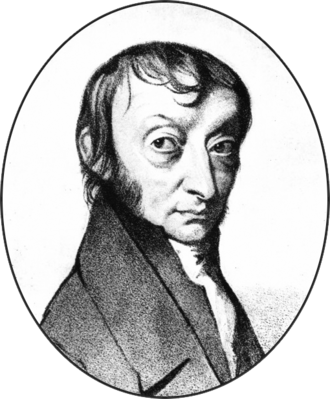
Lorenzo Romano Amedeo Carlo Avogadro, Count of Quaregna and Cerreto[1] (/ˌævəˈɡɑːdroʊ/,[2] also US: /ˌɑːv-/,[3][4][5] Italian: [ameˈdɛːo avoˈɡaːdro]; 9 August 1776 – 9 July 1856) was an Italian scientist, most noted for his contribution to molecular theory now known as Avogadro's law, which states that equal volumes of gases under the same conditions of temperature and pressure will contain equal numbers of molecules. In tribute to him, the ratio of the number of elementary entities (atoms, molecules, ions or other particles) in a substance to its amount of substance (the latter having the unit mole), 6.02214076×10²³ mol−1, is known as the Avogadro constant. This constant is denoted NA, and is one of the seven defining constants of the SI.
Biography
Amedeo Avogadro was born in Turin to a noble family of the Kingdom of Sardinia (now part of Italy) in the year 1776. He graduated in ecclesiastical law at the late age of 20 and began to practice. Soon after, he dedicated himself to physics and mathematics (then called positive philosophy),[6] and in 1809 started teaching them at a liceo (high school) in Vercelli, where his family lived and had some property.
In 1811, he published an article with the title Essai d'une manière de déterminer les masses relatives des molécules élémentaires des corps, et les proportions selon lesquelles elles entrent dans ces combinaisons ("Essay on a manner of Determining the Relative Masses of the Elementary Molecules of Bodies and the Proportions by Which They Enter These Combinations"), which contains Avogadro's hypothesis. Avogadro submitted this essay to Jean-Claude Delamétherie's Journal de Physique, de Chimie et d'Histoire naturelle ("Journal of Physics, Chemistry and Natural History").
In 1820, he became a professor of physics at the University of Turin. Turin was now the capital of the restored Savoyard Kingdom of Sardinia under Victor Emmanuel I. Avogadro was active in the revolutionary movement of March 1821. As a result, he lost his chair in 1823 (or, as the university officially declared, it was "very glad to allow this interesting scientist to take a rest from heavy teaching duties, in order to be able to give better attention to his researches"). Eventually, King Charles Albert granted a Constitution (Statuto Albertino) in 1848. Well before this, Avogadro had been recalled to the university in Turin in 1833, where he taught for another twenty years.
Little is known about Avogadro's private life, which appears to have been sober and religious. He married Felicita Mazzé and had six children.[dubious ^–^ discuss] Avogadro held posts dealing with statistics, meteorology, and weights and measures (he introduced the metric system into Piedmont) and was a member of the Royal Superior Council on Public Instruction.
He died on 9 July 1856.
Accomplishments
In honor of Avogadro's contributions to molecular theory, the number of molecules per mole of substance is named the Avogadro constant, NA. It is exactly 6.02214076×10²³ mol−1.[7]^ The Avogadro constant is used to compute the results of chemical reactions. It allows chemists to determine the amounts of substances produced in a given reaction to a great degree of accuracy.
Johann Josef Loschmidt first calculated the value of the Avogadro constant, the number of particles in one mole, sometimes referred to as the Loschmidt number in German-speaking countries (Loschmidt constant now has another meaning).
Avogadro's law states that the relationship between the masses of the same volume of all gases (at the same temperature and pressure) corresponds to the relationship between their respective molecular weights. Hence, the relative molecular mass of a gas can be calculated from the mass of a sample of known volume.
Avogadro developed this hypothesis after Joseph Louis Gay-Lussac published his law on volumes (and combining gases) in 1808. The greatest problem Avogadro had to resolve was the confusion at that time regarding atoms and molecules. One of his most important contributions was clearly distinguishing one from the other, stating that gases are composed of molecules, and these molecules are composed of atoms. (For instance, John Dalton did not consider this possibility.) Avogadro did not actually use the word "atom" as the words "atom" and "molecule" were used almost without difference. He believed that there were three kinds of "molecules", including an "elementary molecule" (our "atom"). Also, he gave more attention to the definition of mass, as distinguished from weight.
In 1815, he published Mémoire sur les masses relatives des molécules des corps simples, ou densités présumées de leur gaz, et sur la constitution de quelques-uns de leur composés, pour servir de suite à l'Essai sur le même sujet, publié dans le Journal de Physique, juillet 1811 ("Note on the Relative Masses of Elementary Molecules, or Suggested Densities of Their Gases, and on the Constituents of Some of Their Compounds, As a Follow-up to the Essay on the Same Subject, Published in the Journal of Physics, July 1811") about gas densities.
In 1821 he published another paper, Nouvelles considérations sur la théorie des proportions déterminées dans les combinaisons, et sur la détermination des masses des molécules des corps (New Considerations on the Theory of Proportions Determined in Combinations, and on Determination of the Masses of Atoms) and shortly afterwards, Mémoire sur la manière de ramener les composès organiques aux lois ordinaires des proportions déterminées ("Note on the Manner of Finding the Organic Composition by the Ordinary Laws of Determined Proportions").
In 1841, he published his work in Fisica dei corpi ponderabili, ossia Trattato della costituzione materiale de' corpi, 4 volumes.
Response to the theory
The scientific community did not give great attention to Avogadro's theory, and it was not immediately accepted. André-Marie Ampère proposed a very similar theory three years later (in his Sur la détermination des proportions dans lesquelles les corps se combinent d'après le nombre et la disposition respective des molécules dont leurs particules intégrantes sont composées; "On the Determination of Proportions in which Bodies Combine According to the Number and the Respective Disposition of the Molecules by Which Their Integral Particles Are Made"), but the same indifference was shown to his theory as well.
Only through studies by Charles Frédéric Gerhardt and Auguste Laurent on organic chemistry was it possible to demonstrate that Avogadro's law explained why the same quantities of molecules in a gas have the same volume.
Unfortunately, related experiments with some inorganic substances showed seeming contradictions. This was finally resolved by Stanislao Cannizzaro, as announced at Karlsruhe Congress in 1860, four years after Avogadro's death. He explained that these exceptions were due to molecular dissociations at certain temperatures, and that Avogadro's law determined not only molecular masses, but atomic masses as well.
In 1911, a meeting in Turin commemorated the hundredth anniversary of the publication of Avogadro's classic 1811 paper. King Victor Emmanuel III attended, and Avogadro's great contribution to chemistry was recognized.
Rudolf Clausius, with his kinetic theory on gases proposed in 1857, provided further evidence for Avogadro's law. Jacobus Henricus van 't Hoff showed that Avogadro's theory also held in dilute solutions.
Avogadro is hailed as a founder of the atomic-molecular theory.
See also
- Avogadrite (mineral)
- Avogadro (lunar crater)
References...
Knowledge Web Content (See main node)
Nickname/Alias: Conte de Quaregna
Achievements: One of the founders of physical chemistry.
Born: August 9, 1776; Turin, Italy
Died: July 9, 1856; Turin, Italy (Aged 79)
Field & Discipline: Chemistry
Language: Italian
Education: Grammar school, Turin; University of Turin (1792-97)
Major Work: “Essai d'une maniere de determiner les masses relatives des molecules elementaires des corps . . .” (1811)
Life & Times:
In 1792, Avogadro entered the Faculty of Law of the University of Turin, where he spent the next three years, receiving a degree in jurisprudence in 1795 and the title of Doctor of Canon Law the following year. In 1800, Avogadro had begun to take private lessons in mathematics and physics. He made impressive progress and decided to make the natural sciences his vocation. He was possibly inspired by the recent discoveries by his compatriot [inspired by] Volta*, since the first scientific research he undertook, in 1803, together with his brother Felice, was into electricity.
In 1806, at the time his first essay on electricity was published in France, Avogadro left his administrative position with the government to begin a teaching career. His first job was as demonstrator at the “Collegio delle Province”, a boarding school attached to the University of Turin. Then, on 7th October 1809, Avogadro became professor of natural philosophy (mathematics and physics,) at the College of Vercelli, where he spent the next eleven years.
In 1809, [published by] De la Mettrie* published, in the “Journal de Physique”, a six-page paper by Avogadro on the concepts of alkalinity and acidity, and then in July 1811, Avogadro’s most famous work appeared in the same journal, titled “A way of determining relative mass of elementary particles,” in the same issue as a long article by the great chemist [work related to] Berzelius*.
In 1809, [work related to] Gay-Lussac* had discovered that all gases, when subjected to an equal rise in temperature, expand by the same amount. In his essay of 1811, Avogadro deduced that at a given temperature all gases must therefore contain the same number of particles per unit volume. This idea had been considered by others at the time, including [work related to] Dalton*, but then rejected, because it implied the concept of a divisibility of elementary particles which appeared to make no sense.
Resorting to what has been called “Avogadro's Hypothesis”, he proposed the existence of two orders of particles at the elementary level, these being atoms and molecules. This assumption applied to both solids, when in the form of vapors and gaseous elements. From the “equal volumes, equal numbers” generalization, Avogadro offered chemists a way to determine the relative weights of the elements and their compounds, regardless of their physical state and chemical composition.
No previous scientist had made this distinction between the atoms of a substance and its molecules. Using his hypothesis, Avogadro explained the simple combining ratios of gases found by Gay-Lussac, by showing that under the same physical conditions, equal volumes of gases contained the same number of particles. It had already been seen that the electrolysis of water, to form hydrogen and oxygen, produced twice as much hydrogen, by volume, as oxygen. Avogadro reckoned that each molecule of water must contain hydrogen and oxygen atoms in the proportion of 2 to 1.
Also, because the oxygen collected weighed 8 times as much as the hydrogen, the oxygen atoms present must be 16 times as heavy as the hydrogen atoms. It also followed from Avogadro's hypothesis that a molar volume of any substance, the volume whose mass is one gram of molecular weight, contains the same number of molecules. This quantity, now known as Avogadro's Number, or Constant, is equal to 6.02252 x 10²³.
For Avogadro, between 1811 and his appointment at the University of Turin in 1820 was a productive scientific period, during which he published 12 essays and articles. For the next six years Avogadro turned his attention to the study of the physical behaviour of gases and vapours. This was the beginning of twenty years of work on the problem of specific heats of bodies in their three states and on many attempts to correlate them with other physical and chemical characteristics. In the last year of his stay in Vercelli, the Royal Academy of Sciences made Avogadro a permanent member.
A few months after his appointment in Turin, Avogadro read an extensive paper to the Turin Academy of Sciences, the 160-page long Nouvelles considerations sur la theorie des proportions determinees dans les combinaisons et sur la determination des masses des molecules des corps, in which he clearly reasserted the “equal volumes, equal numbers” generalization, stressing its superiority over the use of chemical equivalents as a precise method to determine the weights of chemical elements and compounds.
Political changes of 1821 led to the suppression of his chair, along with several others, and Avogadro lost his position in 1822. After 1832, the number of Avogadro's publications declined, as he was devoting most of his time to gathering material for the preparation of his most extensive work, the four-volume “The Physics of Heavy Bodies”, published between 1837 and 1841. This treatise was devoted to the study of the constitution of heavy ordinary bodies, the nature of molecules, the nature of molecular forces and how physical states could be interpreted in terms of these forces.
In the early 1840s, Avogadro turned his attention to two totally unrelated fields of research. The first resulted in a mathematical analysis of the dielectric, published in 1844 and the second on a clearer method for classifying and designating chemical compounds. In the last years of his scientific career Avogadro turned to the study of atomic volumes. Between 1846 and 1852, he published four articles on the subject in the “Memoires” of the Academy of Turin.
An 1853 paper to the Royal Academy of Sciences of Turin (the last of Avogadro's many contributions) was a 70-page analysis of Regnault*'s recent series of observations on the behaviour of gases subject to different degrees of compression. Avogadro died in Turin. Two years after his death, his fellow Italian [work related to] Cannizzaro* showed how the application of Avogadro's hypothesis could solve many of the major problems in chemistry. At the Karlsruhe Chemical Congress of 1860, Avogadro's 1811 paper was read again to a much wider and more receptive audience of distinguished scientists.
Extra Connections: His work related to that of [work related to] Berthollet*
Assessment: Principally remembered for the hypothesis, subsequently known as Avogadro's Law, stating that, at a given temperature, equal volumes of all gases contain the same number of molecules.
Oneliner: Amedeo Avogadro, chemist and discoverer of Avogadro’s number
Bibliography:
- Abbot, David (ed.), The Biographical Dictionary of Chemists', Blond Educational: London, 1983.
- Morselli, Mario, Amedeo Avogadro, Dordrecht & Boston: D. Reidel Publishing Co., 1984.
Father: Count Filippo Avogadro
Mother: Anna Maria Vercellone
Siblings: Felice; Lorenzo; Luigi
Spouse: Felicita Mazzia (m. 1815)
Children: 7 children