Dalton, John
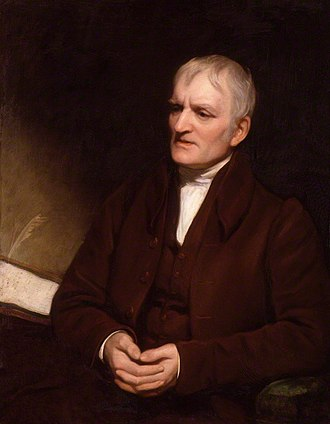
Name: John Dalton
Achievements: Atomic theory of matter
Born: September 6, 1766; Eaglesfield, Cumbria, England
Died: July 27, 1844; Manchester, England (Aged 77)
Field & Discipline: Science; Chemistry; Physics
Language: English
Father: Joseph Dalton
Mother: Deborah Greenup
Siblings: Five, of whom: Jonathan; Mary
Spouse: None
Children: None
Education: Pardshaw Hall Quaker School
Major Work:
"New System of Chemical Philosophy"
Life & Times:
After two years teaching, during which time Dalton was tutored by the Quaker naturalist Elihu Robinson, he worked as a farm laborer for a year, and then accepted a teaching job at the new Quaker-sponsored school in Kendal, where he remained for 12 years (1781-1793.)
The school, whose benefactors included entrepreneurs such as [benefactor was] Darby*, was equipped by the Quakers and boasted an extensive library, which included the works [studied] Newton*, and scientific equipment, which offered a stimulating atmosphere to the young Dalton. Lectures were also given by itinerant scientists.
One Kendal resident who particularly influenced Dalton was the blind philosopher [taught by] Gough*, (who is mentioned in [a fan was] Wordsworth*'s poem "The Excursion.”) Recognizing Dalton's talent, Gough tutored him in mathematics, literature, languages, and botany and encouraged him to investigate meteorology. In 1787, Dalton began a meteorological diary that he kept for 57 years. It eventually contained 200,000 observations.
In 1792, Dalton was appointed professor of mathematics and natural philosophy in "New College" in Manchester, established by the Presbyterians for free-church “Dissenters.” The school opened shortly after [work related to] Joseph Priestley*'s nearby Warrington Academy for Dissenters had closed. It offered a first-class education to both laymen and candidates for the ministry (Cambridge and Oxford Universities were open only to members of the Church of England.)
While in Manchester, Dalton began to study the phenomenon of color-blindness, which afflicted himself and his brother, Jonathan. In 1793, he made the first systematic study of red-green color-blindness, outlining his results in an essay: "Extraordinary Facts Relating to the Vision of Colours,” which he presented to the Manchester Literary and Philosophical Society in 1794. His study suggested that deficiency in color perception was caused by discoloration of the liquid medium of the eyeball.
After 1794, Dalton read the results of all his research to the Philosophical Society. Most subjects dealt with aspects of meteorology -- the barometer, thermometer, hygrometer, rainfall, the formation of clouds, and the evaporation and the distribution and character of atmospheric moisture, including the concept of the dew point. He was the first to confirm that rain is caused by a fall in temperature, and he determined that the density of water varies with temperature.
In 1800, Dalton resigned from New College to become secretary of the Manchester Literary and Philosophical Society and to work as a public and private teacher of mathematics and chemistry. Within five years, he had completed an outline of the work that would ensure his scientific reputation.
Dalton began by investigating the composition and behavior of gases. Having established that air is a mixture, not a compound, Dalton proved that in a mixture of gases, each gas acts independently of the other. In 1803, this finding led to the law of partial pressures, now known as Dalton's law, which states that in a mixture of gases, the total pressure is the sum of the pressures that each component would exert if it alone occupied the same volume.
Believing that this could be explained only by the behavior of atoms or "particles of matter,” he concluded that the solubility of a gas depends on the weight of its atoms, and went on to study the variation of a gas volume with temperature. Finding that gas at constant pressure expands 1/480 for each degree Fahrenheit, he concluded (independently of [co-discoverer with] Gay-Lussac*) that all gases have the same coefficient of thermal expansion (the law of gaseous expansion at constant pressure, according to which gas expands as it rises in temperature).
Dalton's work on gases led him to formulate his atomic theory. He concluded that gases must be made up of particles that occupy spaces between the particles that make up water, and that in a mixture of gases the different particles must intermingle rather than separate into layers, depending on their density, or weight.
He became convinced that the nature of mixed gases could be understood only by reference to atoms, and decided to use atomic weight as a practicable way of comparing individual atoms, theorizing that these weights should be evident from the relative weights of the elements that combine into well-known chemical compounds.
The hypothesis led him to express relative atomic weights of elements in multiples of the weight of one element -- hydrogen (the lightest known element) -- and then to calculate a table of relative weights. He published the table in 1805 and later included it in his famous book, "A New System of Chemical Philosophy" (1808). Although many of Dalton's atomic weights (not to be confused with equivalent weights) were incorrect, he established a pattern that for the first time introduced order to the science.
Essentially, Dalton's atomic theory stated that: i) matter cannot be subdivided indefinitely because each element consists of indivisible particles called atoms; ii) the atoms of the same element are alike in every respect, having the same weight (mass), volume and chemical properties; iii) atoms of different elements have different properties; iv) in chemical combinations of different elements, atoms join together to form compound atoms (now called molecules).
Dalton's formula for water -- one hydrogen atom combined with one oxygen atom -- was wrong, but he was correct for carbon monoxide ("carbonic oxide") and carbon dioxide ("carbonic acid,” discovered by [work related to] Black*).
To Dalton, the atom was a material core of individual weight and size for individual elements, surrounded by an atmosphere of heat, which he regarded as material but weightless. He never appreciated the difference between atoms and molecules of elements.
Dalton's atomic theory was the most significant development in chemistry since the findings of the French chemist [developed the work of] Lavoisier*. In response to Dalton's work, Swedish chemist [corresponded with] Berzelius* began a series of experiments to determine accurately the relative weights of atoms.
Berzelius was to replace Dalton's system with the chemical symbols still used today. Other 19th century chemists whose investigations resolved many of the methodological problems in Dalton's work included [work improved on by] Gay-Lussac*, [work improved on by [Avogadro*, [work improved on by] Cannizzaro* and [work improved on by] Mendeleyev*.
In 1803, Dalton gave a course of lectures at the Royal Institution in London, where he met [met] Davy*, [met] Wollaston*, [met] Cavendish* and [met] Banks*. In 1817, he became President of the Manchester Philosophical Society.
In 1822, he was elected to the Royal Society and to the French Academie des Sciences. When he traveled to Paris that year, he was introduced to [met] Laplace*, [met] Berthollet*, Gay-Lussac, [met] Thenard*, [met] Arago*, [met] Biot*, [met] Alexander von Humboldt*, [met] Cuvier*, and [met] AM Ampere*. In 1833, thanks to the efforts of [helped by] Babbage*, and others, he was awarded a government pension. His most successful pupil was the English physicist [taught] Joule*.
Extra Connections:
When elected to the Manchester Literary and Philosophical Society, he was sponsored by [sponsored by] Percival* and [sponsored by] Robert Owen*.
His work related to that of [work related to] Leibniz*, and [work related to] Sturgeon*.
He was a family friend of [family friend of] William Henry*
Assessment: One of the founders of atomic theory
Oneliner: John Dalton, English founder of atomic theory
Bibliography:
- Dictionary of National Biography.
- Dictionary of Scientific Biography.
- Encyclopedia Britannica.
- Greenaway, Frank, John Dalton and the Atom, London: Heinemann, 1966.