Franz Joseph Emp

ACHIEVEMENT(S): His ultimatum to Serbia led to World War I
NICKNAME/ALIAS: Francis Joseph I
DATE AND PLACE OF BIRTH: August 18, 1830, Vienna, Austria.
DATE/PLACE OF DEATH/AGE AT DEATH: November 21, 1916, Vienna, Austria. Aged 86.
DISCIPLINE: Austro-Hungarian Emperor
FIELD: Royalty
LANGUAGE: German
PARENTS: Archduke Francis Charles of Austria; Sophie of Bavaria
SIBLINGS: Ferdinand-Joseph Maximilian, Emperor of Mexico; Louis Victor
SPOUSE: Elisabeth of Bavaria (first cousin. assassinated)
CHILDREN: Archduke Rudolf (commited suicide at age 31)
anne
EDUCATION: Royal tutors
MAJOR WORK : N/A
LIFE AND TIMES:
When he was 18, Franz Josef was sent to serve with the Austrian forces in Italy, where Lombardy-Venetia, supported by King Charles Albert of Sardinia, had rebelled against Austrian rule. This crisis for the Habsburg monarchy resulted in revolution, which spread to the capitals of the Austrian Empire. Emperor Ferdinand abdicated, Franz Josef's father, the Archduke, was passed over, and Franz Josef, still only 18, was proclaimed Emperor of Austria at Olmutz (Olomouc).
During the first 10 years of his reign he established himself as a conservative ruler, running foreign policy (having been taught in his youth by Austrian Foreign Minister Metternich*), and making strategic domestic political decisions. His main advisers were Prince Schwarzenberg (prime minister and foreign minister 1848-52), Leo, Graf von Thun, and Alexander, Freiherr von Bach. Schwarzenberg, an expert in international affairs, achieved a powerful position for Austria, particularly after the Olmutz convention of 1850, in which Austria gained predominance over Prussia in Germany.
At home, Schwarzenberg subdued the Hungarian revolt and pacified Lombardy, but his rule was harsh. He established a massively complex bureaucratic system and developed an oppressive police force, creating mood of rebellion. When the government in 1851 withdrew its 1849 promise of a constitution, the unrest became keener and more threatening. After Schwarzenberg's death in 1852, Franz Josef decided not to replace him as prime minister but to play a greater part in politics himself. In 1859, army expenditure had to be severely cut just when the military was engaged in a series of ill-fated wars: in particular, the 1859 war against the Kingdoms of Piedmont (led by Cavour*) and Sardinia and the Empire of France. Austria's military reputation abroad was in decline and at home harsh police methods were causing great discontent.
After the humiliating 1859 defeat, Franz Josef decided to allow some form of constitutional experiment. As a result the country was in a constant state of crisis until 1867. Meanwhile, the question of predominance in Germany loomed large. In 1863, the King of Prussia chose to absent himself from a congress of princes at Frankfurt, attended by the heads of all German states. The Prussian king's absence was a sign to Austria that Prussia no longer regarded Austria as the leading German power.
In 1864, desperately seeking a remedy, Franz Josef entered into a comradeship-in-arms with Prussia in a war against Denmark. But after their victory, conflicts again arose, and war between Austria and Prussia became inevitable. In the midst of these crises, relations with Italy became seriously strained. In April, 1866, Italy aligned itself with Prussia. In June, Austria, an agreement with Napoleon III* of France persuaded Italy to remain neutral in any Austria-Prussia war. In return for neutrality, Austrian possessions in Italy would be given to the Kingdom of Sardinia, regardless of the outcome of the war.
After Austria's defeat by Bismarck's* Prussia, Franz Josef, keen to restore order within his empire, made a compromise with Hungary in 1867, in which an "Imperial and Royal Dual Monarchy" was created. Austria and Hungary now coexisted in equal partnership. While the compromise gave the Hungarians considerable leverage to extend their influence, the losers were the Slavs. The Bohemians (Czechs) and Poles, did not share in the privileged position of the German-Austrians in the Austrian, or Western, half of the empire, while the Croats, Slovaks, and South Slavs had none of the prerogatives enjoyed by the Hungarians in the Hungarian, or Eastern, half. Thus, virtually overnight, Franz Josef's multinational empire had violated its own law of the basic equality of all national groups, and each country's individual relationship to the Emperor was now replaced by the submission of the various nationalities to German-Austrian or Hungarian overlordship.
Unrest continued and intensified when a final attempt at reform (in which the Slavic languages would have been given equal status with Hungarian and German) was vetoed by Franz Josef, under pressure from German-Austrian nationalists. Bad relations developed between Franz Josef and the Czechs, who had been pressing for many years for recognition and restoration of their ancient rights.
Trouble also developed between the Emperor and the Hungarian-ruled South Slavs in Croatia and Serbia, who after 1867 found themselves subjected to a process of Hungarianization. It was clear that Franz Josef did not understand the importance of nationalities in Austro-Hungarian internal affairs, and, in particular, failed to see how internal affairs were affecting his relationship with Russia and the political situation in the Balkans. In the years after 1878, Franz Josef forged a new Austro-German alliance.
Franz Josef was considered a singular, isolated figure, both abroad and at home, an old-style monarch in a changing world. His only son, Archduke Rudolf, with his outspoken support of liberal causes and his increasingly erratic and scandalous personal life, was a great thorn in Franz Josef's side, but when Rudolf killed himself at age 31 in a suicide pact with a 17-year-old baroness at Mayerling in 1889, Franz Josef was devastated.
Eleven years later, disaster struck again in 1898, the year of Franz Josef's Golden Jubilee, when his wife, the Empress Elisabeth, was assassinated by an Italian anarchist in Geneva. Then, in June, 1914, his nephew and heir-apparent, Franz Ferdinand and his wife were assassinated in Sarajevo by a Bosnian-Serb student, the key event that led to war with Serbia, and then to World War I. Franz Josef spent the first two years of the war at Schonbrunn, where he died.
ASSESSMENT: Toward the end of his life he became a universally revered man, a figure that for all his insufficiencies held together the shambles of his multinational state.
EXTRA CONNECTIONS: Met Ulysses S. Grant* in 1878.
Careme* cooked for him.
He sidelined Hungarian nationalist Kossuth*
He met steel-man CM Schwab*
ONELINER: Franz Josef, Austro-Hungarian Emperor
BIBLIOGRAPHY:
EB
Beller, Steven, Francis Joseph, London & New York: Longman, 1996
Pantheon wife rank 242 Empress Elisabeth of Austria - Wikipedia
Archduke Franz Ferdinand Carl Ludwig Joseph Maria of Austria[a] (18 December 1863 – 28 June 1914) was the heir presumptive to the throne of Austria-Hungary.[1] His assassination in Sarajevo was the most immediate cause of World War I.
Franz Ferdinand was the eldest son of Archduke Karl Ludwig of Austria, the younger brother of Emperor Franz Joseph I of Austria. Following the death of Crown Prince Rudolf in 1889 and the death of Karl Ludwig in 1896, Franz Ferdinand became the heir presumptive to the Austro-Hungarian throne. His courtship of Sophie Chotek, a lady-in-waiting, caused conflict within the imperial household, and their morganatic marriage in 1900 was only allowed after he renounced his descendants' rights to the throne. Franz Ferdinand held significant influence over the military, and in 1913 he was appointed inspector general of the Austro-Hungarian armed forces.
On 28 June 1914, Franz Ferdinand and his wife were assassinated in Sarajevo by the 19-year-old Gavrilo Princip, a member of Young Bosnia. Franz Ferdinand's assassination led to the July Crisis and precipitated Austria-Hungary's declaration of war against Serbia, which in turn triggered a series of events that eventually led – four weeks after his death – to Austria-Hungary's allies and Serbia's allies declaring war on each other, starting World War I.
...
Assassination
Main article: Assassination of Archduke Franz Ferdinand

As described by contemporary Spanish magazine El Mundo Gráfico: "The moment when the Austrian archdukes, following the first attempt against their lives, arrived at the City Council (of Sarajevo), where they were received by the mayor and the municipal corporation."
 Franz Ferdinand's blood-stained uniform

The 1910 Gräf & Stift Bois de Boulogne phaeton automobile in which Archduke Franz Ferdinand and his wife were assassinated. It is now displayed in the Museum of Military History in Vienna
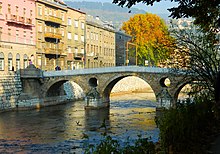
The Latin Bridge near the assassination site
On Sunday, 28 June 1914, at about 10:45 am, Franz Ferdinand and his wife were assassinated in Sarajevo, the capital of the Austro-Hungarian province of Bosnia and Herzegovina. The perpetrator was 19-year-old Gavrilo Princip, a member of Young Bosnia and one of a group of assassins organized and armed by the Black Hand.[4]
Earlier in the day, the couple had been attacked by Nedeljko Čabrinović, also a Young Bosnia conspirator, who had thrown a grenade at their car. However, the bomb detonated behind them, injuring the occupants in the following car. On arriving at the Governor's residence, Franz asked "So you welcome your guests with bombs!"[28]
After a short rest at the Governor's residence, the royal couple insisted on seeing all those who had been injured by the bomb at the local hospital. However, no one told the drivers that the itinerary had been changed. When the error was discovered, the drivers had to turn around. As the cars backed down the street and onto a side street, the line of cars stalled.
At this time, Princip was sitting at a cafe across the street. He instantly seized his opportunity and walked across the street and shot the royal couple.[28] He first shot Sophie in the abdomen and then shot Franz Ferdinand in the neck. Franz leaned over his crying wife. He was still alive when witnesses arrived to render aid.[4] His dying words to Sophie were, "Don't die darling, live for our children."[28]
Princip's weapon was the pocket-sized FN Model 1910 pistol chambered for the .380 ACP cartridge provided him by Serbian Army Military Intelligence Lieutenant-Colonel and Black Hand leader Dragutin Dimitrijević.[29]
Franz Ferdinand's aides attempted to undo his coat but realized they needed scissors to cut it open: the outer lapel had been sewn to the inner front of the jacket for a smoother fit to improve his appearance to the public. Whether or not as a result of this obstacle, his wound could not be attended to in time to save him, and he died within minutes. Sophie also died en route to the hospital....