Mussolini
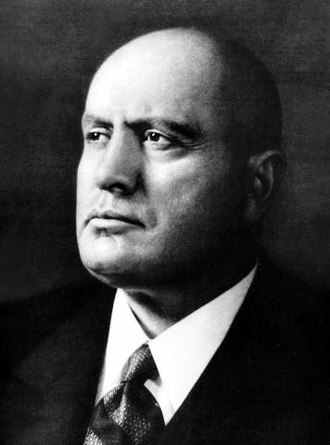
Name: Benito Amilcare Andrea Mussolini
Nickname/Alias: Il Duce (the Leader)
Achievements: Founder of Fascist party
Born: July 29, 1883; Predappio, Italy
Died: April 28. 1945; near Dongo, Italy. Aged 61
Field & Discipline: Government & Politics; Political leader
Language: Italian
Father: Alessandro Mussolini
Mother: Rosa Maltoni
Siblings: Arnaldo; Edvige
Spouse: Rachele Guidi
Children: Vittorio; Bruno; Romano; Edda; Anna Maria
Education: Village school, Predappio; Salesian school, Faenza, Italy; Giosue Carducci, Forlimpopoli, Italy
Life & Times:
After working as a schoolmaster in Italy in his late teens, Mussolini went to Switzerland where he gained the reputation of being a revolutionary and was imprisoned a number of times.
On his return to Italy in 1904, he re-entered radical politics, becoming a journalist and working with trade unions. He founded his own newspaper, "The Class Struggle" and in 1912 was made editor of the main Socialist newspaper: "Avanti". He became known as a firebrand and dangerous Socialist.
He strongly opposed Italy's entry into the First World War I (1914-18) and took a nationalistic stance, resigning his editorship of Avanti, and eventually being expelled from the Socialist party. He did, however, join the army and was wounded.
On his return home, Mussolini began to make speeches stressing the need for a strong, vigorous Italian leader, who would make sweeping social changes. It was clear he meant himself. He appealed to a wide spectrum of discontents, attracting a mix of revolutionaries, republicans, anarchists, and disgruntled Socialists. At a meeting in 1919, about 200 of his supporters adopted the fascist symbol and the black-shirt uniform of the anarchists.
As time went on, the charismatic Mussolini began drawing ever bigger crowds and at one meeting in Naples, addressed 40,000. When a general strike was called in 1922, he announced that if the government did not stop it, the Fascists would. The Fascist militia marched on Rome, King Victor Emmanuel III capitulated, and on October 31, 1922, at 39, Mussolini became the youngest ever Prime Minister of Italy.
Italians who had suffered a divided country, years of strikes, economic crises, and political chaos heartily welcomed Mussolini. Though most of his first cabinet were not Fascists, they agreed that he take dictatorial powers for one year.
After the 1924 elections, the Fascists had a majority in the Italian parliament and Mussolini's power was confirmed. After Socialist politician Giacomo Matteotti questioned the validity of the election results, he was murdered. Mussolini almost certainly was not involved in the killing, but the chance of co-operation with Socialists was lost. Some anti-Fascists went into exile but most were allowed to remain in Italy as long as they kept out of politics.
Under Mussolini, order was restored, Italy was united, and strikes stopped. He brought in government insurance, welfare programs, and ordered housing built for landless laborers in rural areas. In accordance with his belief that everything was subservient to the State, these social reforms were carried out under the firm supervision of the Fascists.
His agenda included making Italy self-sufficient in food production, creating an agricultural population of healthy, contented hard-working peasants, and stopping civil unrest and urban crime. He implemented massive public works programs, including the reclamation of large areas of wastelands such as the malaria-infested Pontine marshes. These policies were all part of his grand design to restore the country to the glory of ancient days.
But over the years, the Fascist party became a haven for the inadequate and the corrupt. The middle class remained content as long as the economy prospered and life went along smoothly. Most of the upper classes enjoyed Mussolini's revival of pomp and ceremony. The poor and those who disagreed had no voice. Abroad, Mussolini was regarded as a benign dictator with almost superhuman power.
He became famous as "the man who made the railways work"; he was praised by writer [a fan was] Shaw* and poet [a fan was] Pound*. [a fan was] Freud* sent him a book inscribed to "the hero of culture", and [a fan was] Gandhi* called him "the savior of Italy".
All this changed in October, 1935, when Mussolini invaded Abyssinia (Ethiopia), encouraged by [collaborated with] Hitler*, with whom he had now become fatally entangled, even though he disliked Hitler and was contemptuous of many Nazis.
Mussolini agonized over becoming a German ally as he watched Hitler's ambitions lead to the Second World War in 1939. Until then, Italy had become the only Western power to threaten Germany after the Nazi invasion of Austria. But in June, 1940, Italy joined the war on Hitler's side.
By 1943, with Mussolini in poor health, his tight rein on the country began to loosen. For the first time in almost 20 years, workers began to go on strike and overt unrest increased. When the Allies invaded Sicily in July, 1943, political opposition to Mussolini came to a head.
The Fascist Grand Council voted to allow the King to take over the military. The next day Mussolini was arrested and imprisoned in the Abruzzi Mountains. In September, he was rescued in a daring raid by German commandos and taken to Munich. Since Italy had capitulated to the allies on September 3, Mussolini set up a new Fascist government, the Salo Republic, in northern Italy. At Hitler's insistence, he ordered the execution of those in the Grand Council who had voted against him, including his son-in-law.
In 1945, as the allies routed the Germans from Italy, Mussolini refused offers of a flight to safety in Switzerland or Spain and retreated to the Valtellina in Northern Italy to try to make a last stand. But he could not rally enough men. With his mistress Claretta Petacci, he attempted to cross the frontier into Austria disguised as a German soldier, but was recognized by the Communist partisans, who killed both him and Petacci. Their bodies were taken to Milan and strung up by the feet in Piazzale Loreto.
Extra Connections: Was publicly supported by [a fan was] Carrel*.
Made [ennobled] Marconi G* a Marquis
He was an admirer of [a fan of] D’Annunzio* and [a fan of] Respighi*
Opposed by [opposed by] JB Priestley*
He gave [gave funeral oration for] Puccini’s* funeral oration
He recruited [recruited to Academy] Fermi* into his Italian Academy
Assessment: Brought about the downfall of Italy and himself by allying with Hitler and entering the Second World War
Oneliner: Benito Mussolini, Fascist Dictator of Italy
Bibliography:
- Joes, Anthony James, Mussolini, Franklin Watts, London, 1982.