Mussolini, B 2
(see main node)
Benito Amilcare Andrea Mussolini (UK: /ˌmʊsəˈliːni, ˌmʌs-/ *MU(U)SS-ə-LEE-nee*, US: /ˌmuːs-/ *MOOSS-*, Italian: [beˈniːto aˈmilkare anˈdrɛːa mussoˈliːni];[1] 29 July 1883 – 28 April 1945) was an Italian dictator and journalist who founded and led the National Fascist Party (PNF). He was Prime Minister of Italy from the March on Rome in 1922 until his deposition in 1943, as well as "Duce" of Italian fascism from the establishment of the Italian Fasces of Combat in 1919 until his summary execution in 1945 by Italian partisans. As dictator of Italy and principal founder of fascism, Mussolini inspired and supported the international spread of fascist movements during the inter-war period.[2][3][4][5][6]
Mussolini was originally a socialist politician and a journalist at the *Avanti!* newspaper. In 1912, he became a member of the National Directorate of the Italian Socialist Party (PSI),[7] but he was expelled from the PSI for advocating military intervention in World War I, in opposition to the party's stance on neutrality. In 1914, Mussolini founded a new newspaper, Il Popolo d'Italia, and served in the Royal Italian Army during the war until he was wounded and discharged in 1917.
Mussolini denounced the PSI, his views now centering on Italian nationalism instead of socialism, and later founded the fascist movement which came to oppose egalitarianism[8] and class conflict, instead advocating "revolutionary nationalism" transcending class lines.[9] On 31 October 1922, following the March on Rome (28–30 October), Mussolini was appointed prime minister by King Victor Emmanuel III, becoming the youngest individual to hold the office up to that time. After removing all political opposition through his secret police and outlawing labor strikes,[10]
Mussolini and his followers consolidated power through a series of laws that transformed the nation into a one-party dictatorship. Within five years, Mussolini had established dictatorial authority by both legal and illegal means and aspired to create a totalitarian state. In 1929, Mussolini signed the Lateran Treaty with the Holy See to establish Vatican City.
Mussolini's foreign policy aimed to expand the Italian possessions and the fascist sphere of influence. In the 1920s, he ordered the Pacification of Libya, instructed the bombing of Corfu over an incident with Greece, established a protectorate over Albania, and incorporated the city of Fiume into the Italian state via agreements with Yugoslavia. In 1936, Ethiopia was conquered following the Second Italo-Ethiopian War and merged into Italian East Africa (AOI) with Eritrea and Somalia. In 1939, Italian forces annexed Albania. ‘’
Between 1936 and 1939, Mussolini ordered the Italian military intervention in Spain in favor of Francisco Franco during the Spanish Civil War. At the same time, Mussolini initially tried to retain the status quo established after World War I by sending troops at the Brenner Pass to delay Anschluss and taking part in the Treaty of Lausanne, the Lytton Report, the Four-Power Pact and the Stresa Front. However, he ultimately alienated the democratic powers following growing opposition to Italy within the League of Nations, which he left in 1937; now hostile to France and Britain, Italy formed the Axis alliance with Germany and Japan.
The wars of the 1930s, although successful, had costed Italy enormous resources, leaving the country unprepared for the upcoming Second World War. Therefore, when Poland was invaded on 1 September 1939, Mussolini declared Italy's non-belligerence. However, on 10 June 1940, believing that Allied defeat was imminent, he decided to join the war on the side of Germany to share the potential spoils of victory. Yet the conflict proved to be far from over; after three years of campaigns in France, East Africa, the Sahara, the Balkans, and the Soviet Union, the tide of the conflict had turned in favour of the Allies.
Following the invasion of Sicily and a motion of no confidence passed by the Grand Council of Fascism, king Victor Emmanuel III dismissed Mussolini as head of government and placed him in custody (25 July 1943). After the king agreed to an armistice with the Allies, on 12 September 1943 Mussolini was rescued from captivity in the Gran Sasso raid by German paratroopers and Waffen-SS commandos led by Major Otto-Harald Mors.
Adolf Hitler, after meeting with the rescued former dictator, then put Mussolini in charge of a puppet state in German-occupied northern Italy, the Italian Social Republic (Italian: Repubblica Sociale Italiana, RSI),[11] informally known as the Salò Republic, which served as a collaborationist regime of the Germans in their fight against the Allies, the Kingdom of Italy, now a co-belligerent of the Allies, and the Italian resistance.
In late April 1945, in the wake of near total defeat, Mussolini and his mistress Clara Petacci attempted to flee to Switzerland,[12] but both were captured by Italian communist partisans and summarily executed by firing squad on 28 April 1945 near Lake Como. The bodies of Mussolini and his mistress were then taken to Milan, where they were hung upside down at a service station to publicly confirm their demise.[13]
- Early life
- Rise to power
- Fascist Italy
- World War II
- Death
- Personal life
- Religious views
- Mussolini's views on antisemitism and race
- Legacy
- Writings
- See also
- References
- Bibliography
Early life

Birthplace of Benito Mussolini in Predappio; the building now hosts exhibitions on contemporary history

Mussolini's father, Alessandro

Mussolini's mother, Rosa
Mussolini was born on 29 July 1883 in Dovia di Predappio, a small town in the province of Forlì in Romagna. Later, during the Fascist era, Predappio was dubbed "Duce's town" and Forlì was called "Duce's city", with pilgrims going to Predappio and Forlì to see the birthplace of Mussolini.
Benito Mussolini's father, Alessandro Mussolini, was a blacksmith and a socialist,[14] while his mother, Rosa (née Maltoni), was a devout Catholic schoolteacher.[15] Given his father's political leanings, Mussolini was named Benito after liberal Mexican president Benito Juárez, while his middle names, Andrea and Amilcare, were for Italian socialists Andrea Costa and Amilcare Cipriani.[16] In return the mother obtained that he be baptised at birth.[15] Benito was the eldest of his parents' three children. His siblings Arnaldo and Edvige followed.[17]
As a young boy, Mussolini would spend some time helping his father in his smithy.[18] Mussolini's early political views were strongly influenced by his father, who idolized 19th-century Italian nationalist figures with humanist tendencies such as Carlo Pisacane, Giuseppe Mazzini, and Giuseppe Garibaldi.[19]
His father's political outlook combined views of anarchist figures such as Carlo Cafiero and Mikhail Bakunin, the military authoritarianism of Garibaldi, and the nationalism of Mazzini. In 1902, at the anniversary of Garibaldi's death, Mussolini made a public speech in praise of the republican nationalist.[20]
Mussolini was sent to a boarding school in Faenza run by Salesian monks.[21] Despite being shy, he often clashed with teachers and fellow boarders due to his proud, grumpy, and violent behavior.[15] During an argument, he injured a classmate with a penknife and was severely punished.[15] After joining a new non-religious school in Forlimpopoli, Mussolini achieved good grades, was appreciated by his teachers despite his violent character, and qualified as an elementary schoolmaster in July 1901.[15][22]
...
Rise to power
Formation of the National Fascist Party
Main articles: Fascism and Italian Fascism
By the time he returned from service in the Allied forces of World War I, very little remained of Mussolini the socialist. Indeed, he was now convinced that socialism as a doctrine had largely been a failure. In 1917 Mussolini got his start in politics with the help of a £100 weekly wage (the equivalent of £7100 as of 2020) from the British security service MI5, to keep anti-war protestors at home and to publish pro-war propaganda.
This help was authorized by Sir Samuel Hoare, who was posted in Italy at a time when Britain feared the unreliability of that ally in the war, and the possibility of the anti-war movement causing factory strikes.[65] In early 1918 Mussolini called for the emergence of a man "ruthless and energetic enough to make a clean sweep" to revive the Italian nation.[66] Much later Mussolini said he felt by 1919 "Socialism as a doctrine was already dead; it continued to exist only as a grudge".[67] On 23 March 1919 Mussolini re-formed the Milan fascio as the Fasci Italiani di Combattimento (Italian Combat Squad), consisting of 200 members.[68]

The platform of Fasci italiani di combattimento, as published in "Il Popolo d'Italia" on 6 June 1919

Italian ethnic regions claimed in the 1930s by the Italian irredentism: * Green: Nice, Ticino and Dalmatia * Red: Malta * Violet: Corsica * Savoy and Corfu were later claimed
The ideological basis for fascism came from a number of sources. Mussolini drew from the works of Plato, Georges Sorel, Nietzsche, and the economic ideas of Vilfredo Pareto, to develop fascism. Mussolini admired Plato's The Republic, which he often read for inspiration.[69]
The Republic expounded a number of ideas that fascism promoted, such as rule by an elite promoting the state as the ultimate end, opposition to democracy, protecting the class system and promoting class collaboration, rejection of egalitarianism, promoting the militarization of a nation by creating a class of warriors, demanding that citizens perform civic duties in the interest of the state, and utilizing state intervention in education to promote the development of warriors and future rulers of the state.[70] Plato was an idealist, focused on achieving justice and morality, while Mussolini and fascism were realist, focused on achieving political goals.[71]
The idea behind Mussolini's foreign policy was that of spazio vitale (vital space), a concept in Italian Fascism that was analogous to Lebensraum in German National Socialism.[72] The concept of spazio vitale was first announced in 1919, when the entire Mediterranean, especially so-called Julian March, was redefined to make it appear a unified region that had belonged to Italy from the times of the ancient Roman province of Italia,[73][74] and was claimed as Italy's exclusive sphere of influence. The right to colonize the neighboring Slovene ethnic areas and the Mediterranean, being inhabited by what were alleged to be less developed peoples, was justified on the grounds that Italy was allegedly suffering from overpopulation.[75]
Borrowing the idea first developed by Enrico Corradini before 1914 of the natural conflict between "plutocratic" nations like Britain and "proletarian" nations like Italy, Mussolini claimed that Italy's principal problem was that "plutocratic" countries like Britain were blocking Italy from achieving the necessary spazio vitale that would let the Italian economy grow.[76] Mussolini equated a nation's potential for economic growth with territorial size, thus in his view the problem of poverty in Italy could only be solved by winning the necessary spazio vitale.[77]
Though biological racism was less prominent in Italian Fascism than in National Socialism, right from the start the spazio vitale concept had a strong racist undercurrent. Mussolini asserted there was a "natural law" for stronger peoples to subject and dominate "inferior" peoples such as the "barbaric" Slavic peoples of Yugoslavia. He stated in a September 1920 speech:
When dealing with such a race as Slavic—inferior and barbarian—we must not pursue the carrot, but the stick policy ... We should not be afraid of new victims ... The Italian border should run across the Brenner Pass, Monte Nevoso and the Dinaric Alps ... I would say we can easily sacrifice 500,000 barbaric Slavs for 50,000 Italians ...
— Benito Mussolini, speech held in Pola, 20 September 1920[78][79]

Mussolini in the 1920s
In the same way, Mussolini argued that Italy was right to follow an imperialist policy in Africa because he saw all black people as "inferior" to whites.[80] Mussolini claimed that the world was divided into a hierarchy of races (stirpe, though this was justified more on cultural than on biological grounds), and that history was nothing more than a Darwinian struggle for power and territory between various "racial masses".[80] Mussolini saw high birthrates in Africa and Asia as a threat to the "white race" and he often asked the rhetorical question "Are the blacks and yellows at the door?" to be followed up with "Yes, they are!".
Mussolini believed that the United States was doomed as the American blacks had a higher birthrate than whites, making it inevitable that the blacks would take over the United States to drag it down to their level.[81] The very fact that Italy was suffering from overpopulation was seen as proving the cultural and spiritual vitality of the Italians, who were thus justified in seeking to colonize lands that Mussolini argued—on a historical basis—belonged to Italy anyway, which was the heir to the Roman Empire.
In Mussolini's thinking, demography was destiny; nations with rising populations were nations destined to conquer; and nations with falling populations were decaying powers that deserved to die. Hence, the importance of natalism to Mussolini, since only by increasing the birth rate could Italy ensure that its future as a great power that would win its spazio vitale would be assured. By Mussolini's reckoning, the Italian population had to reach 60 million to enable Italy to fight a major war—hence his relentless demands for Italian women to have more children in order to reach that number.[80]
Mussolini and the fascists managed to be simultaneously revolutionary and traditionalist;[82][83] because this was vastly different from anything else in the political climate of the time, it is sometimes described, by some authors, as "The Third Way".[84] The Fascisti, led by one of Mussolini's close confidants, Dino Grandi, formed armed squads of war veterans called blackshirts (or squadristi) with the goal of restoring order to the streets of Italy with a strong hand.
The blackshirts clashed with communists, socialists, and anarchists at parades and demonstrations; all of these factions were also involved in clashes against each other. The Italian government rarely interfered with the blackshirts' actions, owing in part to a looming threat and widespread fear of a communist revolution.
The Fascisti grew rapidly; within two years they transformed themselves into the National Fascist Party at a congress in Rome. In 1921, Mussolini won election to the Chamber of Deputies for the first time.[16] In the meantime, from about 1911 until 1938, Mussolini had various affairs with the Jewish author and academic Margherita Sarfatti, called the "Jewish Mother of Fascism" at the time.[85]
March on Rome
Main article: March on Rome

Mussolini and the Quadrumvirs during the March on Rome in 1922: from left to right: Michele Bianchi, Emilio De Bono, Italo Balbo, and Cesare Maria De Vecchi
In the night between 27 and 28 October 1922, about 30,000 Fascist blackshirts gathered in Rome to demand the resignation of liberal Prime Minister Luigi Facta and the appointment of a new Fascist government. On the morning of 28 October, King Victor Emmanuel III, who according to the Albertine Statute held the supreme military power, refused the government request to declare martial law, which led to Facta's resignation.
The King then handed over power to Mussolini (who stayed in his headquarters in Milan during the talks) by asking him to form a new government. The King's controversial decision has been explained by historians as a combination of delusions and fears; Mussolini enjoyed wide support in the military and among the industrial and agrarian elites, while the King and the conservative establishment were afraid of a possible civil war and ultimately thought they could use Mussolini to restore law and order in the country, but failed to foresee the danger of a totalitarian evolution.[86]
Appointment as Prime Minister
As Prime Minister, the first years of Mussolini's rule were characterized by a right-wing coalition government composed of Fascists, nationalists, liberals, and two Catholic clerics from the People's Party. The Fascists made up a small minority in his original governments. Mussolini's domestic goal was the eventual establishment of a totalitarian state with himself as supreme leader (Il Duce), a message that was articulated by the Fascist newspaper Il Popolo d'Italia, which was now edited by Mussolini's brother, Arnaldo.
To that end, Mussolini obtained from the legislature dictatorial powers for one year (legal under the Italian constitution of the time). He favored the complete restoration of state authority, with the integration of the Italian Fasces of Combat into the armed forces (the foundation in January 1923 of the Voluntary Militia for National Security) and the progressive identification of the party with the state. In political and social economy, he passed legislation that favored the wealthy industrial and agrarian classes (privatizations, liberalizations of rent laws and dismantlement of the unions).[16]
In 1923, Mussolini sent Italian forces to invade Corfu during the Corfu incident. In the end, the League of Nations proved powerless, and Greece was forced to comply with Italian demands.
...
Fascist Italy
Main article: Fascist Italy (1922–1943)
Organizational innovations
German-American historian Konrad Jarausch has argued that Mussolini was responsible for an integrated suite of political innovations that made fascism a powerful force in Europe. First, he went beyond the vague promise of future national renewal, and proved the movement could actually seize power and operate a comprehensive government in a major country along fascist lines. Second, the movement claimed to represent the entire national community, not a fragment such as the working class or the aristocracy. He made a significant effort to include the previously alienated Catholic element.
He defined public roles for the main sectors of the business community rather than allowing it to operate backstage. Third, he developed a cult of one-man leadership that focused media attention and national debate on his own personality. As a former journalist, Mussolini proved highly adept at exploiting all forms of mass media, including such new forms as motion pictures and radio. Fourth, he created a mass membership party, with free programs for young men, young women, and various other groups who could therefore be more readily mobilized and monitored. He shut down all alternative political formations and parties (but this step was not an innovation by any means). Like all dictators he made liberal use of the threat of extrajudicial violence, as well as actual violence by his Blackshirts, to frighten his opposition.[91]
Police state
See also: Assassination attempts on Benito Mussolini

Mussolini in his early years in power
Between 1925 and 1927, Mussolini progressively dismantled virtually all constitutional and conventional restraints on his power and built a police state. A law passed on 24 December 1925—Christmas Eve for the largely Roman Catholic country—changed Mussolini's formal title from "President of the Council of Ministers" to "Head of the Government", although he was still called "Prime Minister" by most non-Italian news sources.
He was no longer responsible to Parliament and could be removed only by the King. While the Italian constitution stated that ministers were responsible only to the sovereign, in practice it had become all but impossible to govern against the express will of Parliament. The Christmas Eve law ended this practice, and also made Mussolini the only person competent to determine the body's agenda. This law transformed Mussolini's government into a de facto legal dictatorship. Local autonomy was abolished, and podestàs appointed by the Italian Senate replaced elected mayors and councils.
While Italy occupied former Austro-Hungarian areas between years 1918 and 1920, five hundred "Slav" societies (for example Sokol) and slightly smaller number of libraries ("reading rooms") had been forbidden, specifically so later with the Law on Associations (1925), the Law on Public Demonstrations (1926) and the Law on Public Order (1926)—the closure of the classical lyceum in Pisino, of the high school in Voloska (1918), and the five hundred Slovene and Croatian primary schools followed.[92] One thousand "Slav" teachers were forcibly exiled to Sardinia and to Southern Italy.
On 7 April 1926, Mussolini survived a first assassination attempt by Violet Gibson, an Irish woman and daughter of Lord Ashbourne, who was deported after her arrest.[93] On 31 October 1926, 15-year-old Anteo Zamboni attempted to shoot Mussolini in Bologna. Zamboni was lynched on the spot.[94][95] Mussolini also survived a failed assassination attempt in Rome by anarchist Gino Lucetti,[96] and a planned attempt by the Italian anarchist Michele Schirru,[97] which ended with Schirru's capture and execution.[98]
All other parties were outlawed following Zamboni's assassination attempt in 1926, though in practice Italy had been a one-party state since 1925 (with either his January speech to the Chamber or the passage of the Christmas Eve law, depending on the source). In 1928, an electoral law abolished parliamentary elections. Instead, the Grand Council of Fascism selected a single list of candidates to be approved by plebiscite.
The Grand Council had been created five years earlier as a party body but was "constitutionalized" and became the highest constitutional authority in the state. On paper, the Grand Council had the power to recommend Mussolini's removal from office, and was thus theoretically the only check on his power. However, only Mussolini could summon the Grand Council and determine its agenda. To gain control of the South, especially Sicily, he appointed Cesare Mori as a Prefect of the city of Palermo, with the charge of eradicating the Sicilian Mafia at any price. In the telegram, Mussolini wrote to Mori:
Your Excellency has carte blanche; the authority of the State must absolutely, I repeat absolutely, be re-established in Sicily. If the laws still in force hinder you, this will be no problem, as we will draw up new laws.[99]
Mori did not hesitate to lay siege to towns, using torture, and holding women and children as hostages to oblige suspects to give themselves up. These harsh methods earned him the nickname of "Iron Prefect". In 1927, Mori's inquiries brought evidence of collusion between the Mafia and the Fascist establishment, and he was dismissed for length of service in 1929, at which time the number of murders in Palermo Province had decreased from 200 to 23. Mussolini nominated Mori as a senator, and fascist propaganda claimed that the Mafia had been defeated.[100]
In accordance with the new electoral law, the general elections took the form of a plebiscite in which voters were presented with a single PNF-dominated list. According to official figures, the list was approved by 98.43% of voters.[101]
The "Pacification of Libya"
Main article: Pacification of Libya...
Economic policy
Further information: Economy of Fascist Italy
| Corporatism |
|---|
 Politics portal |
Mussolini launched several public construction programs and government initiatives throughout Italy to combat economic setbacks or unemployment levels. His earliest (and one of the best known) was the Battle for Wheat, by which 5,000 new farms were established and five new agricultural towns (among them Littoria and Sabaudia) on land reclaimed by draining the Pontine Marshes. In Sardinia, a model agricultural town was founded and named Mussolinia, but has long since been renamed Arborea.
This town was the first of what Mussolini hoped would have been thousands of new agricultural settlements across the country. The Battle for Wheat diverted valuable resources to wheat production away from other more economically viable crops. Landowners grew wheat on unsuitable soil using all the advances of modern science, and although the wheat harvest increased, prices rose, consumption fell and high tariffs were imposed.[107] The tariffs promoted widespread inefficiencies and the government subsidies given to farmers pushed the country further into debt.

The inauguration of Littoria in 1932
Mussolini also initiated the "Battle for Land", a policy based on land reclamation outlined in 1928. The initiative had a mixed success; while projects such as the draining of the Pontine Marsh in 1935 for agriculture were good for propaganda purposes, provided work for the unemployed and allowed for great land owners to control subsidies, other areas in the Battle for Land were not very successful. This program was inconsistent with the Battle for Wheat (small plots of land were inappropriately allocated for large-scale wheat production), and the Pontine Marsh was lost during World War II. Fewer than 10,000 peasants resettled on the redistributed land, and peasant poverty remained high. The Battle for Land initiative was abandoned in 1940.
In 1930, in "The Doctrine of Fascism" he wrote, "The so-called crisis can only be settled by State action and within the orbit of the State."[108] He tried to combat economic recession by introducing a "Gold for the Fatherland" initiative, encouraging the public to voluntarily donate gold jewelry to government officials in exchange for steel wristbands bearing the words "Gold for the Fatherland". Even Rachele Mussolini donated her wedding ring. The collected gold was melted down and turned into gold bars, which were then distributed to the national banks.
Government control of business was part of Mussolini's policy planning. By 1935, he claimed that three-quarters of Italian businesses were under state control. Later that year, Mussolini issued several edicts to further control the economy, e.g. forcing banks, businesses, and private citizens to surrender all foreign-issued stock and bond holdings to the Bank of Italy. In 1936, he imposed price controls.[109] He also attempted to turn Italy into a self-sufficient autarky, instituting high barriers on trade with most countries except Germany.
In 1943, Mussolini proposed the theory of economic socialization.
Railways
Mussolini was keen to take the credit for major public works in Italy, particularly the railway system.[110] His reported overhauling of the railway network led to the popular saying, "Say what you like about Mussolini, he made the trains run on time."[110] Kenneth Roberts, journalist and novelist, wrote in 1924:
The difference between the Italian railway service in 1919, 1920 and 1921 and that which obtained during the first year of the Mussolini regime was almost beyond belief. The cars were clean, the employees were snappy and courteous, and trains arrived at and left the stations on time — not fifteen minutes late, and not five minutes late; but on the minute.[111]
In fact, the improvement in Italy's dire post-war railway system had begun before Mussolini took power.[110][112] The improvement was also more apparent than real. Bergen Evans wrote in 1954:
The author was employed as a courier by the Franco-Belgique Tours Company in the summer of 1930, the height of Mussolini's heyday, when a fascist guard rode on every train, and is willing to make an affidavit to the effect that most Italian trains on which he travelled were not on schedule—or near it. There must be thousands who can support this attestation. It's a trifle, but it's worth nailing down.[113]
George Seldes wrote in 1936 that although the express trains carrying tourists generally—though not always—ran on schedule, the same was not true for the smaller lines, where delays were frequent,[110] while Ruth Ben-Ghiat has said that "they improved the lines that had a political meaning to them".[113]
Propaganda and cult of personality
Main article: Italian Fascism
Mussolini's foremost priority was the subjugation of the minds of the Italian people through the use of propaganda. The regime promoted a lavish cult of personality centered on the figure of Mussolini. He pretended to incarnate the new fascist Übermensch, promoting an aesthetic of exasperated Machismo that attributed to him quasi-divine capacities.[114]
At various times after 1922, Mussolini personally took over the ministries of the interior, foreign affairs, colonies, corporations, defense, and public works. Sometimes he held as many as seven departments simultaneously, as well as the premiership. He was also head of the all-powerful Fascist Party and the armed local fascist militia, the MVSN or "Blackshirts", who terrorized incipient resistance in the cities and provinces. He would later form the OVRA, an institutionalized secret police that carried official state support. In this way he succeeded in keeping power in his own hands and preventing the emergence of any rival.
Mussolini also portrayed himself as a valiant sportsman and a skilled musician. All teachers in schools and universities had to swear an oath to defend the fascist regime. Newspaper editors were all personally chosen by Mussolini, and only those in possession of a certificate of approval from the Fascist Party could practice journalism. These certificates were issued in secret; Mussolini thus skillfully created the illusion of a "free press". The trade unions were also deprived of any independence and were integrated into what was called the "corporative" system. The aim, inspired by medieval guilds and never completely achieved, was to place all Italians in various professional organizations or corporations, all under clandestine governmental control.

From 1925, Mussolini styled himself Il Duce (the leader)
Large sums of money were spent on highly visible public works and on international prestige projects. These included as the Blue Riband ocean liner SS *Rex*; setting aeronautical records with the world's fastest seaplane, the Macchi M.C.72; and the transatlantic flying boat cruise of Italo Balbo, which was greeted with much fanfare in the United States when it landed in Chicago in 1933.
The principles of the doctrine of Fascism were laid down in an article by eminent philosopher Giovanni Gentile and Mussolini himself that appeared in 1932 in the Enciclopedia Italiana. Mussolini always portrayed himself as an intellectual, and some historians agree.[115] Gunther called him "easily the best educated and most sophisticated of the dictators", and the only national leader of 1940 who was an intellectual.[25] German historian Ernst Nolte said that "His command of contemporary philosophy and political literature was at least as great as that of any other contemporary European political leader."[116]
...
Culture

Benito Mussolini and Fascist Blackshirt youth in 1935
Nationalists in the years after World War I thought of themselves as combating the liberal and domineering institutions created by cabinets—such as those of Giovanni Giolitti, including traditional schooling. Futurism, a revolutionary cultural movement which would serve as a catalyst for Fascism, argued for "a school for physical courage and patriotism", as expressed by Filippo Tommaso Marinetti in 1919.
Marinetti expressed his disdain for "the by now prehistoric and troglodyte Ancient Greek and Latin courses", arguing for their replacement with exercise modelled on those of the Arditi soldiers ("[learning] to advance on hands and knees in front of razing machine gun fire; to wait open-eyed for a crossbeam to move sideways over their heads etc."). It was in those years that the first Fascist youth wings were formed: Avanguardia Giovanile Fascista (Fascist Youth Vanguards) in 1919, and Gruppi Universitari Fascisti (Fascist University Groups) in 1922.
After the March on Rome that brought Mussolini to power, the Fascists started considering ways to politicize Italian society, with an accent on education. Mussolini assigned former ardito and deputy-secretary for Education Renato Ricci the task of "reorganizing the youth from a moral and physical point of view." Ricci sought inspiration with Robert Baden-Powell, the founder of Scouting, meeting with him in England, as well as with Bauhaus artists in Germany. The Opera Nazionale Balilla was created through Mussolini's decree of 3 April 1926, and was led by Ricci for the following eleven years. It included children between the ages of 8 and 18, grouped as the Balilla and the Avanguardisti.
Mussolini in a portrait
According to Mussolini: "Fascist education is moral, physical, social, and military: it aims to create a complete and harmoniously developed human, a fascist one according to our views". Mussolini structured this process taking in view the emotional side of childhood: "Childhood and adolescence alike ... cannot be fed solely by concerts, theories, and abstract teaching. The truth we aim to teach them should appeal foremost to their fantasy, to their hearts, and only then to their minds".
The "educational value set through action and example" was to replace the established approaches. Fascism opposed its version of idealism to prevalent rationalism, and used the Opera Nazionale Balilla to circumvent educational tradition by imposing the collective and hierarchy, as well as Mussolini's own personality cult.
Another important constituent of the Fascist cultural policy was Catholicism. In 1929, a concordat with the Vatican was signed, ending decades of struggle between the Italian state and the papacy that dated back to the 1870 takeover of the Papal States by the House of Savoy during the unification of Italy. The Lateran Treaty, by which the Italian state was at last recognized by the Catholic Church, and the independence of Vatican City was recognized by the Italian state, were so much appreciated by the ecclesiastic hierarchy that Pope Pius XI acclaimed Mussolini as "the Man of Providence".[117]
The 1929 treaty included a legal provision whereby the Italian government would protect the honor and dignity of the Pope by prosecuting offenders.[118] Mussolini had had his children baptized in 1923 and himself re-baptized by a Catholic priest in 1927.[119] After 1929, Mussolini, with his anti-communist doctrines, convinced many Catholics to actively support him.
Foreign policy
In foreign policy, Mussolini was pragmatic and opportunistic. At the center of his vision lay the dream to forge a new Roman Empire in Africa and the Balkans, vindicating the so-called "mutilated victory" of 1918 imposed by the "plutodemocracies" (Britain and France) that betrayed the Treaty of London and usurped the supposed "natural right" of Italy to achieve supremacy in the Mediterranean basin.[120][121] However, in the 1920s, given Germany's weakness, post-war reconstruction problems and the question of reparations, the situation of Europe was too unfavorable to advocate an openly revisionist approach to the Treaty of Versailles.
In the 1920s, Italy's foreign policy was based on the traditional idea of Italy maintaining "equidistant" stance from all the major powers in order to exercise "determinant weight", which by whatever power Italy chose to align with would decisively change the balance of power in Europe, and the price of such an alignment would be support for Italian ambitions in Europe and Africa.[122] In the meantime, since for Mussolini demography was destiny, he carried out relentless natalist policies designed to increase the birthrate; for example, in 1924 making advocating or giving information about contraception a criminal offense, and in 1926 ordering every Italian woman to double the number of children that they were willing to bear.[123] For Mussolini, Italy's current population of 40 million was insufficient to fight a major war, and he needed to increase the population to at least 60 million Italians before he would be ready for war.[124]
...
From 1936 through 1939, Mussolini provided huge amounts of military support to the Nationalists in the Spanish Civil War. This active intervention on the side of Franco further distanced Italy from France and Britain. As a result, Mussolini's relationship with Adolf Hitler became closer, and he chose to accept the German annexation of Austria in 1938, followed by the dismemberment of Czechoslovakia in 1939. In May 1938, during Hitler's visit to Italy, Mussolini told the Führer that Italy and France were deadly enemies fighting on "opposite sides of the barricade" concerning the Spanish Civil War, and the Stresa Front was "dead and buried".[140] At the Munich Conference in September 1938, Mussolini continued to pose as a moderate working for European peace, while helping Nazi Germany annex the Sudetenland. The 1936 Axis agreement with Germany was strengthened by signing the Pact of Steel on 22 May 1939, that bound together Fascist Italy and Nazi Germany in a full military alliance.
Members of TIGR, a Slovene partisan group, plotted to kill Mussolini in Kobarid in 1938, but their attempt was unsuccessful.
World War II
Gathering storm

Mussolini in a portrait
By the late 1930s, Mussolini's obsession with demography led him to conclude that Britain and France were finished as powers, and that it was Germany and Italy who were destined to rule Europe if for no other reason than their demographic strength.[141] Mussolini stated his belief that declining birth rates in France were "absolutely horrifying" and that the British Empire was doomed because one-quarter of the British population was over 50.[141]
As such, Mussolini believed that an alliance with Germany was preferable to an alignment with Britain and France as it was better to be allied with the strong instead of the weak.[142] Mussolini saw international relations as a Social Darwinian struggle between "virile" nations with high birth rates that were destined to destroy "effete" nations with low birth rates. Mussolini believed that France was a "weak and old" nation as the French weekly death rate exceeded the birthrate by 2,000, and he had no interest in an alliance with France.[143]
Such was the extent of Mussolini's belief that it was Italy's destino to rule the Mediterranean because of Italy's high birth rate that he neglected much of the serious planning and preparations necessary for a war with the Western powers.[144] The only arguments that held Mussolini back from full alignment with Berlin were his awareness of Italy's economic and military unpreparedness, meaning he required further time to rearm, and his desire to use the Easter Accords of April 1938 as a way of splitting Britain from France.[145]
A military alliance with Germany as opposed to the already existing looser political alliance with the Reich under the Anti-Comintern Pact (which had no military commitments) would end any chance of Britain implementing the Easter Accords.[146] The Easter Accords in turn were intended by Mussolini to allow Italy to take on France alone by sufficiently improving Anglo-Italian relations that London would presumably remain neutral in the event of a Franco-Italian war (Mussolini had imperial designs on Tunisia, and had some support in that country[147]).[146] In turn, the Easter Accords were intended by Britain to win Italy away from Germany....
Mussolini first learned of Operation Barbarossa after the invasion of the Soviet Union had begun on 22 June 1941, and was not asked by Hitler to involve himself.[168] On 25 June 1941, he inspected the first units at Verona, which served as his launching pad to Russia.[169] Mussolini told the Council of Ministers of 5 July that his only worry was that Germany might defeat the Soviet Union before the Italians arrived.[170]
At a meeting with Hitler in August, Mussolini offered and Hitler accepted the commitment of further Italian troops to fight the Soviet Union.[171] The heavy losses suffered by the Italians on the Eastern Front, where service was extremely unpopular owing to the widespread view that this was not Italy's fight, did much to damage Mussolini's prestige with the Italian people.[171] After the Japanese attack on Pearl Harbor, he declared war on the United States on 11 December 1941.[172][173] A piece of evidence regarding Mussolini's response to the attack on Pearl Harbor comes from the diary of his Foreign Minister Ciano:
A night telephone call from Ribbentrop. He is overjoyed about the Japanese attack on America. He is so happy about it that I am happy with him, though I am not too sure about the final advantages of what has happened. One thing is now certain, that America will enter the conflict and that the conflict will be so long that she will be able to realize all her potential forces. This morning I told this to the King who had been pleased about the event. He ended by admitting that, in the long run, I may be right. Mussolini was happy, too. For a long time he has favored a definite clarification of relations between America and the Axis.[174]
Following Vichy France's collapse and the Case Anton, Italy occupied the French territories of Corsica and Tunisia. Italian forces had also achieved victories against insurgents in Yugoslavia and in Montenegro, and Italo-German forces had occupied parts of British-held Egypt on their push to El-Alamein after their victory at Gazala.
Although Mussolini was aware that Italy, whose resources were reduced by the campaigns of the 1930s, was not ready for a long war, he opted to remain in the conflict to not abandon the occupied territories and the fascist imperial ambitions.[175]
Dismissal and arrest
Main article: Fall of the Fascist regime in Italy

Marshal Pietro Badoglio succeeded Mussolini as Prime Minister.
By 1943, Italy's military position had become untenable. Axis forces in North Africa were finally defeated in the Tunisia Campaign in early 1943. Italy suffered major setbacks on the Eastern Front as well. The Allied invasion of Sicily brought the war to the nation's very doorstep.[11] The Italian home front was also in bad shape as the Allied bombings were taking their toll.
Factories all over Italy were brought to a virtual standstill because raw materials, such as coal and oil, were lacking. Additionally, there was a chronic shortage of food, and what food was available was being sold at nearly confiscatory prices. Mussolini's once-ubiquitous propaganda machine lost its grip on the people; a large number of Italians turned to Vatican Radio or Radio London for more accurate news coverage. Discontent came to a head in March 1943 with a wave of labor strikes in the industrial north—the first large-scale strikes since 1925.[176]
Also in March, some of the major factories in Milan and Turin stopped production to secure evacuation allowances for workers' families. The German presence in Italy had sharply turned public opinion against Mussolini; for example, when the Allies invaded Sicily, the majority of the public there welcomed them as liberators.[177]
Mussolini feared that with Allied victory in North Africa, Allied armies would come across the Mediterranean and attack Italy. In April 1943, as the Allies closed into Tunisia, Mussolini had urged Hitler to make a separate peace with the USSR and send German troops to the west to guard against an expected Allied invasion of Italy.
The Allies landed in Sicily on 10 July 1943, and within a few days it was obvious the Italian army was on the brink of collapse. This led Hitler to summon Mussolini to a meeting in Feltre on 19 July 1943. By this time, Mussolini was so shaken from stress that he could no longer stand Hitler's boasting. His mood darkened further when that same day, the Allies bombed Rome—the first time that city had ever been the target of enemy bombing.[178]
It was obvious by this time that the war was lost, but Mussolini could not extricate himself from the German alliance.[179] By this point, some prominent members of Mussolini's government had turned against him. Among them were Grandi and Ciano. Several of his colleagues were close to revolt, and Mussolini was forced to summon the Grand Council on 24 July 1943. This was the first time the body had met since the start of the war. When he announced that the Germans were thinking of evacuating the south, Grandi launched a blistering attack on him.[11]
Grandi moved a resolution asking the king to resume his full constitutional powers—in effect, a vote of no confidence in Mussolini. This motion carried by a 19–8 margin.[176] Mussolini showed little visible reaction, even though this effectively authorized the king to sack him. He did, however, ask Grandi to consider the possibility that this motion would spell the end of Fascism. The vote, although significant, had no de jure effect, since the prime minister was only responsible to the king.[179]
Despite this sharp rebuke, Mussolini showed up for work the next day as usual. He allegedly viewed the Grand Council as merely an advisory body and did not think the vote would have any substantive effect.[176] That afternoon, at 17:00, he was summoned to the royal palace by Victor Emmanuel. By then, Victor Emmanel had already decided to sack him; the king had arranged an escort for Mussolini and had the government building surrounded by 200 carabinieri.
Mussolini was unaware of these moves by the king and tried to tell him about the Grand Council meeting. Victor Emmanuel cut him off and formally dismissed him from office, although guaranteeing his immunity.[176] After Mussolini left the palace, he was arrested by the carabinieri on the king's orders. The police took Mussolini in a Red Cross ambulance car, without specifying his destination and assuring him that they were doing it for his own safety.[180] By this time, discontent with Mussolini was so intense that when the news of his downfall was announced on the radio, there was no resistance of any sort. People rejoiced because they believed that the end of Mussolini also meant the end of the war.[176] The king appointed Marshal Pietro Badoglio as the new prime minister.
[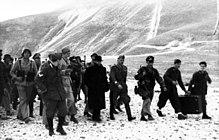
Mussolini rescued by German troops from his prison in Campo Imperatore on 12 September 1943.
In an effort to conceal his location from the Germans, Mussolini was moved around: first to Ponza, then to La Maddalena, before being imprisoned at Campo Imperatore, a mountain resort in Abruzzo where he was completely isolated. Badoglio kept up the appearance of loyalty to Germany, and announced that Italy would continue fighting on the side of the Axis. However, he dissolved the Fascist Party two days after taking over and began negotiating with the Allies.
On 3 September 1943, Badoglio agreed to an Armistice between Italy and Allied armed forces. Its announcement five days later threw Italy into chaos; German troops seized control in Operation Achse. As the Germans approached Rome, Badoglio and the king fled with their main collaborators to Apulia, putting themselves under the protection of the Allies, but leaving the Italian Army without orders.[181]
After a period of anarchy, they formed a government in Malta, and finally declared war on Germany on 13 October 1943. Several thousand Italian troops joined the Allies to fight against the Germans; most others deserted or surrendered to the Germans; some refused to switch sides and joined the Germans. The Badoglio government agreed to a political truce with the predominantly leftist Partisans for the sake of Italy and to rid the land of the Nazis.[182]
...
Yielding to pressure from Hitler and the remaining loyal fascists who formed the government of the Republic of Salò, Mussolini helped orchestrate a series of executions of some of the leaders who had betrayed him at the last meeting of the Fascist Grand Council. One of those executed was his son-in-law, Galeazzo Ciano. As head of state and Minister of Foreign Affairs for the Italian Social Republic, Mussolini used much of his time to write his memoirs. Along with his autobiographical writings of 1928, these writings would be combined and published by Da Capo Press as My Rise and Fall. In an interview in January 1945 by Madeleine Mollier, a few months before he was captured and executed by Italian partisans, he stated flatly: "Seven years ago, I was an interesting person. Now, I am little more than a corpse." He continued:
Yes, madam, I am finished. My star has fallen. I have no fight left in me. I work and I try, yet know that all is but a farce... I await the end of the tragedy and—strangely detached from everything—I do not feel any more an actor. I feel I am the last of spectators.[187]
Death
Main article: Death of Benito Mussolini

Cross marking the place in Mezzegra where Mussolini was shot
American newsreel coverage of the death of Mussolini in 1945
On 25 April 1945, Allied troops were advancing into northern Italy, and the collapse of the Salò Republic was imminent. Mussolini and his mistress Clara Petacci set out for Switzerland, intending to board a plane and escape to Spain.[188] Two days later on 27 April, they were stopped near the village of Dongo (Lake Como) by communist partisans named Valerio and Bellini and identified by the Political Commissar of the partisans' 52nd Garibaldi Brigade, Urbano Lazzaro. During this time, Petacci's brother posed as a Spanish consul.[189]
With the spread of the news of the arrest, several telegrams arrived at the command of the National Liberation Committee for Northern Italy (CLNAI) from the Office of Strategic Services (OSS) headquarters in Siena with the request that Mussolini be entrusted to the control of the United Nations forces.[190] In fact, clause number 29 of the armistice signed in Malta by Eisenhower and the Marshal of Italy Pietro Badoglio on 29 September 1943, expressly provided that:
"Benito Mussolini, his main fascist associates and all persons suspected of having committed crimes of war or similar crimes, whose names are on the lists that will be delivered by the United Nations and which now or in the future are in territory controlled by the allied military command or by the Italian government, will be immediately arrested and handed over to the United Nations forces".[191]
The next day, Mussolini and Petacci were both summarily shot, along with most of the members of their 15-man train, primarily ministers and officials of the Italian Social Republic. The shootings took place in the small village of Giulino di Mezzegra and were conducted by a partisan leader who used the nom de guerre Colonnello Valerio. His real identity is unknown, but conventionally he is thought to have been Walter Audisio, who always claimed to have carried out the execution, though another partisan controversially alleged that Colonnello Valerio was Luigi Longo, subsequently a leading communist politician in post-war Italy.[192][193]
Mussolini's corpse
On 29 April 1945, the bodies of Mussolini, Petacci, and the other executed Fascists were loaded into a van and moved south to Milan. At 3:00 a.m., the corpses were dumped on the ground in the old Piazzale Loreto. The piazza had been renamed "Piazza Quindici Martiri" (Fifteen Martyrs' Square) in honor of fifteen Italian partisans recently executed there.[194]
[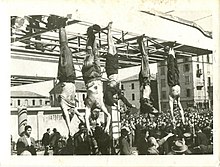
From left to right, the bodies of Bombacci, Mussolini, Petacci, Pavolini and Starace in Piazzale Loreto, 1945.
After being kicked and spat upon, the bodies were hung upside down from the roof of an Esso gas station.[195] The bodies were then stoned from below by civilians. This was done both to discourage any Fascists from continuing the fight, and as an act of revenge for the hanging of many partisans in the same place by Axis authorities. The corpse of the deposed leader was subject to ridicule and abuse. Fascist loyalist Achille Starace was captured and sentenced to death and then taken to the Piazzale Loreto and shown the body of Mussolini, which he saluted just before being shot. His body was strung up beside Mussolini's....
Legacy
Family

Tomb of Mussolini in the family crypt, in the cemetery of Predappio
Mussolini was survived by his wife, Rachele Mussolini, two sons, Vittorio and Romano Mussolini, and his daughters Edda (the widow of Count Ciano) and Anna Maria. A third son, Bruno, was killed in an air accident while flying a Piaggio P.108 bomber on a test mission, on 7 August 1941. His oldest son, Benito Albino Mussolini, from his marriage with Ida Dalser, was ordered to stop declaring that Mussolini was his father and in 1935 forcibly committed to an asylum in Milan, where he was murdered on 26 August 1942 after repeated coma-inducing injections.[64]
Alessandra Mussolini, granddaughter of Mussolini, is politically active in Italian right circles. She has been a member of the European Parliament for the far-right Social Alternative movement, a deputy in the Italian lower chamber and served in the Senate as a member of Silvio Berlusconi's Forza Italia party. Alessandra Mussolini is the daughter of Romano Mussolini (Benito Mussolini's fourth son), and of Anna Maria Scicolone, **Sophia Loren's sister.
Neo-fascism
Main article: Neo-fascism § Italy
Although the National Fascist Party was outlawed by the postwar Constitution of Italy, a number of successor neo-fascist parties emerged to carry on its legacy. Historically, the largest neo-fascist party was the Italian Social Movement (Movimento Sociale Italiano), which disbanded in 1995 and was replaced by National Alliance, a conservative party that distanced itself from Fascism (its founder, former foreign minister Gianfranco Fini, declared during an official visit to Israel that Fascism was "an absolute evil").[251] National Alliance and a number of neo-fascist parties were merged in 2009 to create the short-lived People of Freedom party led by then Prime Minister Silvio Berlusconi, which eventually disbanded after the defeat in the 2013 general election. In 2012, many former members of National Alliance joined Brothers of Italy, led by current Prime Minister of Italy, Giorgia Meloni.
Knowledge Web Content (see main node)
Benito Amilcare Andrea Mussolini
Nickname/Alias: Il Duce (the Leader)
Achievements: Founder of Fascist party
Born: July 29, 1883; Predappio, Italy
Died: April 28. 1945; near Dongo, Italy. Aged 61
Field & Discipline: Government & Politics; Political leader
Language: Italian
Education: Village school, Predappio; Salesian school, Faenza, Italy; Giosue Carducci, Forlimpopoli, Italy
Life & Times:
After working as a schoolmaster in Italy in his late teens, Mussolini went to Switzerland where he gained the reputation of being a revolutionary and was imprisoned a number of times. On his return to Italy in 1904, he re-entered radical politics, becoming a journalist and working with trade unions. He founded his own newspaper, "The Class Struggle" and in 1912 was made editor of the main Socialist newspaper: "Avanti". He became known as a firebrand and dangerous Socialist.
He strongly opposed Italy's entry into the First World War I (1914-18) and took a nationalistic stance, resigning his editorship of Avanti, and eventually being expelled from the Socialist party. He did, however, join the army and was wounded. On his return home, Mussolini began to make speeches stressing the need for a strong, vigorous Italian leader, who would make sweeping social changes. It was clear he meant himself. He appealed to a wide spectrum of discontents, attracting a mix of revolutionaries, republicans, anarchists, and disgruntled Socialists. At a meeting in 1919, about 200 of his supporters adopted the fascist symbol and the black-shirt uniform of the anarchists.
As time went on, the charismatic Mussolini began drawing ever bigger crowds and at one meeting in Naples, addressed 40,000. When a general strike was called in 1922, he announced that if the government did not stop it, the Fascists would. The Fascist militia marched on Rome, King Victor Emmanuel III capitulated, and on October 31, 1922, at 39, Mussolini became the youngest ever Prime Minister of Italy. Italians who had suffered a divided country, years of strikes, economic crises, and political chaos heartily welcomed Mussolini. Though most of his first cabinet were not Fascists, they agreed that he take dictatorial powers for one year.
After the 1924 elections, the Fascists had a majority in the Italian parliament and Mussolini's power was confirmed. After Socialist politician Giacomo Matteotti questioned the validity of the election results, he was murdered. Mussolini almost certainly was not involved in the killing, but the chance of co-operation with Socialists was lost. Some anti-Fascists went into exile but most were allowed to remain in Italy as long as they kept out of politics.
Under Mussolini, order was restored, Italy was united, and strikes stopped. He brought in government insurance, welfare programs, and ordered housing built for landless laborers in rural areas. In accordance with his belief that everything was subservient to the State, these social reforms were carried out under the firm supervision of the Fascists. His agenda included making Italy self-sufficient in food production, creating an agricultural population of healthy, contented hard-working peasants, and stopping civil unrest and urban crime. He implemented massive public works programs, including the reclamation of large areas of wastelands such as the malaria-infested Pontine marshes. These policies were all part of his grand design to restore the country to the glory of ancient days. But over the years, the Fascist party became a haven for the inadequate and the corrupt. The middle class remained content as long as the economy prospered and life went along smoothly. Most of the upper classes enjoyed Mussolini's revival of pomp and ceremony. The poor and those who disagreed had no voice. Abroad, Mussolini was regarded as a benign dictator with almost superhuman power.
He became famous as "the man who made the railways work"; he was praised by writer [a fan was] Shaw* and poet [a fan was] Pound*. [a fan was] Freud* sent him a book inscribed to "the hero of culture", and [a fan was] Gandhi* called him "the savior of Italy".
All this changed in October, 1935, when Mussolini invaded Abyssinia (Ethiopia), encouraged by [collaborated with] Hitler*, with whom he had now become fatally entangled, even though he disliked Hitler and was contemptuous of many Nazis. Mussolini agonized over becoming a German ally as he watched Hitler's ambitions lead to the Second World War in 1939. Until then, Italy had become the only Western power to threaten Germany after the Nazi invasion of Austria. But in June, 1940, Italy joined the war on Hitler's side.
By 1943, with Mussolini in poor health, his tight rein on the country began to loosen. For the first time in almost 20 years, workers began to go on strike and overt unrest increased. When the Allies invaded Sicily in July, 1943, political opposition to Mussolini came to a head.
The Fascist Grand Council voted to allow the King to take over the military. The next day Mussolini was arrested and imprisoned in the Abruzzi Mountains. In September, he was rescued in a daring raid by German commandos and taken to Munich. Since Italy had capitulated to the allies on September 3, Mussolini set up a new Fascist government, the Salo Republic, in northern Italy. At Hitler's insistence, he ordered the execution of those in the Grand Council who had voted against him, including his son-in-law.
In 1945, as the allies routed the Germans from Italy, Mussolini refused offers of a flight to safety in Switzerland or Spain and retreated to the Valtellina in Northern Italy to try to make a last stand. But he could not rally enough men. With his mistress Claretta Petacci, he attempted to cross the frontier into Austria disguised as a German soldier, but was recognized by the Communist partisans, who killed both him and Petacci. Their bodies were taken to Milan and strung up by the feet in Piazzale Loreto.
Extra Connections: Was publicly supported by [a fan was] Carrel*.
Made [ennobled] Marconi* a Marquis
He was an admirer of [a fan of] D’Annunzio* and [a fan of] Respighi*
Opposed by [opposed by] JB Priestley*
He gave [gave funeral oration for] Puccini’s* funeral oration
He recruited [recruited to Academy]Fermi* into his Italian Academy
Assessment: Brought about the downfall of Italy and himself by allying with Hitler and entering the Second World War
Oneliner: Benito Mussolini, Fascist Dictator of Italy
Bibliography:
- Joes, Anthony James, Mussolini, Franklin Watts, London, 1982.
Father: Alessandro Mussolini
Mother: Rosa Maltoni
Siblings: Arnaldo; Edvige
Spouse: Rachele Guidi
Children: Vittorio; Bruno; Romano; Edda; Anna Maria