Savery
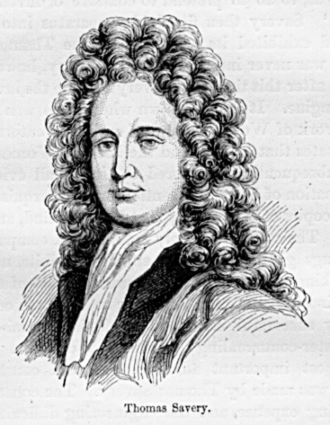
Name: Thomas Savery
Achievements: Steam engine
Born: c1650; Shilstone, Devonshire, England
Died: 1715; London, England (Aged around 65)
Field & Discipline: Engineering
Language: England
Father: Richard Savery
Mother: Unknown
Siblings: Unknown
Spouse: Unknown
Children: Unknown
Education: Unknown
Major Work:
“The Miner’s Friend” (1702)
Life & Times:
Savery trained as a military engineer and in 1696 invented a machine for polishing plate glass and patented a method of rowing becalmed ships by means of a paddle-wheel on each side of the ship worked by a capstan set between them. The king of England, William III, thought it was a great idea but it never got taken up by the navy. He then published an account of his invention: “Navigation Improved,” in which he made a strong protest about his treatment by naval officials.
Like many inventors and entrepreneurs at that time, Savery experimented with ways of draining water from mines. He had been brought up in a mining district and was well aware of the problem. In 1698, after years of experimentation, he took out a patent for a machine for raising water which he later named “The Miner’s Friend”.
The French physicist [work related to] Papin* had previously shown how water could be raised by a vacuum produced by the condensation of steam and had published an account of his investigations and Savery probably heard of it through discussions with other inventors and scientists.
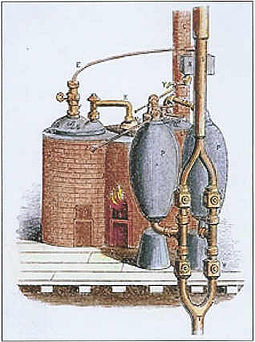
Savery was the first to make a practical application of steam for mechanical purposes. His machine consisted of a closed vessel, filled with water, into which steam under pressure was introduced. The steam forced the water up and when the water was expelled the steam was condensed by a sprinkler. This had the effect of producing a vacuum strong enough to raise more water through a valve below.
Savery was determined not to have this invention ignored and he so he carried out a vigorous advertising campaign which soon attracted customers. His engines (the device became known as the [developed] steam engine*were used for supplying water to large buildings as well as for pumping out mines.
His patent protected him when [pump improved by] Newcomen* independently designed his own atmospheric-pressure piston engine which worked better than Savery’s because the intensity of pressure was not limited by the pressure of the steam. Savery and Newcomen then joined forces in developing more efficient engines. In 1764 [anticipated] Watt* became involved when he was asked to repair a Newcomen model engine.
Savery was promoted to captain of engineers in 1702 and three years later became treasurer of the hospital for sick seamen through the patronage of Prince George of Denmark. In 1706 he took out a patent for a double hand bellows which made possible the smelting of metal in a wood or coal fire without need of a furnace. He also invented an odometer to measure the distance traveled by ships.
In 1714 he was appointed surveyor of the waterworks at Hampton Court (built by Cardinal Wolsey. In the early 1690s, King William III's massive rebuilding and expansion work, which was intended to rival the Palace of Versailles, destroyed much of the Tudor palace.)
Extra Connections: His engine was improved by [engine improved by] Desaguliers*
Comparison with Newcomen steam engine
The Savery steam pump was much lower in capital cost than the Newcomen steam engine, with a 2 to 4 horsepower Savery pump costing from 150–200 GBP.[18] It was also available in small sizes, down to one horsepower. Newcomen steam engines were larger and much more expensive. The larger size was due to the fact that piston steam engines became very inefficient in small sizes, at least until around 1900 when 2 horsepower piston engines were available.[19] Savery-type pumps continued to be produced well into the late 18th century.
Fire Engine Act
Savery's original patent of July 1698 gave 14 years' protection; the next year, 1699, an Act of Parliament was passed which extended his protection for a further 21 years. This act "Encouraging Thomas Savery's invention for raising water and relating to all sorts of mill work" became known as the "Fire Engine Act". Savery's very broad patent covered all pumps that raised water by fire.[5]
The architect James Smith of Whitehill acquired the rights to use Savery's pump in Scotland. In 1699, he entered into an agreement with the inventor, and in 1701 he secured a patent from the Parliament of Scotland, modelled on Savery's grant in England, and designed to run for the same period of time. Smith described the machine as "an engine or invention for raising of water and occasioning motion of mill-work by the force of fire", and he claimed to have modified it to pump from a depth of 14 fathoms, or 84 feet.[3][6]
In England, Savery's patent meant that Thomas Newcomen was forced to go into partnership with him. By 1712, arrangements had been made between the two men to develop Newcomen's more advanced design of steam engine, which was marketed under Savery's patent, adding water tanks and pump rods so that deeper water mines could be accessed with steam power.[7] Newcomen's engine worked purely by atmospheric pressure, thereby avoiding the dangers of high-pressure steam, and used the piston concept invented in 1690 by the Frenchman Denis Papin to produce the first steam engine capable of raising water from deep mines.[8]
When Papin was back to London in 1707, he was asked by Isaac Newton, new President of the Royal Society after Robert Boyle, Papin's friend, to work with Savery, who worked for five years with Papin, but never gave any credit nor revenue to the French scientist.
After his death in 1715 Savery's patent and Act of Parliament became vested in a company, The Proprietors of the Invention for Raising Water by Fire.[9] This company issued licences to others for the building and operation of Newcomen engines, charging as much as £420 per year patent royalties for the construction of steam engines.[10] In one case a colliery paid the Proprietors £200 per year and half their net profits "in return for their services in keeping the engine going".[11]
The Fire Engine Act did not expire until 1733, four years after the death of Newcomen.[12]
Assessment: Invented and produced the first successful machine powered by steam.
Oneliner: Thomas Savery, inventor of first practical steam engine
Bibliography:
- Dictionary of National Biography.
- Encyclopedia Britannica.
- Singer: History of Technology.