Pauli
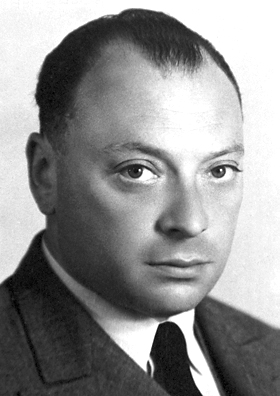
NAME: Pauli, Wolfgang Ernst.
ACHIEVEMENT(S): Nobel Prize for Physics in 1945 for his 1925 discovery of the exclusion principle: no two electrons can occupy the same quantum state simultaneously.
NICKNAME/ALIAS: None.
DATE/PLACE OF BIRTH: 25th April 1900, in Vienna, Austria.
DATE/PLACE/AGE AT DEATH: 15th December 1958, in Zurich, Switzerland. Aged 58
DISCIPLINE: Quantum Physicist.
FIELD: Physics.
LANGUAGE: French.
PARENTS: Wolfgang Joseph Pauli and Bertha Schultz.
SIBLINGS:
SPOUSE: 1st Kate Depner; 2nd Franciska Bertram, married 1934.
CHILDREN: None.
EDUCATION: High school in Vienna to 1918; University of Munich, 1918-22.
MAJOR WORK: 'Collected Scientific Papers', 1964
LIFE AND TIMES:
In 1922, after receiving his doctorate for a thesis on the hydrogen molecule ion, Pauli was made an assistant lecturer in theoretical physics at the University of Gottingen, where he worked with physicist <worked with> Born 2*, and guest lecturer Danish physicist <worked with> Bohr*.
At Bohr's lectures Pauli began to consider some of the fundamental problems involved in Bohr's quantum theory of the atom (such as the existence of various electron energy levels within an atom) and decided that classical physics could not explain why electrons were distributed in various energy levels outside the nucleus, each energy level containing a set number of electrons.
Although Bohr had constructed his model from empirical data, he had not been able to explain why the model worked. Pauli worked on this problem, first as Bohr's assistant when he moved to the University of Copenhagen in late 1922, then as assistant in theoretical physics at Hamburg, under Wilhelm Lenz, in 1923.
At Hamburg, he also began to consider another problem in atomic theory, known as the Zeeman effect. In 1896, the Dutch physicist Pieter Zeeman had found that the presence of a strong magnetic field caused the lines of an atomic spectrum to split, but by 1923, nobody had been able to explain this phenomenon.
Early 1925, Pauli suggested that electron energy states must include a fourth quantum number in addition to the three already known. These three were: principle quantum number 'n', its azimuthal quantum number 'l', and its magnetic quantum number 'm'. Pauli felt that the fourth quantum number could have one of two possible numerical values: either +1/2 or -1/2.
At the time, Pauli had no idea how this fourth quantum number could be interpreted in physical terms. The problem was solved three years later when Dutch physicists Samuel Goudsmit and George Uhlenbeck discovered electron spin, suggesting that an electron could spin in one of two directions, clockwise or anti-clockwise. Their designation of these spins as +1/2 or -1/2 corresponded exactly to the dual-value fourth quantum number Pauli had predicted. This fourth quantum number was identified by the spin quantum number 's'.
In 1924, still on the Zeeman effect problem, Pauli worked out an explanation for the fact that all electrons in an atom do not occupy the lowest energy level. His “exclusion principle” of 1925 stated that no two electrons in an atom could be in the same state at the same time.
Pauli's reasoning for this was that no two electrons can have exactly the same set of four quantum numbers. He stated that an electron in the first energy level, 'n' = 1, must have an azimuthal quantum number (‘l’) of 0, because 'l' = n - 1. They must also have a magnetic quantum number of 0, because 'm' = plus '1' or minus 'l', but they can have a spin quantum number (‘m’) of either +1/2 or -1/2. Pauli showed that electrons in the first energy level were limited to having quantum numbers of either 1, 0, 0, and +1/2 or 1,0,0, and -1/2.
Since Pauli's exclusion principle ruled that there could be no more than one electron in each of these two states, only two electrons could occupy the first energy level. Pauli also showed how the second energy level could hold no more than eight electrons, the third level no more than eighteen, and so on.
In this way Pauli provided a theoretical basis for the electron orbital characteristics originally developed by Bohr more than a decade earlier. Pauli’s exclusion principle has since been generalized to include a whole class of particles of which the electron is only one.
In 1927, Pauli went back to Gottingen to teach for a year, during which time he worked with Born, <worked with> Heisenberg* and <worked with> Dirac*. Then, when the director of the Swiss Federal Institute of Technology, chemical physicist Peter Debye, retired in 1928, Pauli moved to Zurich to run the Institute.
At the same time, physicist <knew> Schrodinger* left the University of Zurich, his place being taken by Gregor Wentzel, who, together with Pauli, organized seminars on new developments in theoretical physics. By 1939, they had turned Zurich into a major theoretical physics research center.
In his early Zurich years, Pauli addressed the problem of beta decay. According to contemporary quantum theory the loss of a beta particle (an electron) from an atomic nucleus should be accompanied by the loss of a quantity of energy, and the spectrum produced by beta decay should therefore be characterized by a series of lines. This was known as the law of conservation.
However in the late 1920’s it was observed that the spectra associated with beta decay were always continuous spectra, suggesting that some extra energy and momentum was missing. Keen to retain the law of conservation, in 1930 Pauli proposed a solution to this mystery. He suggested that the loss of a beta particle by a nucleus was accompanied by the loss of a second particle, uncharged and with little or no mass, which carried away the missing energy and momentum from the nucleus.
He also suggested that this second particle, first named by Pauli as a "neutron" (sure enough the chargeless nuclear particle was to be discovered by English physicist James Chadwick in 1932) had gone unnoticed because it interacted with matter so seldom that it was virtually impossible to detect.
After Chadwick's discovery, American physicist <work furthered by> Fermi* renamed Pauli's particle the "neutrino" or "little neutron" and in 1934, Fermi incorporated the neutrino into a mathematical theory of beta decay. Because of the elusive nature of the neutrino, it was 22 years before it would first be observed.
In 1933, Pauli wrote an important paper on wave mechanics for the 'Handbuch der Physik' and, in 1935-36, he was visiting professor at the Institute for Advanced Studies in Princeton, New Jersey. On his return to Zurich, he stayed at the institute until the outbreak of World War II, when, despite Switzerland being neutral, he felt it safer to leave Europe.
In 1940 he was appointed to the chair of theoretical physics at the Institute for Advanced Studies in Princeton, where he remained throughout the war. In 1946, he returned to Zurich, became a Swiss citizen and continued his work on elementary particles.
During the late 1940s and early 1950s, Pauli, fascinated both by the complex psychology behind scientific activity and by the frequently irrational origins of the philosophical foundations of science, studied the works of psychoanalyst C.G. Jung. At the end of 1930, shortly after his postulation of the neutrino and immediately after his divorce and his mother's suicide, Pauli experienced a personal crisis. In January 1932 he consulted psychiatrist and psychotherapist Carl Jung, who also lived near Zurich. Jung immediately began interpreting Pauli's deeply archetypal dreams based on the I Ching,[21] and Pauli became a collaborator of Jung's.
During this period he wrote essays and lectures on the subject, which he published in 1952, in the book 'Natureklarung und Psyche', co-written with Jung. He died after a sudden, serious illness.
ASSESSMENT: Pauli made important contributions to modern quantum theory, especially with his exclusion principle.
EXTRA CONNECTIONS:
He worked with <worked with> Oppenheimer*.
ONELINER: Wolfgang Pauli, quantum physics pioneer
BIBLIOGRAPHY:
Newton, David E., "Wolfgang Pauli", in Notable Twentieth Century Scientists, ed. Emily J. McMurray, New York & London: Gale Research, 1995.