Twain
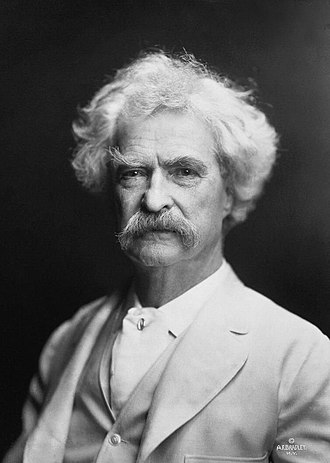
Name: Samuel Langhorne Clemens
Nickname/Alias: Mark Twain
Achievements: “Huckleberry Finn”
Born: November 30, 1835; Florida, Missouri
Died: April 21, 1910, Redding, Connecticut (Aged 74)
Field & Discipline: Literature; Publishing; Writer; Journalist
Language: English
Father: John Marshall Clemens
Mother: Jane Lampton
Siblings: Orion; Henry; Pamela
Spouse: Olivia Langdon
Children: Susy; Jean; Clara
Education: Schools in Hannibal, Missouri
Major Work:
"The Adventures of Tom Sawyer"
"Life on the Mississippi"
"The Adventures of Huckleberry Finn"
Life & Times:
At 16, Twain worked as typesetter for his brother, Orion, who founded the "Hannibal (Missouri) Journal". Twain contributed humorous sketches to the paper and, at 17, had a sketch printed in a Boston publication. At 18, he left Hannibal to work as a printer on several newspapers around the country.
In 1856 Twain set out to seek his fortune in South America, but changed his mind when on the steamboat to New Orleans he met a pilot who took him on as his apprentice. He spent the next four years on the Mississippi, getting his pilot's license in 1859. In 1861, he served briefly in a Confederate militia, then joined his brother Orion who had been made territorial secretary of Nevada territory.
Twain became a prospector, staking claims for mining and timber, and speculating in local stocks. In 1862, he took a reporter's job with the Virginia City "Territorial Enterprise," and a year later began using the pseudonym "Mark Twain,” which on the Mississippi meant "two fathoms deep".
Twain moved to San Francisco, where writer[encouraged by] Harte* encouraged him to keep writing, and he produced "Jim Smiley and His Jumping Frog". Published in 1865 in "The Saturday Press" of New York and syndicated throughout the U.S., it brought Twain critical approval and made him nationally known.
In 1866, Twain was hired as travel correspondent for the "Alta California" and, in 1867, took off on a five-month voyage to southern Europe, the Crimea, Palestine, and Egypt. His travel reports were published not only by the "Alta California" but also by [published by] Greeley*'s "New York Tribune".
Twain's humorous travel pieces were such a hit that a publisher offered to bring out a collected edition. Harte helped with the revisions, and "The Innocents Abroad; or, The New Pilgrim's Progress" was published in 1869. Twain did a lecture tour of California and Nevada, and, in 1872, wrote "Roughing It", about his stagecoach journey to Nevada and a sailing trip in the Pacific. In 1873, in collaboration with a friend, he wrote a satire on contemporary politics and finance, called "The Gilded Age".
In 1875, after a lecture tour in the U.S. and England, Twain wrote a long piece describing his experiences as a Mississippi pilot, serialized in 1875 in "Atlantic Monthly," edited by [a pal of] Howells*, New England's foremost literary editor and critic. Howells became a close friend and constantly promoted Twain as a serious writer.
Twain's 1876 account of an American country boy's childhood: "The Adventures of Tom Sawyer" was an almost immediate children's classic. At the end of the 1870s, Twain traveled with his family to Europe and spent several months in England, where he met [met] Charles Darwin*. On his return to the U.S. he wrote "The Prince and the Pauper" (1881), a book about childhood and set in England. In 1884 came "Huckleberry Finn," regarded as his finest book.
In spite of his continuing popular success, Twain had money troubles. He set up his own publishing firm which did well with "Tom Sawyer" and even better with the "Memoirs" of Ulysses S. [published memoirs of] Grant*, but it eventually began to lose money. Twain moved his family to Europe, where he solved his money problems with literary pieces and lectures.
He was a celebrity in England, where he contributed to magazines like "The Idler," edited by English humorist [worked for] Jerome K. Jerome*. Disapproving of British imperialism in South Africa, Twain returned to the U.S. in 1900 and settled in New York. Three years later, he took his family to settle in Italy, near Florence, but returned to America after his wife's death in 1904.
In 1907, he received an honorary degree from Oxford University, together with French sculptor [honored with] Rodin* and French composer [honored with] Saint-Saens*.
Twain's autobiography remained unfinished at his death.
Extra Connections:
Twain became one of the first to buy a [used typewriter of] Remington* typewriter.
He was a fan of actress Sarah [a fan of] Bernhardt*.
Met authors [met] Wilkie Collins* and [met] Robert Louis Stevenson*
Knew steel-maker [knew] CM Schwab*
Influenced by the work of [influenced by] Malory*
Wrote a piece satirizing King [satirized] Leopold II of Belgium*
Assessment: Twain's two novels of American life, "The Adventures of Tom Sawyer" and "Huckleberry Finn" gave him a permanent reputation
Oneliner: Mark Twain, great American writer
Bibliography:
- Kaplan, Justin, Mark Twain and His World, Simon and Schuster, New York, 1974.
Letters and Politics 12/17/13 3rd vol autobiography; Congo, Philipines, teleharmonium http://120years.net/wordpress/?page_id=234