Defoe
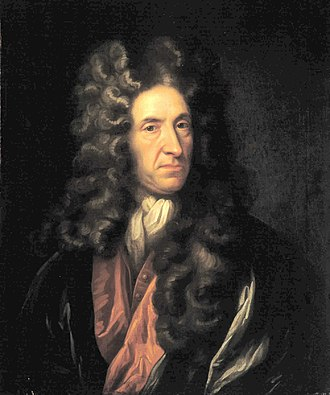
Name: Daniel Defoe
Achievements: First “realistic” novels
Born: Autumn, 1660, London, England
Died: April 24, 1731, London, England. Aged 70
Field & Discipline: Literature; Writer
Language: English
Education: Dissenters' School, Dorking; Charles Morton's Dissenters' Academy, Stoke Newington
Major Work:
"The Life and Strange Surprising Adventures of Robinson Crusoe"
"The Fortunes and Misfortunes of Moll Flanders"
"Legion's Memorial"
Life & Times:
Defoe intended to enter the church (he even had a fondness for writing religious poetry), but changed his mind when he left school, and opted for the commercial world. In 1681, he set himself up in the wholesale hosiery business in London.
Soon after, he became interested in politics, and in 1683 began writing political pamphlets. His first pamphlet countered the view of his fellow Whigs and argued it would best serve Christian interests if the Turks were allowed to capture Vienna. From this point on, he was often attacked as a liberal independent.
When the Catholic James II came to the English throne in 1685, Defoe, a committed Protestant, joined the ill-fated rebellion led by the Duke of Monmouth, and just managed to escape after the disastrous Battle of Sedgemoor.
In 1689, after James fled to France, Defoe rode into London as a volunteer trooper in the triumphal procession of the new Protestant monarchs, [supported] William of Orange* & Mary. In the meantime, Defoe prospered as an international merchant until 1692, when because of world circumstances and his own rashness went broke.
In 1701, Defoe achieved fame for two publications. "The True-Born Englishman", a satiric poem, defended the "foreign" King (William was Dutch). "Legion's Memorial", defended five men from Kent, who had been illegally imprisoned for petitioning the Commons for an increase in defense spending. The pamphlet, presented to the speaker of the House of Commons, Robert Harley, declared in outspoken terms that "Englishmen are no more to be slaves to Parliaments than to a King". Defoe was acclaimed by the people of London, but was regarded by the establishment as a dangerous rebel.
When King William died in 1702, the Tories came to power and began to increase their attacks on Protestant freechurchmen ("Dissenters") like Defoe. In reply, Defoe wrote one of his most effective pamphlets, "The Shortest Way with Dissenters", ridiculing the bigotry of the Tories by pretending to argue for the extermination of all Dissenters. The pamphlet had a huge sale, but the irony blew up in his face.
Many Dissenters and High Anglicans took it seriously, and when the hoax was exposed, they were furious. Defoe was charged with seditious libel in May, 1703, and in July, was sentenced to stand three times in the pillory, fined heavily, and imprisoned until November. Defoe's exposure in the pillory seriously compromised his respectability and other writers, including [avoided by] Swift* and [influenced] Joseph Addison*, began to shun him.
At the same time, his prosperous brick and tile works collapsed, leaving him near penniless. He appealed to Prime Minister Harley, who arranged a pardon and release in November, 1703, and hired him as a government pamphleteer and spy.
In 1704, Defoe began his famous periodical, "The Review", a three-times-a-week newspaper that lasted nine years. He wrote it all himself and used it to express opinions on just about everything. He claimed the paper was politically non-partisan, but it was in effect the main government organ, its political line corresponding with that of the moderate Tories. Defoe discussed politics, current affairs, religion, trade, manners, and morals. The work undoubtedly had a considerable influence on the development of later essay periodicals such as [influenced] Steele* and Addison's "The Tatler" and "The Spectator".
In 1706, Defoe actively promoted the Union with Scotland, and in 1709, he dedicated his "History of the Union" to Queen Anne. After 1714, with the fall of the Tories, he supported the accession of George I, and continued to write and carry out intelligence work for the new Whig government.
In 1712, Defoe dropped "The Review" and started a new trade journal, "Mercator". In 1712-13, after writing several anti-Catholic pamphlets, he was imprisoned briefly by the Whigs. He was convicted of libel in 1715, but escaped punishment through the intervention of the Secretary of State, [patron was] Charles Townshend*, who in return got Defoe's promise to continue spying on the Tories.
In 1719, though still active as a journalist, Defoe began his career as novelist with: "The Life and Strange Surprising Adventures of Robinson Crusoe," based on the memoirs of voyagers and castaways, such as [based story on] Selkirk*, who lived on an uninhabited tropical island from 1704 to 1709. The work was part adventure and part exploration of man's need for society and his struggle with nature. Employing a first-person narrator and sometimes genuine journal entries, Defoe created the first realistic frame for the English novel.
After the novel's huge success, Defoe concentrated on books rather than pamphlets, publishing two "Crusoe" sequels ("Farther Adventures" and "Serious Reflections"), and then "Memoirs of a Cavalier" (1720) and "Captain Singleton" (1720). In 1722, he published "The Fortunes and Misfortunes of Moll Flanders", after which came "A Journal of the Plague Year" and "The History of Colonel Jack." His last great work of prose fiction, "Roxana", appeared in 1724.
During the 1720s, politically controversial no longer, Defoe wrote a number of historical works, including "A Tour Through the Whole Island of Great Britain" (1724-27) and "A General History of the Pirates" (1724-28). In his last years, he also produced works on religion.
Extra Connections: Wrote an article on [wrote about] Macgregor*.
Wrote about [wrote about] East India Co EIC*
Probably bribed [probably bribed] Graham Duke of Montrose*
Assessment: Extremely versatile and prolific writer, who produced 560 books, pamphlets and journals on a wide range of subjects.
Oneliner: Daniel Defoe, prolific writer.
Bibliography:
- Collier's Encyclopedia.
- Companion to English Literature.
- Encyclopedia Britannica.
- West, Richard, The Life & Strange Surprising Adventures of Daniel Defoe, London: Harper Collins, 1997.
Father: James Foe
Mother: Alice
Siblings: Mary; Elizabeth
Spouse: Mary Tuffley
Children: Maria; Benjamin; Hannah; Daniel; Henrietta; Sophia