Addison J 2
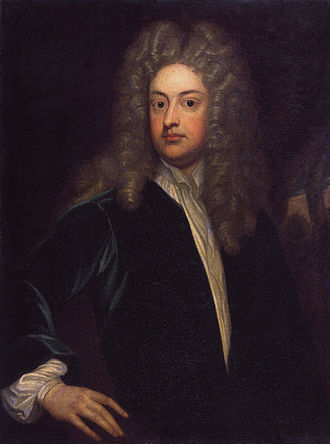
Joseph Addison (1 May 1672 – 17 May 1719) was an English essayist, poet, playwright, and politician. He was the eldest son of Lancelot Addison. His name is usually remembered alongside that of his long-standing friend Richard Steele, with whom he founded The Spectator magazine. His simple prose style marked the end of the mannerisms and conventional classical images of the 17th century.[1]
Life and work
Background
Addison was born in Milston, Wiltshire, but soon after his birth his father, Lancelot Addison, was appointed Dean of Lichfield and the family moved into the cathedral close. His father was a scholarly English clergyman. Joseph was educated at Charterhouse School, London, where he first met Richard Steele, and at The Queen's College, Oxford.[2] He excelled in classics, being specially noted for his Neo-Latin verse, and became a fellow of Magdalen College.
In 1693, he addressed a poem to John Dryden, and his first major work, a book of the lives of English poets, was published in 1694. His translation of Virgil's Georgics was published in the same year. Dryden, Lord Somers and Charles Montague, 1st Earl of Halifax, took an interest in Addison's work and obtained for him a pension of £300 a year to enable him to travel to Europe with a view to diplomatic employment, all the time writing and studying politics.
While, in Switzerland, in 1702, he heard of the death of William III, an event which lost him his pension, as his influential contacts, Halifax and Somers, had lost their employment with the Crown.
Political career
Addison returned to England at the end of 1703. For more than a year he remained unemployed, but the Battle of Blenheim in 1704 gave him a fresh opportunity to distinguish himself. The government, specifically Lord Treasurer Godolphin, commissioned Addison to write a commemorative poem about the battle, and he produced The Campaign, which was received with such satisfaction that he was appointed Commissioner of Appeals in Halifax's government.[3]
His next literary venture was an account of his travels in Italy, Remarks on several parts of Italy, &c., in the years 1701, 1702, 1703, published in 1705 by Jacob Tonson.[4]
In 1705, with the Whigs in power, Addison was made Under-Secretary of State and accompanied Lord Halifax on a diplomatic mission to Hanover, Germany. A biography of Addison states: "In the field of his foreign responsibilities Addison's views were those of a good Whig. He had always believed that England's power depended upon her wealth, her wealth upon her commerce, and her commerce upon the freedom of the seas and the checking of the power of France and Spain."[5]
In 1708 and 1709, Addison was a Member of Parliament for the borough of Lostwithiel. He was soon appointed secretary to the new Lord Lieutenant of Ireland, Lord Wharton. Under the direction of Wharton, he was an MP in the Irish House of Commons for Cavan Borough from 1709 until 1713. In 1710, he represented Malmesbury, in his home county of Wiltshire, holding the seat until his death in 1719.[citation needed]
Magazine founder
He met Jonathan Swift in Ireland and remained there for a year. Later, he helped form the Kitcat Club and renewed his friendship with Richard Steele. In 1709, Steele began to publish the Tatler, and Addison became a regular contributor. In 1711, they began The Spectator; its first issue appeared on 1 March 1711. This paper, which was originally a daily, was published until 20 December 1714, interrupted for a year by the publication of The Guardian in 1713. His last publication was The Freeholder, a political paper, in 1715–16.
Plays
He wrote the libretto for Thomas Clayton's opera Rosamond, which had a disastrous premiere in London in 1707.[6] In 1713 Addison's tragedy Cato was produced, and was received with acclamation by both Whigs and Tories. He followed this effort with a comedic play, The Drummer (1716).
Cato[]

The actor John Kemble, in the role of Cato, revived at Covent Garden in 1816, drawn by George Cruikshank.
Main article: Cato, a Tragedy
In 1712, Addison wrote his most famous work, Cato, a Tragedy. Based on the last days of Marcus Porcius Cato Uticensis, it deals with conflicts such as individual liberty versus government tyranny, Republicanism versus Monarchism, logic versus emotion, and Cato's personal struggle to retain his beliefs in the face of death. It has a prologue written by Alexander Pope and an epilogue by Samuel Garth.[7]
The play was a success throughout the British Empire. It continued to grow in popularity, especially in America, for several generations. It is cited by some historians as a literary inspiration for the American Revolution, being known to many of the Founding Fathers. General George Washington sponsored a performance of Cato for the Continental Army during the difficult winter of 1777–78 at Valley Forge. According to John J. Miller, "no single work of literature may have been more important than Cato" for the leaders of the American revolution.[8]
Scholars have identified the inspiration for several famous quotations from the American Revolution in Cato. These include:
- Patrick Henry's famous ultimatum: "Give me liberty or give me death!"
(Supposed reference to Act II, Scene 4: "It is not now time to talk of aught/But chains or conquest, liberty or death.").[9]
- Nathan Hale's valediction: "I regret that I have but one life to give for my country."
(Supposed reference to Act IV, Scene 4: "What a pity it is/That we can die but once to serve our country.").[9]
- Washington's praise for Benedict Arnold in a letter: "It is not in the power of any man to command success; but you have done more – you have deserved it."
(Clear reference to Act I, Scene 2: "'Tis not in mortals to command success; but we'll do more, Sempronius, we'll deserve it.").
In 1789, Edmund Burke quoted the play in a letter to Charles-Jean-François Depont entitled Reflections on the revolution in France, saying that the French people may yet be obliged to go through more changes and "to pass, as one of our poets says, 'through great varieties of untried being,'" before their state obtains its final form.[10] The poet referred to is Addison and the passage quoted is from Cato (V.i. II): "Through what variety of untried being, through what new scenes and changes must we pass!"
Though the play has fallen from popularity and is now rarely performed, it was popular and often cited in the eighteenth century, with Cato being an example of republican virtue and liberty. John Trenchard and Thomas Gordon were inspired by the play to write an epistolary exchange entitled Cato's Letters (1720–1723), concerning individual rights, using the name "Cato".[citation needed]
The action of the play involves the forces of Cato at Utica, awaiting the attack of Caesar immediately following his victory at Thapsus (46 BC). The noble sons of Cato, Portius and Marcus, are both in love with Lucia, the daughter of Lucius, an ally of Cato. Juba, prince of Numidia, one of Cato's warriors, loves Cato's daughter Marcia. Meanwhile, Sempronius, a senator, and Syphax, a general of the Numidians, are conspiring secretly against Cato, hoping to prevent the Numidian army from supporting him. In the final act, Cato commits suicide, leaving his followers to make their peace with the approaching army of Caesar – an easier task after Cato's death, since he was Caesar's most implacable enemy.
Hymn
Addison wrote the popular church hymn "The Spacious Firmament on High", publishing it in The Spectator in 1712. It is sung either to the tune known as "London (Addison's)" by John Sheeles, written c. 1720, or to "Creation" by Joseph Haydn, 1798.[11]
Marriage and death

Addison in 1719, the year he died
The later part of Addison's life was not without its troubles. In 1716, he married Charlotte, Dowager Countess of Warwick, after working for a time as a tutor for her son. He then lived at Bilton Hall in Warwickshire.[12] His political career continued, and he served as Secretary of State for the Southern Department from 1717 to 1718. His political newspaper The Freeholder was much criticised. His wife was arrogant and imperious; his stepson, Edward Rich, was an unfriendly rake. Addison's shyness in public limited his effectiveness as a member of Parliament. He eventually fell out with Steele over the Peerage Bill.
In 1718, Addison was forced to resign as Secretary of State because of his poor health, but he remained an MP until his death at Holland House, London, on 17 June 1719 (aged 47). He was buried in Westminster Abbey. After his death, an apocryphal story circulated that Addison, on his deathbed, had sent for his wastrel stepson to witness how a Christian man meets death.
On 6 April 1808, Middletown, a town in upstate New York, was renamed Addison in his honour. Addison Road in West Kensington was also named after him.
Contribution
It is as an essayist that Addison is remembered today. He began writing essays quite casually. In April 1709, his childhood friend Richard Steele started the Tatler. Addison contributed 42 essays to the Tatler, while Steele wrote 188. Regarding Addison's help, Steele remarked, "when I had once called him in, I could not subsist without dependence on him".[13] The Tatler was discontinued on 2 January 1711. The Spectator began publication on 1 March of that year, and it continued – being issued daily, and achieving great popularity – until 6 December 1712. It exercised an influence over the reading public of the time, and Addison soon became the leading partner in it, contributing 274 essays out of a total of 635; Steele wrote 236. Addison also assisted Steele with The Guardian, which began in 1713. Addison is the originator of the quote, "Reading is to the mind what exercise is to the body". The quote can be found in Issue 147 of the Tatler.[14]
The breezy, conversational style of the essays later prompted Bishop Richard Hurd to reprove Addison for what he called an "Addisonian Termination", or preposition stranding, a grammatical construction that ends a sentence with a preposition.[15] Alexander Pope in his 1735 Epistle to Dr Arbuthnot made Addison an object of derision, naming him "Atticus", and comparing him to an adder, "willing to wound, and yet afraid to strike".
He wrote an essay entitled Dialogues on Medals which was translated into French by eighteenth-century priest and journalist Simon-Jérôme Bourlet de Vauxcelles (1733–1802). His essay "Adventures of a Shilling" (1710) is a brief, early example of an it-narrative or object narrative, a genre that would become more common later in the century.[16] He also left an incomplete work, Of the Christian Religion.
Timeline...
Knowledge Web Content (see main node)
NAME: Addison, Joseph
ACHIEVEMENTS: One of the great English essayists.
NICKNAME/ALIAS: None
DATE AND PLACE OF BIRTH: May 1, 1672, Milston, Wiltshire, England
DATE/PLACE OF DEATH/AGE AT DEATH: June 17, 1719, London, England.
Aged 47
DISCIPLINE: Writer
FIELD: Literature/Journalism
LANGUAGE: English
PARENTS: Lancelot Addison; Jane Gulston
SIBLINGS: Gulston; Lancelot; Dorothy; Anne
SPOUSE: Charlotte, Dowager Countess of Warwick
CHILDREN: None
EDUCATION: Schools in Amesbury, Salisbury, and Lichfield; Charterhouse Foundation, London; Queen's College, Oxford
MAJOR WORK: Essays: in "The Spectator" and "The Freeholder"; Plays: "Cato", "The Drummer"
LIFE AND TIMES:
At school, Addison met the future essayist/politician Richard Steele*, who became a close friend. At Oxford, Addison's aptitude for Latin verse won him a scholarship to Magdalen College, where he became a Fellow in 1697 and spent the next two years translating the classics, teaching, and writing.
Hoping for a career in the civil service, Addison accepted a government travel grant and, in 1699, headed for Europe. One of the conditions of the grant was that he learn French and make contacts in ambassadorial circles. In Paris, he sought out French critic Boileau*, whom Addison admired for his defense of the classical tradition in literature. In 1702, he spent a year traveling through Italy as tutor to two young English aristocrats. He took a boat trip from Capri to Rome so he could follow Virgil's description of the coastal scenery. While in Italy, he wrote "Remarks on Several Parts of Italy" and a poetic "Letter from Italy". After visits to other European countries, he returned to England in 1704.
In London, Addison joined the Kit-Kat club, whose members included politicians, aristocrats, and literary men, including the playwrights William Congreve*, Vanbrugh*, and his old friend Steele. When the Duke of Marlborough defeated the French at Blenheim, Addison was asked by the Tory government to write a poem celebrating the occasion. Soon after, he was made commissioner of appeals in Customs, a job that required little work for a good salary. When the Whigs were returned to power in 1705, Addison was made Undersecretary to the Secretary of State.
During this period, Addison collaborated with Steele on a play, "The Tender Husband", and was instrumental in Steele's appointment as editor of the London "Gazette". Addison became Member of Parliament in 1708 and was made secretary to the Lord Lieutenant of Ireland. In 1709, while in Ireland, Addison began to contribute essays to Steele's new publication, "The Tatler", a periodical that commented on politics, society and culture and set standards of taste for the educated reading public. After he returned to London in the winter of 1709-1710, Addison wrote most of the essays in "The Tatler".
In 1710, when the Whigs were voted out of government, Addison found himself without a job, but not without anything to do. He plunged into the London literary scene and for a time was on excellent terms with writer Swift* until Swift defected to the Tories. Addison continued to work for "The Tatler" for another year until the publication folded. In 1711, Addison and Steele collaborated on a new periodical, "The Spectator", which came out six times a week. Though it lasted less than two years, the publication was a resounding success, read not only in the coffee houses, clubs and assemblies, but also in schools and colleges. Over 3,000 copies were published of every issue and all 555 issues were collected into seven volumes. Addison's was the dominant voice in the periodical. One of his most famous contributions was a series of essays on Milton*'s "Paradise Lost". He also displayed a humorous side, creating the spoof characters of Captain Sentry, Sir Andrew Freeport, and Roger de Coverley, the archetypal Tory squire. Dr. Johnson*, the leading critic of the day, loved the magazine and praised the prose style.
In 1713, Addison's tragedy "Cato" was first performed at the Drury Lane theater by a cast which included actor/critic Cibber*. The prologue was written by Pope*. Numerous friends advised on the play's final draft, including Lady Mary Wortley-Montagu*. The following year, Addison revived "The Spectator" and published 80 more issues.
When Queen Anne died in 1714 and King George (a German) took over the throne, the Whigs came back to power. Addison accepted the job as secretary to the Regents who were appointed to govern until the King arrived from Hanover. After George arrived in London, Addison became a commissioner of trade and plantations at the Board of Trade. Soon after, he launched a new twice-weekly periodical, the "Freeholder," an instrument of Whig propaganda intended to counter the threat in 1715 of the rebellion by James Stuart, claimant to the throne, who was supported by many Tories. Addison's essays declared his support for a society founded on constitutional ideas.
In 1716, Addison married the dowager Countess of Warwick, with whom he had long been closely associated. In the same year, his comedy "The Drummer" was performed at Drury Lane.
ASSESSMENT: Instrumental in the development of the journalistic essay and renowned for his lucid prose
EXTRA CONNECTIONS: None
ONELINER: Joseph Addison, great essayist
BIBLIOGRAPHY: Smithers, Peter, "The Life of Joseph Addison", Clarendon Press, Oxford, 1968