Bacon, Francis
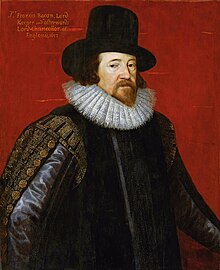
Achievements: Major advance in knowledge management
Born: January 22, 1561; London, England
Died: April 9, 1626; London, England (Aged 75)
Field & Discipline: Law; Politics; Literature; Philosophy
Language: English
Education: Trinity College; Cambridge University
Major Work:
"Essays" (1597-1625)
"New Instrument for the Interpretation of Nature and the Discovery of Truth" (1620)
Life & Times:
Bacon studied law in London and qualified as a barrister in 1582. Two years later he entered Parliament. He was also making his mark at court and became an adviser and friend to the queen's favourite, the [a pal of] Earl of Essex*. Over the next five years, Essex, and other of Bacon's friends such as [a pal of] Fulke Greville* who were favoured by the queen, pleaded with her to favor Bacon but failed. In 1597 he published the first edition of his "Essays," which remains among the most popular of his works. When Essex was in trouble in 1598, Bacon was genuine in his attempts to help him, but when Essex led an armed rebellion against Elizabeth and her advisers in 1601, Bacon drew up an official declaration of Essex's treason. He was rewarded by being given part of the huge fine imposed on [shared fine levied on] Catesby* for his part in the rebellion. After Essex had been executed Bacon was seen by some as having taken part in his former friend's downfall and he wrote an "Apology" justifying his actions. Like all his work, Bacon's "Apology" took a dispassionate tone and he certainly revealed no grief for Essex.
James I succeeded Elizabeth in 1603 and Bacon bombarded the new regime with requests for favor. He got a knighthood in 1603 and the following year was made king's counsel in parliament. He was also made a commissioner on the enquiry into the union between the Scots and English kingdoms. Meanwhile, he had the idea of writing a review, classification and methodization of all knowledge, as had been suggested by [inspired by] Da Vinci* in the fifteenth century. Bacon was disenchanted with the accepted Scholastic view and wanted to restate the objectives of knowledge and the way in which knowledge should be acquired.
In 1605 he published his "Advancement of Learning", the first major work of philosophy to be written in English. Scholasticism took knowledge to be a body of inherited wisdom to be learned through the study of texts and through debate. Bacon saw knowledge as something which could be learned through observation and experiment and the employment of all the senses. In this he anticipated the philosophy of [anticipated] Descartes*. In 1607, Bacon's efforts in Parliament to push through the king's wish for union with Scotland were rewarded with an appointment as Solicitor General. He was still, however, outside the most powerful political circles.
In 1609 he wrote "The Wisdom of the Ancients" in which he gave practical explanations for ancient myths. He was at last made Attorney General in 1613. King James liked Bacon because he believed in upholding the authority of the Crown. His maintenance of the royal prerogative brought Bacon up against Edward Coke, the advocate of common law, and in 1617 he replaced Coke as Lord Keeper of the Great Seal. The next year Bacon became Lord Chancellor and Baron Verulam.
Over the years, he been preparing to write his definitive work on the new philosophy of knowledge and in 1620 he published what he considered to be his most important work: "New Instrument for the Interpretation of Nature and the Discovery of Truth." In this famous book, Bacon states his opposition to [opposed system of] Aristotle’s* thought and discusses the obstacles to true knowledge thrown up by scholasticism, subjectivity, lack of rigor in classification, and reliance on tradition. He also sets out his method for acquiring natural knowledge, a method based on an empirical approach based on observation and experiment. The book was warmly received by scholars and intellectuals at home and on the continent. Bacon was now at the height of his career and he entertained on a grand scale in London and at his country house in Hertfordshire.
In 1621 he was elevated to the rank of viscount but the parliament of that year signaled the beginning of his downfall. Thanks to his alleged involvement in corruption, he was refused an audience with James, and resigned. The Commons barred him from parliament and from holding further state office. He was imprisoned in the Tower for a short while and on his release retired to Hertfordshire. His literary output now became prolific. He wrote a history of Henry VII, began one of Henry VIII, and drafted a history of Great Britain.
In 1623 he published "De Argumentis Scientiarum", an expanded version of "On the Advancement of Learning" version translated into Latin. He completed two of the natural histories he planned - "History of the Winds" and "History of Life and Death" and a philosophical romance about a College of Thinkers entitled "New Atlantis". In 1625 a new enlarged edition of his "Essays" came out. Bacon died after catching cold when he got out of his carriage in freezing weather to buy, kill and stuff a fowl with ice in an experiment concerned with stopping putrefaction.
Extra Connections: Inspired the foundation of the [inspired] Royal Society*.
His work was later used by [a resource for] Smellie*
Knew of [knew about] camera obscura*
Influenced [influenced] Sprat*
Was a patron of [a patron of] Selden*
Used as a resource by [a resource for] Izaac Walton*
Collaborated with [worked with] Hobbes*
Was a friend of [a pal of] D North*
Influenced by [influenced by] Montaigne*
Assessment: His philosophy of science provided a base for experimental science later in the century.
Oneliner: Francis Bacon, early knowledge-management pioneer
Bibliography:
- Bowen, Catherine Drinker, Francis Bacon, The Temper of a Man, Fordham University Press, New York, 1993.
- Quinton, Anthony, Francis Bacon, Oxford University Press, Oxford, 1980.