Gothic Revival
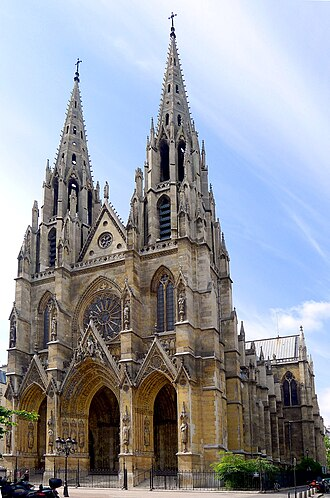
NAME: Gothic Revival
LANGUAGE:
English (and French and German)
TIME:
C1750-1900
LOCATION:
Britain, Europe and United States
CATEGORY:
Architectural movement
DISCIPLINE:
Architecture
SHORT DESCRIPTION:
An 18th –19th century revival of the medieval style of architecture
DESCRIPTION:
The Gothic Revival was initially an eighteenth-century reaction to the neoclassical architecture which had been in vogue since the mid-seventeenth century.
By the middle of the eighteenth century Gothic style was becoming popular in Britain. It was used, for example, by the landscape artist <used by> Kent* who rebelled against the formal garden. Most ruins in Britain were medieval and the addition of a Gothic ruin became associated with romance and mystery.
The earliest documented Gothic ruin was a 'medieval' castle built in England by an amateur architect, Sanderson Miller, in 1746. His ruined castles became so popular as picnic destinations and romantic additions to country estates that he was snowed under with commissions.
Despite its associations with melodramatic literature and gloomy grottos and ruins, Gothic style was also used to add lightness with its pointed windows, arches and tracery. <made fashionable by> Horace Walpole*, the English writer and wit, was one of those who was impressed by Miller's work, and Walpole's country house in the Gothic style at Strawberry Hill made Gothic villas socially acceptable.
The magnificent Fonthill Abbey, the home of William Beckford (built by James Wyatt) is the outstanding example of English Gothic architecture in the 1790's.
Until about 1820, most Gothic architecture in England was found in the private houses of the rich. New money used it to suggest a long line of aristocratic ancestors; esthetes devoted themselves to every detail and searched to reveal the rules to underpin Gothic architecture.
While the British liked the emotional impact of Gothic and connected it with British history, the French were drawn to Gothic by its lightness and were fascinated by the technical complexities of the structure. In 1741 the French architect Soufflot made drawings of Gothic buildings and analysed the optical process by which their structure seemed lighter than it was. After the French revolution, Gothic architecture enthusiasts focussed on the restoration of Gothic churches.
To Germans, Gothic art blended perfectly with the "Sturm und Drang" philosophy of <a supporter was> Herder* although they took longer than the British to accepted the Gothic as a national style. It was during the nineteenth century that the Gothic revival reached its height and it was used mostly in ecclesiastical architecture.
In 1818 the Church Building Act was passed in Britain. As a result, two hundred and fourteen churches were erected of which a hundred and seventy-four were built in the Gothic style. In 1834 the Old Palace at Westminster, London was destroyed by fire and Britain needed a new Parliament building. It was built in the Gothic style, designed by <style used by> Barry* in association with <style used by> Pugin* and was the greatest Gothic Revival project in England. In a late-flowering of Gothic style, 1871-2, Sir George Gilbert Scott built the Law Courts building in London.
Prior to 1840, there were very few new French buildings in Gothic style until <admired by> Merimee* gave <style used by> Viollet-le-Duc* the task of restoring the church of La Madeleine at Vezelay in 1840. In 1845, Gothic was made acceptable when Viollet-le-Duc restored Notre Dame in Paris and was asked to design a new sacristy building in the Gothic style. Over the following thirty years, he restored numerous castles and churches. In Germany, railway stations, churches and the town hall of Munich were built in the Gothic style. The Germans also wanted a national monument and decided on the completion of the unfinished Cologne cathedral. It was regarded as the greatest example of Gothic art by the British as well as the Germans, and was even praised by the French. The project was begun in 1841 and finished in 1880.
<major fan was> Ludwig II* of Bavaria, later became famous for building extravagantly romantic castles.
In the United States, the Gothic style was first adopted idiosyncratically by the rich for their mansions, but the style of American Gothic became more architecturally correct with the building of St Patrick's Cathedral in New York (1859-79) and Gothic style came to dominate public buildings.
EXTRA CONNECTION: <promoted by> Airy* and <promoted by> Sir Edmund Beckett*
Promoted as national project <promoted by> Ruskin*
ONELINER: Gothic Revival, an 18th –19th century revival of the medieval style of architecture
BIBLIOGRAPHY:
Clark, Kenneth, The Gothic Revival, An Essay in the History of Taste, John Murray, London, 1962
Germann, Georg, trans. Onn, Gerald, Gothic Revival, in Europe and Britain: Sources, Influences and Ideas, Lund Humphries with the Architectural Association, London, 1972.
Gothic Revival architecture - Wikipedia