Ruskin
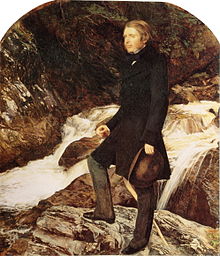
Achievements: Major influential critic on art and architecture
Born: Feburary 8, 1819; London, England
Died: January 20, 1900; Coniston, Lancashire, England. (Aged 81)
Field & Discipline: Art; Architecture; Writer; Critic
Language: English
Education: Christ Church, Oxford
Major Works:
“Modern Painters” (1843-1860)
“The Stones of Venice” (1851)
Life & Times:
During his first year at university, Ruskin had suspected tuberculosis and spent the winter of 1840-41 in Italy, where he studied art and architecture in Florence, Siena, Rome, Naples and Venice. After he returned to England Ruskin settled down to write a book on landscape art in which he discussed the relation between real landscapes and their depiction by landscape artists. He gave highest praise to [a pal of] Turner*, who he had got to know, and who summed up for Ruskin the relation between art and the exquisite beauties of nature. The book was published in May 1843 as the first volume of a series entitled “Modern Painters” and although Ruskin was only twenty-four it was extremely well received.
In 1845 he hired a guide and traveled on foot in the Swiss and Italian alps where he made numerous sketches of scenes drawn by Turner. On his return he finished the second volume of “Modern Painters” in which he analyzed ideas of beauty and in which reflected his new passion for Italian art (with [a fan of] Tintoretto* and Fra Angelico replacing Turner and the divinity of nature).
In 1848 Ruskin married a young girl called Effie Gray. The marriage, which was never consummated, was not successful. Ruskin was now focusing on architecture and had begun to study Gothic styles. He had doubts about the [promoted] Gothic Revival*, insisting that architecturally accurate Gothic features could not just be added to contemporary buildings. [opposed views of] Pugin*, the leading architect of the Gothic Revival in England, was a enthusiastic Catholic convert, and Ruskin worked to counter his views by promoting the idea of a Gothic Revival as a national and secular project.Ruskin believed that the architecture and art of a nation was a moral indicator of the ethical state of the nation, and that during the Renaissance there had been a separation from nature that resulted in barren architecture. Similarly, the industrial age had introduced brutal ugliness.
For Ruskin, the Middle Ages symbolized the highest point of art. His view of the medieval town was one in which beautiful buildings, paintings and carvings were produced by artists working freely and in harmony for the good of society. He also believed that the attitude of the craftsman involved in a work of art is of supreme importance. He wrote that “the right question to ask, respecting all ornament, is simply this: Was it done with enjoyment – was the carver happy while he was about it?” These views were set out in “The Seven Lamps of Architecture” (1849) and in what has become his best-known and most enduring work, “The Stones of Venice” (1851-3). “Stones” was a work of brilliant scholarship, was written after a long stay in Venice during which Ruskin made an exhaustive study of the city’s buildings and its history.
Ruskin publicly defended the work of a group of artists in England known as the Pre-Raphaelites who painted idealized medieval scenes. They contacted him and he met [influenced] Burne-Jones*, [influenced] Hunt* and [influenced] DG Rossetti* . Effie fell in love with another Pre-Raphaelite, [wife left him for] Millais*, and in 1854 her marriage to Ruskin was annulled and she married Millais.
The Oxford Museum of Natural History was designed according to Ruskin’s ideal of Gothic architecture and through this project Ruskin met [influenced] William Morris*, another Pre-Raphaelite and one of his disciples. His circle of friends also included writers [a pal of] Carlyle* and [a pal of] Robert Browning* and [a pal of] Elizabeth Barrett Browning*. His travels had woken a social conscience in Ruskin and he wrote a series of essays in 1861, influenced by the ideas of the social reformer [influenced by] Robert Owen*, on the nature wealth in which he rejected the ideas of the classical economists like [rejected views of] Adam Smith* and [rejected views of] John Stuart Mill*. When “The Cornhill Magazine” began to serialize them, there was such an outcry that the editor, [essays discontinued by] Thackeray*, refused to continue to print them.
In 1869 he was appointed the first Slade professor of fine art at Oxford and became a great success as a lecturer although he was in conflict with the Oxford esthetes led by [opposed views of] Pater*. Ruskin was supported by the mathematics fellow, CL Dodgson (Lewis [supported by] Carroll*) in his opposition to the proposal that science students should be allowed to drop study of the classics.
He established a drawing school for students and donated prints, photographs and drawings for them to study. He wanted to educate the public about art and the relation between art, architecture and the nation’s morality and did so in a series of essays published in “Time and Tide” (1867) and in a publication called “Fors Clavigera” (1871-84).
In 1871, Ruskin bought a house overlooking Coniston Water in the Lake District and gradually spent more of his time there. By now Ruskin’s own mental health was insecure and he was sued for defamation by the artist [was sued by] Whistler*. In 1878 Ruskin suffered an attack of mania and the following year resigned his professorship at Oxford. He corresponded with physicist [corresponded with] Lodge* on recent scientific developments, and wrote to protest at the sale of London Zoo’s elephant “Jumbo” to the American circus owner, [opposed elephant sale to] Barnum*. His last work was his autobiography “Praeterit” (1885-89).
Extra Connections: Met [met] Sorby*and [met] Henry James*
He frequently visited [frequent visitor to] Doulton’s* works
He admired [a fan of] Saussure*
He was a pal of painter JMW [a pal of] Turner*
Assessment: Ruskin was the most influential writer on art and architecture of his time.
Oneliner: John Ruskin, most influential Victorian art critic
Bibliography:
- Hunt, John Dixon, The Wider Sea, A Life of John Ruskin, JM Dent & Sons Ltd., London, 1982.
- Kemp, Wolfgang, The Desire of My Eyes, The Life and Work of John Ruskin, Harper Collins, London, 1991.
- Rosenberg, John D.,The Darkening Glass, A Portrait of Ruskin’s Genius, Columbia University Press, New York, 1986.
Father: John James Ruskin
Mother: Margaret Cox
Siblings: None
Spouse: Euphemia (‘Effie’) Gray
Children: None