Forster G
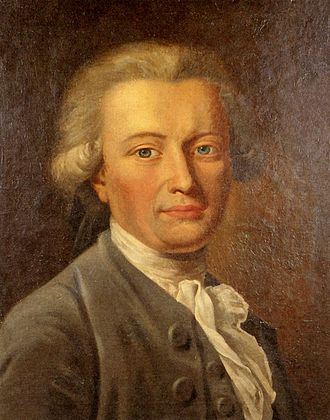
Name: Johann Georg Adam Forster
Nickname/Alias: George
Achievements: Started literary-scientific travel books
Born: November 26, 1754; Nassenhuben, near Danzig, Prussia
Died: January 10, 1794; Paris, France (Aged 39)
Field & Discipline: Natural History; Naturalist; Travel Writer
Language: German; Polish; English
Father: Johann Reinhold Forster
Mother: Justina Elisabeth Nicolai
Siblings: Six
Spouse: Therese Heyne
Children: Therese
Education: Tutored by father; Petrisschule, St. Petersburg
Major Work:
"Views of the Lower Rhine"
Life & Times:
Forster was born into a family of British Protestants who had fled to Germany in the 17th century for political reasons. He was the eldest of seven children born to [father was] Johann Reinhold Forster*, a well-known naturalist and minister of the reformed church. In 1766, his father took Forster for a journey on the Volga, where they studied the climate and the terrain, and then to London.
By 13, Forster had mastered English and published a translation of Michael Lomonossof's "Chronological Abridgement of Russian History.” Forster's father quickly made a name for himself in scientific circles in London.
On the recommendation of influential friends, his father was asked to replace [replaced] Banks* as naturalist on [voyaged with] Cook*'s second voyage to seek the (nonexistent) "southern continent" in the Pacific. Forster went along on the trip and for three years, from 1772 to 1775, he and his father painstakingly recorded their botanical observations. A year after they were back in London, they published "Characteres generum plantarum,” a preliminary account of the specimens they had found.
In 1777, the younger Forster published his first major work, "A Voyage Round the World,” in two volumes, which was a resounding success. (The elder Forster's more scholarly work, "Observations Made during a Voyage Round the World" was published in 1778.) Deliberately avoiding his father's pedantic approach, Forster started a new genre of literary-scientific travel narratives, later developed by [anticipated] Alexander von Humboldt*. In the same year his book was published, the 23-year-old Forster was elected Fellow of the [fellow of] Royal Society*.
In 1778, Forster returned to Germany to take the job of professor of natural history at the Collegium Carolinium in Kassel, where he met prominent men of science and letters, including [met] Blumenbach*. In 1784, Forster was appointed professor of natural history at Vilna, Poland.
In 1786, he published his dissertation, "De plantis esculentis insularum Oceani Australis commentatio botanica" and "Florulae insularum Australium prodromus,” and also engaged in an argument with German philosopher [argued with] Kant* on his theory of the origins of man.
Also in 1786, he published the essay, "Australia and the British Colony in Botany Bay,” which enthusiastically supported Britain's intention to send convicts to Australia to start a new colony.
In 1787, Forster published a German translation of the journals of Captain Cook's fateful third voyage, during which Cook was killed by natives of Hawaii. The volume began with a long preface, entitled "Cook, der Entdecker” (Cook the Discoverer). In 1788 Forster was appointed librarian at the University of Mainz, Germany, where he started a translation service. He would farm out books to trusted translators, edit their work, and add prefaces.
In 1790, Forster and von Humboldt made a long trip through Germany, Belgium, Holland, and France to England, after which Forster published his most important prose work: "Views of the Lower Rhine.”
During the early 1790s, Forster published his translation of the Indian drama "Sakontala,” translating it from the English translation of [translated the work of] Sir William Jones*, who had translated it from the original Sanskrit.
Forster's translation deeply influenced [big influence on] Herder*, who developed a passion for the work and issued a second edition after Forster's death. Forster's work also inspired [inspired] Friedrich Schlegel*, who undertook a philological study of Indian languages.
In 1792, after the capture of Mainz by Napoleonic troops, Forster got deeply involved in political affairs. He joined the Jacobin Club and became a member of a provisional French administration. In early 1793, the French occupation held elections in Mainz and Forster won a seat.
A month later, when the Rhenish National Convention proclaimed independence, Forster was sent as a Rhineland deputy to the National Convention in Paris. However, in April the Germans besieged Mainz, and Forster prudently remained in Paris, where he had a stroke and died
Extra Connections: Another Sanskrit scholar was [work related to] De Chezy*
He knew [knew] Joseph Priestley*
Assessment: Did much to convey to the German academic world the significance of advances in the geographic and biological sciences
Oneliner: JR Forster, early German travel writer
Bibliography:
- Dictionary of National Biography.
- Dictionary of Scientific Biography.
- Saine, Thomas P., Georg Forster, New York: Twayne Publishers, Inc., 1972.