Forster JR
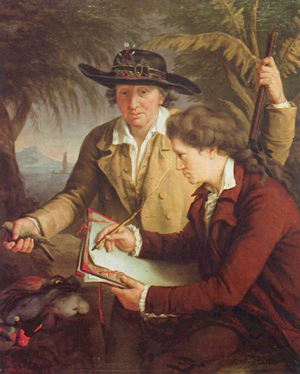
NAME: Forster, Johann Reinhold (left)
ACHIEVEMENT(S): Naturalist on Capt. Cook's second voyage
NICKNAME/ALIAS: None
DATE AND PLACE OF BIRTH: October 22, 1729, Dirschau, [now Tczew], West Prussia [now Poland]
DATE/PLACE OF DEATH/AGE AT DEATH: December 9, 1798, Halle, Germany. Aged 69
DISCIPLINE: Scientist/Geographer
FIELD: Science/Geography
LANGUAGE: German, English
PARENTS: Georg Reinhold Forster; Eva Wolf Plaht
SIBLINGS: None
SPOUSE: Justina Nicolai
CHILDREN: Johann Georg; Carl Reinhold; Virginia Viktoria; Antonia Elisabeth; Wilhelmina Concordia; Carl Anton; Justina Regina
EDUCATION: Rektor Swiderski Latin School; Marienwerder Gymnasium; Joachimsthal-Gymnasium, Berlin; University of Halle, Germany
MAJOR WORK: "Observations Made during a Voyage Round the World"
LIFE AND TIMES:
Forster was born into a well-to-do British family that had emigrated to Germany c. 1642. At 19, he enrolled in the theology course at the University of Halle where he studied oriental and classical languages and attended lectures in natural science. Two years later, he became a "Kandidat" (ordinand) in the reformed ministry of Danzig.
In 1753, Forster accepted the position of parson at Nassenhuben, southeast of Danzig, where he stayed for 12 years. He set up a large library and studied chronology, ancient history, geography, and Ancient Egyptian. In 1765, the Russian government in St. Petersburg hired him to travel to Saratov on the Volga River to check up on the newly-established German colonies.
Forster took along his 10-year-old son to help him make scientific and geographical observations, and left his pregnant wife and five other children behind. Throughout the 2,500-mile trip, Forster and his son collected about 700 specimens of plants, which they categorized and named. They made observations on the terrain, animals, climate, people, and production. Forster also made meteorological observations for the Russian Academy of Sciences in St. Petersburg and eventually provided it with a remarkably accurate map of the area, which was published in "Philosophical Transactions" in 1768.
Back from their trip six months later, Forster and his son stayed in St. Petersburg another nine months, then, without returning home, made their way to England. In London, Forster met Andrew Planta, an assistant keeper and librarian of the British Museum, who introduced him to Daniel Carl Solander, also at the British Museum, who was cataloging the natural history collection.
Within a few months, Forster was established in London, dining with <a pal of> Franklin* and <a pal of> Banks* at the Society of Antiquaries, and in 1767, succeeded <succeeded> Joseph Priestley* as tutor at the Dissenters' Academy for the children of free-churchmen in Warrington, Lancashire.
At Warrington, Forster taught natural history and classical and modern languages, and in 1768 published "An Introduction to Mineralogy". But an argument with the head teacher led to his dismissal in June, 1769.
Forster returned to London and in 1770 published "A Catalogue of British Insects", followed a year later by works on American flora and entomology. In 1772, the Royal Society of London asked Forster to describe a natural history collection presented by the <described collection of> Hudson's Bay Company*.
The resulting papers on zoology, ornithology and ichthyology were published in the "Philosophical Transactions of the Royal Society" in 1772-73. In February, 1772, he was elected fellow of the Royal Society.
In June, 1772, Forster and his son (<son was> Johann Georg Adam Forster*) were appointed to accompany <sailed with> Cook* as naturalists on his second expedition to find the (non-existent) "southern continent." They took the job on 10 days' notice after Banks backed out over a disagreement about accommodations. Now talented botanists, the Forster’s submitted such a fine report on the flora in the Pacific basin that it became the basis for the systematic botanical knowledge of that region.
In 1776, the Forster’s published "Characteres generum plantarum", a small preliminary description of the flora on the voyage, but Forster's most significant work about the voyage was his "Observations Made during a Voyage round the World" (1778), a description of the anthropological, geographical, botanical, zoological, and oceanographic phenomena he had seen.
Eventually, Forster quarreled with the British Admiralty over publication rights to his findings on the voyage, and in 1780, he returned to Germany. In Halle, he became a professor of natural history and mineralogy and published a number of works on zoological subjects, a number of them connected with the Cook voyage.
In 1784, he published a history of northern maritime discovery, and from 1790, edited a magazine which dealt with important scientific voyages. In 1798, shortly before his death, he published an essay outlining his theory of the history of the earth.
ASSESSMENT: A major figure in early environmental studies.
EXTRA CONNECTIONS: Was influenced by <influenced by> Luther*.
Forster was elected a member of the American Philosophical Society in 1793
Anticipated the scope and methods of German naturalist <anticipated> Alexander von Humboldt*.
Also influenced the work of <influenced> Blumenbach* and the science of comparative anthropology.
BIBLIOGRAPHY:
DSB
Hoare, Michael E., The Tactless Philosopher: Johann Reinhold Forster, Melbourne: Hawthorn Press, 1976 .
Johann Reinhold Forster - Wikipedia