Priestley, Joseph
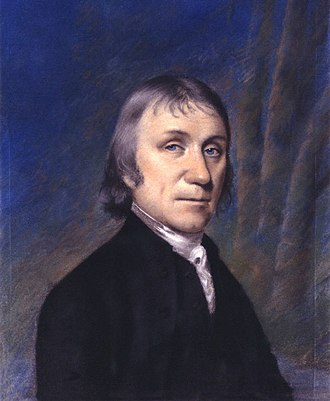
Achievements: Co-discovered oxygen
Born: March 13, 1733; Birstall Fieldhead, near Leeds, Yorkshire, England
Died: February 6, 1804; Northumberland, Pennsylvania (Aged 70)
Field & Discipline: Science; Physics; Chemistry; Politics; Physical Scientist; Political Theorist
Language: English
Father: Jonas Priestley
Mother: Mary Swift
Siblings: Timothy; Joshua; Mary; Martha; three half-sisters
Spouse: Mary Wilkinson
Children: Sarah; Joseph; William; Henry
Education: Batley Grammar School, Leeds, Eglan; Daventry Academy, Daventry, England
Major Work:
"Experiments and Observations on Different Kinds of Air" (six volumes)
Life & Times:
After leaving Daventry Academy at 22, Priestley became assistant minister to the independent Presbyterian congregation in Needham Market, Suffolk. But a stammer and his unorthodox opinions eventually lost him his congregation and three years later, he transferred to a more sympathetic congregation in Nantwich, Cheshire, where he opened a day school with 36 students.
Always interested in science, he provided his pupils with what he called "philosophical instruments": an air pump and a static generator for electrical demonstrations. The success of Priestley's day school led to an appointment as tutor of languages and literature at the recently-founded Dissenters’Warrington Academy in Lancashire. Dissenters were free-church members who dissented from the requirement to take an oath of allegiance to the crown and as such, people like Priestley and his pupils were not allowed into the universities, Parliament, or professions.
Priestley developed courses that would provide a suitable living in industry and commerce, with the emphasis on history, science, and the arts rather than the classics. Since basic textbooks were not available, he wrote and published the "Rudiments of English Grammar" (1761) and "A Course of Lectures on the Theory of Language and Universal Grammar" (1762).
In 1762, Priestley was ordained a minister at Warrington, and in the same year married [married] Mary Wilkinson*, the sister of the great ironmaster [married sister of] John Wilkinson*.
During his years at Warrington, Priestley also wrote "Chart of Biography"(1765), "Essay on a Course of Liberal Education for Civil and Active Life" (1765), "Lectures on History and General Policy" (prepared 1765, published 1788), and "Essay on the First Principles of Government" (1768). British philosopher [influenced] Jeremy Bentham* claimed to have derived his Utilitarian formula ("The greatest happiness of the greatest number") from Priestley's "First Principles of Government."
From 1765, Priestley began to spend one month every year in London. He would seek out the leaders of science, for example, statistician [a pal of] Price* and American statesman [a pal of] Franklin*. On the strength of his electrical experiments, Priestley was elected a member of the [member of] Royal Society* of London in 1766.
The next year, he published "The History and Present State of Electricity," in which he summarized all that was known of electricity to that time and described his own experiments. The volume brought him praise from scientists all over the world, including Italian physicist [admired by] Volta*.
In 1767, Priestley became minister of the Leeds Presbyterian Mill-Hill Chapel and in his spare time began research into gases. He lived next to a brewery and observed "fixed-air"(carbon dioxide) as it effervesced from vats of fermenting liquor. At the time, only three gases were known:- air, carbon dioxide, and hydrogen.
Over the next six years Priestley discovered four new "airs":- nitric oxide (nitrous air), nitrogen dioxide (red nitrous vapor), nitrous oxide ("laughing gas"), and hydrogen chloride (marine acid air).
His success was in large part due to his ability to design and use ingenious laboratory apparatuses, in particular an improved pneumatic trough. By collecting gases above mercury in the trough, instead of in water, he was able to isolate those that were water-soluble.
His essay describing these gas experiments: "On Different Kinds of Air," and published in the Philosophical Transactions of the Royal Society in 1772, was read by French chemist [knew] Lavoisier*, who wrote a theoretical interpretation of Priestley's data.
Priestley's volume on optics in 1772: "History and Present State of Discoveries Relating to Vision, Light, and Colours" was an original contribution to optics, and brought an invitation from [knew] Banks* to join [nearly sailed with] Cook*'s second voyage of exploration (1773-75) as an astronomer.
Priestley was forced to decline when opposition mounted to his Unitarian views (his place was filled by [succeeded by] Johann Reinhold Forster*, who had succeeded him at Warrington, and his son [knew] Georg Forster*). However, Priestley's technique for "impregnating water with fixed-air (carbon dioxide)" was to be used to provide drinking water on the voyage, and later, [work related to] Schweppe* would use the invention to start the soda-water/soft drink industry with bottle caps invented by [work related to] Painter*.
In August, 1774, Priestley's made his most famous discovery, of oxygen, though he wasn't sure what he had discovered at the time. (A year or so earlier, oxygen was also discovered by the Swedish chemist and apothecary (co-discovered oxygen with] Scheele*). Priestley obtained the gas by heating red mercuric oxide, and discovered that a candle would burn in it "with a remarkably vigorous flame".
In October, 1774, Priestley accompanied his patron [patron was] Shelburne* on a trip to Paris, where he met Lavoisier and told him of his oxygen discovery. Lavoisier immediately repeated the experiment, and in 1775-80 conducted intensive investigations, from which he correctly deduced the elementary nature of oxygen, recognized it as the active "principle" of the atmosphere, interpreted its role in combustion and respiration, and in 1789, gave it its name.
Priestley did the majority of his scientific work in the 1770s, preparing five of the six major volumes of experiments with gases, and also producing his major philosophical works, including "Disquisitions Relating to Matter and Spirit" (1777) and the "Doctrine of Philosophical Necessity" (1777).
In addition to his discovery of oxygen, Priestley also described the isolation and identification of ammonia, sulphur dioxide, silicon tetrafluoride, nitrogen (also discovered by Daniel Rutherford in 1772), and a gas later identified as carbon monoxide. Of striking significance was his observation that light was important for plant growth and that green plants gave off oxygen.
These observations became fundamental to the systematic work on photosynthesis by Dutch physician Jan Ingenhousz (begun in 1779) and by the Swiss clergyman-naturalist [influenced] Senebier* over the next two decades. Priestley decomposed ammonia by employing electric sparks and noticed that a dew was formed when mixtures of hydrogen and oxygen were exploded.
In 1780, Priestley moved to Birmingham to live with the Wilkinson’s. He joined the Lunar Society, an informal group of intellectuals, scientists and industrialists which met monthly on the evening of the full moon (when night roads were well-lit). Acting independently of the Royal Society of London, this provincial group between 1766 and 1791 actively promoted science and its applications to industry and crafts. Through this group, Priestley met naturalist [club member with] Erasmus Darwin*; pottery manufacturer [club member with] Wedgwood*; and steam engine inventor [club member with] Watt* and his partner [club member with] Boulton*.
In the years before the French Revolution, Priestley made it no secret that he supported revolutionary principles, being a powerful advocate of civil and religious liberty. This position angered the anti-revolutionary consensus in England, and when Priestley publicly disagreed with British statesman Edmund Burke's anti-revolutionary "Reflections on the Revolution in France" (1790), a Birmingham "Church-and-King" mob destroyed his house, library and laboratory on July 14, 1791, the second anniversary of the storming of the Bastille in Paris.
Priestley accepted his losses with dignity and spent the next two years in London, where he taught history and science at the New College in Hackney, considered by many (including Burke) to be a hot-bed of republicanism.
In 1792, the French Assembly made him an honorary citizen along with [admirer of] Paine* and Jeremy Bentham, and also elected him to the National Assembly. The war with France put him in further disfavor and in 1794, he decided to emigrate to the United States to join his three sons.
Priestley and his wife settled in Northumberland, PA, where he was welcomed by various learned societies, including the American Philosophical Society. He was offered the chair of chemistry at the University of Pennsylvania, but declined. Although he did not become an American citizen and did not involve himself in political affairs, he was a friend of both John Adams and [a pal of] Jefferson*. Jefferson wrote of Priestley that was "one of the few lives precious to mankind".
Priestley continued to be vilified by the British, in particular by [attacked by] Cobbett*, although a new generation of admirers tried to revive his reputation, including authors [admired by] Wordsworth* and [admired by] Coleridge*.
Extra Connections: His work also related to that of:- [work related to] Acheson*; [work related to] Fullerton Baird*; [work related to] Belloc*; [work related to] Dalton*; [work related to] RowlandHill*; [work related to] FG Hopkins*, [work related to] Komensky*; [work related to] Silliman Snr*, [work related to] Coulomb*, [work related to] Cavendish* and [work related to] Montgolfier*
He was a friend of [a pal of] Richard Bright*
Visited [visited] D’Holbach*
Criticized [criticized] Gibbon’s* history.
Assessment: Though celebrated for his liberal religious and political views, was chiefly known for his scientific experiments and the discovery of oxygen.
Oneliner: Joseph Priestley, co-discoverer of oxygen and political radical
Bibliography:
- Encyclopedia Britannica.
- Dictionary of Scientific Biography.
- Dictionary of National Biography.
- Gibbs, F. W., Joseph Priestley: Adventurer in Science and Champion of Truth, London: Thomas Nelson and Sons, 1965.