Lee, Francis Lightfoot
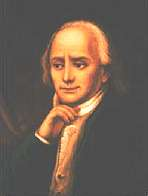
Francis Lightfoot Lee (October 14, 1734 – January 11, 1797) was a Founding Father of the United States and a member of the House of Burgesses in the Colony of Virginia.[1] As an active protester regarding issues such as the Stamp Act of 1765, Lee helped move the colony in the direction of independence from Britain.
Lee was a delegate to the Virginia Conventions and the Continental Congress. He was a signer of the Declaration of Independence and Articles of Confederation as a representative of Virginia. In addition to his career in politics, Lee owned a tobacco plantation as well as many slaves.[2] He was a member of the Lee family, a prominent Virginian dynasty.
Family, education and early life
 Coat of Arms of Francis Lightfoot Lee
Lee was born on October 14, 1734, at Stratford Hall Plantation, in Westmoreland County, Virginia.[3] Lee was the fourth son of Thomas Lee and Hannah Harrison Ludwell. His middle name "Lightfoot" came from Francis Lightfoot, the best man at his father's wedding.[4] He was of English descent and was born into one of the First Families of Virginia. He grew up at Stratford Hall, a large tobacco plantation,[5] which his father completed in 1738. He was educated at home, where Lee pursued classical studies under Dr. Craig.
In 1772, Lee married his cousin, Rebecca Plater Tayloe. They were 2nd cousins, once removed. they had no children. Lee lived his entire life in the region of Virginia between the Rappahannock River and the Chesapeake Bay (known as the Northern Neck).
Lee was the grandson of Col. Richard Lee II and a great-grandson of Col. Richard Lee I. Senator Richard Henry Lee and diplomats William Lee and Dr. Arthur Lee were his brothers. Another brother, Thomas Ludwell Lee, was appointed to a committee, along with Thomas Jefferson, to re-write the laws of Virginia. His namesake Francis Lightfoot Lee II was the son of his brother Richard Henry Lee, and men of the same name descend from him.
Political career
In 1774, Lee was among those who called for a general congress and the first of the Virginia Conventions, which he attended. He served in the Virginia State Senate from 1778 to 1782 and was a delegate to the First Continental Congress held in Philadelphia, serving until 1779. As a congressional representative of Virginia, he signed both the Declaration of Independence and the Articles of Confederation. He was elected to the American Philosophical Society in 1768.[6]
Death and legacy
Lee died of pleurisy at his residence (named "Menokin") in Richmond County, Virginia, on January 11, 1797, following his wife's death four days prior. He is buried in the Tayloe family burial ground at Mount Airy Plantation, near Warsaw, Virginia.[7]
The World War II Liberty Ship SS *Francis L. Lee* was named in his honor.
See also

Francis Lightfoot Lee - Wikipedia
===
AMERICAN CONNECTIONS
FRANK LEE (VA), aka Francis Lightfoot Lee, was
forty-one. The only mild-mannered member of an aggressive and outspoken
family of four brothers, after sixteen years in the Virginia House Frank
became a busy revolutionary responsible for army supply.
His brother Arthur was an entirely different kettle of fish. The
best-educated of the brothers (Eton, Edinburgh University, and the
London law school), Arthur socialized with the movers and shakers during
his years in Britain. In 1777 together with Franklin and Silas Deane he
acted as commissioner negotiating to buy French weapons. A year later it
was Lee who blew the whistle on what he thought was corruption (it
looked as if Deane was taking profit from the funds). It's possible that
Lee just misunderstood diplomatic wheels-within-wheels, but in any case
he was outmaneuvered by Franklin and recalled.
But unknown to the others Lee had spent the previous eighteen months
involved in cloak-and-dagger stuff (laundering war-finance money to
America) with the chief French undercover agent and fake aristocrat
Caron de Beaumarchais. Who had begun his career making wristwatches for
Louis XV's mistress. Then taught the king's daughters the harp. Then
wrote two plays: The Marriage of Figaro and The Barber of
Seville. Then turned deniable royal spy.
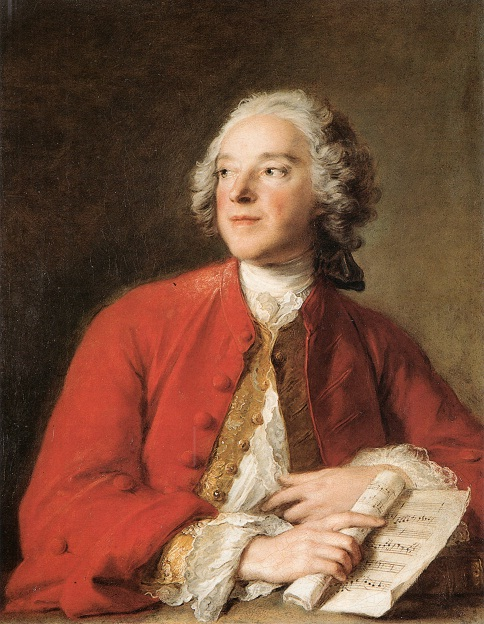
The king sent Beaumarchais to England, from where he reported that the
Brits secretly wanted to get rid of the American colonies. In an
associated bit of double-dealing, Beaumarchais arranged for the
high-tech ironmaking Wilkinson brothers (who also made cylinders for
James Watt's engines) to deliver forty miles of piping to the new Paris
water-supply company in which Beaumarchais himself had shares. The
"double" bit of the dealing was that the Wilkinsons' latest
cylinder-(and cannon-) boring machine would also be delivered, labeled
as "piping."
The French plan was that this cutting-edge machine would then be used to
make new cannon to replace the ones sent to the Americans under the
(first) secret deal brokered by Lee and Beaumarchais (who had set up a
fake company to charter forty ships to take guns, tents, ammunition,
gunpowder, and money to the Caribbean for onward shipment you-know-where
in exchange for sugar, cotton, tobacco, and rice from you-know-who). In
the end the return shipments never happened and the deniable
Beaumarchais lost a fortune. By convincing the committee not to pay its debt to avoid creating a trail that could reveal the Americans' dealing with the French to the British, Lee forced Deane, who eventually died trying to prove that he was owed his rightful compensation, into disgrace and poverty for years.
Meanwhile, by 1783 the Paris water supply system was up and running and
being tested by Charles Augustin Coulomb, physicist, military engineer,
and superintendent of water supply and fountains (at this time,
high-tech stuff). Over the years Coulomb put together more than three
hundred reports for the French Academy of Sciences on everything from
British hospitals to French canals, harbors, machinery, and engineering
projects in general. Later in life Coulomb would be a major influence in
setting up the French secondary education system. His fame, however,
rests on his work in electricity and magnetism and especially his
development of a gizmo for measuring electric charge. Which may be why
an electric charge is now measured in "coulombs."
Early in his career Coulomb also got to spend time on the Atlantic coast
(at Rochefort) working with the Marquis de Montalembert, inventor of a
new kind of fortress (old-buffer military fortress designers forced him
to delay design publication for fifteen years).
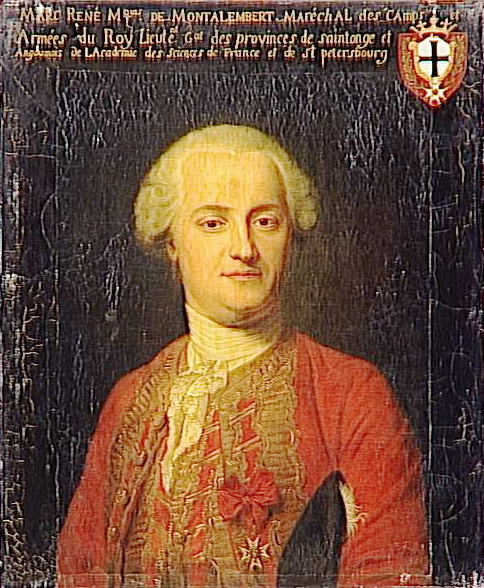
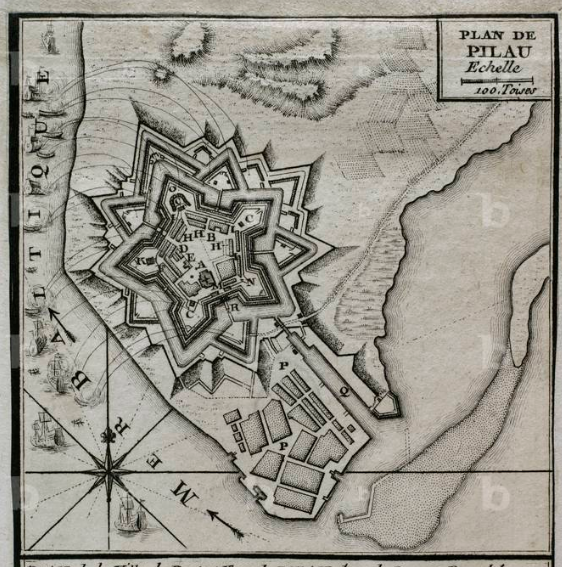
Montalembert changed the
shape of a fort from the previous complicated arrangement of bastions
and angled walls to a simple polygonal or even circular structure. Key
innovation: The fort was built to be aggressive, not defensive. Guns
were placed in enclosed positions (roofed against the downward killing
power of the new shrapnel) all round the fort, so as to be able to shoot
in any direction. Great for clobbering a passing fleet, when time to
shoot was short.
In 1807 New York Harbor this kind of ship-sinking trick was just right
for Lieutenant Colonel Jonathan Williams, looking for a way to
discourage any Brits who might be heading that way. His
Montalembert-inspired "Castle Williams" was circular, with two tiers of
protected cannon. And in terms of Brit discouragement Williams was
right.
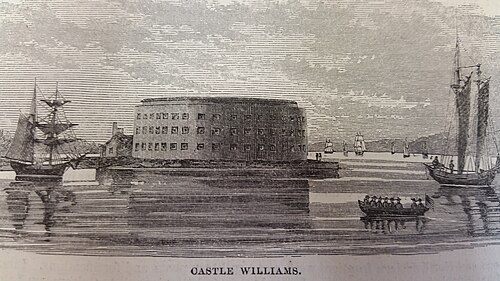
In 1812 the threat of Castle Williams's firepower persuaded the
Brits to bypass New York and set fire to some other city farther south.
Alas for Williams, he never got the credit he deserved. And worse, when
he was superintendent of West Point (where he modernized the curriculum)
and then at Castle Williams, regular army officers objected to having an
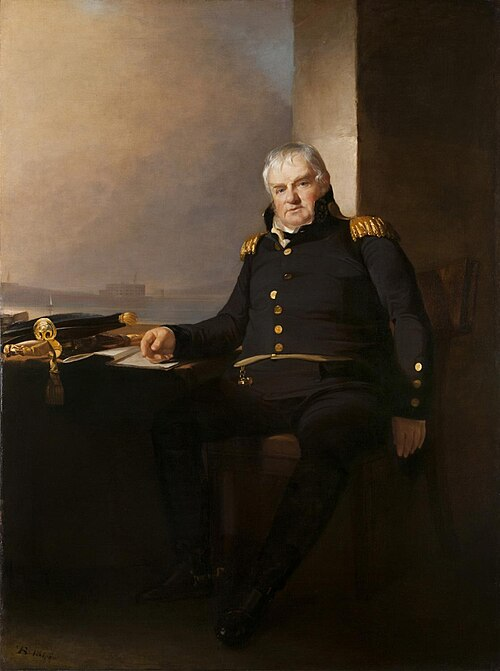
engineer in command. Williams retired and devoted himself to literary and scientific efforts: his Memoir on the Use of the Thermometer in Navigation was presented to the American Philosophical Society.
Williams's case wasn't helped by Secretary of War William Eustis,
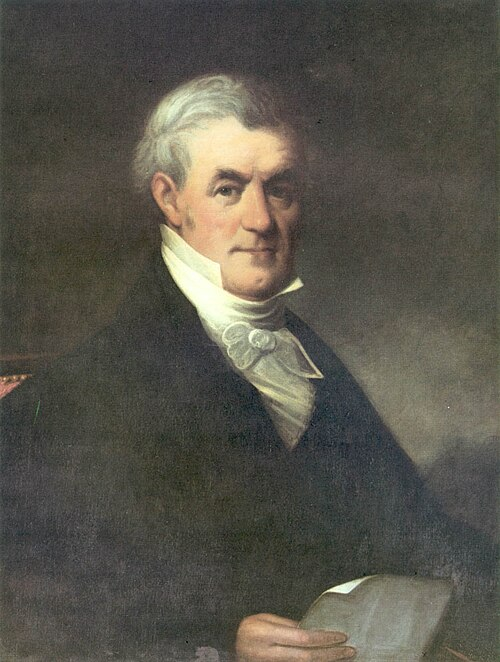
one of the least-qualified holders of the office in American history (though arguably better than Whiskey Pete). Eustis was a doctor (he treated Benedict Arnold's wife Peggy, who was seemingly hysterical over the sudden departure of her husband and the discovery of his plot) with limited military and political experience (as an army surgeon and in Massachusetts local government), appointed by Madison to reform the army. The new secretary proposed a publicly funded volunteer force of fifty thousand plus nine thousand extra infantry and several new military departments. He pushed ahead with equivocation and incompetence.
When war came in 1812 Congress was still arguing about Eustis's plans.
And thanks to his bumbling nothing was ready for the attack on Canada.
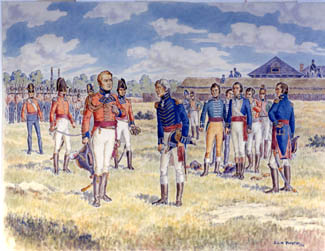
General Hull surrendered Detroit without a shot because Eustis hadn't
told him war was imminent.
Buffalo and Washington, D.C., were attacked
and burned. The country went into uproar and Eustis suddenly became
minister to Holland. The irony was that on June 18, 1812, when Madison
declared war, the immediate reason for the conflict (the British Orders
in Council preventing America from trading with France) had just been
provisionally repealed. But the news would take six weeks to get to the
United States, by which time it was too late.
The repeal of the Orders had been the result of lobbying in Parliament
by Henry Brougham, a brilliant young lawyer representing U.K.
manufacturers who were losing a bundle because the trade embargo was
being counter-enforced by the Americans.
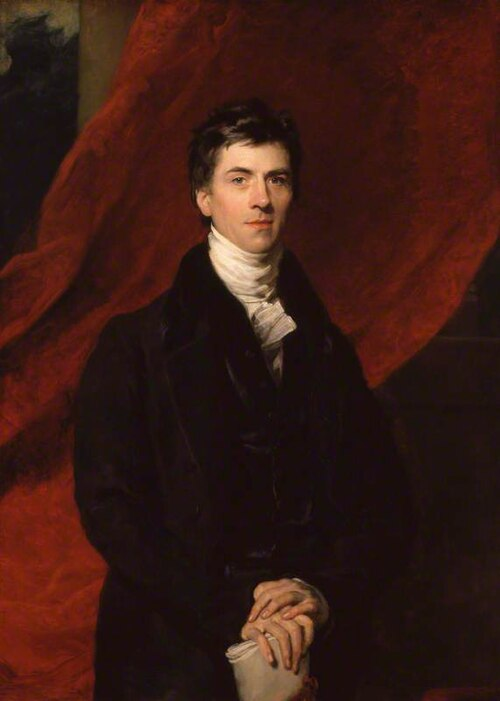
Brougham was a politico to his fingertips (opportunistic, depressive, boozer, eccentric, scheming, charismatic, hypochondriac) and argued for reform of Parliament,
antislavery laws, the legal profession, education, bankruptcy,
charities, and much else. He was also a founder of London University and
authored hundreds of articles in the Law Review. He also helped found the Edinburgh Review where, as a follower of Newton, he launched anonymous attacks against Thomas Young's research on light, settling science back by decades; he also went after astronomer William Herschel.
He also helped establish the Society for the Diffusion of Useful Knowledge, as well as holding some academic posts, including Rector, University of Edinburgh. In later years he spent much of his time in the French town of Cannes, making it a popular resort for the British upper-classes. And ended up lord chancellor (top lawyer), loved or hated.
Re love, Brougham had numerous affairs, the most widely publicized of
which involved a foreign holiday with Caroline Lamb (confusingly, a cousin of "mad, bad, and dangerous to know" Caroline Lamb). Lawyer George Lamb,
the cuckold in question and known by his mother as "unsatisfactory
George," was a red-faced, red-haired uncouth drunk (hence Caroline's
trip) who fancied himself as a dramatist and wrote unsuccessful Gothic
stuff full of brigands with daggers. In 1815 he was on the new
management committee of Drury Lane Theater when Byron showed him a play
he'd been sent by Sir Walter Scott (who was a financial supporter of the
author). Lamb loved it, and in 1816 Bertram hit the stage for
a sensational forty performances.
Bertram ( with Edmund Kean starring in the lead role) was to be the only great moment for Irish cleric and playwright Charles Maturin. Hugo and Dumas were fans, but Samuel Taylor Coleridge publicly denounced the play as dull and loathsome, and "melancholy proof of the depravation of the public mind",[14]^ going nearly so far as to decry it as atheistic. This meant no more spellbinding sermons, so he turned to novels (one with werewolves).
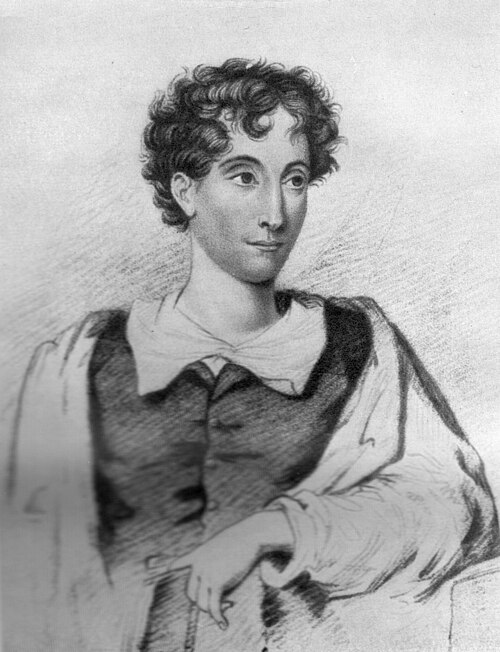
His other works (with Irish plots full of
coded references to English usurpers and invaders) pretty much flopped.
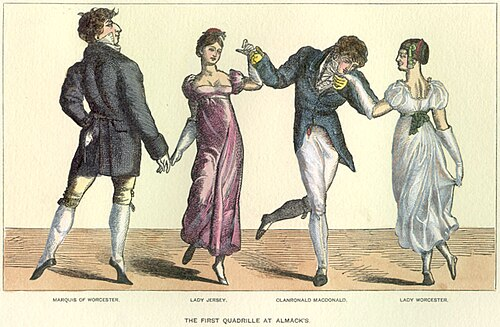
Maturin was an extravagant dresser and crazy for the quadrille.
Lewis Carroll lampooned the dance in "The Lobster Quadrille," part of his 1865 novel Alice's Adventures in Wonderland. Maturin would dance in the daytime with the curtains closed.
This unusual behavior was shared by his nephew's wife, Lady Jane Wilde,
who always closed the curtains when she entertained, dressed like a
tragedy queen in flowing silk, and wore so many portrait brooches she
looked like "a walking family mausoleum."
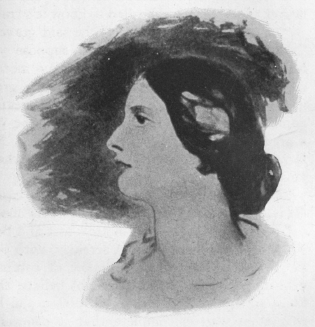
During the Potato Famine in 1846, Jane began to write the nationalist poems and prose that would make her famous. Six feet tall and strikingly handsome, she was an
active feminist, translator (said to have mastered ten languages by the age of 18), writer of travel books, pal of George Bernard Shaw and Yeats and above all, mother of Oscar. For
twenty years after her husband died bankrupt she eked out an existence
in London still holding weekly salons in the dark.
One of Jane's many admirers was William Hamilton, child prodigy math
nerd. By age thirteen he spoke French and Italian and could read
Persian, Arabic, Greek, Latin, Hindi, Sanskrit, Malay, and Hebrew (for
relaxation, he said). To the non-mathematician his work is total
gobbledygook. He invented quaternions (a major stage in the development
of algebra, it says here; it was thought that Carroll's The Mad Hatter was satire of them) and helped establish the wave theory of light (with Fresnel, no thanks to Brougham above).
He also developed some arcane mathematical thing known as a
"Hamiltonian." He was also the Irish royal astronomer at age twenty-one
and never did much.
But in 1839 he got the first look through the Earl of Ross's new giant
telescope. Ross was rich enough to have fun making giant telescope
mirrors. In 1844 he produced an even more giant scope known as the
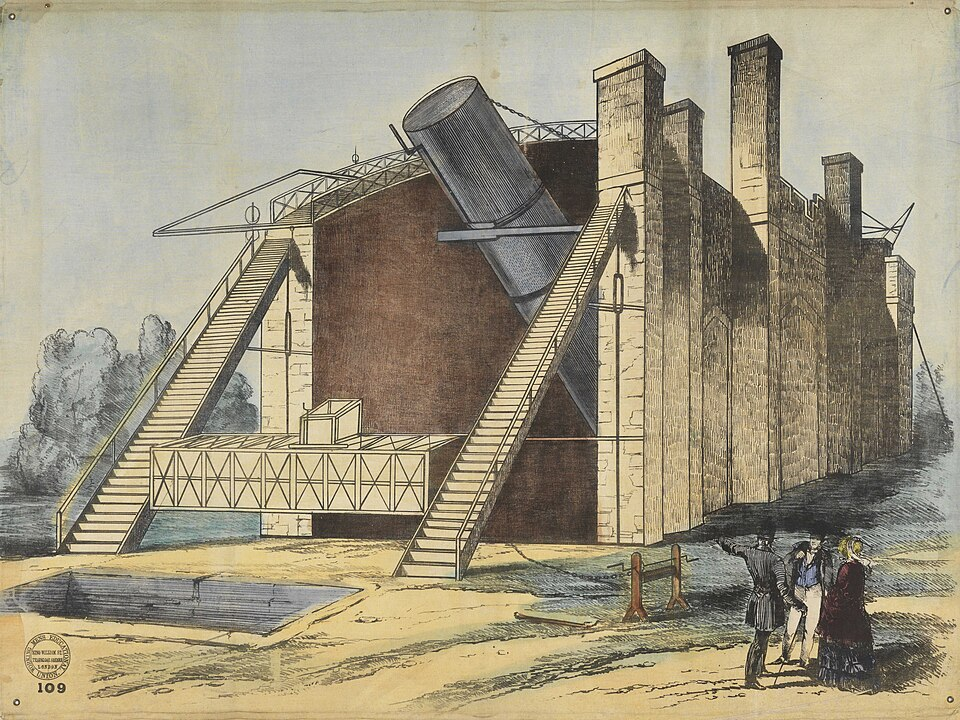
Carrying a six-foot mirror that took three years to
perfect, the telescope stood fifty-six feet high and was for sixty years
the biggest telescope in the world. First used in 1845; regular use waited another two years, due to the aforementioned Potato Famine.
Almost immediately it discovered the Whirlpool Galaxy Messier 51, gave the distinct impression that nebulae were actually dense star clusters, and seriously improved the study of the night sky. So Ross won prizes and the presidency of the Royal
Society.

Sixty years later his youngest son, Charles Parsons (aristocrats' titles
and their family names are often different; it's a Brit thing), was made
society vice president.
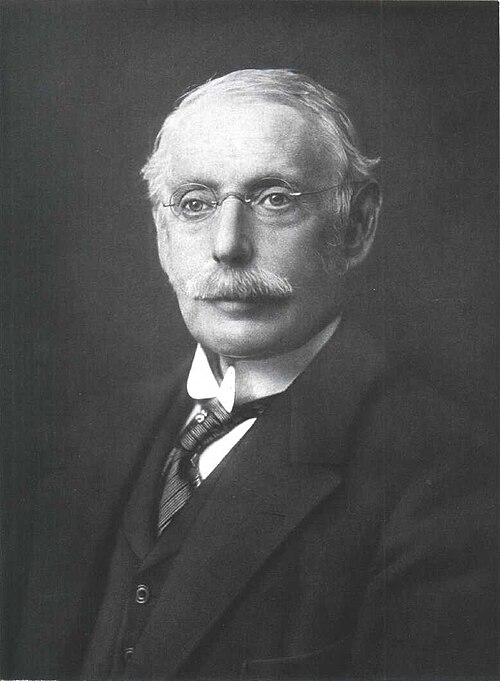
Parsons started out as an engineering apprentice, and by 1884 was so fed up with the clunky old steam engine that he developed a turbine alternative. High-pressure steam hit turbine blades mounted at an angle on an axle and made them spin eighteen
thousand times a minute (more than ten times the speed a steam engine
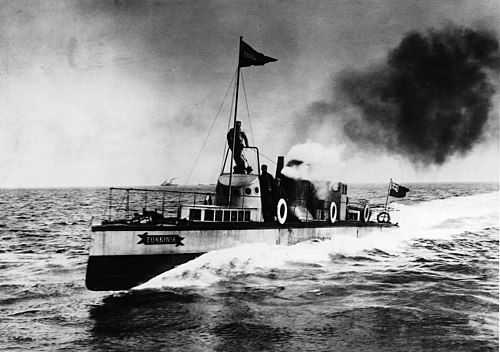
could achieve). By 1894 Parsons's spinning-axle turbine-powered
propellor-driven yacht Turbinia could reach thirty-four
knots. Faster than the fastest ship in the navy.
By 1899 Parsons had a turbine in a destroyer.
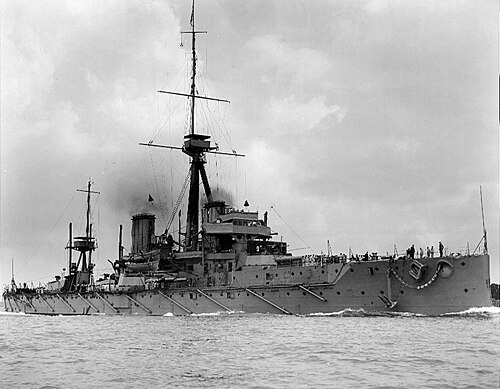
HMS Dreadnought, considered the first modern battleship. In 1906 it was the fastest in the world due to Parsons's steam turbine. He used gearing to slow turbine speed so it
could be used by cargo vessels.
Early on, Parsons also used his turbine to spin copper wire loops
through a magnetic field and generate electricity. In 1884 the license
for this clever trick was snatched up by American George Westinghouse,
at the time busy fighting the "War of the Currents." Westinghouse made
alternating-current electricity: The electron movement (electricity)
went back and forward in the copper wire as the spinning wire loops
"alternatingly" cut the magnetic field first one way then the other.
Westinghouse rival Thomas Edison's direct current used a commutator to
turn this two-way electron flow into "direct" one-way electricity.
Alternating current could be stepped up to high voltage, sent a long
way, and then stepped down again to usable levels. Direct current
couldn't. So Westinghouse was able to build large generating stations a
long way from cities and Edison wasn't. So Edison lost the
electricity-supply battle. Still, he was already a multimillionaire, so
what did he care.
In 1942 Edison's daughter-in-law (married to Charles Edison, then acting
secretary of the navy) sponsored the launch of the giant, Iowa-class
battleship USS New Jersey, which then went on to a distinguished fighting record in World War II, Korea, and Vietnam. In 1982 the ship had her final retrofit when she was provided with Harpoon and Tomahawk missiles.
Much of the success of the $467 million refurbishment was due to the
marine engineer and naval architect involved, FRANK LEE.