Herbart
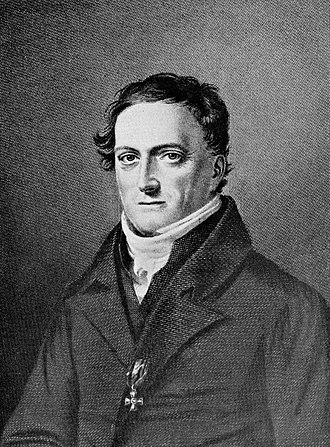
Name: Johann Friedrich Herbart
Achievements: One of the founders of modern scientific pedagogy.
Born: May 4, 1776; Oldenburg, Germany
Died: August 14, 1841; Göttingen, Germany (Aged 65)
Field & Discipline: Philosophy; Pedagogy; Philosopher; Pedagogue
Education: Oldenburg Gymnasium, 1788-94; University of Jena, 1794
Major Work:
“Universal Pedagogy” (1806)
Life & Times:
In 1794 at Jena, Herbart became an enthusiastic student and friend of the philosopher [a pal of] Fichte*. In 1797, before he had graduated, he took on a job tutoring the sons of a nobleman, Karl Friedrich von Steiger, who was the ruler of Interlaken, in Switzerland.Herbart was given complete charge of their education on the condition that he wrote a report to their father every two months.
This period of his life proved to be Herbart’s most important experience in teaching and the surviving reports that he wrote, which are among his most interesting works, contain some of his fundamental thoughts on education.While he was involved with the education of the three boys, in the autumn of 1799 Herbart visited [influenced by]Pestalozzi*, the most famous educator of the time, at his school at Burgdorf. The visit had a profound effect on his ideas.
In 1800, Herbart moved to Bremen, where he wrote three important works on education, “General Thoughts for a Pedagogical Plan of Instruction for the Higher Studies” (1801), “Pestalozzi's Idea of an ABC of Sense Perception” (1802) and “On Pestalozzi's Latest Writing: “How Gertrude Teaches Her Children.” (1802).
In May 1802, Herbart enrolled at the University of Gottingen, where, in 1806, he produced “Universal Pedagogy” (also known as “The Science of Education”), “Chief Points of Metaphysics,” and “Chief Points of Logic” and, a year later, three more works, including “General Practical Philosophy.”
Herbart's theory of education, which became known as “Herbartianism,” was described mainly in “Pestalozzi's Idea of an ABC of Sense Perception” and “Universal Pedagogy,” in which he stated that the aim of upbringing and education was the development of the whole human personality, based on a combination of five principles.
These were inner freedom (or the harmony of moral insight and will), perfection in body and soul, benevolence towards the wishes of others, a just and balanced respect for the rights of others, and equity between reward and punishment. Altogether, Herbart called these “the virtue of self-determination.”
He also maintained that there were five logical steps in the teaching of lessons. The first was preparation, important in generating interest in the pupil by relating new material to be learnt to past ideas or memories.
The next step was presentation, in which Herbart maintained that it was important to present new material by means of concrete examples or actual experience. This was followed by association, in which pupils would, by comparison or illustration, associate the new ideas with something with which they were already familiar.Following on from this was generalization, particularly important to adolescents and designed to develop the mind beyond the level of perception. Finally came application, using knowledge gained in a practical exercise.
In 1809, Herbart became [succeeded] Kant*’s successor as professor at Königsberg, where he stayed for the next twenty years. During his first summer in Konigsberg Herbart also came to know [a pal of] Goethe* and [a pal of] Wilhelm von Humboldt*, the Prussian Minister for Education. In 1810, with the approval of von Humboldt, Herbart set up the first practical course in pedagogics, a seminar that he directed until he left from Kongisberg in 1833.While he was at Konigsberg, he wrote other important works including “Textbook of Psychology” in 1816 and “Psychology As Knowledge Newly Founded on Experience, Metaphysics, and Mathematics,” 1824-25, now translated as “Psychology as a Science.” These were followed by “Letters on the Application of Psychology to Education” in 1831.
Herbart maintained that, accepting that the dynamic interaction of basic sensory experiences was the root of all mental activity and, holding that mental processes can be described with the exactness of mathematical laws, it was possible, scientifically, to describe the combinations and interactions of these perceptions.
He stressed that ideas need not be conscious, but could be temporarily inhibited or repressed and that an unconscious but organised system of ideas could result in an “apperception mass.” Such a system could “apperceive” a new experience and give it richer meaning. Herbart borrowed, but misused, the word “apperceive” from the writings of [borrowed idea from] Leibniz*.
In 1833, when he was rejected as successor to [did not succeed] Hegel* at the University of Berlin, he went back to Gottingen as Professor of Philosophy and stayed there until he died.
Extra Connections: He work related to that of the brothers [work related to] Grimm*, [work related to] Riemann* and [work related to] Wundt*.
Assessment: Herbart maintained that a science of education was possible and developed the idea that education should be a subject for university study.
Oneliner: Johann Friedrich Herbart, early pedagogue
Language: German
Father: Thomas Gerhard Herbart (d. 1809)
Mother: Lucie Schutte (d. 1802)
Siblings: None
Spouse: Mary Jane Drake (married 1811, d. 1876)
Children: None
Bibliography:
- Dunkel, Harold B., Herbart and Herbartianism: An Educational Ghost Story, Chicago & London, University of Chicago Press, 1970.