Cailletet, LP
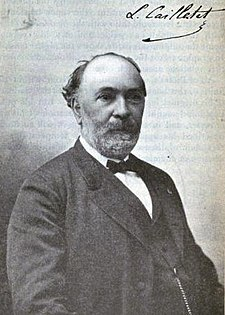
NAME: Cailletet, Louis Paul
ACHIEVEMENTS:
Research into the role of temperature in the liquefaction of gases
NICKNAME/ALIAS:
None
DATE AND PLACE OF BIRTH:
21 September 1832, Chatillon-sur-Seine, Cote d’Or, France
DATE AND PLACE OF DEATH AND AGE AT DEATH:
5 January 1913, Paris, France. Aged 91
DISCIPLINE:
Physicist
FIELD:
Physics
EDUCATION:
Chatillon-sur-Seine
Lycee Henri IV, Paris
Ecole de Mines, Paris
MAJOR WORK:
None
LIFE AND TIMES:
Cailletet’s father was a metallurgist who owned an iron foundry. After completing his education at the college for engineers in Paris, Cailletet returned to his hometown and became the manager of the ironworks. He was especially interested in the blast furnaces and conducted his own research in metallurgy. He was interested in why the tempering process failed in some of the iron pieces and was able to explain this by conducting investigations into the permeability of metals to gases, especially that of iron to hydrogen. When incompletely forged iron retained gas in dissolution it was sometimes highly unstable.
In earlier research on this matter, investigators had used gases which were cooled gradually so that the different elements which had been separated by dissolution in heat could be recombined. Cailletet undertook innovative research in which he used gases which were abruptly cooled at the point of collection and therefore had a different composition. He grasped the significance of the critical temperature above which the liquefaction of a gas will not take place, and to cool the gas in a short time he used expansion. He then succeeded at the end of 1877 in being the first to liquefy oxygen by a process of expansion which began with liquid ethylene and passed through the stage of liquid methane.
At the end of 1877 he was the first to liquefy oxygen and soon afterwards became the first to liquefy nitrogen, hydrogen, nitrogen dioxide, carbon monoxide and acetylene. Within a short period, the Swiss physician Pictet*, using a different experimental method, also liquefied these gases. Cailletet was honored by the Academy of Sciences for this work which opened the way to a unified theory on the role of heat in changes in the physical state.
Cailletet saw the construction of Eiffel’s* high Tower in Paris in the 1880’s as a splendid research opportunity. He installed a 300-metre manometer on the Tower for measuring the elastic force of the air, and conducted studies at the Tower on air resistance to falling bodies. He was interested in aeronautics and was selected as president of the Aero Club of France. He developed automatic cameras and air-sample collectors for studying the upper atmosphere, and an apparatus for measuring the altitude of an airplane. Building on previous work by Bert*, Cailletet also studied a liquid-oxygen respiratory apparatus designed for high-altitude ascents. Cailletet died in 1913.
ASSESSMENT:
Cailletet’s most notable work was on the compression and liquefaction of gases which were then considered to be permanent.
EXTRA CONNECTIONS:
He influenced the work of Dewar*
His work related to that of Onnes*
ONELINER: Paul Cailletet, pioneer in liquefying gases.
BIBLIOGRAPHY:
DSB/EB
Louis Paul Cailletet - Wikipedia
LANGUAGE:
French
PARENTS:
Father: name??
Mother: name??
SIBLINGS:
???
SPOUSE:
???
CHILDREN:
???