Quantz JJ
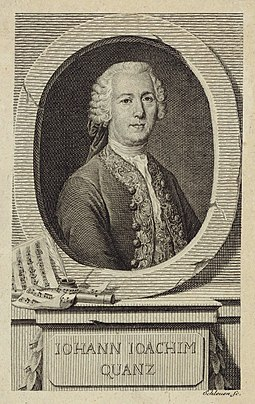
Quantz was born as Hanß Jochim Quantz[1] in Oberscheden, near Göttingen, in the Electorate of Hanover. His father, Andreas Quantz, was a blacksmith who died when Hans was not yet 11; on his deathbed, he begged his son to follow in his footsteps. Nevertheless, from 1708 to 1713 he began his musical studies as a child with his uncle Justus Quantz, a town musician in Merseburg; he also studied for a time with a cousin's husband, the organist Johann Friedrich Kiesewetter. From 1714 on, Quantz studied composition extensively and pored over scores of the masters to adopt their style.[2]^(https://en.wikipedia.org/wiki/Johann_Joachim_Quantz)
In 1716 he joined the town band in Dresden, where in 1717 he studied counterpoint with Jan Zelenka. In March 1718 he was appointed oboist in the newly formed Dresden Polish Chapel of**[**August II**, Elector of Saxony and King of Poland. As it became clear that he couldn't advance as an oboist in the Polish Chapel, Quantz decided to pursue the flute, studying briefly in 1719 with**Pierre-Gabriel Buffardin, principal flute in the**[**Royal Orchestra**. He became good friends with Johann Georg Pisendel, concertmaster of the Royal Orchestra, who greatly influenced his style.[2]^(https://en.wikipedia.org/wiki/Johann_Joachim_Quantz)
Between 1724 and 1727 Quantz completed his education by doing a "Grand Tour" of Europe as a flutist. He studied counterpoint with**Francesco Gasparini in Rome, met**[**Alessandro Scarlatti**in Naples, befriended the flutist**Michel Blavet**in Paris, and in London was encouraged by**Handel**to remain there.
In 1728 Quantz accompanied August II on a state visit to Berlin. The Queen of Prussia was impressed and wanted to hire him. Though August II refused, he allowed Quantz to travel to Berlin as often as he was asked to. That year the Crown Prince, Frederick II of Prussia (Frederick the Great), decided to study the flute and Quantz became his teacher for several visits a year. Quantz later told writer Friedrich Nicolai that he once had to hide in a closet during an outburst of Frederick's domineering father, who disapproved of his son's musical studies. Until 1741 Quantz remained at the Saxon Court in Dresden. He married Anna Rosina Carolina Schindler in 1737; the marriage was not happy, and it was generally known in Berlin that Quantz's wife tyrannized him.
When Frederick II became King of Prussia in 1740, Quantz finally accepted a position as flute teacher, flute maker and composer at the court in Berlin. He joined that court in December 1741 and stayed there for the rest of his career.**^[2]^** He made flutes from at least 1739 and was an innovator in flute design, adding a second key (Eb, in addition to the standard D#) to help with intonation, for example.
As well as writing hundreds of sonatas and concertos, mainly for the flute, he is known today as the author of Versuch einer Anweisung die Flöte traversiere zu spielen (1752) (titled On Playing the Flute in English), a treatise on traverso flute playing. It is a valuable source of reference regarding performance practice and flute technique in the 18th century.
Quantz remained at Frederick's court at Potsdam until his death in 1773. A biography appeared in 1755 in Friedrich Wilhelm Marpurg's Historisch-kritischen Beyträgen zur Aufnahme der Musik; another, in Italian, followed in 1762. His grandnephew, Albert Quantz, published a full-length biography in 1877.
Few of Quantz's works were published during his lifetime. Most of them are for transverse flute, including more than 200 sonatas, around 300 concertos, including several for two flutes; around 45 trio sonatas (mostly for 2 flutes or flute and violin, with continuo); 6 quartets for flute, violin, viola and continuo; various flute duets and flute trios; and unaccompanied caprices and fantasias for flute.
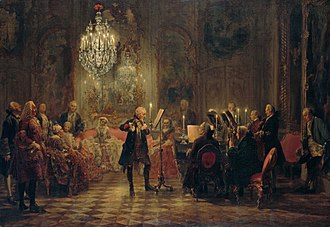
Frederick II became King of Prussia in 1740 and Quantz finally accepted a position at the court in Berlin as royal flute tutor, composer and flute maker.
“In November 1741 I was called by His Majesty of Prussia to Berlin for the last time, and offered a position by His Highness with such favourable conditions that I could no longer refuse to accept: 2,000 thalers a year for life [a previously unheard of sum; in 1728 he had been offered 800 thalers], plus a special payment for my compositions, a hundred Dukaten for each flute that I would construct, the privilege of not having to play in the orchestra, but only in the Royal chamber music, and not having to take orders from anyone but the King. …Thus I left Dresden in December 1741, since I began to serve in the Royal Prussian Service at that time.”
Quantz stayed in service with Frederick for the rest of his life. He worked with the king on flute playing and composition. He supervised the king’s private evening concerts, for which he wrote new works, mainly flute concertos, for the king to play, and he made flutes for the king.
Only a few compositions were published during Quantz’s time in Berlin, most notably the Sei duetti, op. 2 (Berlin, 1759). His most significant contribution to music literature is his Versuch einer Anweisung die Flöte traversiere zu spielen (Berlin, 1752), a very influential treatise on the performance and composition of 18th-century music.
Quantz’s Legacy
Quantz composed over 300 flute concertos and around 230 flute sonatas, as well as trio sonatas, duets and solos. As a flute maker, he developed a design (the ‘Quantz’ flute) that enabled him to produce a particularly rich and vocal tone quality that was greatly admired.
The sonatas and concertos Quantz composed in Berlin were the personal property of the king, so they were not published and were not circulated widely. When Quantz moved to Berlin, Frederick arranged for all of Quantz’s Dresden compositions (excluding the trio sonatas) to also become his property.
Frederick had multiple fair copies made of each work for his various residences: Charlottenbourg, Potsdam, Sanssouçi, le nouveau Palais. Copies of Berlin works were occasionally sent to Dresden. Consequently many manuscript copies of Quantz’s works have survived and scans of some are readily available online from libraries in Berlin and Dresden.
This means we can form a good impression of Quantz as a composer. In his Versuch, Quantz devotes a long final chapter — ‘How a Musician and a Musical Composition Are to Be Judged’ — to a discussion of the forms and styles of music in the middle of the 18th century. His discussion is particularly enlightening when looked at in conjunction with his own concertos and sonatas.
Quantz developed a distinctly personal style. His music is very expressive. The north Germans called thisEmpfindsamkeit,a type or style of music that is intimate, sensitive and subjective. His music is also very inventive. It is well-crafted and natural on a very human scale. It is full of engaging and attractive musical ideas, with contrasts of tone, of light and shade. It tells touching stories and you can hear the influence of Italian opera, especially in the slow movements.
Nineteen years after Quantz’s death, Christoph Friedrich Nicolai (1733–1811), a writer on music who knew Quantz and edited a multi-volume work on the life of Frederick the Great, laments Quantz’s passing. Reflecting on Quantz’s compositions and way of playing, he makes some general comments about changes in musical style:
Style in music, and the style of performance related to it, is like a beautiful flower that delights intimately, but soon withers, rarely blooms again, and even more rarely bears fruit. Hitherto musical style has changed every twenty years or even more rapidly. So it was formerly … and so it will continue.
Nicolai also comments on Quantz's artistry as a performer:
The low tuning of Quantz is no longer used; departed with it are Quantz’s flutes, Quantz’s concertos, and the true art of playing them, without which they suffer indescribably. Now there are perhaps no more than three people in Berlin who still know the way to play them.
[*Johann Joachim Quantz, court musician and long-time flute instructor to Frederick II of Prussia, discussed the shortcomings of Vaucanson's mechanical flute player. In particular its inability to sufficiently move the lips resulted in the necessity of increasing the wind pressure for the upper octaves. Quantz discouraged this method as producing a shrill, unpleasant tone.
The three automata captured the fancy of Voltaire, who celebrated their inventor as “Prometheus’s rival” and persuaded Frederick the Great to invite their maker to join his court. Vaucanson, sensing he could do even better at home, declined the offer?