Helvetius
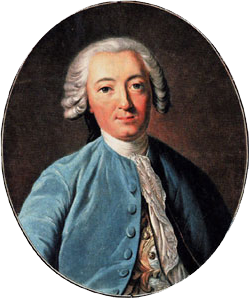
Name: Claude-Adrien Helvetius
Achievement: Established a school of thought on ethics and education
Born: January 26, 1715; Paris, France
Died: December 26, 1771; France
Field & Discipline: Philosophy; Literature
Language: French
Father: Jean-Claude-Adrien Helvetius
Mother: Geneviève-Noëlle de Carvoisin d’Armancourt
Siblings: Geneviève (died shortly after birth)
Spouse: Anne-Catherine de Ligniville d’Autricourt
Children: Élisabeth-Charlotte; Geneviève-Adelaïde
Education: Private tutor from age five to eleven or twelve; Jesuit College Louis-Le-Grand; apprenticeship under his maternal uncle to become Farmer-General
Major Work:
De l’Esprit
Life & Times:
Claude-Adrien Helvetius was born January 26, 1715 in Paris, into a long line of doctors. His father was a physician to Queen Marie Leczinska and once saved the life of King Louis XV. Helvetius was educated by a tutor until the age of eleven or twelve when he was sent to the Louis-Le-Grand Jesuit College. During his time there Helvetius read John [influenced by] Locke*’s ‘Essay on Human Understanding’ which influenced him for the rest of his life. He apprenticed under his uncle as a Farmer (collector) of Taxes in the province of Caen and was appointed Farmer-General of Taxes in 1738.
Helvetius considered his job merely a source of income and looked elsewhere for a way to achieve immortality. He became focused on philosophical problems surrounding economic inequality because he dealt with economics on a daily basis. He was also stimulated by the discussions at the exclusive Parisian salons he frequented. At these salons he met many of the leading writers and thinkers of his day, most notably [met] Voltaire*, [met] Diderot*, [met] Buffon*, [met] Montesquieu*, [met] Rousseau*, and [met] Fontenelle*. He became one of Diderot’s Encyclopedists, thinks from all disciplines who either helped to compile the encyclopedia or agreed with its ‘Enlightenment’ purpose.
In 1751, Helvetius resigned his post as Farmer-General to become Maitre d’Hotel (chamberlain) to the Queen, a position which had no actual duties, but still paid a salary. He decided to devote all his time to philosophical pursuits. The same year he also married a noblewoman, Anne-Catherine de Ligniville d’Autricourt. Anne-Catherine was an intellectual who counted among her friends such as Thomas [pal of] Jefferson* and Benjamin [pal of] Franklin*. Helvetius and his new wife established an estate at Voré and entertained scholars and critics at both Voré and their home in Paris. Among their guests were [pal of] D’ Holbach*, [pal of] Turgot*, and [pal of] Beccaria*. Helvetius also read and was influenced by [influenced by] Condillac*’s Traité des sensations, published in 1754.
In 1758 Helvetius published his first major philosophical work: De l’Esprit, which was attacked by both the ruling classes and the church because of its anti-aristocratic and anti-theological message. Helvetius lost his position as Maitre d’Hotel, the work was banned and existing copies of it were burned. Helvetius also came under fire from fellow philosophers because the radical nature of De L’Espritmade life difficult for everyone identified with him.
He made a formal recantation of his views, but still had to leave France in 1764 to escape persecution. He toured Europe, stopping in England to visit his friend David [pal of] Hume*. In March of 1765, Helvetius visited [visited] Frederick the Great* in Prussia. Inspired by Frederick’s public support of freemasonry, Helvetius, already a freemason, returned to Paris and established a Lodge in 1766. He also entertained and influenced [met] Adam Smith* during Smith’s visit to Paris. On December 26th 1771 an attack of gout in the head and stomach ended Helvetius’ life.
Helvetius’s final work, De l’Homme, was published posthumously in 1772 to avoid the consequences of its reiteration and development of the ideas expressed in De l’Esprit. In both books Helvetius propounded the idea that all normal human beings are born with the same intellectual potential and that differences observed among people, in morality and intellectual capability, are a product of each individual’s experiences from birth. This idea challenged the social system and thus the monarchy by placing all human beings on an equal level.
It also negated the influence of God. Helvetius attacked Christianity and the monarchy even more directly with his pleasure-pain principle. Expanding on the ideas of Locke, Helvetius described emotions as the varied levels of pleasure and pain which accompany sensory experiences which are as a result then avoided or sought out. Via education, a system of rewards would, therefore, teach individuals to find pleasure in socially beneficial actions, and pain in selfish behavior. Helvetius blamed the Church and the monarchy for denying people education and preventing them from improving. He suggested political reforms that included public education for all.
Helvetius may have chosen a poor moment politically to publish De l’Esprit and earn the ire of his enemies and friends, but nonetheless his ideas foreshadowed what lay ahead. The inequality and social unrest that helped to inspire his thoughts on education and the common good were the same factors that lead to the French revolution little more than a decade after his death.
Helvetius inspired socialists and communists alike. He influenced 19th century thinkers Robert [influenced] Owen* and Alexander [influenced] Von Humboldt*. His ideas built on and generalized Locke’s philosophy of sensationalism, but they were ahead of his time. Like so many other great thinkers, his ideas were only recognized as important after he was dead.
Assessment: He contributed to the development of democratic, socialist, and communist ideas. He also contributed to educational ideals.
Proposed Connections: Diderot, Rousseau, Voltaire, Montesquieu, Fontenelle, Jefferson, Franklin
Oneliner: Claude-Adrien Helvetius, French enlightenment philosopher.
Bibliography:
- Cumming, Ian. Helvetius: His Life and Place in the History of Educational Thought. London: Routledge and Kegan Paul Ltd., 1955.
- Horowitz, Irving Louis. Claude Helvetius: Philosopher of Democracy and Enlightenment. New York: Paine-Whitman Publishers, 1954.
- Smith, D.W. Helvétius: A Study in Persecution. Oxford: Clarendon Press, 1965.
- Vartanian, Aram. “Helvétius, Claude-Adrien (1715-1771).” Encyclopedia of Philosophy [electronic resource]. Ed. Donald M. Borchert. Detroit, Michigan: Macmillian Reference USA, 2006.
Claude Adrien Helvétius - Wikipedia
One of the twenty-one children of Jean-Jacques de Ligniville and his wife Charlotte de Saureau, Anne-Catherine de Ligniville, the niece of Madame de Graffigny, married the philosopher Helvétius in 1751. By the time he died twenty years later, the couple had amassed a vast fortune, and with it Madame Helvétius maintained her salon which featured the greatest figures of the Enlightenment for over five decades.[1]
Among the habitués of Madame Helvétius's salon were Julie de Lespinasse and Suzanne Necker, writers Fontenelle, Diderot, Chamfort, Duclos, Saint-Lambert, Marmontel, Roucher, Saurin, André Chénier, and Volney. Thinkers such as Condorcet, d'Holbach, Turgot, Abbé Sieyès, Abbé Galiani, Destutt de Tracy, Abbé Beccaria, Abbé Morellet, Buffon, Condillac or Abbé Raynal mingled with such scientists as d'Alembert, Lavoisier, Cuvier and Cabanis. The sculptor Houdon, Baron Gérard and other leading figures of the time such as Charles-Joseph Panckoucke and François-Ambroise Didot were also attendees. Such politicians as Malesherbes, Talleyrand, Madame Roland and her husband Roland de la Platière, Thomas Jefferson, Benjamin Franklin (who is claimed to have proposed marriage to her),[2] Mirabeau, Pierre Daunou, Garat, Nicolas Bergasse and Napoléon Bonaparte could also be found at her salon.
The salon also provided a steady home for a great clowder of Angora cats. The cats were a well-known feature of Madame Helvétius's salon, always bedecked with silk ribbons and doted on by their loving caregiver.[1] Eighteen in all, the cats were kept company by the Madame's dogs, canaries, and many other pets.[3]
Madame Helvétius died at Auteuil.