Bach CPE
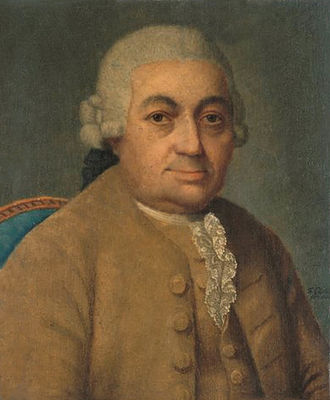
Nickname/Alias: The “Berlin” Bach.
Achievements: Leading classical composer.
Born: March 8, 1714; Weimar, Saxe-Weimar, Germany
Died: December 14, 1788; Hamburg, Germany (Aged 74)
Field & Discipline: Music. Composer.
Language: German.
Father: Johann Sebastian Bach
Mother: Maria Barbara Bach (distant cousin, married 1707)
Siblings: 6 siblings, 13 half-siblings (6 surviving) from father's second marriage.
Of these, Wilhelm Friedemann (musician); Johann Gottfried Bernhard (musician); Gottfried Heinrich (musician); Johann Christoph Friedrich (musician); Johann Christan (musician)
Spouse: Johanna Maria Dannemann (married 1744)
Children: Johann August; Johann Sebastian; Anna Carolina Philippina
Education: Thomas School, Leipzig, 1723-31; Leipzig University, 1731-34; Frankfurt University, 1734-38
Major Work:
“Essay on Keyboard Instruments”
200 sonatas
Life & Times:
Carl Philipp Emanuel, the most famous and most prolific of the sons of [father was] Johann Sebastian Bach*, was born at Weimar on 8th March 1714. He could claim descent from musicians on both sides of his family, and his godfather was the composer [godfather was] Telemann*. C.P.E. (known as Emanuel) Bach was taught music entirely by his father, studied the keyboard, and by the age of 11 could play his father's keyboard pieces by sight, soon helping his father.
Emanuel received a general education at the Thomasschule and in October 1731went to the University of Leipzig to study law, although still living with his parents and acting as musical assistant to his father. Meanwhile he had begun composing in 1730, and under his father's supervision he composed his first known works: two marches and two polonaises and a short minuet.
In 1733 he applied unsuccessfully for a position as organist at Naumburg, and then in September 1734 he moved, again as a law student, to the University of Frankfurt, where he remained until 1738. There he supported himself mainly by giving keyboard lessons and by composing, and directing public concerts and ceremonies. During these years away from his father, Emanuel wrote about a dozen more instrumental works.
In 1738 Emanuel went to Berlin, where he was appointed harpsichordist to the future [harpsichordist to] Frederick II the Great* of Prussia, in whose service he remained for nearly 30 years. In 1744 he married Johanna Maria Dannemann, daughter of a wine merchant, with whom he had three children in the next three years.
During the period from 1756 to 1763, the Seven Years War ended all music in Berlin and in 1758 a Russian attack on the city made it necessary for Bach and his family to move for some months to Zerbst. Back in Berlin, Frederick was fighting for Prussia's existence, and rapidly lost interest in his musical establishment. Emanuel was only paid 500 thalers throughout his service to the king, but Berlin in the 1750s and 1760s still offered other compensations to a court musician. Emanuel now had time for a substantial amount of teaching, his most important pupil being his half-brother Johann Christian Bach. He also had plenty of time for composing and writing.
His most influential compositions in the Berlin years were the solo keyboard pieces, the “Prussian” and “Wurttemberg” Sonatas, his “Sonatas with Varied Repeats,” and the “sample pieces” published with the first part of his “Versuch ber die wahre Art das Klavier zu spielen,” 1753 - 1762, an essay on the art of playing keyboard instruments. This work is now considered to be probably the most important practical treatise on music written in the 18th century, and it established his reputation as the leading keyboard teacher of his time.
For many years he had been writing to his godfather, Telemann, in Hamburg, exchanging music and comparing aspects of his duties at court and Telemann's position as Kantor and music director in Hamburg. Telemann's death in 1767 opened up a possible avenue of development. Competitors for the post were well-known musicians: his brother J. C. F. Bach, H. F Raupach and J. H. Rolle, but after five months of deliberation, Emanuel was chosen.
In March 1768, at the age of 54, CPE Bach, by now the most famous keyboard player and teacher in Europe, assumed his new position in Hamburg as Kantor and music director, being formally installed on 19th ^April. His duties in the new job were similar to those of his father in Leipzig:- to act as director of music in the five principal churches and as Kantor of the Johanneum, the Latin School.
The workload was enormous:- to provide about 200 musical performances, including 10 Passions within the space of 13 days, each year, among the five churches, as well as providing sacred music in the school, funeral music, cantatas for the inaugurations of an endless procession of new pastors, congratulatory cantatas or musical celebrations for various new city officials, and for many other occasions.
Emanuel apparently throve on all this activity and he was at last reasonably well-off. Although his basic salary was a fairly modest 600 Hamburg marks (a rector was paid 1000), there were extra fees attached to most of his duties outside the school and churches. He also entertained a great deal, and formed close friendships with many poets, writers, professors and burghers who, like him, had been attracted by the freedom and openness of Hamburg society.
Through reputation and correspondence, his circle of influence steadily widened. [corresponded with] Diderot*, looking for music for his harpsichord-playing daughter, wrote to Emmanuel with a request for manuscripts of keyboard sonatas. [corresponded with] Haydn* often wrote asking for his latest pieces for piano. And C.G. Neefe, [knew teacher of] Beethoven's* teacher in Bonn, was one of the most dedicated supporters of Emanuel's music and his “Essay,” both of which were basics to Neefe’s teaching.
Emanuel also found many opportunities to perform publicly on the harpsichord, while in other public concerts he directed performances of choral and dramatic works by such composers as Hasse, Telemann, Haydn, [directed performances of] Handel*, [directed performances of] Gluck* and J.S. Bach, as well as his own music. Meanwhile he continued to compose prolifically, mainly church music, although his most successful pieces from this 20-year period are again for the keyboard.
Nearly as important are his 10 symphonies, 12 keyboard concertos, and some chamber works.
Solo keyboard, however, was central to Emanuel's long career and remained so even when he was most pressed with commitments involving other media. The clavichord, or early piano, specifically, the large instrument built to his exacting requirements, remained his most personal mode of expression, although he composed more and more for the piano in the last two decades of his life. He died on December 14, 1788, of an acute “chest ailment” and was buried in the vault of St Michael's Church in Hamburg.
Extra Connections: Met “Star-spangled Banner” composer [met ] JS Smith*
Assessment: His “Essay on Keyboard Instruments” was to have great impact on following musicians. Haydn referred to it as “the school of schools” and Mozart said, “He is the father, we are the children.”
Oneliner: C.P.E. Bach, major composer of his time
Bibliography:
- Helm, Eugene, "Carl Philipp Emanuel Bach,” in The New Grove Bach Family, London: Macmillan, 1983.