Frederick the Great 2
(see main node)
Frederick II (German: Friedrich II.; 24 January 1712 – 17 August 1786) was King in Prussia from 1740 until 1772, and King of Prussia from 1772 until his death in 1786. His most significant accomplishments include his military successes in the Silesian wars, his reorganisation of the Prussian Army, the First Partition of Poland, and his patronage of the arts and the Enlightenment. Frederick was the last Hohenzollern monarch titled King in Prussia, declaring himself King of Prussia after annexing Royal Prussia from the Polish–Lithuanian Commonwealth in 1772. Prussia greatly increased its territories and became a major military power in Europe under his rule. He became known as Frederick the Great (German: Friedrich der Große) and was nicknamed "Old Fritz" (German: "Der Alte Fritz").
In his youth, Frederick was more interested in music and philosophy than in the art of war, which led to clashes with his authoritarian father, Frederick William I of Prussia. However, upon ascending to the Prussian throne, he attacked and annexed the rich Austrian province of Silesia in 1742, winning military acclaim for himself and Prussia. He became an influential military theorist whose analyses emerged from his extensive personal battlefield experience and covered issues of strategy, tactics, mobility and logistics.
Frederick was a supporter of enlightened absolutism, stating that the ruler should be the first servant of the state. He modernised the Prussian bureaucracy and civil service, and pursued religious policies throughout his realm that ranged from tolerance to segregation. He reformed the judicial system and made it possible for men of lower status to become judges and senior bureaucrats. Frederick also encouraged immigrants of various nationalities and faiths to come to Prussia, although he enacted oppressive measures against Catholics in Silesia and Polish Prussia. He supported the arts and philosophers he favoured, and allowed freedom of the press and literature. Frederick was almost certainly homosexual, and his sexuality has been the subject of much study. Because he died childless, he was succeeded by his nephew, Frederick William II. He is buried at his favourite residence, Sanssouci in Potsdam.
Nearly all 19th-century German historians made Frederick into a romantic model of a glorified warrior, praising his leadership, administrative efficiency, devotion to duty and success in building Prussia into a great power in Europe. Frederick remained an admired historical figure through Germany's defeat in World War I, and the Nazis glorified him as a great German leader prefiguring Adolf Hitler, who personally idolised him. His reputation became less favourable in Germany after World War II, partly due to his status as a Nazi symbol. Historians in the 21st century tend to view Frederick as an outstanding military leader and capable monarch, whose commitment to enlightenment culture and administrative reform built the foundation that allowed the Kingdom of Prussia to contest the Austrian Habsburgs for leadership among the German states.
Early life
Frederick was the son of then-Crown Prince Frederick William of Prussia and his wife, Sophia Dorothea of Hanover.[1] He was born sometime between 11 and 12 p.m. on 24 January 1712 in the Berlin Palace and was baptised with the single name Friedrich by Benjamin Ursinus von Bär on 31 January.[2] The birth was welcomed by his grandfather, Frederick I, as his two previous grandsons had both died in infancy.
With the death of Frederick I in 1713, his son Frederick William I became King in Prussia, thus making young Frederick the crown prince. Frederick had nine siblings who lived to adulthood. He had six sisters. The eldest was Wilhelmine, who became his closest sibling.[3] He also had three younger brothers, including Augustus William and Henry.[4] The new king wished for his children to be educated not as royalty, but as simple folk. They were tutored by a French woman, Madame de Montbail, who had also educated Frederick William.[5]
Frederick William I, popularly dubbed the "Soldier King", had created a large and powerful army that included a regiment of his famous "Potsdam Giants"; he carefully managed the kingdom's wealth and developed a strong centralised government. He also had a violent temper and ruled Brandenburg-Prussia with absolute authority.[6]
In contrast, Frederick's mother Sophia, whose father, George Louis of Brunswick-Lüneburg, had succeeded to the British throne as King George I in 1714, was polite, charismatic and learned.[7] The political and personal differences between Frederick's parents created tensions,[8] which affected Frederick's attitude toward his role as a ruler, his attitude toward culture, and his relationship with his father.[9]
During his early youth, Frederick lived with his mother and sister Wilhelmine,[9] although they regularly visited their father's hunting lodge at Königs Wusterhausen.[10] Frederick and his older sister formed a close relationship,[9] which lasted until her death in 1758.[11] Frederick and his sisters were brought up by a Huguenot governess and tutor and learned French and German simultaneously.
Undeterred by his father's desire that his education be entirely religious and pragmatic, the young Frederick developed a preference for music, literature, and French culture. Frederick Wilhelm thought these interests were effeminate,[12] as they clashed with his militarism, resulting in his frequent beating and humiliation of Frederick.[13] Nevertheless, Frederick, with the help of his tutor in Latin, Jacques Duhan, procured for himself a 3,000 volume secret library of poetry, Greek and Roman classics, and philosophy to supplement his official lessons.[14]
Although his father, Frederick William I, had been raised a Calvinist in spite of the Lutheran state faith in Prussia, he feared he was not one of God's elect. To avoid the possibility of his son Frederick being motivated by the same concerns, the king ordered that his heir not be taught about predestination. Despite his father's intention, Frederick appeared to have adopted a sense of predestination for himself.[15] ...
- Early life
- Crown Prince
- Inheritance
- Reign
- Policies
- Military theory
- Later years and death
- Historiography and legacy
- Works by Frederick the Great
Reign
War of the Austrian Succession
Main articles: First Silesian War and Second Silesian War
When Frederick became king, he was faced with the challenge of overcoming Prussia's weaknesses, vulnerably disconnected holdings with a weak economic base.[56] To strengthen Prussia's position, he fought wars mainly against Austria, whose Habsburg dynasty had reigned as Holy Roman Emperors continuously since the 15th century.[57] Thus, upon succeeding to the throne on 31 May 1740,[58] Frederick declined to endorse the Pragmatic Sanction of 1713, a legal mechanism to ensure the inheritance of the Habsburg domains by Maria Theresa of Austria, daughter of Holy Roman Emperor Charles VI. Upon the death of Charles VI on 29 October 1740,[59] Frederick disputed the 23-year-old Maria Theresa's right of succession to the Habsburg lands, while simultaneously asserting his own right to the Austrian province of Silesia based on a number of old, though ambiguous, Hohenzollern claims to parts of Silesia.[60]
Accordingly, the First Silesian War (1740–1742, part of the War of the Austrian Succession) began on 16 December 1740 when Frederick invaded and quickly occupied almost all of Silesia within seven weeks.[53] Though Frederick justified his occupation on dynastic grounds,[61] the invasion of this militarily and politically vulnerable part of the Habsburg empire also had the potential to provide substantial long-term economic and strategic benefits.[62] The occupation of Silesia added one of the most densely industrialised German regions to Frederick's kingdom and gave it control over the navigable Oder River.[63] It nearly doubled Prussia's population and increased its territory by a third.[64] It also prevented Augustus III, King of Poland and Elector of Saxony, from seeking to connect his own disparate lands through Silesia.[65]
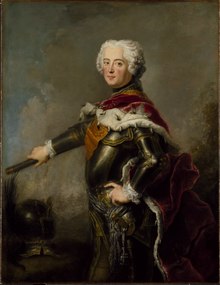
Portrait of Frederick during his early reign by Antoine Pesne (c. 1740, Gripsholm Castle, Sweden)
In late March 1741, Frederick set out on campaign again to capture the few remaining fortresses within the province that were still holding out. He was surprised by the arrival of an Austrian army, which he fought at the Battle of Mollwitz on 10 April 1741.[66] Though Frederick had served under Prince Eugene of Savoy, this was his first major battle in command of an army. In the course of the fighting, Frederick's cavalry was disorganised by a charge of the Austrian horse.
Believing his forces had been defeated, Frederick galloped away to avoid capture,[67] leaving Field Marshal Kurt Schwerin in command to lead the disciplined Prussian infantry to victory. Frederick would later admit to humiliation at his abdication of command[68] and would state that Mollwitz was his school.[69] Disappointed with the performance of his cavalry, whose training his father had neglected in favour of the infantry, Frederick spent much of his time in Silesia establishing a new doctrine for them.[70]
Encouraged by Frederick's victory at Mollwitz, the French and their ally, the Electorate of Bavaria, entered the war against Austria in early September 1741 and marched on Prague.[71] Meanwhile, Frederick, as well as other members of the League of Nymphenburg, sponsored the candidacy of his ally Charles of Bavaria to be elected Holy Roman Emperor. In late November, the Franco-Bavarian forces took Prague, and Charles was crowned King of Bohemia.[72]
Subsequently, he was elected as the Holy Roman Emperor Charles VII on 24 January 1742. After the Austrians pulled their army out of Silesia to defend Bohemia, Frederick pursued them and blocked their path to Prague.[73] The Austrians counter-attacked on 17 May 1742, initiating the Battle of Chotusitz.
In this battle, Frederick's retrained cavalry proved more effective than at Mollwitz,[74] but once more it was the discipline of the Prussian infantry that won the field[75] and allowed Frederick to claim a major victory.[76] This victory, along with the Franco-Bavarian forces capturing Prague, forced the Austrians to seek peace. The terms of the Treaty of Breslau between Austria and Prussia, negotiated in June 1742, gave Prussia all of Silesia and Glatz County, with the Austrians retaining only the portion called Austrian or Czech Silesia.[77]
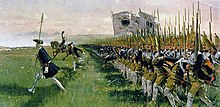
Attack of Prussian Infantry, Hohenfriedberg by Carl Röchling (1913)
By 1743, the Austrians had subdued Bavaria and driven the French out of Bohemia. Frederick strongly suspected Maria Theresa would resume war in an attempt to recover Silesia. Accordingly, he renewed his alliance with France and preemptively invaded Bohemia in August 1744, beginning the Second Silesian War.[78] In late August 1744, Frederick's army had crossed the Bohemian frontier, marched directly to Prague, and laid siege to the city, which surrendered on 16 September 1744 after a three-day bombardment.[79]
Frederick's troops immediately continued marching into the heart of central Bohemia,[68] but Saxony had now joined the war against Prussia.[80] Although the combined Austrian and Saxon armies outnumbered Frederick's forces, they refused to directly engage with Frederick's army, harassing his supply lines instead. Eventually, Frederick was forced to withdraw to Silesia as winter approached.[81] In the interim, Frederick also successfully claimed his inheritance to the minor territory of East Frisia on the North Sea coast of Germany, occupying the territory after its last ruler died without issue in 1744.[82]
In January 1745, the Holy Roman Emperor Charles VII of Bavaria died,[83] taking Bavaria out of the war and allowing Maria Theresa's husband Francis of Lorraine to be eventually elected Holy Roman Emperor.[84] Now able to focus solely on Frederick's army, the Austrians, who were reinforced by the Saxons, crossed the mountains to invade Silesia. After allowing them across,[a]
Frederick pinned them down and decisively defeated them at the Battle of Hohenfriedberg on 4 June 1745.[86] Frederick subsequently advanced into Bohemia and defeated a counterattack by the Austrians at the Battle of Soor.[87] Frederick then turned towards Dresden when he learned the Saxons were preparing to march on Berlin. However, on 15 December 1745, Prussian forces under the command of Leopold of Anhalt-Dessau soundly defeated the Saxons at the Battle of Kesselsdorf.[88] After linking up his army with Leopold's, Frederick occupied the Saxon capitol of Dresden, forcing the Saxon elector, Augustus III, to capitulate.[89]
Once again, Frederick's victories on the battlefield compelled his enemies to sue for peace. Under the terms of the Treaty of Dresden, signed on 25 December 1745, Austria was forced to adhere to the terms of the Treaty of Breslau giving Silesia to Prussia.[90] It was after the signing of the treaty that Frederick, then 33 years old, first became known as "the Great".[91]
Seven Years' War
Main article: Third Silesian War
Though Frederick had withdrawn from the War of the Austrian Succession once Austria guaranteed his possession of Silesia,[92] Austria remained embroiled in the war until the Treaty of Aix-la-Chapelle in 1748. Less than a year after the treaty was signed, Maria Theresa was once more seeking allies, particularly Russia and France, to eventually renew the war with Prussia to regain Silesia.[93] In preparation for a new confrontation with Frederick, the Empress reformed Austria's tax system and military.[94] During the ten years of peace that followed the signing of the Treaty of Dresden, Frederick also prepared to defend his claim on Silesia by further fortifying the province and expanding his army,[95] as well as reorganising his finances.[96]
In 1756, Frederick attempted to forestall Britain's financing of a Russian army on Prussia's border by negotiating an alliance with Britain at the Convention of Westminster, by which Prussia would protect Hanover against French attack, and Britain would no longer subsidise Russia. This treaty triggered the Diplomatic Revolution in which Habsburg Austria and Bourbon France, who had been traditional enemies, allied together with Russia to defeat the Anglo-Prussian coalition.[97]
To strengthen his strategic position against this coalition,[98] on 29 August 1756, Frederick's well-prepared army preemptively invaded Saxony.[99] His invasion triggered the Third Silesian War and the larger Seven Years' War, both of which lasted until 1763. He quickly captured Dresden, besieged the trapped Saxon army in Pirna, and continued marching the remainder of his army toward North Bohemia, intending to winter there.[100] At the Battle of Lobositz he claimed a close victory against an Austrian army that was aiming to relieve Pirna,[101] but afterward withdrew his forces back to Saxony for the winter.[102] When the Saxon forces in Pirna finally capitulated in October 1756, Frederick forcibly incorporated them into his own army.[103] This action, along with his initial invasion of neutral Saxony brought him widespread international criticism;[104] but the conquest of Saxony also provided him with significant financial, military, and strategic assets that helped him sustain the war.[105]

Frederick the Great at the Battle of Zorndorf by Carl Röchling (1904)
In the early spring of 1757, Frederick once more invaded Bohemia.[106] He was victorious against the Austrian army at the Battle of Prague on 6 May 1757, but his losses were so great he was unable to take the city itself, and settled for besieging it instead.[107] A month later on 18 June 1757, Frederick suffered his first major defeat at the Battle of Kolín,[108] which forced him to abandon his invasion of Bohemia.
When the French and the Austrians pursued him into Saxony and Silesia in the fall of 1757, Frederick defeated and repulsed a much larger Franco-Austrian army at the Battle of Rossbach[109] and another Austrian army at the Battle of Leuthen.[110] Frederick hoped these two victories would force Austria to negotiate, but Maria Theresa was determined not to make peace until she had recovered Silesia, and the war continued.[111] Despite its strong performance, the losses suffered from combat, disease and desertion had severely reduced the quality of the Prussian army.[112]
In the remaining years of the war, Frederick faced a coalition of enemies including Austria, France, Russia, Sweden, and the Holy Roman Empire,[113] supported only by Great Britain and its allies Hesse, Brunswick, and Hanover.[114] In 1758 Frederick once more took the initiative by invading Moravia. By May, he had laid siege to Olomouc; but, the Austrians were able to hold the town and destroyed Frederick's supply train, forcing him to retreat into Silesia.[115]
In the meantime, the Russian army had advanced within 100 miles (160 km) east of Berlin. In August, he fought the Russian forces to a draw at the Battle of Zorndorf, in which nearly a third of Frederick's soldiers were casualties.[116] He then headed south to face the Austrian army in Saxony. There, he was defeated at the Battle of Hochkirch on 14 October, although the Austrian forces were not able to exploit their victory.[117]

Frederick the Great after the defeat at the Battle of Hochkirch by Carl Röchling (c. 1900)
During the 1759 campaign, the Austrian and Russian forces took the initiative, which they kept for the remainder of the war.[118] They joined and once more advanced on Berlin. Frederick's army, which consisted of a substantial number of quickly recruited, half-trained soldiers,[119] attempted to check them at the Battle of Kunersdorf on 12 August, where he was defeated and his troops were routed.[120]
Almost half his army was destroyed, and Frederick almost became a casualty when a bullet smashed a snuffbox he was carrying.[121] Nevertheless, the Austro-Russian forces hesitated and stopped their advance for the year, an event Frederick later called the "Miracle of the House of Brandenburg".[122] Frederick spent the remainder of the year in a futile attempt to manoeuvre the Austrians out of Saxony, where they had recaptured Dresden. [123] His effort cost him further losses when his general Friedrich August von Finck capitulated at Maxen on 20 November.[124]
At the beginning of 1760, the Austrians moved to retake Silesia, where Frederick defeated them at the Battle of Liegnitz on 15 August.[125] The victory did not allow Frederick to regain the initiative or prevent Russian and Austrian troops from raiding Berlin in October to extort a ransom from the city.[126] At the end of the campaign season, Frederick fought his last major engagement of the war.[127] He won a marginal victory at the Battle of Torgau on 3 November,[128] which secured Berlin from further raids.[129] In this battle, Frederick became a casualty when he was hit in the chest by a spent bullet.[130]
By 1761, both the Austrian and Prussian military forces were so exhausted that no major battles were fought between them. Frederick's position became even more desperate in 1761 when Britain, having achieved victory in the American and Indian theatres of the war, ended its financial support for Prussia after the death of King George II, Frederick's uncle.[131] The Russian forces also continued their advance, occupying Pomerania and parts of Brandenburg. With the Russians slowly advancing towards Berlin, it looked as though Prussia was about to collapse.[132] On 6 January 1762, Frederick wrote to Count Karl-Wilhelm Finck von Finckenstein, "We ought now to think of preserving for my nephew, by way of negotiation, whatever fragments of my territory we can save from the avidity of my enemies".[133]

Portrait of Frederick by Wilhelm Camphausen (1870). One of many idealized portraits of Frederick.
The sudden death of Empress Elizabeth of Russia in January 1762 led to the succession of the Prussophile Peter III, her German nephew, who was also the Duke of Holstein-Gottorp.[134] This led to the collapse of the anti-Prussian coalition; Peter immediately promised to end the Russian occupation of East Prussia and Pomerania, returning them to Frederick. One of Peter III's first diplomatic endeavours was to seek a Prussian title; Frederick obliged.
Peter III was so enamoured of Frederick that he not only offered him the full use of a Russian corps for the remainder of the war against Austria, he also wrote to Frederick that he would rather have been a general in the Prussian army than Tsar of Russia.[135] More significantly, Russia's about-face from an enemy of Prussia to its patron rattled the leadership of Sweden, who hastily made peace with Frederick as well.[136]
With the threat to his eastern borders over, and France also seeking peace after its defeats by Britain, Frederick was able to fight the Austrians to a stalemate and finally brought them to the peace table. While the ensuing Treaty of Hubertusburg simply returned the European borders to what they had been before the Seven Years' War, Frederick's ability to retain Silesia in spite of the odds earned Prussia admiration throughout the German-speaking territories. A year following the Treaty of Hubertusburg, Catherine the Great, Peter III's widow and usurper, signed an eight-year alliance with Prussia, albeit with conditions that favoured the Russians.[137]
Frederick's ultimate success in the Seven Years' War came at a heavy financial cost to Prussia. Part of the burden was covered by the Anglo-Prussian Convention, which gave Frederick an annual £670,000 in British subsidies from 1758 till 1762.[138] These subsidies ceased when Frederick allied with Peter III,[139] partly because of the changed political situation[140] and also because of Great Britain's decreasing willingness to pay the sums Frederick wanted.[141]
Frederick also financed the war by devaluing the Prussian coin five times; debased coins were produced with the help of Leipzig mintmasters, Veitel Heine Ephraim, Daniel Itzig and Moses Isaacs.[142] He also debased the coinage of Saxony and Poland.[143] This debasement of the currency helped Frederick cover over 20 per cent of the cost of the war, but at the price of causing massive inflation and economic upheaval throughout the region.[144] Saxony, occupied by Prussia for most of the conflict, was left nearly destitute as a result.[145]
While Prussia lost no territory, the population and army were severely depleted by constant combat and invasions by Austria, Russia and Sweden. The best of Frederick's officer corps were also killed in the conflict. Although Frederick managed to bring his army up to 190,000 men by the time the economy had largely recovered in 1772, which made it the third-largest army in Europe, almost none of the officers in this army were veterans of his generation and the King's attitude towards them was extremely harsh.[146] During this time, Frederick also suffered a number of personal losses. Many of his closest friends and family members—including his brother Augustus William,[147] his sister Wilhelmine, and his mother—had died while Frederick was engaged in the war.[148]
First Partition of Poland...
Policies
Administrative modernisation

Idealized portrait of Frederick by Anton Graff (1781, Schloss Charlottenburg, Berlin).
In his earliest published work, the Anti-Machiavel,[178] and his later Testament politique (Political Testament),[179] Frederick wrote that the sovereign was the first servant of the state.[b] Acting in this role, Frederick helped transform Prussia from a European backwater to an economically strong and politically reformed state.[182] He protected his industries with high tariffs and minimal restrictions on domestic trade.
He increased the freedom of speech in press and literature,[183] abolished most uses of judicial torture,[184] and reduced the number of crimes that could be punished by the death sentence.[185] Working with his Grand Chancellor Samuel von Cocceji, he reformed the judicial system and made it more efficient, and he moved the courts toward greater legal equality of all citizens by removing special courts for special social classes.[186] The reform was completed after Frederick's death, resulting in the Prussian Law Code of 1794, which balanced absolutism with human rights and corporate privilege with equality before the law. Reception to the law code was mixed as it was often viewed as contradictory.[187]
Frederick strove to put Prussia's fiscal system in order. In January 1750, Johann Philipp Graumann was appointed as Frederick's confidential adviser on finance, military affairs, and royal possessions, as well as the Director-General of all mint facilities.[188] Graumann's currency reform slightly lowered the silver content of Prussian thaler from 1⁄12 Cologne mark of silver to 1⁄14,[189] which brought the metal content of the thaler into alignment with its face value,[190] and it standardised the Prussian coinage system.[188]
As a result, Prussian coins, which had been leaving the country nearly as fast as they were minted,[189] remained in circulation in Prussia.[191] In addition, Frederick estimated that he earned about one million thalers in profits on the seignorage.[189] The coin eventually became universally accepted beyond Prussia and helped increase industry and trade.[190] A gold coin, the Friedrich d'or, was also minted to oust the Dutch ducat from the Baltic trade.[192] However, the fixed ratio between gold and silver led to the gold coins being perceived as more valuable, which caused them to leave circulation in Prussia. Being unable to meet Frederick's expectations for profit, Graumann was removed in 1754.[192]
Although Frederick's debasement of the coinage to fund the Seven Years' War left the Prussian monetary system in disarray,[191] the Mint Edict of May 1763 brought it back to stability by fixing rates at which depreciated coins would be accepted and requiring tax payments in currency of prewar value. This resulted in a shortage of ready money, but Frederick controlled prices by releasing the grain stocks he held in reserve for military campaigns. Many other rulers soon followed the steps of Frederick in reforming their own currencies.[193] The functionality and stability of the reform made the Prussian monetary system the standard in Northern Germany.[194]
Around 1751 Frederick founded the Emden Company to promote trade with China. He introduced the lottery, fire insurance, and a giro discount and credit bank to stabilise the economy.[195] One of Frederick's achievements after the Seven Years' War included the control of grain prices, whereby government storehouses would enable the civilian population to survive in needy regions, where the harvest was poor.[196] He commissioned Johann Ernst Gotzkowsky to promote the trade and – to take on the competition with France – put a silk factory where soon 1,500 people found employment. Frederick followed Gotzkowsky's recommendations in the field of toll levies and import restrictions. When Gotzkowsky asked for a deferral during the Amsterdam banking crisis of 1763, Frederick took over his porcelain factory, now known as KPM.[197]
Frederick modernised the Prussian civil service and promoted religious tolerance throughout his realm to attract more settlers in East Prussia. With the help of French experts, he organised a system of indirect taxation, which provided the state with more revenue than direct taxation; though French officials administering it may have pocketed some of the profit.[198] In 1781, Frederick made coffee a royal monopoly and employed disabled soldiers, the coffee sniffers, to spy on citizens illegally roasting coffee, much to the annoyance of the general population.[199]
Though Frederick started many reforms during his reign, his ability to see them to fulfilment was not as disciplined or thorough as his military successes.[200]
Religion
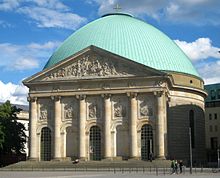
St. Hedwig's Cathedral, the first Roman Catholic church built in Berlin since the Reformation, was erected by the sanction of Frederick, who also sketched its design.[201]
In contrast to his devoutly Calvinist father, Frederick was a religious sceptic, who has been described as a deist.[202][c] Frederick was pragmatic about religious faith. Three times during his life, he presented his own confession of Christian faith: during his imprisonment after Katte's execution in 1730, after his conquest of Silesia in 1741, and just before the start of the Seven Years' War in 1756; in each case, these confessions also served personal or political goals.[205]
He tolerated all faiths in his realm, but Protestantism remained the favoured religion, and Catholics were not chosen for higher state positions.[206] Frederick wanted development throughout the country, adapted to the needs of each region. He was interested in attracting a diversity of skills to his country, whether from Jesuit teachers, Huguenot citizens, or Jewish merchants and bankers. Frederick retained Jesuits as teachers in Silesia, Warmia, and the Netze District, recognising their educational activities as an asset for the nation.[207]
He continued to support them after their suppression by Pope Clement XIV.[208] He befriended the Roman Catholic Prince-Bishop of Warmia, Ignacy Krasicki, whom he asked to consecrate St. Hedwig's Cathedral in 1773.[209] He also accepted countless Protestant weavers from Bohemia, who were fleeing from the devoutly Catholic rule of Maria Theresa, granting them freedom from taxes and military service.[210] Constantly looking for new colonists to settle his lands, he encouraged immigration by repeatedly emphasising that nationality and religion were of no concern to him. This policy allowed Prussia's population to recover very quickly from its considerable losses during Frederick's three wars.[211]
...
Environment and agriculture
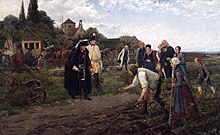
The King Everywhere by Robert Warthmüller [de] 1886, German Historical Museum, Berlin). Frederick is depicted inspecting a potato harvest.
Frederick was keenly interested in land use, especially draining swamps and opening new farmland for colonisers who would increase the kingdom's food supply. He called it Peuplierungspolitik (peopling policy). About 1,200 new villages were founded in his reign.[221] He told Voltaire, "Whoever improves the soil, cultivates land lying waste and drains swamps, is making conquests from barbarism".[222] Using improved technology enabled him to create new farmland through a massive drainage programme in the country's Oderbruch marshland. This programme created roughly 60,000 hectares (150,000 acres) of new farmland, but also eliminated vast swaths of natural habitat, destroyed the region's biodiversity, and displaced numerous native plant and animal communities.
Frederick saw this project as the "taming" and "conquering" of nature,[223] considering uncultivated land "useless",[224] an attitude that reflected his enlightenment era, rationalist sensibilities.[225] He presided over the construction of canals for bringing crops to market, and introduced new crops, especially the potato and the turnip, to the country. For this, he was sometimes called Der Kartoffelkönig (the Potato King).[226]
Frederick's interest in land reclamation may have resulted from his upbringing. As a child, his father, Frederick William I, made young Frederick work in the region's provinces, teaching the boy about the area's agriculture and geography. This created an interest in cultivation and development that the boy retained when he became ruler.[227]
Frederick founded the first veterinary school in Prussia. Unusually for the time and his aristocratic background, he criticised hunting as cruel, rough and uneducated. When someone once asked Frederick why he did not wear spurs when riding his horse, he replied, "Try sticking a fork into your naked stomach, and you will soon see why."[28] He loved dogs and his horse and wanted to be buried with his greyhounds. In 1752 he wrote to his sister Wilhelmine that people indifferent to loyal animals would not be devoted to their human comrades either, and that it was better to be too sensitive than too harsh. He was also close to nature and issued decrees to protect plants.[228]
Arts and education
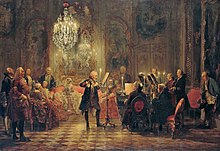
The Flute Concert of Sanssouci by Adolph Menzel (1852, Alte Nationalgalerie, Berlin). Frederick is depicted playing the flute in his music room at Sanssouci as C. P. E. Bach accompanies him on a fortepiano by Gottfried Silbermann.
Frederick was a patron of music,[229] and the court musicians he supported included C. P. E. Bach, Carl Heinrich Graun and Franz Benda.[230] A meeting with Johann Sebastian Bach in 1747 in Potsdam led to Bach's writing The Musical Offering.[231] He was also a talented musician and composer in his own right, playing the transverse flute,[232] as well as composing 121 sonatas for flute and continuo, four concertos for flute and strings, four sinfonias,[233] three military marches and seven arias.[234]
Additionally, the Hohenfriedberger Marsch was allegedly written by Frederick to commemorate his victory in the Battle of Hohenfriedberg during the Second Silesian War.[235] His flute sonatas were often composed in collaboration with Johann Joachim Quantz,[236] who was Frederick's occasional music tutor in his youth[237] and joined his court as composer and flute maker in 1741.[238] Frederick's flute sonatas are written in the Baroque style in which flute plays the melody, sometimes imitating operatic vocal styles like the aria and recitative, while the accompaniment was usually played by just one instrument per part to highlight the delicate sound of the flute.[239]
Frederick also wrote sketches, outlines and libretti for opera that were included as part of the repertoire for the Berlin Opera House. These works, which were often completed in collaboration with Graun,[d] included the operas Coriolano (1749), Silla (1753), *Montezuma* (1755), and Il tempio d'Amore (1756).[241] Frederick saw opera as playing an important role in imparting enlightenment philosophy, using it to critique superstition and the Pietism that still held sway in Prussia.[242] He also attempted to broaden access to opera by making admission to it free.[243]
Frederick also wrote philosophical works,[244] publishing some of his writings under the title of The Works of a Sans-Souci Philosopher.[245] Frederick corresponded with key French Enlightenment figures, including Voltaire, who at one point declared Frederick to be a philosopher-king,[246] and the Marquis d'Argens, whom he appointed as Royal Chamberlain in 1742 and later as the Director of the Prussian Academy of Arts and Berlin State Opera.[247]
His openness to philosophy had its limits. He did not admire the *encyclopédistes* or the French intellectual avant-garde of his time,[248] though he did shelter Rousseau from persecution for a number of years. Moreover, once he ascended the Prussian throne, he found it increasingly difficult to apply the philosophical ideas of his youth to his role as king.[249]
Like many European rulers of the time who were influenced by the prestige of Louis XIV of France and his court,[250] Frederick adopted French tastes and manners,[251] though in Frederick's case, the extent of his Francophile tendencies might also have been a reaction to the austerity of the family environment created by his father, who had a deep aversion for France and promoted an austere culture for his state.[252] He was educated by French tutors,[253] and almost all the books in his library, which covered topics as diverse as mathematics, art, politics, the classics, and literary works by 17th century French authors, were written in French.[254] French was Frederick's preferred language for speaking and writing, though he had to rely on proofreaders to correct his difficulties with its spelling.[255]
...
Science and the Berlin Academy
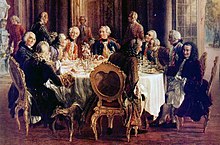
The Round Table of King Frederick II in Sanssouci by Adolph Menzel (1849,Alte Nationalgalerie, Berlin). Frederick is seated at the center with Voltaire (leaning forward in a purple coat), Marquis d'Argens, George Keith,[e] Algarotti, La Mettrie, and Marquis d'Argens.[276]
When Frederick ascended the throne in 1740, he reinstituted the Prussian Academy of Sciences (Berlin Academy), which his father had closed down as an economy measure. Frederick's goal was to make Berlin a European cultural centre that rivalled London and Paris in the arts and sciences.[258] To accomplish this goal, he invited numerous intellectuals from across Europe to join the academy, made French the official language and made speculative philosophy the most important topic of study.[277]
The membership was strong in mathematics and philosophy and included Immanuel Kant, D'Alembert, Pierre Louis de Maupertuis, and Étienne de Condillac. However the Academy was in a crisis for two decades at mid-century,[267] due in part to scandals and internal rivalries such as the debates between Newtonianism and Leibnizian views, and the personality conflict between Voltaire and Maupertuis. At a higher level Maupertuis, director of the Berlin Academy from 1746 to 1759 and a monarchist, argued that the action of individuals was shaped by the character of the institution that contained them, and they worked for the glory of the state.
By contrast d' Alembert took a republican rather than monarchical approach and emphasised the international Republic of Letters as the vehicle for scientific advance.[278] By 1789, the academy had gained an international repute while making major contributions to German culture and thought. For example, the mathematicians he recruited for the Berlin Academy – including Leonhard Euler, Joseph-Louis Lagrange, Johann Heinrich Lambert, and Johann Castillon – made it a world-class centre for mathematical research.[279] Other intellectuals attracted to the philosopher's kingdom were Francesco Algarotti, d'Argens, and Julien Offray de La Mettrie.[277]
Military theory

Frederick the Great Surveying the Field of Battle by Hugo Ungewitter [de] (1906)
Contrary to his father's fears, Frederick became a capable military commander. With the exception of his first battlefield experience at the Battle of Mollwitz, Frederick proved himself courageous in battle.[280] He frequently led his military forces personally and had a number of horses shot from under him during battle.[281]
During his reign he commanded the Prussian Army at sixteen major battles and various sieges, skirmishes and other actions, ultimately obtaining almost all his political objectives. He is often admired for his tactical skills, especially for his use of the oblique order of battle,[282] an attack focused on one flank of the opposing line, allowing a local advantage even if his forces were outnumbered overall.[283] Even more important were his operational successes, especially the use of interior lines to prevent the unification of numerically superior opposing armies and defend the Prussian core territory.[284]
Napoleon Bonaparte saw the Prussian king as a military commander of the first rank;[285] after Napoleon's victory over the Fourth Coalition in 1807, he visited Frederick's tomb in Potsdam and remarked to his officers, "Gentlemen, if this man were still alive I would not be here".[286] Napoleon frequently "pored through Frederick's campaign narratives and had a statuette of him placed in his personal cabinet".[287]...
Later years and death

Grave of Frederick at Sanssouci with potatoes, where he was buried only after the German reunification. (He wished to rest next to his dogs, but this was originally ignored.)
Near the end of his life, Frederick grew increasingly solitary. His circle of close friends at Sanssouci gradually died off with few replacements, and Frederick became increasingly critical and arbitrary, to the frustration of the civil service and officer corps. Frederick was immensely popular among the Prussian people because of his enlightened reforms and military glory; the citizens of Berlin always cheered him when he returned from administrative or military reviews.
Over time, he was nicknamed Der Alte Fritz (The Old Fritz) by the Prussian people, and this name became part of his legacy.[304] Frederick derived little pleasure from his popularity with the common people, preferring instead the company of his pet Italian greyhounds,[305] whom he referred to as his "marquises de Pompadour" as a jibe at the French royal mistress.[306] Even in his late 60s and early 70s when he was increasingly crippled by asthma, gout and other ailments, he rose before dawn, drank six to eight cups of coffee a day, "laced with mustard and peppercorns", and attended to state business with characteristic tenacity.[307]
On the morning of 17 August 1786, Frederick died in an armchair in his study at Sanssouci, aged 74. He left instructions that he should be buried next to his greyhounds on the vineyard terrace, on the side of the corps de logis of Sanssouci. His nephew and successor Frederick William II instead ordered Frederick's body to be entombed next to his father, Frederick William I, in the Potsdam Garrison Church. Near the end of World War II, German dictator Adolf Hitler ordered Frederick's coffin to be hidden in a salt mine to protect it from destruction. The United States Army relocated the remains to Marburg in 1946; in 1953, the coffins of Frederick and his father were moved to Burg Hohenzollern.[308]
On the 205th anniversary of his death, on 17 August 1991, Frederick's coffin lay in state in the court of honour at Sanssouci, covered by a Prussian flag and escorted by a Bundeswehr guard of honour. After nightfall, Frederick's body was interred in the terrace of the vineyard of Sanssouci—in the still existing crypt he had built there—without pomp, in accordance with his will.[309][f] Visitors to his grave often place potatoes on the gravestone in honour of his role in promoting the use of the potato in Prussia.[311]
Historiography and legacy
See also: Portraits of Frederick the Great
....
Frederick the Great - Wikipedia
Knowledge Web Content Knowledge Web Content (see main node)
Name: Frederick II the Great
Nickname/Alias: Frederick II
Achievements: A dominant figure in the history of modern Germany.
Born: January 24, 1712; Potsdam, near Berlin, Prussia (now Germany)
Died: August 17, 1786; Palace of Sans Souci, Potsdam, Prussia (now Germany) (Aged 74)
Field & Discipline: Royalty; King
Language: German; French
Father: Frederick-William I
Mother: Sophia-Dorothea of Hanover
Siblings: Wilhelmina; Frederica; Charlotte; Sophia; Ulrica; Augustus William, Henry; Amalia; Ferdinand
Spouse: Princess Elizabeth Christine of Brunswick-Bevern (married 1733)
Children: None.
Education: Private tutors
Major Work:
“History of My Times” (1750s; published mid-19th century)
Life & Times:
When he was eighteen, Frederick’s mother decided on a double marriage, Frederick to Princess Amelia of England, and his sister, Wilhelmina, to an English prince. The king refused permission and a disappointed Frederick made plans to escape to England when he was on a trip with his father to southwest Germany, in August 1730.
He failed and was court-martialed on a charge of desertion. His father saw the attempt as an act of political rebellion and military insubordination, and he was imprisoned in the fortress of Küstrin. Frederick’s accomplice in the escape plan, his friend Lieutenant Hans Hermann von Katte, was sentenced to death.
Frederick was forced to watch the beheading of his friend and assumed that he would soon face the same punishment.
In 1732, his father relented and Frederick was given a regiment and, in 1733, he accepted the bride chosen for him, Princess Elizabeth Christine of Brunswick-Bevern. The following year he was allowed to set up his own home in the castle of Rheinsberg near Berlin, where he surrounded himself with books and studied a wide variety of subjects. He showed particular interest in military history, politics, philosophy, French literature and music and even composed his own pieces for the flute.
In the late 1730s, he began to write, and his second book, 'Anti-Macchiavel,' compared princes devoted to peace and culture with those who wanted to pomp and power. Before the book was published, Frederick sent it to one of his favorite correspondents, [corresponded with] Voltaire*, who improved it stylistically.
In May 1740, the King died and, on 31st May, Frederick took the throne. By now he was educated, intellectual and exceptionally ambitious. Once he became king, he made it crystal clear to his ministers that he would be the one who decided policy.
His first actions as king included the abolishment of torture and the establishment of the Academy of Sciences, under a French president. The Academy attracted leading men of the time, including [his Academy included] Maupertuis*, [his Academy included] Algarotti* and [his Academy included] Euler*, but [turned down by] d'Alembert* refused the offer of the presidency.
With the sudden death of the Holy Roman Emperor, Charles VI, in October 1740, Frederick saw the chance to win glory in war and to make important territorial gains for Prussia. The heir to the Empire was the young Archduchess Maria Theresa, whose military and financial position was shaky.
Frederick immediately tried to benefit from Austria's apparent weakness and, reviving an old claim to the province of Silesia, attacked the province in December 1740. He had hoped that Maria Theresa would surrender most of Silesia in return for a promise of Prussian support against her other enemies, but things didn’t quite go to plan. Maria Theresa refused Frederick’s terms and, following a chain of diplomatic reactions, the situation led directly to the War of Austrian Succession.
Frederick successfully defeated the Austrians at Mollwitz in 1741, then again at Chotusitz in 1742. Then, having concluded an alliance with France for fifteen years, he forced Maria Theresa to give him Upper and Lower Silesia under the Treaty of Breslau, which ended the first phase of the war in 1742.
The second Silesian War was fought between 1744 and 1745 and ended with the Treaty of Dresden, which increased Frederick's territories. The Treaty of Aix-la-Chapelle finally established Prussian rule in Silesia in 1748.
The time between 1745 and 1756 was a period of peace, during which Frederick spent his time and energy perfecting the already highly centralized organization built up by his father. He also gave a lot of thought to increasing the prosperity of his subjects, which would, in turn, increase the prosperity of the state.
He issued a series of domestic reforms that modernized Prussia and financed the creation of hundreds of new villages. He also passed agricultural reforms and built thousands of miles of new roads.
Trade with other states was encouraged through improved communications, particularly the building of canals to serve Berlin and, with a view to raising money for future wars, Frederick protected woolen and other manufactures with a high import tariff.
To consolidate the authority of the state, Frederick reorganized the Prussian justice system and established a centralized and uniform system of courts. Under this new enlightened system, the first German law code was adopted, and speeded up the process of law.
Under the new code, the sentence of death could only be passed with Frederick’s personal approval. Prussian judges were trained in the standardized system, gaining Prussian courts the reputation of being the most honest in Europe. Other liberating changes included an enforced education system, universal religious toleration and freedom of the press, while a legal basis for further industrial and economic development was also set up.
Frederick kept a full orchestra which, for many years, included [employed] C P E Bach* and Berlin became, in Voltaire's phrase, ‘Sparta in the morning and Athens in the afternoon’. In 1750, Frederick persuaded Voltaire to come to live in Berlin but, within six months, the two men had fallen out then, after two more years of friendship, they broke off relations.
All the time, Frederick expected war to break out again at any time and, in
1755, thinking that he was about to be attacked by a dangerous combination of
Russian, Austrian, French or British powers, he hit first. In August 1756, he invaded Saxony and Bohemia, triggering the Seven Years' War.
Determined to avoid more wars, he immediately signed an important alliance with Russia. In 1772, he joined Russia and Austria in the First Partition of Poland, which gained him West Prussia. Then in 1778, on the death of Max Joseph, the Elector of Bavaria, he prevented Austria from taking over a large part of Bavaria.
In his last years, in 1785 Frederick organized the League of Princes, which, by playing on the fears of the lesser German states, united a number of them against Austria. At this time, he lived mostly in the great palace of Sans Souci, at Potsdam, which had been built for him between 1745 and 1747 and housed his collection of books, paintings and antiquities.
Extra Connections: Influenced the work of military strategist [influenced] Clausewitz* and [influenced] Gribeauval*.
He was visited by the philosopher [visited by] Helvetius*
He honored Prussian General [honored]Blucher*
Assessment: A leading advocate of the ideas of enlightened government, who was influential throughout much of Europe.
Oneliner: Frederick the Great of Prussia, enlightened despot
Bibliography:
- Encyclopedia Britannica.
- Collier's Encyclopedia.
- MacDonogh, Giles, Frederick the Great: A Life in Deed and Letters, London, Weidenfeld & Nicolson, 1999.