Hunt WH
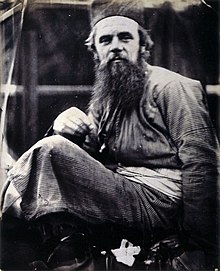
Achievement: Elevated painting technique to new standards of realistic detail and use of color.
Born: April 2, 1827; London, England
Died: September 7, 1910; London, England
Field & Discipline: Art; Painting
Language: English
Father: William Hunt
Mother: Sarah Hobman
Siblings: Elizabeth Ann Hunt (b. 1823); Maria Hunt Peagrim (b. 1825); Sarah Hunt Wilson (b. 1829); Edward Henry Hunt (b. 1832); Emily Hunt (b. 1836)
Spouse: 1) Fanny Waugh (1865); 2) Edith Waugh (1875-1910)
Children: Cyril Benone Hunt; Gladys Holman-Hunt; Hilary Holman Hunt
Education: Royal Academy of Arts, London
MAJOR WORKS:
The Light of the World (1854)
The Finding of the Saviour in the Temple (1854-5)
The Triumph of the Innocents (two versions: 1884, Tate Gallery, London; 1885, Liverpool)
LIFE AND TIMES:
William Holman Hunt discovered an affinity for painting at an early age. At 12, he told his father—a warehouse manager—of his intentions to become an artist, but William Hunt Sr.’s wishes for his son to enter into business prevailed. Young Hunt became a clerk, but continued to practice his passion thanks to indulgent superiors, off-hour lessons, and free time spent copying works at the British Museum. By 16 he had defiantly announced to his family his intentions to leave the trade and pursue art full time. During this time he was to meet and enter into an intimate friendship with [formed Pre-Raphaelite Brotherhood with] Millais*, a younger artist and student of the Royal Academy. In 1844, after two failed entrance attempts, Hunt himself would be admitted into the Academy. Hunt had an early success when his The Eve of St. Agnes (1848), a depiction of Keats’ poem, was selected for exhibition by the Academy.
Hunt and Millais soon found [formed Pre-Raphaelite Brotherhood with] Dante Gabriel Rossetti*, and the three, together with a small group of like-minded artists and critics, formed the Pre-Raphaelite Brotherhood. First conceived as a secret society, the “PRB” was defined by a shared dislike for the painting of the post-Renaissance period and especially the work of Raphael, whose paintings of Christ they thought “pompous” and “posturing.” Though Hunt’s work was generally well regarded before his convening of the Pre-Raphaelite Brotherhood, the critics harshly attacked the work of the newly formed cadre. Writers of the day, among them [criticized by] Dickens*, regarded the painters’ use of realism in depicting religious scenes as an act of irreverence. In the convention of the time, these subjects were best seen in an idealized light. These attacks in the press led to some financial hardship for Hunt, and he soon found it necessary to take work cleaning and restoring the paintings of Rigaud at Trinity House. At this time he also received financial assistance from the Millais family.
Hunt’s artistic reputation was subsequently salvaged when [championed by] Ruskin* became a champion for the Pre-Raphaelite cause, writing favorable letters to the press. At this time Hunt also began an acquaintanceship with the philosopher [knew] Carlyle*, who often visited the artist’s studio and found an affinity for the religious content of Hunt’s The Hireling Shepard (1851-52) and Our English Coasts (1852, also known as Strayed Sheep).
In addition to religious themes, Hunt’s body of work also includes numerous depictions of literary topics. Other than Keats, with The Eve of St. Agnes (1848) and later Isabella and the Pot of Basil (1876), Hunt painted scenes from the plays of Shakespeare in works such as Valentine Rescuing Sylvia from Proteus (1851). The Lady of Shalott (1857) was commissioned for an edition of [illustrated] Tennyson*’s poetry, which also featured illustrations by Hunt’s fellow Pre-Raphaelites.
While boyhood Bible studies left a lasting impression on Hunt, he was in fact an atheist until converting to Protestantism in 1851. This profound conversion would inform his entire body of work as well as his personal life, and his paintings would become the most powerful religious images of the Victorian Era. Specifically, The Light of the World (1853) can be said to be the best known of all British religious paintings. The picture, depicting Christ knocking on a darkened door representing mankind’s soul, was the subject of a multitude of reproductions that permeated the British Empire and beyond. Although the painting’s background displays much of Hunt’s signature naturalistic style, his depiction of Christ—crowned and bejeweled—dismayed Hunt’s usual ally Carlyle, who dismissed the representation as “mere Papistical fantasy.” This criticism fueled Hunt’s desire to visit the Holy Land and paint directly from biblical settings. In 1854, he embarked upon a two-year visit to Syria and Palestine, and he would return there in 1869 and 1873. His accounts of these journeys betray an English chauvinism common in this imperial era.
One noted result of his travels is The Scapegoat(1854-55), a hyper-realistic depiction of a miserable, half-starved goat (representing Christ) on the shores of the Dead Sea. The piece was met with mixed reaction among the public. Some viewed the work as an indication of mental instability, thus proving his nickname among the Brotherhood: “The Mad.” Hunt’s technique includes careful attention to detail, brilliant lighting, and a heightened use of color. Obsessed with accuracy, Hunt preferred to paint outdoors—even at night. The term “luminosity” has been applied to Hunt and the Pre-Raphaelites’ unique technique of painting very thinly over a background coat of white paint, thus giving the colors a sense of transparency. The resulting works, such as Hunt’s Our English Coasts, were considered major innovations in the history of color.
The Pre-Raphaelite Brotherhood would officially disband in 1854 due to artistic and personal diffraction. While each of his contemporaries eventually strayed from the group’s original vision, Hunt alone would carry on the principles of the Pre-Raphaelites through to the end of his days. However, Pre-Raphaelitism as a stylistic school would continue to thrive, gaining adherents and influencing the larger art world. Two younger Oxford-educated artists, [influenced] Burne-Jones* and [influenced] William Morris*, melded Pre-Raphaelite ideas with their own interest in both medieval and mythological themes as well as the decorative arts. Notably, Hunt’s painting technique influenced not only younger generations of painters but some of his older contemporaries as well, such as landscape painter, close friend, and Hunt portrait subject [influenced] Lear*. In the end, Hunt’s Pre-Raphaelite Brotherhood would have a profound and lasting influence on British culture.
Hunt’s later years were marked by both continued artistic success and personal adversity. In 1860 he would have his biggest financial success when The Finding of the Saviour in the Temple would fetch the unprecedented sum of 5,500 pounds from an art dealer. In 1865, Hunt gave up on a lengthy and often scandalous affair/courtship with the model Annie Miller, whose entanglements with other painters in his circle led to a lasting estrangement between Hunt and Rossetti. He married Fanny Waugh in 1865, but she would die tragically later that year after complications in childbirth. Between 1866 and 1868, Hunt lived and worked in Florence, and in 1875—amidst the vigorous protests of both families—Hunt married his dead wife’s younger sister Edith. The couple was forced to elope to Switzerland, as their union was at the time forbidden by British law.
The Triumph of the Innocents (1880-84), jubilantly depicting Mary and the Christ child’s journey from Bethlehem, was the most successful of his later works. His definitive two-volume account Pre-Raphaelitism and the Pre-Raphaelite Brotherhood was published in 1905. In later life, Hunt’s eyesight failed, an irony for one to whom acuity was always so important. Hunt is buried in St. Paul’s Cathedral.
Assessment: Hunt created some of the best-known religious paintings of Victorian England and co-founded the influential Pre-Raphaelite art movement.
Oneliner: William Holman Hunt, Pre-Raphaelite founder
Bibliography:
- Barringer, Tim, Reading the Pre-Raphaelites, New Haven, Conn.: Yale University Press, 1999.
- Coleridge, Mary E., Holman Hunt (Masterpieces in Colour series), London: T.C. & E.C. Jack, 1908.
- Hilton, Timothy, The Pre-Raphaelites,London: Thames and Hudson, 1970.
- Holman-Hunt, Diana, My Grandfather, His Wives and Loves, London: Hamish Hamilton, 1969.
- Hunt, William Holman. Encyclopædia Britannica. Retrieved January 5, 2004, from http://www.britannica.com/eb/article?eu=42486
- Millais, Sir John Everett, 1st Baronet. Encyclopædia Britannica. Retrieved January 5, 2004, from http://www.britannica.com/eb/article?eu=54011
- Pre-Raphaelite Brotherhood. Encyclopædia Britannica. Retrieved January 5, 2004, from http://www.britannica.com/eb/article?eu=62779
- The Pre-Raphaelite Critic, Periodical Criticism of the Pre-Raphaelite Movement: 1846 to 1900. Retrieved January 5, 2004, from http://www.engl.duq.edu/servus/PR_Critic/index.html
- Rossetti, Dante Gabriel. Encyclopædia Britannica. Retrieved January 5, 2004, from http://www.britannica.com/eb/article?eu=65805
- William Holman Hunt. The Artchive. Retrieved January 5, 2004, from http://www.artchive.com/artchive/H/hunt.html.
- William Holman Hunt. Preraphaelites.com. Retrieved January 5, 2004, from http://www.preraphaelites.com/bio.asp?pStr=10017.
- William Holman Hunt Chronology. National Museums Liverpool. Retrieved January 8, 2004 from http://www.liverpoolmuseums.org.uk/walker/pre-raphaelites/triumph/chronology.asp.
AUDIO/VISUAL:
- The Artchive: http://www.artchive.com/
- ArtMagick: http://www.artmagick.com/
- PreRaphaelites.com: http://www.preraphaelites.com/
- The Victorian Web: http://www.victorianweb.org/painting/whh/
- The Pre-Raphaelite Society: http://www.pre-raphaelitesociety.org/index.htm
- Olga’s Gallery: http://www.abcgallery.com/index.html