Blake, William
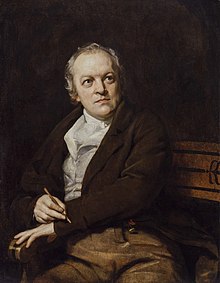
ACHIEVEMENTS: A prolific illustrator and poet of the Romantic period. Moderately successful during his lifetime, his mystical beliefs were misunderstood by many and he wasn't fully appreciated until after his death.
DATE AND PLACE OF BIRTH: Nov. 28, 1757, London, UK
DATE/PLACE OF DEATH/AGE AT DEATH: Aug. 12, 1827, London. Aged 69
DISCIPLINE: Art, Literature
FIELD: Artist, Poet
LANGUAGE: English
EDUCATION: Age 10-14 Pars' Drawing School; 14-21 apprentice to master engracer James Basire. 21 Royal Academy
MAJOR WORK: The Marriage of Heaven and Hell; The Visions of the Daughters of Albion; America, A Prophecy; The Songs of Experience; Europe, A Prophecy; The First Book of Urizen; The Song of Los; The Book of Los; and The Book of Ahania
LIFE AND TIMES:
William Blake was born in London on November 28, 1757. His family owned a hosiery shop. He learned to read and write from his parents and didn't attend any formal schooling until he was 10. These early years had an important influence on Blake, and he later said that it was at this time that he began to have mystical visions.
He had an interest art and literature, so at 10 his father sent him to Par's Drawing School. At 14, due to the prohibitive cost of continued schooling in art, James Blake arranged for William to become the apprentice of master engraver James Basire. Basire was the engraver for the London Society of Antiquaries and Blake assisted him in making drawings of Westminster Abbey. In the Abbey, Blake began to appreciate the Gothic style and mysticism that was represented there. At 21, Blake was admitted to the Royal Academy, but clashed with the restrictions placed upon him by his teachers.
He began to follow the mystical thinker Swedenborg*, but drew away from the sect once it began to have more religious overtones. In 1782 Blake married Catherine Boucher, the illiterate daughter of a merchant. Blake taught Catherine to read and write and assist him in printmaking. In 1783 Blake published his first work: 'Poetical Sketches.' In 1784, Blake's father died and Blake and Catherine moved into a house adjacent to the family's hosiery business. He began a business selling prints in partnership with a fellow apprentice, James Parker. However, the business did not thrive and in 1787 Blake moved out of the house. He soon had another setback when his favorite brother Robert died. Blake recounted that he saw his brother's spirit rise out of his body at death and go up towards heaven. Blake later claimed that his Robert appeared to him and showed him how to develop a new printing method of making illuminated books.
In 1789, Blake and Catherine hand-published the illuminated: ' Songs of Innocence.' Europe was feeling the political and cultural effects of the American Revolution at this time and in 1789 the French Revolution broke out. Blake's writings become more concerned with politics and in 1791 Joseph Johnson, who published Tom Paine's 'Rights of Man,' printed Blake’s poem: 'The French Revolution.'
However, it was considered too risky to publish at that time. Also in 1791 he was hired to engrave the drawings for a children's book by Wollstonecraft*: 'Original Stories from Real Life.' Blake was now entering his peak period of artistic creativity but he was frustrated by the publishing industry that inhibited artistic growth. Many artists felt the same creative pressures. Fuseli*, a leader in the artist community and a friend of Blake's, satirized the privatization of art in his own work.
Blake tried to avoid being subject to a publisher by printing and publishing his own material and making it directly available from his home. He became very productive between 1793 and 1796, self-publishing a number of his most notable works including 'The Marriage of Heaven and Hell;' 'The Visions of the Daughters of Albion'; 'America, A Prophecy'; 'The Songs of Experience'; 'Europe, A Prophecy'; 'The First Book of Urizen'; 'The Song of Los'; 'The Book of Los'; and 'The Book of Ahania.'
From 1796 until 1800 he was commissioned to do illustrations for a number of works. However, due to England's war with France, the market for such things was not good and Blake struggled to find success. Blake also struggled to achieve recognition as a serious artist, rather than simply an artisan performing what was essentially skilled labor. So it was that in 1800, a minor poet and patron of the arts named William Hayley, who was a friend of Romney*, asked Blake to live at his estate. Blake and his wife Catherine were enthusiastic about the opportunity to get out of London for a while and enjoy the countryside. Within a couple years, however, the visionary poet was chafing at the constraints of working for the whims of Hayley and the upper class patrons of Sussex. He wrote to a friend that, "I find on all hands great objections to my doing anything but the meer drudgery of business, & intimidations that if I do not confine myself to this, I shall not live; this has always pursu'd me... But if we fear to do the dictates of our Angels, & tremble at the tasks set before us; if we refuse to do Spiritual Acts because of natural Fears of natural Desires!"
Courageously, Blake moved back to London, but even though the art market had improved, Blake was not finding work. He suffered a number of artistic and critical setbacks. Some reviewers wondered if he were sane, and Blake's frustration drove away his friends and admirers. After the failure of 'A Descriptive Catalogue of Pictures' in 1809, Blake became somewhat of a recluse for the next decade. Slowly but surely, and due to the commitment of some young artists such as John Linnell and John Varley, Blake came back into public life. His longtime patron Thomas Butts commissioned a series of watercolors for the Book of Job. The watercolors were eventually engraved and published.
Blake also began a series of illustration of Dante's 'Divine Comedy' commissioned by John Linnell. Blake. He was working on these when he died.Blake was satisfied toward the end of his life that his art and poetry would continue to be appreciated and understood. It wasn't until Alexander Gilchrist wrote 'William Blake: Pictor Ignotus' in 1863 that Blake's work gained a significant and world-wide following that continues to this day. DG Rossetti* published of a volume of Blake's poems in 1874 that brought even more attention to his work. Blake influenced many other poets too, the most noteworthy of which is Yeats* who greatly admired Blake's work and wrote often of it in his work.
ASSESSMENT: A mystical poet and artist who struggled to find success in his lifetime but lived to see his work gain a wide audience which continued to grow after his death.
EXTRA CONNECTIONS: He knew Wilkie Collins*
He illustrated Lavater's* work.
One of his admirers was Lamb*
ONELINER: William Blake, 19th century mystic poet and illustrator
BIBLIOGRAPHY:
Bindman, David: 'Blake, William', The Grove Dictionary of Art Online, ed. L. Macy (Accessed April 21, 2002) <>McCalman, Iam (ed.) (1999).