Wollstonecraft
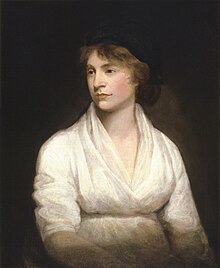
ACHIEVEMENTS: Early feminist
DATE AND PLACE OF BIRTH: 27 April 1759, London, England
DATE AND PLACE OF DEATH AND AGE AT DEATH: 10 September 1797, London, England. Aged 38
DISCIPLINE: Writer and feminist
FIELD: Literature
LANGUAGE: English
PARENTS:
Father: Edward John Wollstonecraft
Mother: Elizabeth Dickson
SIBLINGS:
4 brothers: Edward, Henry, James, Charles
2 sisters: Eliza, Everina
SPOUSE:
William Godwin
CHILDREN:
By Gilbert Imlay:
I daughter: Fanny
By William Godwin:
1 daughter:Mary
EDUCATION:
Primary schools
mostly self-educated
MAJOR WORK:
"A Vindication of the Rights of Women" (1792)
and
"Thoughts on the Education of a Daughter" (1786)
"Mary, A Fiction"1788
LIFE AND TIMES:
In 1778 Wollstonecraft moved to Bath as live-in companion to a wealthy widow. She was recalled home to nurse her mother in 1781 and when her mother died six months later moved in with her friend Fanny Blood’s family. Wollstonecraft took in sewing and Fanny Blood painted and sold watercolours. In 1783 Wollstonecraft was again called home to look after her younger sister, Eliza, who was suffering post-natal depression. Wollstonecraft's solution was to kidnap Eliza and remove her from her husband, home and baby.
The three women opened a day school in Islington, North London, which failed. They were then joined by another of Wollstonecraft's sisters and opened a school in Newington Green. From the start, this was a more successful venture. Newington Green was at that time a centre for dissenters from the Anglican church, many of whom had radical ideas on education. Wollstonecraft met Price*, the philosopher, Joseph Priestley*, the scientist, and Sarah Burgh, widow of the educator James Burgh who had also raised the question of women's education.
In 1785 Wollstonecraft went to Lisbon to look after Fanny, who had married there and was expecting a child. Fanny had always been frail and was to die of tuberculosis. Wollstonecraft was convinced that her pregnancy had killed her and she vowed never to marry. She arrived home to find that her sisters had been unable to keep the school going. Encouraged by a friend, Wollstonecraft wrote an educational tract. In "Thoughts on the Education of a Daughter" (1786) she began to formulate a political philosophy. She emphasised the importance of the early care and environment of children and the need to treat them as individuals, not as untrained adults. She suggested adapting the progress of education to the child's development and hinted at the need for women to receive an education which would make them employable. Having given the Blood’s her fee for the book, Wollstonecraft then became governess to the three daughters of Lord and Lady Kingsborough in County Cork, Ireland. During her time in Ireland, Wollstonecraft wrote a novel, "Mary, A Fiction" before being dismissed after ten months' service.
She returned to London determined to make her living as a writer. Her publisher, Joseph Johnson, took her into his home and gave her work as an editor, translator, writer and reviewer. He founded a radical journal, the "Analytical Review", and Wollstonecraft contributed reviews on travelogues, children's book and romances as well as fiction and educational works. She introduced the principles of education for women in her reviews and she singled out for praise writers who gave equal respect to women's intellect. At Johnson's home she met the radical philosophers Godwin* and Thomas Paine*, the Swiss artist Fuseli* and the artist and poet Blake*. She began to be more outspoken in her own writing, praising the early ideas of the French revolutionaries and calling for political reform in Britain.
On educational matters, she criticized the views of Rousseau* the French philosopher, who declared that women existed to please men. In 1790 she attacked Burke's* "Reflection of the Revolution in France" under the title "Vindication of the Rights of Men".
In 1791-2 Wollstonecraft's "Vindication of the Rights of Women" was published. Her radical friends loved it, but the majority of the educated public, including the writer Horace Walpole* and the educationist Hannah More*, thought it was inflammatory. She had now made her name politically. Partly as a result of the refusal of Fuseli and his wife to accept her idea of a menage a trois, Wollstonecraft took off for Paris in 1792. There she met an attractive American called Gilbert Imlay by whom she had a daughter, Fanny, in May 1794. In the same year, the first volume of her history of the French revolution was published. Imlay did not return Wollstonecraft's passionate devotion and she became increasingly unhappy. She attempted suicide in 1795 after which Imlay sent her on a convalescent trip to Scandinavia.
She was aware of the need to remain financially independent and wrote "Letters from Sweden" which is considered to contain some of her best prose and most acute political insights. When she returned to London in October 1795 Wollstonecraft found Imlay living with a young actress, and reacted by jumping off Putney Bridge into the river Thames. She was rescued by two fishermen who found her unconscious in the water.
Friends rallied round her, in particular William Godwin, with whom she formed a close friendship which gradually turned to love. She drafted a political novel, "The Wrongs of Women", wrote an analytical essay on esthetics and an essay on childcare under the title "Letters on the Management of Infants". She became pregnant by Godwin at the end of 1796 and they married in March 1797. In August she gave birth to a daughter Mary, who later became Mary Shelley*. Eleven days later Wollstonecraft died.
ASSESSMENT: She is an icon of the feminist movement and admired as one of the first articulate pioneers for women's rights (which she saw primarily as the right to be educated).
EXTRA CONNECTIONS: She abridged Lavater’s* book on physiognomy
She knew fellow-libertarian Roscoe*
ONELINER: Mary Wollstonecroft, mother of Mary Shelley and early feminist
BIBLIOGRAPHY:
Ferguson, Moira, and Todd, Janet, Mary Woolstonecraft, Twayne Publishers Ltd., Boston, 1984
Tomalin, Claire, The Life and Death of Mary Wollstonecraft, Penguin Books Ltd., London, 1977.