Lamb, Charles
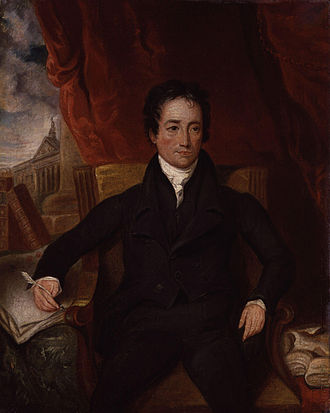
Nickname/Alias: Elia
Achievements: Essays
Born: February 10, 1775; London, England
Died: December 27, 1834; Edmonton, Middlesex, England (Aged 59).
Field & Discipline: Literature; Essayist; Critic
Language: English
Father: John Lamb
Mother: Elizabeth Field
Siblings: John; Mary
Spouse: None
Children: None
Education: Christ's Hospital, London
Major Work: "Elia: Essays which have appeared under that Signature in the London Magazine" (1823)
Life & Times:
At the Christ's Hospital school, Lamb was a contemporary of [a pal of] Coleridge* with whom he formed a lasting friendship. Only pupils who were intending to enter the church went on to university and Lamb's stutter prevented him from following this course. When he left school in 1789 he worked as a clerk for the South Sea Company before becoming a clerk in the accountant's office of the [worked for] East India Company* in 1792.
His work at India House involved copying out details of the auction sales of the tea, spices and silk imported by the company. In between auctions he had plenty of time for writing, reading, and regular attendance at Drury Lane and Convent Garden theatres. In 1794, his first published work, a poem in the "Morning Chronicle" was inspired by the acting of Sarah [inspired by] Siddons*.
The strain of difficult conditions at home, the disappearance of Coleridge to married life in Bristol, and his own disappointment in love, gave Lamb a breakdown at the end of 1795 and he spent some time in an asylum. There was some mental instability in the family history and the following year Lamb's elder sister Mary became temporarily deranged, murdered their mother, and was committed to a private asylum. Lamb continued to visit her and after the death of their father in 1799 Mary came to live with him, an arrangement which lasted for the rest of his life except for periods when Mary became unstable.
He continued to progress at work while publishing some of his poems and a couple of plays. He corresponded with many friends including Coleridge, [a pal of] Wordsworth* and [a pal of] Southey* and in 1802 he visited Coleridge in the Lake District. In spite of his own religious faith and lack of revolutionary views, Lamb had a number of friends including William Hazlitt, Leigh Hunt and [a pal of] Godwin* who were confirmed atheists and political radicals.
Godwin among other projects published children’s literature. In 1807 he commissioned Lamb and his sister to write simple narratives of Shakespeare's plays for children. "Tales from Shakespeare" was a success and became a children's classic. In 1808, Lamb had another success with a children's version of Homer's "Odyssey" called "The Adventures of Ulysses", and in 1809 he and Mary wrote "Mrs Leicester's School", a collection of tales supposedly told by the pupils of an imaginary school.
His first attempts at literary criticism appear in "Specimens of English Dramatic Poets Who Lived About the Time of Shakespear" (sic) (1808).
He wrote critiques on Shakespeare and William Hogarth for Hunt's literary magazine, the "Reflector", and in 1814 he reviewed the "Excursion" by Wordsworth in the presitigious "Quarterly Review". Lamb's criticism of contemporary poets is found mainly in his letters. He admired Southey and [a fan of] Blake* and disliked [disliked work of] Byron* and [disliked work of] Percy Bysshe Shelley*. Shelley admired Lamb and regretted that they never met.
Lamb's best writing, for which he became famous, is found in the essays he wrote for the "London Magazine" under the pseudonym 'Elia', the name of an obscure clerk he had met in his first job. For the first issue of the magazine in December 1820 he wrote an account of his early experiences as a clerk. It went down well and he was asked for another contribution. Lamb became a regular contributor and in 1823 published a collected volume of essays titled "Elia: Essays which have appeared under that Signature in the London Magazine".
Unlike Hazlitt and Hunt, who also wrote essays, Lamb did not have an agenda based on general principles. He was not interested in persuading his readers to any particular point of view and he avoided subjects like religion and politics.
His essays were nearly always written in an autobiographical form, and incorporated many of his own experiences, although the character of Elia is a fictional one and does not represent the real Lamb. They were written in different forms - as memoirs, literary appreciation, biographical sketches and fantasies - and they were serious, poetic, prosaic, melancholy, ironic and amusing. He now had a certain amount of fame and had done well enough at work to be able to retire in 1825 with a generous pension which would continue to be paid to Mary on his death. In 1827 they moved to Enfield, outside London, and Lamb missed his friends badly.
When Mary was confined he became lonely and tended to drink too much. He continued to contribute to various publications, including the "Spectator", and also wrote plays and poems, none of which reflected his talent as an essayist. In 1833 "The Last Essays of Elia" were brought out and in the same year, when Mary's health broke down again, Lamb decided to join her in a private mental home so that she would not be distressed without him. In December 1834 he fell while walking and died following complications.
Extra Connections: Met [met] Wilkie Collins*.
Knew [knew] Mary Shelley* and the actor [knew]Macready*
Assessment: Lamb is remembered as one of the supreme exponents of the essay form of literature.
Oneliner: Charles Lamb, great English essayist
Bibliography:
- Barnett, George L, Charles Lamb, Twayne Publishers, Boston, 1976.
- Cecil, David, A Portrait of Charles Lamb, Constable and Co. Ltd., London, 1983.