Carroll, Lewis
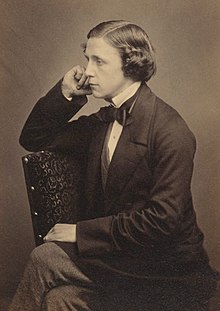
OTHER-NAME: Charles Lutwidge Dodgson
BIRTH: January 27, 1832, Daresbury Parsonage, Cheshire, England
DEATH: January 14, 1898, The Chestnuts, Guildford, England
DISCIPLINE: Literature; Math; The Arts
FIELD: Fiction & poetry; algebra; photography
ASSESSMENT: A significant contributor to children’s literature. He also contributed to early photography and to mathematics.
LANGUAGE: English
EDUCATION: Home-schooled until age twelve; Richmond School; Rugby; Christ Church, Oxford
ACHIEVEMENT: ‘Alice’s Adventures in Wonderland’
MAJOR-WORK: ‘Alice’s Adventures in Wonderland’
PARENTS: Charles Dodgson and Frances Jane Lutwidge
SPOUSE: None
SIBLINGS: Frances Jane , Elizabeth Lucy , Caroline Hume , Mary Charlotte , Skeffington Hume, Wilfred Longley , Louisa Fletcher , Margaret Anne , Henrietta Harington.
CHILDREN: None
DETAILS:
Lewis Carroll was the pseudonym of Charles Lutwidge Dodgson, the enigmatic mathematician and author of children’s stories including ‘Alice’s Adventures in Wonderland’ and nonsense poetry. The son of Reverend Charles Dodgson, curate of Daresbury, and Frances Jane Lutwidge, Charles was born at his father’s parsonage in Cheshire, England on January 27, 1832. He was home-schooled until age twelve by his mother and father. He then attended Richmond School, Rugby and Christ Church, Oxford, where he studied Mathematics and Classics.
In 1852, while still an undergraduate, he published his first poems in the Oxonian Advertiser. In 1855, he became lecturer in mathematics at Christ Church. In 1856 he invented his pen-name to preserve his privacy as an author.
Christ Church faculty were required to take clerical orders and although Charles was ordained a deacon on December 22nd 1861, for some reason he declined to take holy orders. It has been speculated that problems with doctrine, combined with a lifelong stammer and a deaf right ear might have influenced his decision.
Charles focused on teaching mathematics, logic, and religion. He wrote and published prodigiously both in math and literature. His first book, ‘A syllabus of plane algebraical geometry, systematically arranged, with formal definitions, postulates, and axioms,’ was published in 1860. His mathematical writing concentrated primarily on explaining and interpreting Euclid and featured the whimsical humor that became his trademark. Although underappreciated during his lifetime, Charles’ mathematical work has gained recognition in the years since his death.
The event that most notably shaped his life (and which determined how he would be remembered) was the arrival in 1856 of a new college dean, Henry Liddell with his family including a little daughter, Alice. Charles had just bought a camera and while he was photographing the Cathedral he met and was enchanted by the four-year-old.
It was at a picnic on July 4th 1862 that Alice and her sisters asked for a story. ‘Alice’s Adventures in Wonderland’ began to form in Charles’s mind. Almost a year later, in June 1863, Charles and the Liddells had a falling-out which ended with a civil, but less close relationship. This did not, however, prevent Charles from presenting the family with a hand-illustrated copy of the first version of ‘Alice,’ entitled ‘Alice’s Adventures under Ground,’ for Christmas in 1864.
Alice was not Charles’ only child friend. As a cleric, teacher, and popular photographer he met many young girls who became favorite companions and artistic subjects. His preference for their company and his tendency to photograph them in the nude have led to accusations of pedophilia which, however, remain unproven.
Along with other friends came other stories. In late 1871, Charles published a sequel to ‘Alice’ called ‘Through the Looking Glass and What Alice found there.’ In 1876 came the epic nonsense poem ‘The Hunting of the Snark.’ Over the course of his life, Charles wrote more than 300 pieces including works of fiction, poetry, mathematics, and puzzles.
Charles was also an avid artist and photographer. Although his acquaintance, art critic John Ruskin* told him he was untalented, Charles continued to draw and maintained friendships with artists and writers, many of whom he also photographed. These included painters D.G. Rossetti* and J.E. Millais*, poet Alfred Lord Tennyson*, and actress Ellen Terry*. Charles also photographed architecture and landscapes, but is particularly noted for his photographs of young children, from whom, at a time when sitting for a photograph required around forty-five seconds of immobility, he managed to capture an expression of liveliness.
In 1881 Charles resigned as mathematical lecturer at Christ Church but retained his student and resident privileges, devoting much of his time of his time to the production of three books on logic.
A multifaceted man, Charles used his time to indulge an interest in invention, parliamentary election procedure, science and the paranormal. In 1882 he joined the newly-formed Society for Psychical Research, joining the company of author Arthur Conan Doyle*, chemist and physicist William Crookes*, physicists Oliver Lodge* and JJ Thomson*, and naturalist Alfred Russel Wallace*. Charles also wrote an amazing number of letters, some of which, addressed to his young friends, were puzzles within letters.
The last years of his life were devoted to his books on logic, two of which were completely destroyed by his family when they cleaned out his rooms after he died on January 14th, 1898 at his new home, The Chestnuts, in Guildford, England.
Charles Dodgson’s life is, in retrospect, much like the puzzles he was so fond of working into his stories and letters. It is impossible to know the true nature of his relationship with his child friends. Scholars have speculated that he was gay, that he was a pedophile, that he used drugs, that he was paralyzed with shyness, even that he was Jack the Ripper. The facts of his life do not explain the paradoxical nature of the man. He wrote about parliamentary election procedure as well as about rules for playing lawn tennis. He was a deacon who disagreed with the doctrine of his church. He was a member of the Society for Psychical Research which debunked false séances, but he still believed in spirit photography.
Above all, Charles Dodgson, aka Lewis Carroll, changed the nature of children’s literature.
ONELINER: Lewis Carroll, Victorian children’s author
OTHER CONNECTIONS: Dali illustrations
BIBLIOGRAPHY:
Morton N. Cohen, , Charles Lutwidge [Lewis Carroll] (1832-1898)’,Oxford Dictionary of National Biography, Oxford University Press, 2004 [accessed 22 May 2007]
Bakewell, Michael. Lewis Carroll: A Biography. London: William Heinemann Ltd., 1996
AUDIO/VISUAL:
http://people.virginia.edu/~ds8s/carroll/.html
includes photographs of Millais, Terry, Tennyson, Rossetti and Alice Liddell taken by
http://www.gutenberg.org/etext/19002
contains a facsimile of the original manuscript written and illustrated by and given to Alice Liddell
http://www.gutenberg.org/files/19002/19002-h/images/
just the illustrations from the original manuscript