Hoffmann ETA
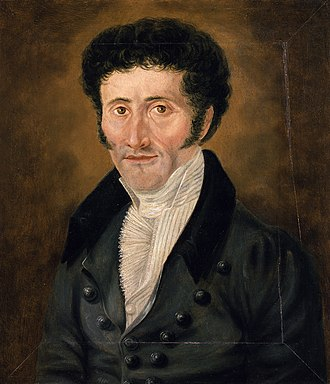
NAME: Hoffmann Ernst Theodor Amadeus
ACHIEVEMENTS:
Best known in the Offenbach ballet version of some of his writings: “Tales of Hoffmann.”
NICKNAME/ALIAS: ETA, Johannes Kreisler
DATE AND PLACE OF BIRTH:
24 January 1776, Konigsberg, Germany (now Kaliningrad, Russia).
DATE AND PLACE OF DEATH AND AGE AT DEATH:
25 June 1822, Berlin, Germany. Aged 46
DISCIPLINE:
Writer, composer
FIELD:
Literature, music
LANGUAGE:
German
PARENTS:
Father: Christoph Ludwig Hoffmann
Mother: Luise Albertine Doerffer
SIBLINGS:
1 brother
SPOUSE:
Maria Michalina Trzinska
CHILDREN:
None
EDUCATION:
German Reformed School, Konigsberg
University of Konigsberg
MAJOR WORK:
"Phantasiestucke in Callots Manier" (1814-15) "Fantasy Pieces in the Style
of Callot")
"Nachtstucke" (1817, "Hoffmann's Strange Stories)
"Die Serapionsbruder" (1819-21, "The Serapion Brethren")
LIFE AND TIMES:
Hoffmann was attracted to music and while still a boy he read the "Confessions" of Rousseau* and was inspired to imitate the French philosopher and write an opera while lying in bed.
At university he began writing fiction and after completing his studies in Berlin, in 1800 Hoffmann took a job as law officer in the Polish lands recently annexed by Prussia. In 1802 he married a Polish girl and a year later he was published for the first time when an essay on the use of the classical chorus in drama was accepted by a magazine. He remained in the Polish provinces until his job came to an end after the defeat of Prussia in the war with France in 1806.
Throughout this time, Hoffmann had written music, plays and criticism, and in 1808 he became musical director of a theatre in Bamberg, Bavaria. Released from the drudge of being a bureaucrat, he composed operas, ballets and songs, conducted, designed sets, painted scenery and wrote music criticism. He signed some of his reviews "Johannes Kreisler", a name he used later for the character of the mad conductor in one of his novels.
His first fictional work, "Ritter Gluck", (a short story which was in part an interpretation of the career of Gluck* as a composer of opera) was published in March 1809. In 1813 he moved to Dresden to conduct opera and it was around this time that he changed his third given name from 'Wilhelm' to 'Amadeus', in honour of Mozart*. Hoffmann was also an enthusiastic admirer of Beethoven*. The wars with France made earning a living difficult and in 1814 Hoffmann accepted a job at the Court of Appeal in Berlin.
Before he left Leipzig for Berlin he published the first of four volumes of his collected short stories under the title: "Fantasy Pieces in the Style of Callot". He settled with his wife in a flat in Berlin, overlooking the Royal Theater and surrounded by cafes and wine bars in which he spent much of his time in the remaining seven years of his life.
His short stories provided the entrée into Berlin literary circles and Hoffmann's reputation as a writer was established. His originality lay in his fantastical approach, combined with acute psychological insights. He wrote believably about madmen, ghosts and automata. In 1815 Hoffmann wrote a novel "Die Elixiere des Teufels" ("The Devil's Elixir") and in 1816 his last major musical work, the opera "Undine", was performed in Dresden.
It was his short stories for which editors clamoured. His most significant story during the early years in Berlin was "Der Sandmann," about demonic possession. The ballet "Coppelia" by Delibes* is based on this Hoffmann story, in which Hoffmann names one of his characters (a professor of physics with magical powers) after the famous Italian physiologist Spallanzani*.
Although his position at the Court of Appeal was made permanent in 1816 and his salary later substantially increased, Hoffmann never had enough money and at times turned out stories he later wanted to disown. In 1816-17 a new collection of stories was published, entitled "Nachstucke" ("Hoffman's Strange Stories").
He was seriously ill in 1816 and spent three months at a spa in Silesia, and from then on his health deteriorated. His next collection of stories called "Die Serapionsbruder" ("The Serapion Bethren") and was published in four volumes in 1819-21). They were translated and became popular in the United States, Britain and France as well as in Germany.
Hoffmann's stories had a strong appeal for other creative artists. Berlioz* read his stories, the composer Wagner* drew inspiration from them of his opera "Die Meistersinger von Nurnberg", and Offenbach* made Hoffmann the central character of his opera, "The Tales of Hoffman". The American writer Poe* is only one of the many authors who was influenced by Hoffman.
In 1819 Hoffmann was seconded to the Committee set up to investigate radicals such as Follen* who were involved the revolutionary movement for German nationalism. Despite having ridiculed student radicals for their excessive patriotism in his writing, Hoffman recommended mild treatment for the radicals held in Berlin although he insisted that Follen's brother, Auguste, be jailed.
Hoffman became increasingly ill from 1820 and suffered from a progressive paralysis. He continued to write and died, tortured by financial worries.
ASSESSMENT: Hoffman is remembered for his stories about the supernatural and the
magical in which reality and unreality are disturbingly combined.
EXTRA CONNECTIONS: None
ONELINER: ETA Hoffmann, writer of horror stories
BIBLIOGRAPHY:
Hewett-Thayer, Harvey W, Hoffman: Author of the Tales, Princeton University Press, Princeton, 1948
On to the Next Stop on the Mystery Tour