Poe EA
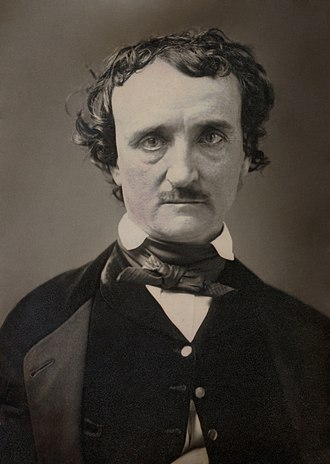
ACHIEVEMENT: Wrote the first detective stories.
DATE AND PLACE OF BIRTH: 19 January 1809, Boston, MA.
DATE AND PLACE OF DEATH AND AGE AT DEATH: mysteriously 7 October 1849, Baltimore, MD. Aged 40 (cemetery and grave)
CATEGORY: Writer
PROFESSIONAL/CRAFT ASSOCIATION: Literature
EDUCATION:
Schools in London
Richmond Academy
University of Virginia], West Point
MAJOR WORK:
"Tales of the Grotesque and Arabesque" (1845)
"The Ravenand other Poems" (1845)
LIFE AND TIMES:
In 1826 Poe entered the University of Virginia where he studied ancient and modern languages and wrote poetry. He then went to Boston, probably with money secretly given him by Mrs Poe, and spent the next seven weeks living as frugally as he could. During this time he met a young printer who agreed to publish his poems. They were brought out in a pamphlet title "Tamerlane and Other Poems by a Bostonian" in August 1827. Very few copies sold and it was not reviewed.
In May 1827 he joined the army for a five-year period, under the name Edgar A. Perry because he feared that his creditors would track him down. After the death of his mother, his stepfather grudgingly bought him out of the army in 1829 and arranged for his entry to West Point the following year. Poe had continued to write poetry and eventually managed to get his poems published under the title "Al Aaraaf, Tamerlane, and Minor Poems" At West Point he hated the rigidly scheduled life which allowed him only two hours a week in the library. In January 1831, with the co-operation of sympathetic officers, he managed to collect enough misdemeanors to be court-martialed and was duly expelled. He tried to get a letter of recommendation to Lafayette 2* so that he could go to Paris and join the revolutionary army but this project came to nothing.
In New York he found a publisher and his "Poems" were brought out in April 1831. He got one warm review and a brief mention. He began to write fiction, stimulated by an announcement in a magazine of a prize of a hundred dollars for the winner of a short story competition. Poe sent five stories to the magazine but did not win the prize. However, the magazine did publish his stories. One of them, "Metzengerstein" was intended as a parody of the sort of German horror story written by ETA Hoffman*.
In 1835 he returned to Richmond to take up the post of editor of the "Southern Literary Messenger," was dismissed for drinking but reinstated. In 1836 he married. Poe worked six days a week on the "Southern Literary Messenger" and was allowed to print his own work, though not given permission to sign anything that had not been previously published. The quality of Poe's reviews were soon attracting attention to the magazine but his biting wit made his proprietor nervous. Poe moved to New York and throughout the financial scares of 1837 wrote steadily while his aunt earned money keeping a boarding house. In 1838 he published "The Narrative of Arthur Gordon Pym", the allegedly true narrative of the adventures of a shipwrecked man.
In 1838 he moved to Philadelphia, now confident that his stories could sell on their own. He remembered comments by Sir Walter Scott* in his essay "On the Supernatural in Fictitious Composition" where Scott used the term "arabesque" for horror stories with a fantasy element. Poe adopted this description and used the term "grotesques" for the parodies where he piled on the horror . He wrote two stories "William Wilson" and "The Fall of the House of Usher" published in a collection of his stories called "Tales of the Grotesque and Arabesque".
When he was not writing, Poe met writers, actors and artists in the Falstaff hotel where he was noted for never having a drink. He met William Burton, the owner of "Burton's Gentleman's Magazine" and was given the job of co-editor. After quarrelling with Burton, Poe resigned in 1840. That year his story "The Man of the Crowd" was published in "Graham's Lady's and Gentleman's Magazine." This story, of a man who looks out of the window of his club and sees a man in the crowd whom he is compelled to follow, became a favorite of the French poet, Baudelaire*.
In 1841 Poe accepted a job as editor of "Graham's" magazine where he published his story "The Murders in the Rue Morgue" that May. This was Poe's first story of "ratiocination" as called his detective stories. He created the character of a detective whom he called C. Auguste Dupin, based on the work of French detective Vidocq* In 1842, his wife Virginia became ill and although she recovered she was never well again and had several acute episodes when her death was expected. Three months later, Poe resigned from the magazine and under the strain of no job and his desperate fears about his wife, he began to drink again. He wrote two reviews of great critical importance.
In a review of Longfellow'spoetry he stated his own theory of poetry in which he encouraged the new school of American poetry at whose head he placed Longfellow and James Lowell. In a review of Nathaniel Hawthorne*'s"Twice Told Tales" he praised Hawthorne's writing and gave his own theory about how to write a short story and the advantages of the genre; this became the standard definition of the short story. In 1843 Poe won a hundred dollar prize from a Philadelphia paper for his story"The Gold Bug". It was published in the "Dollar Newspaper" in June and reprinted in the "The Saturday Courier" with woodcuts.
In 1844, with no opportunities in Philadelphia, he went back to New York. He wrote the successful "Balloon Hoax" for the "New York Sun". He then got a job as sub-editor of the "New York Mirror". He lectured at Boston and wrote literary reviews. It was now that he wrote his most famous poem "The Raven"which appeared in January 1845 in the "American Review". In 1845 he became editor of the "Broadway Journal" and republished his short stories. "The Ravenand other Poems" and a selection of Tales were published in 1845. In one of his last works, “Eureka” he suggested the concept of the big bang*, and a universe so large the light from distant stars had not yet arrived (which also dealt with the Olbers* Paradox).
After his wife died he went back to Richmond and became engaged to his childhood sweetheart, Elmira Royster who was by then widowed. During a party in Richmond, he suddenly left and caught a boat to Baltimore where he was found six days later, dying in the road.
ASSESSMENT: Poe's poem "The Raven"is one of the best known poems of the nineteenth century. He raised short story writing to new heights and he wrote the first
detective stories.
EXTRA CONNECTIONS: Through translations of his work into French by Mallarme* he influenced Debussy*.
He Rachmaninov 2*, Conan Doyle*, Verne* and was influenced by French composer Ravel*
Next Stop on the Mystery Tour
ONELINER: Edgar Allen Poe, writer of the first detective story
BIBLIOGRAPHY:
Bittner, William, Poe, A Biography, Elek Books, London, 1962
Quinn, Arthur Hobson, Edgar Allan Poe, A Critical Biography, D. Appleton-Century Company, London, 1941
LANGUAGE: English
PARENTS: Father: David Poe Mother: Elizabeth Arnold
SIBLINGS: 1 brother: William 1 sister: Rosalie
SPOUSE: Virginia Clemm CHILDREN: None
Liberty ship: A total of seven Weyerhauser Liberty ships were damaged by enemy action and returned to service.
The SS Edgar Allen Poe was torpedoed November 8th, 1942, while steaming alone to New Caledonia in the South Pacific with a Navy cargo. The First Assistant Engineer and fireman were killed in the explosion. The ship was a total loss and turned over to the Navy as a store ship. She was laid up in Subic Bay, Philippines Islands, and scrapped in 1949. Build by Weyerhauser.