Gluck
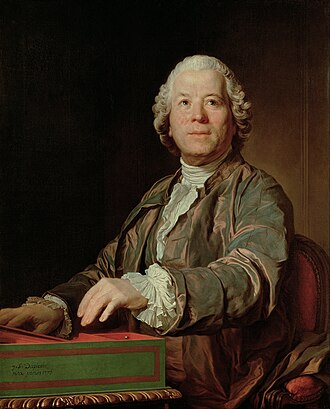
Full Name: Christoph Willibald Ritter von Gluck
Nickname/Alias: Christoph Willibald Gluck
Achievements: Played an important role in operatic history, striking a new balance between music and drama.
Born: July 2, 1714; Erasbach, near Berching, Upper Palatinate, Germany.
Died: November 15, 1787; Vienna, Austria (Aged 73)
Field & Discipline: Music; Opera; Composer
Language: German
Father: Alexander Gluck
Mother: Maria Walburga
Siblings: 6 brothers, 2 sisters, all younger
Spouse: Maria Anna Bergin
Children: None; adopted his niece Marianne Hedler
Education: At home; Prague University
Major Work:
"Orfeo ed Euridice"
Life & Times:
At 20 or 21 Gluck went to Vienna and began to study music seriously, and to compose. There he met Italian nobleman Antonio Maria Prince Melzi, who engaged him for his orchestra in Milan, where Gluck also studied composition with organist and composer Giovanni Battista Sammartini, the foremost musician in Milan, from whom he learned the new Italian style of instrumental music.
In 1741, when Gluck was 27, his first opera, "Artaserse", with libretto by the Italian poet Pietro Metastasio, opened the Milan opera season, and was an instant success. Subsequent commissions kept Gluck busy for three more years. "Demofoonte" was produced in 1742, "Arsace" in 1743, "Sofonisba" in 1744, and "Ippolito" in 1745.
Lord Middlesex, director of Italian opera at London’s Haymarket Theater, believed somebody should challenge composer [was a competitor of] Handel's* hold on London opera and invited Gluck to do so.
Gluck's "La caduta de' giganti" opened in early 1746. The libretto, by A.F. Vanneschi, glorified the hero of the day, the Duke of Cumberland, after his victory at Culloden over [wrote opera about] Prince Charles Edward Stuart* (Bonnie Prince Charlie). Neither this work, nor Gluck's "Artamene", staged soon after, met with success. But, ironically, Gluck won Handel's admiration.
In 1747, Gluck's opera/serenade “Le nozze d'Ercole e d'Ebe" was presented at Pillnitz Castle, near Dresden, on the occasion of the double wedding between the electoral families of Bavaria and Saxony. In early 1748, Gluck was back in Vienna, at work on Pietro Metastasio's "Semiramide riconosciuta". The opera, which opened the Burgtheater, was a brilliant success.
In Copenhagen, he composed the opera/serenade "La Contessa dei Numi", in celebration of the birth of the heir to the Danish throne. In Prague, he wrote "Ezio" (1750) and "Issipile" (1751-52). In Naples in the summer of 1752, Gluck composed music for Metastasio's drama "La clemenza di Tito".
Back in Vienna in 1754 Empress Maria Theresa appointed him opera director to the imperial court. The revival of the Italian opera in Vienna in 1760 offered Gluck new
possibilities. In 1761, he met poet Ranieri Calzabigi, and the pair agreed to collaborate.
In 1762, their first collaborative work, the dramatic ballet "Don Juan, ou Le Festin de pierre", was hugely successful.
Gluck then set to work on Calzabigi's libretto, "Orfeo ed Euridice" and the work was produced in Vienna in 1762. It became his best-known work.
Meanwhile, Gluck was also working on a series of commissioned works, some with librettos by Metastasio. His "Il trionfo di Clelia" was performed in Bologna in 1763 and the second version of "Ezio" (of 1750) in Vienna in 1763. "Il Parnaso confuso", "Telemaco ossia L'isola di Circe", and the dance drama "Semiramide" were all written for the second marriage of the Holy Roman emperor Joseph II in 1765, and all were performed in Vienna in that year.
While the theaters of Vienna were closed in mourning for Emperor Francis I (Gluck's opera-serenade "La corona", commissioned by Empress Maria Theresa, could not be performed), Gluck studied the French composers, especially the scores of [studied work of] Lully* and [studied work of] Rameau*, settled down with Calzabigi to work on the music for "Alceste", which was first performed in 1767.
Gluck accepted an invitation by the Paris Opera to stage his "Iphigenie en Aulide", based on playwright [used work of] Racine's* tragedy. Both "Iphigenie", performed in the spring of 1774 and the French version of "Orfeo" performed in the summer of the same year met with tremendous success.
In October 1774, Gluck was appointed official court composer in Vienna, but returned to Paris, where the new version of "L'Arbre enchant" in 1775 brought Gluck little success In 1776 Gluck returned to Vienna. At the end of May 1777, Gluck returned again to Paris. His "Armide" was presented in September.
On his final visit to Paris at the end of 1778, where he put on "Iphigenie en Tauride" and "Echo et Narcisse". "Iphigenie" brought him his greatest success in Paris, but "Echo" met with little success. Gluck suffered a stroke during the rehearsals of "Echo" and returned to Vienna in October.
Gluck, who had met [met] Mozart* once in Paris, now met him several times, but no close personal relationship developed. In 1781, Gluck suffered a second stroke, which partly paralyzed him. On November 15, 1787, he had a further stroke, from which he died.
Extra Connections: His pal [a pal of] Salieri* conducted Gluck’s music at the funeral of [his music played at funeral of] Rousseau*
Assessment: Gluck was not only a reformer of an over-stylized art, but also a creative musical dramatist in his own right.
Oneliner: C W Gluck, opera composer
Bibliography:
- Encyclopedia Britannica.
- The New Grove Dictionary of Music and Musicians.
- Oxford Dictionary of Music.
Christoph Willibald Gluck - Wikipedia