NIPCC HEARTLAND
---
NO MERRI
note color below
crypto mirror BOGUS STUDY
===
---
https://www.desmog.com/**2012/02**/23/what-passes-brain-trust-heartland/
Has beens, also-rans, deniers-for-hire on retainer at “think tank”
Update: 13th scientist disavows Heartland connection (See: Watkins at bottom of this post)
The Heartland Institute maintains a stable of 13 scientists on retainer for the express purpose of attacking the work of the Nobel Prize winning Intergovernmental Panel on Climate Change (IPCC), according to budget information released last week in the Heartland document dump.
The scientists, ranging from one of the world’s least credible deniers-for-hire (Dr. S. Fred Singer) to a sessional lecturer on the evolution and history of the domestic dog (Susan Crockford), include no top climate scientists currently publishing in the peer-reviewed literature.
The best paid “expert” on the Heartland list is Craig Idso,a former Director of Environmental Science at Peabody Energy (the largest coal company in the world). Heartland pays Idso $11,600 a month through his Center for the Study of CO2 & Global Change, which like theHeartland Institute, has charitable status and therefore operates with an effective subsidy from the American taxpayer. (Funny how quick libertarians are to fleece old Uncle Sam when THEY get to kick the money back to their rich friends.)
Coming in at $5,000 a month is Idso’s principal partner in the regular IPCC attack, Fred Singer, who for the last 20 years has denied pretty much any health threat with a corporate sponsor: the health impacts of second-hand smoke; coal’s role in creating acid rain; the danger of asbestos; or DDTCFCs in creating the ozone hole; and, of course, the human cause and potential consequences of climate change. (See Naomi Oreskes excellent book, Merchants of Doubt for the full, devastating story ot Singer’s lucrative denial business.)
Together, Idso and Singer developed what they call the Nongovernmental International Panel on Climate Change (NIPCC), which Heartland funds as “the most comprehensive and authoritative rebuttal of the United Nations’ IPCC reports.”
Number 3 on the list of Heartland’s beneficiaries, at $1,667 a month, is the Australian Robert Carter, a geologist at James Cook University in Queensland and a staff member for theInstitute of Public Affairs, an Australian think tank which, like the Heartland Institute,takes funding from the tobacco and oil industries.
The fourth, fifth and sixth experts on Heartland’s anonymous donor dole, all at $1,000 a month, are Madhav Khandekar, Indur Goklany andRobert Ballin**g. Khandekar is another think-tank double-dipper, a retired Environment Canada researcher who also shows up on the experts list at the Canadian think tank, the Fraser Institute, which subsidized an earlier IPCC attack called the Independent Summary for Policymakers. Khandekar has also been an “expert” on other discredited climate change denial organizations, includingFriends of Science and the Natural Resources Stewardship Project.
Goklany, a Senior Advisor at the U.S. Interior Department, is currently under scrutiny over whether the funding he has accepted from Heartland violates U.S. law against federal employees taking payments that could put them in conflict with their governmental duties.
And Robert Balling is a geography professor at Arizona State who turns up as an expert on several industry funded(taxpayer subsidized) policy hothouses masquerading as “think tanks” and educational organizations. Balling was a trendsetter among climate-change deniers for hire, working as early as the late 1990s for the coal barons of the Western Fuels Association on its Greening Earth Society project.
Coming in with a lower profile and a lower monthly retainer ($750 a month) are Anthony Lupo, and Canadian “Terrestrial Animal” specialists Crockford (the dog expert from the University of Victoria) and Mitch Taylor, a contract lecturerat the Lakehead University who has argued that polar bears are in no danger from climate change.
The weather forecaster Joe D’Aleo gets just $500 a month, (kid-stuff compared to the $88,000 that Heartland is kicking over to D’Aleo’s meteorological colleague Anthony Watts). D’Aleo, co-founder of The Weather Channel, predicted in the 2008 Farmers Almanac that the world was entering a cooling phase. (No word whether he updated that prediction after 2009 was the second hottest year on record and 2010 tied for the hottest.)
It must be disappointing to be Willie Soon, at just $125 a month. Soon is an astrophysicist at the Harvard-Smithsonian Center for Astrophysics. But his credibility has sustained a series of terrible blows. It was reported last year, for example, that he took took more than $1 million in funding from oil and coal companies, including the Koch Foundation, Southern and Exxon. He’d earlier been reportedly taking money from the American Petroleum Institute and he and Sallie Baliunas had a paper discredited in the journal Climate Research (it was so bad, the editor resigned in protest).
Also budgeted at $125 a month are Craig Loehle, a pulp and paper industry scientist, and David Watkins, who appears to be a water resources specialist in the civil and environmental engineering department at Michigan Tech. There being no obvious public record of Watkins having said anything embarrassingly silly about climate science, it’s not immediately clear what his name is doing on the Heartland list.
Update: David Watkins, Associate Professor and Graduate Program Director at Michigan Tech contacted the DeSmogBlog today to say:
I have had no contact with the Heartland Institute, have not received [nor have been offered] any funding from them, and have no idea how I ended up in their 2012 budget. M(y) university administration is trying to contact Heartland to find out how this misuse of my name occurred.
Apologies to Dr. Watkins for any embarrassment we might have caused him by repeating the erroneous, and potentially damaging, contention that he was accepting money from Heartland. Read the official response from Michigan Tech University.
---
===
mashey 2012 https://www.desmog.com/wp-content/uploads/files/fake.pdf
NIPCC lots
A quick NIPCC sample of familiar people, mostly climate fakexperts:
186
Anderson, economics professor at GMU, author Fire and Ice187
Armstrong, marketing forecaster at Wharton School, U Pennsylvania
Avery, agricultural economist at Hudson Institute
Bast, President of Heartland, tobacco advocate, no degree known
Battaglia, chemistry professor, author of Green Outside, Red Inside
Carter, marine geologist, adjunct researcher at James Cook University
Corbyn, meteorologist with a secret forecasting method188
Courtney, coal industry scientist and editor
Crockford, best-known as researcher of the evolution of dogs
D’Aleo, retired TV meteorologist
Easterbrook, emeritus geology professor, known for imminent global cooling
Goklany, EE and policy analyst at US Dept of Interior
Goldberg, mechanical engineer
Gray, retired coal industry researcher
Haapala, economist, SEPP Exec. VP
Hagen, combustion engineer
Heiss (dec), rocket scientist
Idso, Craig, geographer, Chair of CSCDGC
Idso, Sherwood, soil scientist, president of CSCDGC
Jaworowski (dec), retired prof of atomic radiation
Khandekar, retired Environment Canada scientist
Kininmonth, retired meteorologist
Labohm, economist
Lupo, atmospheric scientist
Maccabee, radiation biophysicist,
Monckton, UK Viscount, claimed membership in House of Lords
His presence alone causes a serious credibility problem.
Motl, Czech theoretical physicist, string theorist, blogger (not for children)
Scafetta, theoretical physicist dedicated to planetary cycles, not CO2
Schmitt, geologist/astronaut
Segalstad, geologist
Soon, astrophysicist at HS CfA, not Harvard U
Weber, meteorologist with German Coal Mining Association
---
---
https://www.desmogblog.com/2017/06/13/epa-chief-scott-pruitt-red-team-climate-science-eight-year-old-talking-point-heartland-institute
Like many of his Trump administration colleagues,Environmental Protection Agency (EPA) chief Scott Pruitthas never really been down with the whole climate science thing.
Pruitt has denied that carbon dioxide from fossil fuel burning is the key driver of climate change, instead hedging his bets with an assortment of ifs, buts, and maybes.
Now, Pruitt is suggesting that what the American public really needs is more debate, more false equivalence, and more delay on policies to cut greenhouse gas emissions.
In an interview on a Breitbart online radio segment, Pruitt has backed the idea of pitting climate science deniers up against actual climate scientists in what he called a “Red Team, Blue Team” debate.
Citing an idea from a column in the Wall Street Journal, Pruitt suggested “those scientists get into a room and ask, ‘What do we know? What don’t we know? What risk does it pose to health in the United States and the world, with respect to this issue of CO2?’”
According to Pruitt, this would be a “true, legitimate, peer reviewed, objective, transparent discussion about CO2” — a discussion “the American people deserve.”
On the face of it, the suggestion might seem reasonable. What’s wrong with a good old debate, right?
Before we look at the people who have been pushing this “red team” idea, it’s worth clarifying something.
The Real Red Team
A version of this “red team” process already exists, and it’s called scientific peer review.
Scientists do research, write-up their findings, and submit them to a journal. The journal sends the paper to other qualified scientists who critique the work, sometimes mercilessly. That work may get published; at which point other scientists can build on the findings or find ways to reject them.
This is partly why, after the publication of tens of thousands of research papers going back a century or more, science academies and institutions around the world agree that global warming is real, is caused by humans, and is a serious problem.
So in the blue corner, you have all the credible and reasonable science, and in the red corner, you have something else.
In reality, the climate science denial industry has been touting itself as a viable “red team” for more than a decade.
Media Matters for America (MMFA), a think tank that monitors media outlets for “conservative misinformation,” has traced some of the history of the “red team” talking point back to a 2014 submission to the EPA from Professor John Christy, an atmospheric scientist at the University of Alabama in Huntsville.
After the submission, Christy continued to promote the idea in congressional testimony and to receptive media, says MMFA.
Heartland Institute as the Red Team
But before all this, one of America’s most notorious groups pushing climate science denial — the Heartland Institute — was touting the “red team” concept.
Since 2009, Heartland has been paying contrarian scientists to produce a report that specifically aims to undermine the scientific assessments produced by the United Nations Intergovernmental Panel on Climate Change (IPCC).
Heartland calls its reports the Nongovernmental International Panel on Climate Change (NIPCC). Others call them cherry-picked, selective pseudo-science.
In Heartland’s first NIPCC report in 2009, the group framed their critique as an innocent and disinterested “Team B.”
“It is a time-honored tradition in science to set up a ‘Team B’ which examines the same original evidence but may reach a different conclusion,” the preface mused.
In a follow-up 2011 “interim report,” Heartland again touted its credentials as a “Team B,” explaining its formative roots at a meeting in Milan in 2003 organized by Fred Singer and his Science and Environmental Policy Project (SEPP).
But in the following 2013 report — Climate Change Reconsidered II — the language had been tweaked. What was “Team B” was now a “Red Team.”

Heartland's 2013 NIPCC report used the term “red team.”
Long-serving Heartland scientist and NIPCC coordinator, the late Australian Dr. Bob Carter, wrote about the “red team” in a September 2013 column for the Rupert Murdoch–owned tabloid, the Daily Telegraph, based in Sydney.
Carter wrote: “In classic Green Team: Red Team tactical management style, the NIPCC has the role of providing an alternative Red Team view of the science of global warming, acting as a sort of 'defense counsel' to verify and counter the arguments mounted for climate alarm by the IPCC's Green Team prosecution.”
China Crisis
Later that year, Carter was in California to present the NIPCC report to the Ayn Rand Institute, alongside Singer and Heartland president Joe Bast.
Bast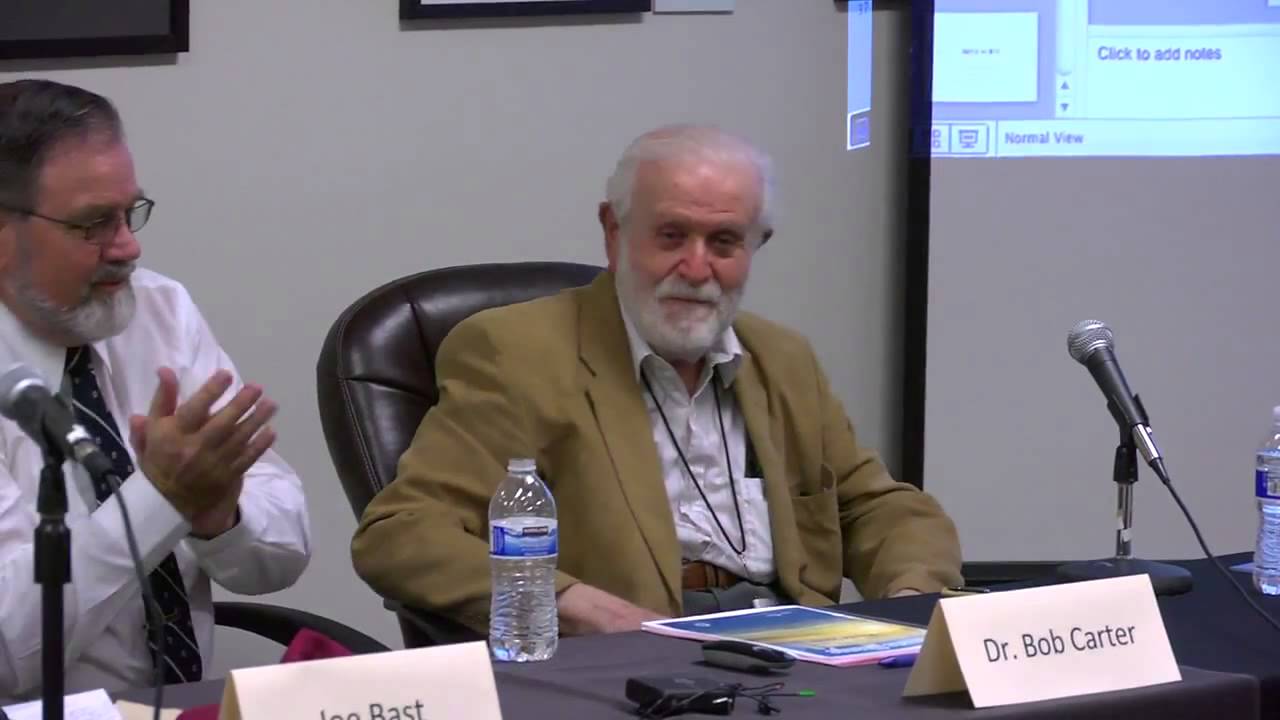 as “the mother of all environmental scare stories” but then suggested the science was actually a sinister cover for something else entirely.
“Groups on the left understand if we can control energy, you can control human beings, and that’s what it was all about,” claimed Bast.
Environmentalists were trying to “shut down the engines of the world,” Bast said, without saying why they might want to do any of those things.
“This was a search for a scientific justification for a political agenda,” Bast added. “The whole idea is to control energy.” (As a group that tirelessly defends the use of fossil fuels while attacking renewable energy, you have to wonder if it’s actually Heartland that wants to “control energy.”)
“We concluded we have to go after the science,” he said, adding Heartland’s “products and programs” would look to reach “all the way down to elementary school classrooms.” In recent weeks, Heartland has been mailing a condensed version of its NIPCC report to tens of thousands of school teachers across the country.
Bast told the room that two NIPCC reports had been “peer reviewed by the authors themselves,” which, by the way, is not how peer review works.
Bast said the NIPCC report had been “translated by the Chinese Academy of Sciences” while his communications director, Jim Lakely, held the Chinese version aloft.
After a round of applause, Bast said he hoped “other academies of science,” including Australia, would follow suit, implying the Chinese Academy of Sciences had somehow endorsed the report.
At the time of the Chinese version being released, Bast had issued a press release claiming a “historic moment” for global warming science. He sent Heartland staff, including Carter, to Beijing for a press opportunity.
But as DeSmog reported, the CAS issued a statement saying: “The claim of the Heartland Institute about CAS’ endorsement of its report is completely false.”
Bast was forced to apologize and had to pull the publication from his website and withdraw the original press release. But once Carter was out of China, Bast re-issued the press release and rejected the criticisms of the CAS.
Oddly, none of this detail made its way into Bast’s opening remarks.
Fake Discussion...
==
attack on wapo cohen list ~ ipcc:
physics professor who scooped the Nobel Science Prize in 1973 sagely notes, "It is amazing how stable temperature has been over the last 150 years."
Professor Giaever and the rank and file of scientists are increasingly aware that the ‘consensus’ Cohen and his collaborators alludes to is little more than 77 of 10,000 scientists polled.
Surge in Government Climate Experts Going Skeptic
To further llustrate just how off base Cohen’s spin really is just observe the increasing number of experts who actually worked for the IPCC as contributors / editors / reviewers now turning against global warming junk science. (Hat Tip: The Galileo Movement).
Below, for Cohen and those other mainstream media deniers of climate realism, is a list of just 50 former IPCC experts whose voices your prejudiced ears refuse to hear
- Dr Robert Balling: "The IPCC notes that "No significant acceleration in the rate of sea level rise during the 20th century has been detected." (This did not appear in the IPCC Summary for Policymakers).
- Dr. Lucka Bogataj: "Rising levels of airborne carbon dioxide don't cause global temperatures to rise.... temperature changed first and some 700 years later a change in aerial content of carbon dioxide followed."
- Dr John Christy: "Little known to the public is the fact that most of the scientists involved with the IPCC do not agree that global warming is occurring. Its findings have been consistently misrepresented and/or politicized with each succeeding report."
- Dr Rosa Compagnucci: "Humans have only contributed a few tenths of a degree to warming on Earth. Solar activity is a key driver of climate."
- Dr Richard Courtney: "The empirical evidence strongly indicates that the anthropogenic global warming hypothesis is wrong."
- Dr Judith Curry: "I'm not going to just spout off and endorse the IPCC because I don't have confidence in the process."
- Dr Robert Davis: "Global temperatures have not been changing as state of the art climate models predicted they would. Not a single mention of satellite temperature observations appears in the (IPCC) Summary for Policymakers."
- Dr Willem de Lange: "In 1996, the IPCC listed me as one of approximately 3,000 "scientists" who agreed that there was a discernable human influence on climate. I didn't. There is no evidence to support the hypothesis that runaway catastrophic climate change is due to human activities."
- Dr Chris de Freitas: "Government decision-makers should have heard by now that the basis for the longstanding claim that carbon dioxide is a major driver of global climate is being questioned; along with it the hitherto assumed need for costly measures to restrict carbon dioxide emissions. If they have not heard, it is because of the din of global warming hysteria that relies on the logical fallacy of 'argument from ignorance' and predictions of computer models."
- Dr Oliver Frauenfeld: "Much more progress is necessary regarding our current understanding of climate and our abilities to model it."
- Dr Peter Dietze: "Using a flawed eddy diffusion model, the IPCC has grossly underestimated the future oceanic carbon dioxide uptake."
- Dr John Everett: "It is time for a reality check. The oceans and coastal zones have been far warmer and colder than is projected in the present scenarios of climate change. I have reviewed the IPCC and more recent scientific literature and believe that there is not a problem with increased acidification, even up to the unlikely levels in the most-used IPCC scenarios."
- Dr Eigil Friis-Christensen: "The IPCC refused to consider the sun's effect on the Earth's climate as a topic worthy of investigation. The IPCC conceived its task only as investigating potential human causes of climate change."
- Dr Lee Gerhard: "I never fully accepted or denied the anthropogenic global warming (AGW) concept until the furor started after [NASA's James] Hansen's wild claims in the late 1980's. I went to the [scientific] literature to study the basis of the claim, starting at first principles. My studies then led me to believe that the claims were false."
- Dr Indur Goklany: "Climate change is unlikely to be the world's most important environmental problem of the 21st century. There is no signal in the mortality data to indicate increases in the overall frequencies or severities of extreme weather events, despite large increases in the population at risk."
- Dr Vincent Gray: "The (IPCC) climate change statement is an orchestrated litany of lies."
- Dr Kenneth Green: "We can expect the climate crisis industry to grow increasingly shrill, and increasingly hostile toward anyone who questions their authority."
- Dr Mike Hulme: "Claims such as '2,500 of the world's leading scientists have reached a consensus that human activities are having a significant influence on the climate' are disingenuous ... The actual number of scientists who backed that claim was "only a few dozen."
- Dr Kiminori Itoh: "There are many factors which cause climate change. Considering only greenhouse gases is nonsense and harmful. When people know what the truth is they will feel deceived by science and scientists."
- Dr Yuri Izrael: "There is no proven link between human activity and global warming. I think the panic over global warming is totally unjustified. There is no serious threat to the climate."
- Dr Steven Japar: "Temperature measurements show that the climate model-predicted mid-troposphere hot zone is non-existent. This is more than sufficient to invalidate global climate models and projections made with them."
- Dr Georg Kaser: "This number (of receding glaciers reported by the IPCC) is not just a little bit wrong, but far out of any order of magnitude ... It is so wrong that it is not even worth discussing,"
- Dr Aynsley Kellow: "I'm not holding my breath for criticism to be taken on board, which underscores a fault in the whole peer review process for the IPCC: there is no chance of a chapter [of the IPCC report] ever being rejected for publication, no matter how flawed it might be."
- Dr Madhav Khandekar: "I have carefully analysed adverse impacts of climate change as projected by the IPCC and have discounted these claims as exaggerated and lacking any supporting evidence."
- Dr Hans Labohm: "The alarmist passages in the (IPCC) Summary for Policymakers have been skewed through an elaborate and sophisticated process of spin-doctoring."
- Dr. Andrew Lacis: "There is no scientific merit to be found in the Executive Summary. The presentation sounds like something put together by Greenpeace activists and their legal department."
- Dr Chris Landsea: "I cannot in good faith continue to contribute to a process that I view as both being motivated by pre-conceived agendas and being scientifically unsound."
- Dr Richard Lindzen: "The IPCC process is driven by politics rather than science. It uses summaries to misrepresent what scientists say and exploits public ignorance."
- Dr Harry Lins: "Surface temperature changes over the past century have been episodic and modest and there has been no net global warming for over a decade now. The case for alarm regarding climate change is grossly overstated."
- Dr Philip Lloyd: "I am doing a detailed assessment of the IPCC reports and the Summaries for Policy Makers, identifying the way in which the Summaries have distorted the science. I have found examples of a summary saying precisely the opposite of what the scientists said."
- Dr Martin Manning: "Some government delegates influencing the IPCC Summary for Policymakers misrepresent or contradict the lead authors."
- Stephen McIntyre: "The many references in the popular media to a "consensus of thousands of scientists" are both a great exaggeration and also misleading."
- Dr Patrick Michaels: "The rates of warming, on multiple time scales have now invalidated the suite of IPCC climate models. No, the science is not settled."
- Dr Nils-Axel Morner: "If you go around the globe, you find no sea level rise anywhere."
- Dr Johannes Oerlemans: "The IPCC has become too political. Many scientists have not been able to resist the siren call of fame, research funding and meetings in exotic places that awaits them if they are willing to compromise scientific principles and integrity in support of the man-made global-warming doctrine."
36. Dr Roger Pielke:"All of my comments were ignored without even a rebuttal. At that point, I concluded that the IPCC Reports were actually intended to be advocacy documents designed to produce particular policy actions, but not as a true and honest assessment of the understanding of the climate system."
- Dr Jan Pretel: "It's nonsense to drastically reduce emissions ... predicting about the distant future-100 years can't be predicted due to uncertainties."
- Dr Paul Reiter: "As far as the science being 'settled,' I think that is an obscenity. The fact is the science is being distorted by people who are not scientists."
- Dr Murray Salby: "I have an involuntary gag reflex whenever someone says the "science is settled. Anyone who thinks the science is settled on this topic is in fantasia."
- Dr Tom Segalstad: "The IPCC global warming model is not supported by the scientific data."
- Dr Fred Singer: "Isn't it remarkable that the Policymakers Summary of the IPCC report avoids mentioning the satellite data altogether, or even the existence of satellites--probably because the data show a (slight) cooling over the last 18 years, in direct contradiction to the calculations from climate models?"
- Dr Hajo Smit: "There is clear cut solar-climate coupling and a very strong natural variability of climate on all historical time scales. Currently I hardly believe anymore that there is any relevant relationship between human CO2 emissions and climate change."
- Dr Roy Spencer: "The IPCC is not a scientific organization and was formed to regulate carbon dioxide emissions. Claims of human-cause global warming are only a means to that goal."
- Dr Richard Tol: "The IPCC attracted more people with political rather than academic motives. In AR4, green activists held key positions in the IPCC and they succeeded in excluding or neutralising opposite voices."
- Dr Tom Tripp: "There is so much of a natural variability in weather it makes it difficult to come to a scientifically valid conclusion that global warming is man made."
- Dr Robert Watson: "The (IPCC) mistakes all appear to have gone in the direction of making it seem like climate change is more serious by overstating the impact. That is worrying. The IPCC needs to look at this trend in the errors and ask why it happened."
- Dr Gerd-Rainer Weber: "Most of the extremist views about climate change have little or no scientific basis."
- Dr David Wojick: "The public is not well served by this constant drumbeat of alarms fed by computer models manipulated by advocates."
- Dr Miklos Zagoni: "I am positively convinced that the anthropogenic global warming theory is wrong."
- Dr. Eduardo Zorita: "Editors, reviewers and authors of alternative studies, analysis, interpretations, even based on the same data we have at our disposal, have been bullied and subtly blackmailed. By writing these lines... a few of my future studies will not see the light of publication."
===
The 430-page report was coauthored and edited by three climate science researchers:Craig D. Idso,Ph.D., editor of the online magazine CO2 Science and author of several books and scholarly articles on the effects of carbon dioxide on plant and animal life; Robert M. Carter,Ph.D., a marine geologist and research professor at James Cook University in Queensland, Australia; and S. Fred Singer, Ph.D., a distinguished atmospheric physicist and first director of the U.S. Weather Satellite Service. Seven additional scientists and one policy expert on sustainable growth made contributions to the volume.
===
2014
NIPCC in Washington– April 7 to 10 Presentations by Lead Authors/Editors and Others Nongovernmental International Panel on Climate Change Volumes 1, 2 & 3 of Climate Change Reconsidered II The Physical Science, Biological Impacts, and Economics, Energy, and Policy Open to the Public Monday April 7 – Noon --
Competitive Enterprise Institute – Light Lunch (Seating Limited) Contact: Myron Ebell1899 L ST NW Floor 12 Phone: 202/331-101
Tuesday April 8 – 8 am Breakfast at the Capitol Hill Club 300 1st St SE Phone: 202/484-4590 Contact: Aaron Stover Cell: 703/801-7916 11:30 Lunch at theCato Institute – co-sponsored by theGeorge C. Marshall Foundation 1000 Massachusetts Ave NW Contact at Cato: Rachel Goldman Phone: 202/218-4606 Contact at Marshall: Jeff Kueter Phone: 202/296-9655 Wednesday, April 9 8 am Press conference, National Press Club, Bloomberg Room Thursday, April 10 Briefings on Capitol Hill (Not open to the public) ###################################################
9th International Conference on Climate Change Press Release, The Heartland Institute, Mar 17, 2014 http://climateconference.heartland.org/ July 7 – 9 -- Las Vegas, Nevada Includes the Findings of the New Report of the Nongovernmental Int
==
heartland 2008
Conference for Skeptics
The conference was described by Washington Post reporter, Juliet Eilperin, as "a sort of global warming doppelganger conference, where everything was reversed." At the event, skeptics unveiled their response to the United Nations Intergovernmental Panel on Climate Change (IPCC). The Nongovernmental International Panel on Climate Change (NIPCC) report, edited by corporate-funded skeptic Fred Singer, argued that "recent climate change stems from natural causes." Eilperin notes that "while the IPCC enlisted several hundred scientists from more than 100 countries to work over five years to produce its series of reports, the NIPCC document is the work of 23 authors from 15 nations, some of them not scientists."[1]
The New York Times reports that while the Heartland conference "was largely framed around science ... when an organizer made an announcement asking all of the scientists in the large hall to move to the front for a group picture, 19 men did so." The conference invitation identified its goal as "to generate international media attention to the fact that many scientists believe forecasts of rapid warming and catastrophic events are not supported by sound science."[2]
The Heartland Institute offered "$1,000 to those willing to give a talk," and "a free weekend at the Marriott Marquis in Manhattan, including travel costs, to all elected officials wanting to attend," according to the RealClimate blog.[3]
^To ^schedule ^an ^interview ^with ^the ^authors ^and ^editors ^of ^Climate ^Change Reconsidered: ^2011 ^Interim Report, ^contact ^Jim Lakely, ^director ^of ^communications ^at ^The ^Heartland Institute, ^at jlakely@heartland.org ^or ^312/377-4000.
^
==
Global Warming Skeptics Insist Humans Not at Fault
By Juliet Eilperin
Washington Post Staff Writer
Tuesday, March 4, 2008
When Christopher Monckton, who served as a special adviser to former British prime minister Margaret Thatcher, ponders the current political push to curb greenhouse gases linked to climate change, he thinks of King Canute.
According to Monckton, Canute -- the Viking who ruled England along with much of Scandinavia nearly a thousand years ago -- took his courtiers to the ocean's edge one day, set down his throne and ordered the tide not to come in. The tide, of course, came in, and the king got his feet wet.
The lesson? The king taught his advisers "humility," Monckton said, by showing them that even he, a king, could not control nature. In the same way, he argued, modern-day politicians should not fool themselves into thinking that humanity is having a big impact on climate.
Monckton, along with other high-profile global warming skeptics such as University of Virginia professor emeritus S. Fred Singer and Virginia state climatologist Patrick J. Michaels, are gathered in New York this week for a conference aimed at challenging the idea that a scientific consensus exists on climate change. Sponsored by the Heartland Institute, a free-market think tank funded by energy and health-care corporations as well as conservative foundations and individuals, the 2 1/2 -day session poses a stark contrast to the near-unanimous chorus of concern expressed by top U.S. politicians and most of the scientific mainstream.
Both the Republicans and Democrats are poised to nominate presidential candidates this year who back a mandatory federal cap on greenhouse gases. After years of voicing doubt, President Bush has said repeatedly that he is convinced that humans are contributing to Earth's warming and that the nation needs to break its dependency on fossil fuels.
Not so, say the skeptics. While the U.N. Intergovernmental Panel on Climate Change shared a Nobel Peace Prize with former vice president Al Gore last year, this cadre of critics has formed a counter-group called the Nongovernmental International Panel on Climate Change (NIPCC), which issued a report yesterday arguing that recent climate change stems from natural causes. (While the IPCC enlisted several hundred scientists from more than 100 countries to work over five years to produce its series of reports, the NIPCC document is the work of 23 authors from 15 nations, some of them not scientists.)
"We reached the opposite conclusion," said Singer, who edited the report. Singer added that his group surveyed the same peer-reviewed studies the IPCC did, as well as other papers and some more recent scientific articles. The effect of human-generated greenhouse gas emissions, he said, is "not a cause for concern, at least not yet. If the evidence changes, I'll change my opinion, okay?"
Singer welcomed the chance to address a friendly audience for a change -- "This is a very nice, warm atmosphere," he observed -- and Heartland Institute President Joseph L. Bast said he believes skeptics are now on the verge of overturning the idea that humans are driving climate change.
"Yeah, I think we're at a tipping point that's going in exactly the opposite direction," Bast said. "That point of view has had its moment. That moment has passed."
The meeting represented a sort of global warming doppelganger conference, where everything was reversed. State and local leaders seeking to reduce carbon emissions gather at IPCC meetings to swap ideas; the skeptics' conference attracted lawmakers from at least seven states who are opposed to binding emissions cuts. Sen. John F. Kerry (D-Mass.) made the trek to the United Nations climate change conference last year at Bali; Sen. James M. Inhofe (R-Okla.), who proclaims global warming a "hoax," sent an aide to New York to discuss how many scientists have started contacting the senator to voice their doubts about climate change.
While international climate conferences can be tense and a bit gloomy at times, the organizers of the Heartland gathering tried to keep things light, hosting a comedian who mocked Gore and screening films with titles such as "Apocalypse No!" and "An Inconvenient Truth or Convenient Fiction?" Some moments of levity were unintentional. Ralph Reed -- a prominent GOP consultant until becoming ensnared in the scandal surrounding his former business partner, lobbyist Jack Abramoff -- roamed the halls while an environmental advocate tracked his movements.
Several climate scientists and environmental advocates poked fun at the meeting. Frank O'Donnell, who heads the watchdog group Clean Air Watch, said the conference "looks like the climate equivalent of Custer's last stand. They seem to have tried to find every last skeptic on Earth and put them in one hotel off Broadway."
Gene Karpinski, president of the League of Conservation Voters, said he was not surprised that roughly 500 participants had gathered at the meeting. "I'm sure that the flat Earth society had a few final meetings before they broke up."
And Princeton University geosciences professor Michael Oppenheimer said that with the media and many politicians now ignoring the climate skeptics, "they have to get together to talk to each other, because nobody else is talking to them."
On a more serious note, Oppenheimer questioned why the conference attendees were not addressing the genuinely muddier aspects of climate science, such as what level of sea rise the world faces and whether methane released from the tundra would exacerbate warming in the years to come.
"There are huge uncertainties that are still attributed to this problem," he said. He added that he welcomes conferences on unsettled questions such as the rate of ice-sheet melt, but "the core of the science on climate change is settled, and nothing these people do is going to change that."
---
frontline:
The alternate reality, what is that? Explain that.
If you don’t want to believe in climate change, what these people have managed to do is create this entire alternate reality you can believe in, starting from a set of skeptical scientists. There are skeptical meetings where you can go to where the meetings are full of skeptics. There are skeptical reports written by the NIPCC [Nongovernmental International Panel on Climate Change], for example.
So there is this entire alternate reality that you can use if you don’t want to believe in climate change. I mean, it’s absurd and an unreal reality, but that’s what it is, and that’s what people use it for. …
It’s just this lawyerly “Let’s create some reasonable doubt.” It’s not legitimate in any actual scientific sense.
Why is it not legitimate in any scientific sense, in terms of characterizing the credentials, the publishing? …
Yeah, they will say that there are people who believe both sides, and they’ll say that, you know, “We have a credentialed writing team,” and things like that.
But that’s not right. I mean, the NIPCC is illegitimate in a couple of ways. First off, science has to be consistent. If you argue that the earth isn’t warming, you cannot then argue the warming is natural. Those two cannot both be right. And in science, you have to put together an argument that every step is right.
We’re not lawyers. We’re trying to determine actual truth here. We’re trying here. So the earth is warming; we have ascribed the warming to humans. We can predict about how much warmer it will get over the next century. And then social scientists take over and try to convert that into how bad that will be, and then the economists work on whether they can do anything about that. But that’s real science. It’s not the earth isn’t warming, and if it is warming it’s not due to humans. That’s not a consistent scientific statement.
As far as legitimacy of the writing teams, … there are a lot of people out there who claim to be credentialed and don’t believe in climate change. These are people who don’t work on climate. If you are going to look for a doctor, you would not go to a Ph.D. physicist; you wouldn’t go to someone who has a bachelor’s degree in biology. You would want an M.D., and an M.D. who studies exactly the disease that you, God forbid, don’t actually have but think you might have. You want someone who’s an exact expert. And that’s what we do. …
If you look at how many actual experts they have, it’s very few. There are very, very small numbers. … The writing team of the NIPCC has three or four, maybe five, credentialed climate scientists. And the IPCC, on the other hand, has thousands of scientists on it, and they are experts in what they’re writing on. And so, you know, it’s really when you look at the details you can see how the bizarro universe is frayed and fake. It’s like a New York soundstage where all the buildings are cardboard. They kind of look real from a distance, but they are not real. They are just these fake facades, and that’s what the alternative universe of climate skepticism is. …
Are there legitimately published [skeptic] scientists?
Yeah, the small number of legitimate climate skeptics do occasionally publish. But what I would hasten to add is that if you combine all of them, you’ll get three or four skeptical papers a year. They get published in peer-reviewed literature. The peer-reviewed literature is sort of the goal standard. I mean, it’s got out. It’s been reviewed for accuracy and has past peer review.
Over that time, you get three or four skeptical papers a year. Over that same time, you probably get 10,000 papers that aren’t skeptical, that either explicitly or implicitly endorse the mainstream view of climate science. Journal of Geophysical Research, for example, publishes 40,000 pages a year. And that’s just one journal from one organization.
So the balance, or the overwhelming balance, of stuff that gets published is completely consistent with mainstream climate science. But the very small number of skeptical papers that do get published get infinitely amplified by the uncertainty machines. Fox News will pick it up, and The Wall Street Journal will pick it up, and the presidential candidates will start talking about it. And so it sounds like, wow, there are all these skeptical scientists out there when they don’t — it’s just a mirage. …
If you had to pick one or two examples of the cherry-picking or misinformation that give people an idea of what you think is grossly inaccurate, … are there any couple that come to mind?
Yeah. So there’s a lot of debate about the surface temperature record. That’s the record that we use to know how much warming we’ve had over the last 100 years. And that has really come under, I think, really inaccurate, withering fires.
People are always claiming that they’ll show a picture of a temperature station which is next to a parking lot, and they’ll say: “Look. Look at the station. How can you possibly get accurate temperature measurements from this?”
But a tremendous amount of work has gone into that. There have been multiple groups [who have] looked at this. Scientists aren’t idiots. So the really obvious sources of uncertainty people have looked at. People have done lots of analyses about the impact of urbanization versus rural stations and things like that. So there have been so many analyses that there’s really no question the earth is warming. In fact, the IPCC calls it unequivocal, meaning basically beyond doubt, and I think that’s exactly right.
And anybody who claims the earth isn’t getting warmer, you know that person is deep into denial.
[Founder and president of the Science and Environmental Policy Project] Fred Singer claims the earth isn’t warming.
He does claim the earth isn’t warming. I tried to have a conversation with Fred about that and explained to him that, and he didn’t accept any of my arguments. …
Fred Singer is, I think, a professional contrarian. When I was in graduate school, I worked on stratospheric ozone depletion, and Fred would call me when I was in grad school and talk to me about how he didn’t think humans were depleting ozone. And before that, he had real questions about whether humans were causing acid rain, and he didn’t think that nuclear winter was a super-sound science. And he really criticized the work that connected secondhand smoke to health impacts.
And now he doesn’t think global warming is an issue. So at least he’s consistent. But I think in all those cases, he’s quite wrong. So I know Fred. I talked to Fred, but I don’t think he’s right.
And is he peer-reviewed? And is this his area? What’s his credential for climate science? …
He does have some credentials in climate science. He does occasionally write papers — not very many. I don’t see him at meetings. I don’t think he’d be considered a front-line climate scientist. … He does occasionally have his name on peer-reviewed papers. …
But of course, it’s funny. You talk like oh, you know, you scientists, you’re shutting down the other side or whatever. There might be some people, right, legitimately –
They have to make the claim that climate scientists are corrupt. Most people realize if all of the climate scientists in the world agree that this is happening, it’s going to be bad, most people would say, “Well, we should do something about it.” So step number one is you have to criticize the climate scientist.
And that’s where the argument is that they are in it for grant money; they’re communists; they’re socialists. That’s where those arguments come from. They are trying to say: “You can’t believe the experts, so you should believe me instead. I know nothing about this. Therefore, I’m the most believable person, because the experts can’t be believed.”
It’s an argument that at its core makes no sense at all. I mean, we live in a society where we trust experts. We go to doctors because they’re experts. We go to accountants because they’re experts. We go to architects because they are experts. And we rely on experts.
So you think, well, we should go to a climate scientist; they are the experts. But they are trying to make this argument that the experts are the last people you should believe. The less somebody knows, the more believable they should be.
[They argue there's been no warming in the last decade.]
That’s just wrong. You can, if you want, very carefully select the end points of your time series, the starting month and the ending month, and then maybe you come up with something that shows no warming. But that’s not a legitimate way to do science. You don’t pick your answer and then select the time series, select your data to fit your answer.
If you look at all of the data, it’s quite clear that the warming is continuing and that we’re not cooling. We’re not not warming. I mean, that’s very clear from the data if you look at all the data.
Is it the number of years? Is that what it is? Because they only picked 10 years?
Exactly. That’s exactly right. For climate calculations, you really have to pick a decade or two decades or hopefully three decades. That’s what the National Weather Service picks when they do climate. They pick 30-year periods. [cf riding the down escalator] So you really have to look at these longer time periods to see if the temperature is going up. And if you look at a decade, you see that this decade is much warmer than the previous decade, and that’s really the comparison you want to make.
If you look at individual years, you can get any kind of results. It’s like looking at the stock market during a day; you know, it’s 20 points higher than it was three hours ago. What does that mean? That doesn’t tell you anything about the direction of the stock market, what it does over a few hours. Similarly, what the climate does one year versus next year tells you nothing about long-term trends, zero. It’s impacted by the short-term variability, just like the stock market. The climate, sensitive things like El Niño cycles, weather variability, things like that can determine whether one year is warmer or cooler than the next. You have to look at decades. …
[What about Climategate?]
The Heartland Institute's 2008 International Conference on Climate Change was a conference held at the Marriott New York Marquis Times Square Hotel in New York between March 2-4 . The conference was organised and "sponsored" by the Heartland Institute, a U.S. think tanks that in preceding years received substantial funding from Exxon for its work downplaying the significance of global warming.
(For a separate article on the 2009 conference see Heartland Institute/International Conference on Climate Change (2009)).
Contents [hide] |
Conference for Skeptics
The conference was described by Washington Post reporter, Juliet Eilperin, as "a sort of global warming doppelganger conference, where everything was reversed." At the event, skeptics unveiled their response to the United Nations Intergovernmental Panel on Climate Change (IPCC). The Nongovernmental International Panel on Climate Change (NIPCC) report, edited by corporate-funded skeptic Fred Singer, argued that "recent climate change stems from natural causes." Eilperin notes that "while the IPCC enlisted several hundred scientists from more than 100 countries to work over five years to produce its series of reports, the NIPCC document is the work of 23 authors from 15 nations, some of them not scientists."[1]
The New York Times reports that while the Heartland conference "was largely framed around science ... when an organizer made an announcement asking all of the scientists in the large hall to move to the front for a group picture, 19 men did so." The conference invitation identified its goal as "to generate international media attention to the fact that many scientists believe forecasts of rapid warming and catastrophic events are not supported by sound science."[2]
The Heartland Institute offered "$1,000 to those willing to give a talk," and "a free weekend at the Marriott Marquis in Manhattan, including travel costs, to all elected officials wanting to attend," according to the RealClimate blog.[3]
Manhattan Declaration on Climate Change
The conference resulted in the grandly titled communiqué 'The Manhattan Declaration on Climate Change'. A scientifically illiterate document largely containing opinion masquerading as fact. It disputes the greenhouse effect of CO2 , and disputes the consensus of scientists on climate change. It also claims "That human-caused climate change is not a global crisis." A position which should lead an enquiring mind to ask whether the Heartland Institute is ready to accept a naturally occurring global crisis exists . The document also boldly states "That adaptation as needed is massively more cost-effective than any attempted mitigation and that a focus on such mitigation will divert the attention and resources of governments away from addressing the real problems of their peoples." The promoting of adaptation over mitigation is not surprising although it should be noted no supporting evidence is offered and it is in stark contrast to the Stern Report which holds the opposite view and contains a great deal of evidence to support it. [4]
Speakers at the Conference
- Joseph L. Bast, President, The Heartland Institute; "Conference Host"
- David Archibald, Australian oil explorer and
- Scott Armstrong, professor at the Wharton School, University of Pennsylvania,
- Dennis Avery, a fellow at the Hudson Institute
- Timothy Ball,Chairman and Chair of the Scientific Advisory Committee of the Natural Resources Stewardship Project (NRSP)
- Robert Balling
- E. Calvin Beisner
- David Bellamy
- Bob Carter
- Donald J. Boudreaux
- Sandy Liddy Bourne
- Robert L. Bradley Jr.
- William M. Briggs
- H. Sterling Burnett,
- John A. Charles, Jr., President and CEO of Cascade Policy Institute
- Paul Chesser, director of Climate Strategies Watch, a project of the John Locke Foundation.
- John Coleman,
- Ralph Conner, local legislation manager for the Heartland Institute
- Roy Cordato, vice president for research and resident scholar at the John Locke Foundation
- Richard S. Courtney, a founding member of European Science and Environment Forum
- Joseph D’Aleo,
- David H. Douglass,
- Paul Driessen, a senior fellow with the Committee For A Constructive Tomorrow and Center for the Defense of Free Enterprise
- John Dale Dunn,
- Myron Ebell, director of energy and global warming policy at the Competitive Enterprise Institute
- Michael J. Economides
- Michael R. Fox,
- Dan Gainor, is the the T. Boone Pickens Fellow and vice president of the Business & Media Institute, a project of the by the conservative media watchdog group, the Media Research Center
- Fred Goldberg
- Stanley B. Goldenberg,
- Robert Gordon, president of Responsible Resources
- Vince Gray
- William M. Gray
- Kenneth P. Green, resident scholar at the American Enterprise Institute.
- Tom Harris, executive director of the Natural Resources Stewardship Project and the International Climate Science Coalition
- Howard Hayden,
- David Henderson
- Donald Hertzmark
- Art Horn
- Christopher C. Horner
- Craig D. Idso
- Andrei Illarionov, a senior fellow at the Cato Institute
- Roy Innis, national chairman and chief executive officer of the Congress of Racial Equality
- Yuri A. Izrael
- Zbigniew Jaworowski
- Jim Johnston, Heartland Institute
- Madhav Khandekar
- Václav Klaus
- David Legates,
- Jay H. Lehr, senior fellow and science director of the Heartland Institute
- Marlo Lewis Jr., senior fellow at the Competitive Enterprise Institute
- Craig Loehle,
- Leon Louw, executive director of the Free Market Foundation, South Africa
- Howard Maccabee,
- Ken Malloy
- Jim Martin, president of the 60 Plus Association
- Phelim McAleer,
- Ann McElhinney,
- Ross McKitrick
- Owen McShane, chairman of the policy panel of the New Zealand Climate Science Coalition and director of the Centre for Resource Management Studies
- Patrick Michaels, senior fellow in environmental studies at the Cato Institute.
- Fred Michel,
- Steven J. Milloy
- Ferenc Miskolczi
- Barun S. Mitra, founder and director of the Liberty Institute
- Lord Christopher Monckton
- Marc Morano
- Julian Morris, executive director of International Policy Network
- Robert P. Murphy, an economist with the Institute for Energy Research
- Iain Murray, senior fellow in energy, science and technology at the Competitive Enterprise Institute
- Todd Myers, environmental director at the Washington Policy Center
- James J. O'Brien,
- Kendra Okonski, International Policy Network
- Jim Ott
- Tim Patterson
- Benny Peiser
- Andreas Prokoph
- Richard W. Rahn, chairman of the Institute for Global Economic Growth and the Advisory Board of the European Center for Economic Growth
- Paul Reiter,
- Ronald J. Rychlak,
- David W. Schnare is the senior fellow for energy and the environment at the Thomas Jefferson Institute for Public Policy
- Joel Schwartz, visiting scholar at the American Enterprise Institute
- Tom Segalstad,
- Frederick Seitz, director emeritus of the Atlantic Legal Foundation
- Russell Seitz,
- Daniel R. Simmons, director of the Natural Resources Task Force at the American Legislative Exchange Council
- S. Fred Singer, president of the Science and Environmental Policy Project
- Tim Slagle,
- Willie Soon, chief science adviser at the Science and Public Policy Institute
- Douglas Southgate
- Roy W. Spencer,
- John Stossel,
- Thomas Tanton is fellow in environmental studies at the Pacific Research Institute and an adjunct scholar at the Institute for Energy Research
- George H. Taylor
- James M. Taylor, managing editor of Environment & Climate News, a Heartland Institute newsletter
- Mitch Taylor
- David G. Tuerck
- Paul Waggoner,
- Anthony Watts
- Gerd-Rainer Weber,
- Miklos Zagoni
Co-Sponsors
- Alternate Solutions Institute, Pakistan
- Americans for Prosperity, United States
- Americans for Tax Reform, United States
- Asociacion de Consumidores Libres, Costa Rica
- Association for Liberal Thinking, Turkey
- Business & Media Institute, United States
- Carbon Sense Coalition, Australia
- Cascade Policy Institute, United States
- Cathay Institute for Public Affairs, China
- Center for the Defense of Free Enterprise, United States
- Center for the Dissemination of Economic Knowledge, Venezuela
- Center for the Study of Carbon Dioxide and Global Change, United States
- Center of the American Experiment, United States
- Centro de Innovación y Desarrollo Humano, Uruguay
- Centro de Investigaciones de Instituciones y Mercados de Argentina, Argentina
- Citizens Alliance for Responsible Energy, United States
- Committee for a Constructive Tomorrow, United States
- Competitive Enterprise Institute, United States
- Congress of Racial Equality, United States
- Discovery Institute, United States
- Doctors for Disaster Preparedness, United States
- Economic Thinking, United States
- European Center for Economic Growth, United Kingdom
- Freedom Foundation of Minnesota, United States
- Free Enterprise Action Fund, United States
- Free Market Foundation, South Africa
- Frontiers of Freedom Institute, United States
- Fundacion Atlas 1853, Argentina
- Hayek Institute, Austria
- Idea Channel, United States
- The Independent Institute, United States
- Institute of Public Affairs, Australia
- Institut für Unternehmerische Freiheit, Germany
- Instituto de Libre Empresa, Peru
- Instituto Liberdade, Brazil
- International Climate Science Coalition, Canada - Australia - New Zealand
- International Policy Network, United Kingdom
- Istituto Bruno Leoni, Italy
- JunkScience.com, United States
- Liberty Institute, India
- Lion Rock Institute, Hong Kong
- John Locke Foundation, United States
- George C. Marshall Institute, United States
- Minimal Government Institute, Philippines
- National Center for Policy Analysis, United States
- New Zealand Business Roundtable, New Zealand
- Oregon Institute of Science and Medicine, United States
- Pacific Research Institute, United States
- Property and Environment Research Center, United States
- Science and Environmental Policy Project, United States
- Science and Public Policy Institute, United States
- Sovereignty International, United States
Conference Website
Website (original): http://www.heartland.org/NewYork08/newyork08.cfm
Website current: http://climateconference.heartland.org/past-conferences/iccc1/
Articles and Resources
Sources
- ↑ "Global Warming Skeptics Insist Humans Not at Fault", Washington Post, March 4, 2008.
- ↑ Andrew C. Revkin, "Cool View of Science at Meeting on Warming", New York Times, March 4, 2008.
- ↑ "What if you held a conference, and no (real) scientists came?", Real Climate (blog), January 30, 2008.
- ↑ "[1]"
Related SourceWatch Articles
- Climate Change
- Heartland Institute/International Conference on Climate Change (2009)
- Researching global warming skeptics
- SourceWatch:Project:Creating Articles on Sponsors and Speakers at The 2008 International Conference on Climate Change
- think tanks
External Articles
- Bill Berkowitz, "Global warming 'skeptics' conference enabled by conservative philanthropy", Media Transparency, March 5, 2008.
| This article is a stub. You can help by expanding it. |
===
http://sepp.org/index.cfm
weekly newsleter 2014?
http://www.sepp.org/twtwfiles/2014/TWTW%203-29-14.pdf
The Week That Was: 2014-03-29 (March 29, 2014) Brought to You by SEPP (www.SEPP.org)
The Science and Environmental Policy Project
################################################### Quote of the Week: Any body of scientists that adopts pressure group tactics is endangering its status as the guardian of principles of scientific philosophy that are worth keeping. By Charles Fleming [H/t Alex Henney on Bishop Hill ###################################################
Number of the Week: 34.2% & 23.3% ################################################### NIPCC in Washington – April 7 to 10 Presentations by Lead Authors/Editors and Others Nongovernmental International Panel on Climate Change Volumes 1, 2 & 3 of Climate Change Reconsidered II The Physical Science, Biological Impacts, and Economics, Energy, and Policy Open to the Public Monday April 7 – Noon -- Competitive Enterprise Institute – Light Lunch (Seating Limited) Contact: Myron Ebell 1899 L ST NW Floor 12 Phone: 202/331-101 Tuesday April 8 – 8 am Breakfast at the Capitol Hill Club 300 1st St SE Phone: 202/484-4590 Contact: Aaron Stover Cell: 703/801-7916 11:30 Lunch at the Cato Institute – co-sponsored by the George C. Marshall Foundation 1000 Massachusetts Ave NW Contact at Cato: Rachel Goldman Phone: 202/218-4606 Contact at Marshall: Jeff Kueter Phone: 202/296-9655 Wednesday, April 9 8 am Press conference, National Press Club, Bloomberg Room Thursday, April 10 Briefings on Capitol Hill (Not open to the public)
###################################################
9th International Conference on Climate Change Press Release, The Heartland Institute, Mar 17, 2014 http://climateconference.heartland.org/ July 7 – 9 -- Las Vegas, Nevada Includes the Findings of the New Report of the Nongovernmental International Panel on Climate Change (NIPCC) Climate Change Reconsidered II, Volumes 1, 2, and 3 ###################################################
THIS WEEK: By Ken Haapala, Executive Vice President, Science and Environmental Policy Project (SEPP) NIPCC: More reports from the independent researchers of the Nongovernmental International Panel on Climate Change (NIPCC) are on the way. Volume 2 of Climate Change Reconsidered II: Biological Impacts is being published and the Summary for Policymakers is available on the web. No doubt this report will be in stark contrast with a report from the UN Intergovernmental Panel on Climate Change (IPCC), which covers some of the same material. The main difference is that the NIPCC includes material that the IPCC conveniently ignores. This material emphasizes the large benefits to plant life, the environment, and humanity from enhanced atmospheric carbon dioxide (CO2). If the UN IPCC report follows the patterns of the past, it will contain alarming comments of possible harms far in the future from enhanced atmospheric CO2 – catastrophic anthropogenic (man-made) global warming (CAGW). NIPCC has found no strong evidence that CAGW exists. The UN IPCC used models to make claims of future CAGW. But, the models have never been validated, thus are purely speculative, not scientific. See link under Challenging the Orthodoxy. *************
IPCC: The latest report of the IPCC Working Group II: Impacts, Adaptation and Vulnerabilities is due to be released on March 31, 2014. Initial leaks indicated that the tone would be moderate compared with the alarmist tone of the last report, which contained many errors of fact, such as the glaciers in the Himalaya Mountains will melt by 2040. However, this optimism may have been premature. Later reports indicate there is a hardening of lines among the alarmists, which is to be expected. Too many politicians, climate scientists, and leaders of Green organizations has staked their reputations of the promotion of CAGW. They will not back down quietly. One could assesses the demands of the alarmists with the announcement of the Summary for Policymakers for the IPCC Fifth Assessment Report (AR5) in October, 2013. Even though the climate models on which predictions of CAGW are failing epically -- and that after 35 years of research, after spending tens of billions of dollars, failed to narrow the range of estimated temperature values for a doubling of CO2, controllers of the report insisted they are 95% confident in the findings of the report. An indication that the less alarmist view of the proceedings may not be correct is the resignation of Richard Tol, a convening lead author of the chapter on economics. He requested his name be removed from the report. In other work, Tol, an economist at the University of Sussex, estimated that for most of this century human CO2 emissions will be beneficial to humanity, only causing net harm near the end of the century. Strident alarmists would consider him a heretic. One can only wait to see what dominates the UN IPCC, will it be rigorous science, or raw political power? For a wide range of speculation see links under Problems in the Orthodoxy. *************
US Exports: Russia’s venture into the Crimea is increasing political calls for opening the US energy markets to exporting oil and natural gas --- particularly, exporting natural gas to Europe, lessening dependence on Russian gas. Companies such as Dow argue such actions will raise the cost of natural gas in the US, squashing the only substantial new job growth that is occurring. A study by NERA Economic Consulting, updated in February, shows that the increase in US prices will be minor. Dow has formed a group called America’s Energy Advantage. This group largely ignores the costs of transporting the natural gas from wellhead in the US to city gate in Europe. NERA estimates these costs, in 2018, will amount to $6.33/Mcf (2012 dollars). The costs include the costs of new pipelines on both ends, liquefaction, shipping, and regasification. Thus, natural gas in the US will have still a significant price advantage over Europe. Other objections being raised is that it will take too long. It may be too late for the Crimea, but not too late to influence other Russian actions. Some brought up the experience in Greece. When another option to Russian gas appeared, Gazprom renegotiated its prices, lowering them. There is speculation whether President Obama will encourage oil and gas exports. Perhaps his inaction on the Keystone pipeline is the best indicator. The pipeline requires no government grants or subsidies – just government approvals. It was to bring heavy oil from Canada, the largest US trading partner, to refineries on the Gulf Coast, in part replacing heavy oil from Venezuela, an unreliable source. The southern part of the pipeline has been built. After over five years, the northern part, over which the Administration has control has not been approved. Instead, the Administration; is using it to leverage campaign contributions for the Democratic Party. See Article #3 and links under Energy Issues – Non-US and Washington’s Control of Energy. *************
Alaska Squeeze: Washington continues to squeeze the oil industry in Alaska, which once provided 10% of the oil consumed by the US. Washington’s policy threatens the Alaskan pipeline. At its peak of 1988, the throughput of the pipeline averaged 2,032,928 bbl. per day. In 2013, the average was 534,480 bbl. per day, a drop of almost 74%. If volume drops to about 300,000 bbl. per day the pipeline will freeze and cannot be restarted. By law, once it stops, this valuable national asset would have to be disassembled. By continuing to squeeze oil production, Washington is squeezing the budget of Alaska, which depends heavily on royalties from oil. Washington is preventing development the Coastal Plain (ANWR), the National Petroleum Reserve, Indian Lands, and hobbling development of the Chukchi Sea OCS work by Shell. In contrast, Russian is proceeding aggressively with its development of the oil reserves in its portion the Chukchi Sea. One joint ventures includes Shell. Among the Russian fields being explored is one about 40 to 50 miles from Shell’s US leaseholds and about 150 miles from the Russian coast. US recoverable resources are estimated to be 40 Billion barrels of oil. Congress must decide if a tiny portion of ANWR can be developed, the balance is under the control of the Administration. The Administration refused to permit a 3-D survey of ANWR. The speculation is that the Administration does not want the public to know the extent of the resources that it is locking-up. The State has sued the Federal government on the grounds that, based on an interpretation of the agreement which provided statehood, Alaska has the right to develop oil and national gas on its lands, and Indians have the right to develop oil and natural gas on their lands. It will be interesting to see how the courts interpret this state rights issue. *************
Japan: In wake of the tsunami that wiped out the cooling pumps of the Fukushima reactor, the government of Japan implemented stringent regulations for nuclear power plants. It appears that many of the nuclear plants shut down after the Fukushima incident will not be reopened because it is uneconomic to modify them to meet the new regulations. Japan’s answer to low-cost baseload electricity is coal. After China, Japan is the second largest importer of coal and may be building more coal-fired power plants. See Article #4. *************
Regulators on the March: One of the pernicious features of the Clean Water Act and the Endangered Species Act is that they give great power to government agencies to determine the need for regulations, which the same agency then implements. The courts have deferred to the government agencies on the science justifying the expansion of government control. There is no counterbalancing power to the actions of these agencies. Often these actions result in significant costs to private parties that continue to own the land but are subject to government control of its use. The EPA and the Corps of Engineers have announced the expansion of control of significant amounts of private and state-owned lands under the Clean Water Act. EPA uses broad definitions of waters that it can control, such as leaves made wet from rain are waters of the US. Similarly, US Fish and Wildlife Service uses narrow definitions of species to include minor local adaption of a species to be a separate species. It has announced the lesser prairie chicken as threatened, which will give it control of major sections of five Western states. Several years ago, Fish and Wildlife listed the polar bear as threatened, even though populations are growing. See links under EPA and other Regulators on the March *************
McIntyre: In 2012, Steven McIntyre filed a Freedom of Information Act request to the University of Western Australia. He was seeking the data behind a survey by Lewandowsky et al. that found that skeptics are conspiracy theorists. According to McIntyre, the survey data was manipulated after the fact. Based on other information received, McIntyre filed for a retraction of the study. University of Western Australia flatly denied request for retraction. Apparently the Vice Chancellor’s feelings were hurt, accusing McIntyre of inflammatory statements and becoming unbalanced on the issue. The university policy is that research data must be available to other researchers. See link under Climategate Continued *************
Green Revolution: March 25, 2014 marked the 100th anniversary of the birth of Norman Borlaug. He was the primary person responsible for the Green Revolution that greatly expanded food productivity, allowing many farmers to break the shackles of subsistence agriculture. By way of contrast, March 29, 2014 marked the symbolic effort of the other green revolution to turn off electric lights for one hour. This second green revolution is largely for the wealthy, demanding that those less fortunate not be allowed reliable, affordable electricity provided fossil fuels. See links under Agriculture Issues & Fear of Famine and Environmental Industry. *************
Number of the Week: 34.2% & 23.3% The Census Bureau reported "Mining, quarrying, and oil and gas extraction industries were the most rapidly growing part of our nation's economy over the last several years," From 2007 to 2012 the number of employees rose 23.3 percent to 903,641 and the revenues grew 34.2 percent to $555.2 billion. Of course, most if not all of the growth came from oil and gas extraction, and the data do not reflect the growth in 2013. Also, the data do not reflect the job growth is in service industries and industries that benefit from reliable supplies of oil and low-cost natural gas. This growth is not the result of policies implemented by the current Administration
. ###################################################
ARTICLES: For the numbered articles below, please see this week’s TWTW at: www.sepp.org. The articles are at the end of the pdf. 1. The Coming Paradigm Shift on Climate By S. Fred Singer, American Thinker, Mar 27, 2014 http://www.americanthinker.com/2014/03/the_coming_paradigm_shift_on_climate_.html 2. Climate Forecast: Muting the Alarm Even while it exaggerates the amount of warming, the IPCC is becoming more cautious about its effects. By Matt Ridley, WSJ, Mar 27, 2014 http://online.wsj.com/news/articles/SB10001424052702303725404579460973643962840?mod=t rending_now_3 3. Energy Seriousness for Europe Shale gas, not windmills, can free the continent from reliance on Russia. Editorial, WSJ, Mar 27, 2014 http://online.wsj.com/news/articles/SB10001424052702303725404579461251566976372?mod= WSJ_Opinion_AboveLEFTTop&mg=reno64-wsj 4. Japan's Answer to Fukushima: Coal Power Many Nuclear Plants Are Too Expensive to Retrofit to Meet Tightened Safety Standards By Mari Iwata, WSJ, Mar 27, 2014 http://online.wsj.com/news/articles/SB10001424052702304688104579464942892719528?mod= WSJ_business_LeadStoryCollection&mg=reno64-wsj ###################################################
NEWS YOU CAN USE: Climategate Continued UWA Vice-Chancellor Refuses Lewandowsky Data By Steve McIntyre, Climate Audit, Mar 28, 2014 http://climateaudit.org/2014/03/28/uwa-vice-chancellor-refuses-lewandowsky-data/#more-19056 The ‘Fine’ Paper That Had To Be Pulled By Michael Kile, Quadrant, Mar 26, 2014 http://quadrant.org.au/opinion/doomed-planet/2014/03/fine-paper-retracted/ Challenging the Orthodoxy Climate Change Reconsidered II: Biological Impacts Summary for Policy Makers, Nongovernment International Panel on Climate Change, April 2014 http://heartland.org/media-library/pdfs/CCR-IIb/Summary-for-Policymakers.pdf ‘Warming Interrruptus’ – Causes for The Pause By David Whitehouse, GWPF, Mar 26, 2014 [H/t WUWT] http://www.thegwpf.org/warming-interruptus-causes-for-the-pause/ [SEPP Comment: A summary of the after-the-fact excuses why there no longer is a warming trend as the models, and alarmists, predicted. A video and a link to the paper.] IPCC Scientists Knew Data and Science Inadequacies Contradicted Certainties Presented to Media, Public and Politicians, But Remained Silent. By Tim Ball, A Different Perspective, Mar 22, 2014 http://drtimball.com/2014/ipcc-scientists-knew-data-and-science-inadequacies-contradictedcertainties-presented-to-media-public-and-politicians-but-remained-silent-2/ [SEPP Comment: A lengthy post explaining some of the weaknesses in the models and some of the self-serving pronouncements of the IPCC.] Uncovering deceptions in the climate change debate By Jay Lehr, Daily Caller, Mar 28, 2014 http://dailycaller.com/2014/03/28/uncovering-deceptions-in-the-climate-changedebate/#ixzz2xLQ1UKO8 [SEPP Comment: A review of Tim Ball’s new book: The Deliberate Corruption of Climate Science.] Environmental Scams By Vincent Gray, NZ Climate Truth Newsletter No. 329, Mar 24, 2014 http://theclimatescepticsparty.blogspot.com.au/2014/03/environmental-scams.html AR5 inquiry follow-up By Nic Lewis, Bishop Hill, Mar 27, 2014 http://bishophill.squarespace.com/blog/2014/3/27/ar5-inquiry-followup.html [SEPP Comment: More on the comments of the Lewis/Crok report criticizing the IPCC Summary for Policymakers.] Regional Newspaper Story Educating Public on Climate Reality - maybe news you can use By Joseph D’Aleo, ICECAP, Mar 26, 2014 http://icecap.us/index.php/go/joesblog/regional_newspaper_story_educating_public_on_climate_reality1/ Defending the Orthodoxy Press Release No. 985 World Meteorological Organization http://www.wmo.int/pages/mediacentre/press_releases/pr_985_en.html?utm_source=Weekly+Car bon+Briefing&utm_campaign=33e161a42dCarbon_Brief_Weekly_18_7_137_18_2013&utm_medium=email&utm_term=0_3ff5ea836a- 33e161a42d-215218249 UN scientists see grim future if no climate action By Richard Ingham, AFP, Mar 23, 2014 http://www.google.com/hostednews/afp/article/ALeqM5iTNR6GKheuVnlyYMQva0e4qsitfg?doc Id=35631058-5d3e-4f00-bebf- 0cc8c02639e2&utm_source=Weekly+Carbon+Briefing&utm_campaign=33e161a42dCarbon_Brief_Weekly_18_7_137_18_2013&utm_medium=email&utm_term=0_3ff5ea836a- 33e161a42d-215218249 Questioning the Orthodoxy The Denier Mantle Moves On By Charles Battig, American Thinker, Mar 28, 2014 http://www.americanthinker.com/2014/03/the_denier_mantle_moves_on.html The IPCC: Providing ‘Hope for Our Earth’ By Donna Laframboise, NFC, Mar 26, 2014 [H/t Climate Depot] http://nofrakkingconsensus.com/2014/03/26/the-ipcc-providing-hope-for-our-earth/ “What We Really Know” and What the AAAS Failed to Mention. By Jim Steele, WUWT, Mar 23, 2014 http://wattsupwiththat.com/2014/03/23/the-aaass-lost-climate-integrity/ If People Are Like Polar Bears, We’ll Be Fine By Patrick J. Michaels and Paul C. "Chip" Knappenberger, CATO, Mar 28, 2014 http://www.cato.org/blog/people-are-polar-bears-well-be-fine The Collapsing Souffle of Climate Change By Steven Hayward, Power Line, Mar 27, 2014 http://www.powerlineblog.com/archives/2014/03/the-climate-souffle.php A Mother, a Daughter & a New IPCC Leak By Donna Laframboise, NFC, Mar 25, 2014 http://nofrakkingconsensus.com/2014/03/25/a-mother-a-daughter-a-new-ipcc-leak/ [SEPP Comment: The question for the ages: When does an IPCC final report become the final report?] Climate Boffins Target Depression Engineering the Emissions Target Depression By Viv Forbes, NCTSP, Mar 25, 2014 http://theclimatescepticsparty.blogspot.com.au/2014/03/climate-boffins-target-depression.html [SEPP Comment: Apparently the anti-CO2 politicians do not understand population growth and arithmetic.] The Washington Post Responds to Me, and I Reply to the Post By John Hinderaker, Power Line, Mar 22, 2014 http://www.powerlineblog.com/archives/2014/03/the-washington-post-responds-to-me-and-ireply-to-the-post.php Problems in the Orthodoxy At U.N. climate talks, many seek sterner warnings of GDP losses By Alister Doyle, Reuters, Mar 28, 2014 [H/t GWPF] http://news.yahoo.com/u-n-climate-talks-many-seek-sterner-warnings-143150264.html Governments reject IPCC economist's 'meaningless' climate costs estimate UK-based Richard Tol, who has criticised overall report, accused of underestimating costs of climate change in economics section By Suzanne Goldenberg, Guardian, Mar 28, 2014 [H/t GWPF] http://www.theguardian.com/environment/2014/mar/28/ipcc-climate-costs-estimatemeaningless?CMP=twt_fd Prof Richard Tol wants his name removed from “exaggerated” IPCC report By Jo Nova, Her Blog, Mar 27, 2014 http://joannenova.com.au/2014/03/prof-richard-tol-wants-his-name-removed-from-exaggeratedipcc-report/#more-34473 Global Warming Will Not Cost the Earth, Leaked IPCC Report Admits By James Delingpole, Breitbart, Mar 26, 2014 [H/t GWPF] http://www.breitbart.com/Breitbart-London/2014/03/26/Global-warming-will-not-cost-the-earthleaked-IPCC-report-admits Leading Scientist Removes His Name from “Silly” and “Apocalyptic” Climate Change Document By Nick Hallett, Breitbart, Mar 25, 2014 http://www.breitbart.com/Breitbart-London/2014/03/25/Climate-Change-Report-Author-Asksfor-Name-to-be-Removed Climate change: the debate is about to change radically By Andrew Lilico, Telegraph, UK, Mar 25, 2014 [H/t GWPF] http://blogs.telegraph.co.uk/finance/andrewlilico/100026933/climate-change-the-debate-is-aboutto-change-radically/ Dissent among scientists over key climate impact report By Matt McGrath, BBC, Mar 24, 2014 [H/t Climate Depot] http://www.bbc.com/news/science-environment-26655779 Spiegel Reports: “Leading Scientist Leaves IPCC …Dispute Surrounding UN Climate Panel Escalates” By P Gosselin, No Tricks Zone, Mar 27, 2014 http://notrickszone.com/2014/03/27/spiegel-reports-leading-scientist-leaves-ipcc-disputesurrounding-un-climate-panel-escalates/ U.N. climate author withdraws because the report has become ‘too alarmist’ By Cheryl K. Chumley, The Washington Times, Mar 27, 2014 http://www.washingtontimes.com/news/2014/mar/27/un-climate-author-withdraws-damnobvious-warmer-te/ “They will adapt,” Mr. Tol said, Reuters reported. “Farmers are not stupid.” EU leaders delay decision on climate targets By Dave Keating, EuropeanVoice, Mar 21, 2014 http://www.europeanvoice.com/article/2014/march/eu-leaders-delay-decision-on-climatetargets/80180.aspx IPCC admission from new report: ‘no evidence climate change has led to even a single species becoming extinct’ By Anthony Watts, WUWT, Mar 28, 2014 http://wattsupwiththat.com/2014/03/28/ipcc-admission-from-new-report-no-evidence-climatechange-has-led-to-even-a-single-species-becoming-extinct/ New UN Report Is Cautious On Making Climate Predictions By Fred Pearce, Environment 360, Mar 24, 2014 http://e360.yale.edu/feature/new_un_report_is_cautious_on_making_climate_predictions/2750/ Secret UN Report: IPCC Doubts Prognoses On Species Extinction By Axel Bojanowski, Spiegel Online, Via GWPF, Mar 24, 2014 http://www.thegwpf.org/secret-un-report-ipcc-doubts-prognoses-on-species-extinction/ Seeking a Common Ground EconTalk: Christy and Emanuel By Judith Curry, Climate Etc. Mar 24 2014 http://judithcurry.com/2014/03/24/econtalk-christy-and-emanuel/ Nate Silver, Roger Pielke, and journalism ethics By Luboš Motl, The Reference Frame, Mar 29, 2014 http://motls.blogspot.com/2014/03/nate-silver-roger-pielke-and-journalism.html#more More scientific mavericks needed By Judith Curry, Climate Etc., Mar 23, 2014 http://judithcurry.com/2014/03/23/more-scientific-mavericks-needed/ Review of Recent Scientific Articles by NIPCC For a full list of articles see www.NIPCCreport.org The Greening of Asia Reference: Ichii, K., Kondo, M., Okabe, Y., Ueyama, M., Kobayashi, H., Lee, S.-J., Saigusa, N., Zhu, Z. and Myneni, R.B. 2013. Recent changes in terrestrial gross primary productivity in Asia from 1982 to 2011. Remote Sensing 5: 6043-6062. http://nipccreport.org/articles/2014/mar/25mar2014a1.html Needing More Food, but Biting the Hand that Feeds Us Reference: Muldowney, J., Mounsey, J. and Kinsella, L. 2013. Agriculture in the climate change negotiations; ensuring that food production is not threatened. Animal 7:s2: 206-211 http://nipccreport.org/articles/2014/mar/25mar2014a3.html Urban Heat Islands of China Reference: He, Y., Jia, G., Hu, Y. and Zhou, Z. 2013. Detecting urban warming signals in climate records. Advances in Atmospheric Sciences 30: 1143-1153. http://nipccreport.org/articles/2014/mar/26mar2014a1.html The Sad State of Sub-Daily Precipitation in CMIP5 Climate Models Reference: Rosa, D. and Collins, W.D. 2013. A case study of subdaily simulated and observed continental convective precipitation: CMIP5 and multiscale global climate models comparison. Geophysical Research Letters 40: 10.1002/2013GL057987. http://nipccreport.org/articles/2014/mar/26mar2014a3.html Measurement Issues Just How Angry Was Our Summer? By Des Moore, Quadrant, Mar 28, 2014 http://quadrant.org.au/opinion/doomed-planet/2014/03/just-angry-summer/ [SEPP Comment: Australia’s official temperature takers may be experiencing a fever.] New paper finds global sea level rise has decelerated 31% since 2002 along with the 'pause' of global warming By Staff Writer, Hockey Schtick, Mar 23, 2014 http://hockeyschtick.blogspot.co.uk/2014/03/new-paper-finds-global-sea-level-rise.html Link to paper: The rate of sea-level rise By Anny Cazenave, et al., Nature Climate Change, Mar 23, 2014 http://hockeyschtick.blogspot.co.uk/2014/03/new-paper-finds-global-sea-level-rise.html Study: Many US weather stations show cooling, maximum temperatures flat By Anthony Watts, WUWT, Mar 25, 2014 http://wattsupwiththat.com/2014/03/25/study-many-us-weather-stations-show-cooling-maximumtemperatures-flat/ Changing Weather Disasters Cost More Than Ever — But Not Because of Climate Change By Roger Pielke Jr, FiveThirtyEightScience, Mar 19, 2014 [H/t Climate Depot] http://fivethirtyeight.com/features/disasters-cost-more-than-ever-but-not-because-of-climatechange/ Google Could Greatly Improve Weather Forecasts: Will It Take the Necessary Steps? By Cliff Mass, Weather Blog, Mar 26, 2014 http://cliffmass.blogspot.com/2014/03/google-could-greatly-improve-weather.html Thousands of Ducks Die as Great Lakes Ice Covers Food Supply By Mark Leberfinger, AccuWeather, Mar 22, 2014 http://www.accuweather.com/en/weather-news/chaotic-winter-hard-on-ducks-b/24590501 Changing Cryosphere – Land / Sea Ice New study shows Arctic sea ice extent ~6000 years ago was much less than today By Anthony Watts, WUWT, Mar 24, 2014 http://wattsupwiththat.com/2014/03/24/new-study-shows-arctic-sea-ice-extent-6000-years-agowas-much-less-than-today/ [SEPP Comment: Confirming some prior studies.] Arctic Sea Ice Appears to Have Reached Maximum And Other Ice Observations By Just The Facts, WUWT, Mar 25, 2014 http://wattsupwiththat.com/2014/03/25/arctic-sea-ice-appears-to-have-reached-maximum-andother-ice-observations/ Glacial advances in Nyainqentanglha maybe linked to North Atlantic cooling By Staff Writers, Beijing, China (SPX), Mar 24, 2014 http://www.terradaily.com/reports/The_MIS_3_glacial_advances_in_the_Nyainqentanglha_and_p ossible_linkage_to_the_North_Atlantic_cooling_999.html Latest admission from NSIDC on forecasting sea ice extent is a far cry from ‘Arctic death spriral’ By Anthony Watts, WUWT, Mar 28, 2014 http://wattsupwiththat.com/2014/03/28/latest-admission-from-nsidc-on-forecasting-sea-iceextent-is-a-far-cry-from-arctic-death-spriral/ Acidic Waters New paper finds no effect of "acidification" on plankton from CO2 levels 8 times higher than today By Staff Writer The Hockey Schtick, Mar 26, 2014 http://hockeyschtick.blogspot.com/2014/03/new-paper-finds-no-effect-of.html Link to paper: Response of benthic foraminifera to ocean acidification in their natural sediment environment: a long-term culturing experiment By K. Haynert, J. Schönfeld, R. Schiebel, B. Wilson, and J. Thomsen, Biogeosciences, Mar 26, 2014 http://www.biogeosciences.net/11/1581/2014/bg-11-1581-2014.html Agriculture Issues & Fear of Famine How one man battled the bureaucrats to save a billion lives By Marc Sidwell, City A.M. Mar 27, 2014 http://www.cityam.com/article/1395949106/how-one-man-battled-bureaucrats-save-billion-lives Israel no longer worried about its water supply, thanks to desalination plants
By Joel Greenberg, McClatchy DC, Mar 20, 2014 [H/t GWPF] http://www.mcclatchydc.com/2014/03/20/221880/israel-no-longer-worried-about.html Un-Science or Non-Science? Deep Ocean Current May Slow Due to Climate Change By Staff Writers, Philadelphia PA(SPX), Mar 24, 2014 http://www.terradaily.com/reports/Deep_Ocean_Current_May_Slow_Due_to_Climate_Change_9 99.html Lowering Standards Some comments on the Royal Society report By Alex Henney, Bishop Hill, Mar 25, 2014 http://bishophill.squarespace.com/blog/2014/3/25/some-comments-on-the-royal-societyreport.html U.S. National Academy of Sciences: Doubling Down on Climate Alarmism (and taking science down a notch with it) By James Rust, Master Resource, Mar 27, 2014 http://www.masterresource.org/2014/03/u-s-nas-climate-alarmism/#more-30060 Geographical magazine does climate By Andrew Montford, Bishop Hill, Mar 22, 2014 http://bishophill.squarespace.com/blog/2014/3/22/geographical-magazine-does-climate.html BBC Trust Distances Itself From Executive Who Ordered To Gag Climate Sceptics By David Rose, Daily Mail, Via GWPF, Mar 23, 2014 http://www.thegwpf.org/bbc-trust-distance-itself-from-executive-who-ordered-to-gag-climatesceptics/ Protecting scientists By Andrew Montford, Bishop Hill, Mar 23, 2014 http://bishophill.squarespace.com/blog/2014/3/23/protecting-scientists.html [SEPP Comment: BBC: No more debates between global warming promoters and skeptics – skeptics not allowed, they may beat the promoters.] Dishonest Government Data A Threat To Our Civilization By Victor Davis Hanson, IBD, Mar 27, 2014 http://news.investors.com/ibd-editorials-viewpoint/032714-694914-lack-of-honesty-ingovernment-could-mean-end-of-america.htm?p=full Communicating Better to the Public – Exaggerate, or be Vague? The IPCC: Providing ‘Hope for Our Earth’ By Donna Laframboise, NFC, Mar 26, 2014 http://nofrakkingconsensus.com/2014/03/26/the-ipcc-providing-hope-for-our-earth/ Link to Report: Hope for our Earth from Yokohama: Saving the Planet in Yokohama, By IPCC, Mar 2014 http://nofrakkingconsensus.files.wordpress.com/2014/03/hopeforourearthfromyokohama.pdf [SEPP Comment: The new science, propaganda.] Climate Change Dangers Here Now, Will Worsen Many Human Ills, UN Panel Warns By Seth Borenstein, AP, Mar 25, 2014 http://www.huffingtonpost.com/2014/03/24/climate-changedangers_n_5019412.html?
utm_source=Weekly+Carbon+Briefing&utm_campaign=33e161a42dCarbon_Brief_Weekly_18_7_137_18_2013&utm_medium=email&utm_term=0_3ff5ea836a- 33e161a42d-215218249
Coloring Reality with Climate Division Ranks By Anthony Watts, WUWT, Mar 27, 2014 http://wattsupwiththat.com/2014/03/27/coloring-reality-with-climate-division-ranks/ [SEPP Comment: NOAA cannot report monthly temperatures clearly to the public. Why?] Global warming is big risk for people By Seth Borenstein, AP, Mar 24, 2014 [H/t Clyde Spencer] http://news.msn.com/science-technology/global-warming-is-big-risk-for-people Communicating Better to the Public – Make things up. Oxfam report: Global hunger exacerbated by climate change By Laura Barron-Lopez, The Hill, Mar 25, 2014 http://thehill.com/blogs/e2-wire/e2-wire/201630-report-global-hunger-exacerbated-by-climatechange Southern Beaufort polar bear ‘decline’ & reduced cub survival touted in 2008 was invalid, PBSG now admits By Susan Crockford, Polar Bear Science, Mar 24, 2014 http://polarbearscience.com/2014/03/24/southern-beaufort-polar-bear-decline-reduced-cubsurvival-touted-in-2008-was-invalid-pbsg-now-admits/ [SEPP Comment: Exposing Fish & Wildlife in action.] AGW Con needs a Minder to cover for AGW New Tricks By Geoff Brown, NCTCS, Mar 23, 2014 http://theclimatescepticsparty.blogspot.com.au/2014/03/agw-con-needs-minder-to-cover-fromagw.html [SEPP Comment: More CO2 propaganda.] Anti-fracking/Keystone groups make desperate 'cancer' claims to push agenda By Ashe Schow, Washington Examiner, Mar 27, 2014 http://washingtonexaminer.com/anti-frackingkeystone-groups-make-desperate-cancer-claims-topush-agenda/article/2546426 Communicating Better to the Public – Go Personal. Smearing Climate Skeptics By Russell Cook, American Thinker, Mar 27, 2014 http://americanthinker.com/2014/03/smearing_climate_skeptics.html Nick Cohen “deniers have won” — gets startlingly close to the truth By Jo Nova, Her Blog, Mar 23, 2014 http://joannenova.com.au/2014/03/nick-cohen-deniers-have-won-gets-startlingly-close-to-thetruth/#more-34425 [SEPP Comment: Nova exhibits great rebuttals to Cohen’s accusations.] Examiner Editorial: Desperate about Keystone XL? Throw mud at the Kochs Editorial, Washington Examiner, Mar 24, 2014 http://washingtonexaminer.com/examiner-editorial-desperate-about-keystone-xl-throw-mud-atthe-kochs/article/2546209 Expanding the Orthodoxy VIMS model now capable of street-level storm-tide predictions By David Malmquistfor VIMS News, Gloucester Point VA (SPX) Mar 28, 2014 http://www.terradaily.com/reports/VIMS_model_now_capable_of_street_level_storm_tide_predic tions_999.html Questioning European Green Kelly on engineering reality By Andrew Montford, Bishop Hill, Mar 28, 2014 http://bishophill.squarespace.com/blog/2014/3/28/kelly-on-engineering-reality.html Link to report: Technology Introductions in the Context of Decarbonization: Lessons from recent history By Michael Kelly, GWPF, http://www.thegwpf.org/content/uploads/2014/03/Kelly-lessons.pdf Devastating Renewable energy subsidies in Europe By Dennis Ambler, SPPI, Mar 26, 2014 http://sppiblog.org/news/devastating-renewable-energy-subsidies-in-europe Stunning Absurdity From Germany’s Energy Feed-In Act…Wind-Park Operators Earn Most When Turbines Are Idle! By P Gosselin, No Tricks Zone, Mar 28, 2014 http://notrickszone.com/2014/03/28/stunning-absurdity-from-germanys-wind-energy-feed-in-actwind-park-operators-earn-the-most-when-turbines-are-idle/ [SEPP Comment: Getting paid more when the turbine is idle, and the electricity is not needed, then when the turbine is operating and the electricity is useful?] Questioning Green Elsewhere Going Green A Luxury Good For Rich At Expense Of Poor Editorial, IBD, Mar 27, 2014 http://news.investors.com/ibd-editorials/032714-694978-only-the-wealthy-can-afford-to-beenvironmentalists.htm Human Achievement Hour: Lights On! By William Yeatman, Master Resource, March 28, 2014 [H/t Cooler Heads] http://www.masterresource.org/2014/03/30049/ Lomborg: Earth Hour just a feel-good campaign By Bjørn Lomborg, USA Today, Mar 27, 2014 http://www.usatoday.com/story/opinion/2014/03/27/bjorn-lomborg-earth-hour-electricitycolumn/6975265/ Green Jobs The green economy By Martin Livermore, Scientific Alliance, Mar 28, 2014 http://scientific-alliance.org/scientific-alliance-newsletter/green-economy The green myth: Why renewables destroy jobs By Matthew Sinclair, City A.M. Mar 25, 2014 http://www.cityam.com/article/1395776963/green-myth-why-renewables-destroy-jobs Non-Green Jobs Energy Boom Spurs Growth West of the Mississippi Bu Jesse Holland, AP, Mar 27, 2014 http://bigstory.ap.org/article/energy-boom-spurs-growth-west-mississippi Technology creates jobs as much as it destroys them It's a good thing we don't all have to dig the fields by hand By Matt Ridley, Rational Optimist, Mar 23, 2014 http://www.rationaloptimist.com/blog/technology-will-not-destroy-all-jobs.aspx Funding Issues GOP: Predict storms, not climate change By Pete Kasperowicz, The Hill, Mar 28, 2014 http://thehill.com/blogs/e2-wire/e2-wire/202051-gop-government-should-focus-on-stormprediction-not [SEPP Comment: Message to NOAA: we know storms and weather events kill people – climate change is another thing.] Feds spent $700,000 on a climate change musical By Michael Bastasch, Daly Caller, Mar 26, 2014 [H/t Timothy Wise] http://dailycaller.com/2014/03/26/feds-spent-700000-on-a-climate-change-musical/ [SEPP Comment: The government has too much money to spend.] Oil money provided the foundation of polar bear research, now its “greenwash”
By Susan Crockford, Polar Bear Science, Mar 27, 2014 http://polarbearscience.com/2014/03/27/oil-money-provided-the-foundation-of-polar-bearresearch-now-its-greenwash/ The Political Games Continue Bombshell in WAPO/Keystone Scandal: Did the Post Coordinate with Congressional Democrats? By John Hinderaker, Power Line, Mar 26, 2014 http://www.powerlineblog.com/archives/2014/03/bombshell-in-wapokeystone-scandal-did-thepost-coordinate-with-congressional-democrats.php Subsidies and Mandates Forever US wind projects fall 93 percent By Laura Barron-Lopez, The Hill, Mar 27, 2014 http://thehill.com/blogs/e2-wire/e2-wire/201916-us-wind-projects-fall-93-percent [SEPP Comment: No wonder the US wind industry want subsidies that are predictable, consistent, and stable. Because its electricity is unpredictable, inconsistent, and unstable, few will invest in the industry without subsidies.] Biofuel groups push for renewal of tax credits By Timothy Cama, The Hill, Mar 25, 2014 http://thehill.com/blogs/e2-wire/e2-wire/201620-biofuel-groups-push-for-renewal-of-tax-credits EPA and other Regulators on the March Feds assert authority over streams, wetlands By Laura Barron-Lopez, The Hill, Mar 25, 2014 http://thehill.com/blogs/e2-wire/e2-wire/201652-feds-hunker-down-on-protections-of-streamswetlands White House tackles methane emissions in sweeping strategy By Laura Barron-Lopez, The Hill, Mar 28, 2014 http://thehill.com/blogs/e2-wire/e2-wire/202038-white-house-drops-strategy-to-reduce-methaneemissions Lesser prairie chicken listed as threatened species By Timothy Cama, The Hill, Mar 27, 2014 http://thehill.com/blogs/e2-wire/e2-wire/201979-lesser-prairie-chicken-listed-as-threatenedspecies Alaskans battle for survival against feds’ protection of migratory birds By Valerie Richardson, Washington Times, Mar 26, 2014 http://www.washingtontimes.com/news/2014/mar/26/alaskans-battle-for-survival-against-fedsprotecti/ D.C. May Soon Tell You What to Eat to Reduce Your Carbon Footprint By Mallory Carr and Daren Bakst, The Foundry, Mar 24, 2014 [H/t Timothy Wise] http://blog.heritage.org/2014/03/24/usda-hhs-consider-global-warming-formulating-dietaryguidelines/ EPA's shredding system makes bad news about climate regulations disappear By Ron Arnold, Washington Examiner, Mar 25, 2014 http://washingtonexaminer.com/epas-shredding-system-makes-bad-news-about-climateregulations-disappear/article/2546272 Members of the ‘Independent’ EPA Advisory Committee Got $180 Million from EPA By David Kreutzer, The Foundry, Mar 26, 2014 http://blog.heritage.org/2014/03/26/members-independent-epa-advisory-committee-got-180- million-epa/ Regulating Our Way to Prosperity According to government math, issuing new rules is the same as minting money. By Roger Meiners, Reason, Mar 18, 2014 http://reason.com/archives/2014/03/18/regulating-our-way-to-prosperity Energy Issues – Non-US Energy security towers over EU-US summit By Staff Writers, EurActiv, Mar 26, 2014 [H/t GWPF] http://www.euractiv.com/sections/global-europe/energy-security-towers-over-eu-us-summit- 301174 Sanctions could pinch Russia's energy sector By Laura Barron-Lopez, The Hill, Mar 28, 2014 http://thehill.com/blogs/e2-wire/e2-wire/202021-report-sanctions-could-hurt-russian-oil-and-gas European energy and climate policy in the face of the Russian interventions in Crimea and Ukraine By Dieter Helm, Energies Futures Network, Mar 17, 2014
http://www.dieterhelm.co.uk/sites/default/files/Ukraine%20implications_0.pdf Major points, as edited by GWPF Mar 22, 2013: http://www.dieterhelm.co.uk/sites/default/files/Ukraine%20implications_0.pdf Germany’s Green Energy Shift Increases Dependence On Russian Gas By Hans-Werner Sinn, WirtschaftsWoche, Translated by Philipp Mueller, GWPF, Mar 24, 2014 http://www.thegwpf.org/germanys-green-energy-shift-increases-dependence-on-russia-gas/ Ukraine Crisis Spurs Calls For Europe To Rethink Shale By Selina Williams, WSJ, Via GWPF, Mar 27, 2014 http://www.thegwpf.org/ukraine-crisis-spurs-calls-for-europe-to-rethink-shale/ Energy policy in Germany: Big problems in Europe’s powerhouse By Jürgen Krönig, Policy Network, Mar 27, 2014 [H/t GWPF] http://policy-network.net/pno_detail.aspx?ID=4612&title=Energy-policy-in-Germany-Bigproblems-in-Europes-powerhouse Obama Pitches Shale Gas as EU Seeks to Cut Russian Imports (1) By Ewa Krukowska, Bloomberg, Mar 26, 2014 [H/t GWPF] http://www.businessweek.com/news/2014-03-26/obama-pitches-shale-gas-to-eu-seeking-to-cutimports-from-russia Brazil scrambles to avoid power rationing as costs soar By Jeb Blount, Reuters, Mar 24, 2014 [H/t GWPF] http://articles.chicagotribune.com/2014-03-24/business/sns-rt-us-brazil-electricity-analysis- 20140324_1_power-rationing-president-dilma-rousseff-hydroelectric-dams 'Big six' energy firms face competition inquiry By Staff Writers, BBC, Mar 27, 2014 http://www.bbc.com/news/business-26734203 Energy wars spark UK blackout fears By Suzie Neuwirth, City A.M. Mar 28, 2014 http://www.cityam.com/article/1395986091/energy-wars-spark-uk-blackout-fears [SEPP Comment: A guaranteed return on costs does not inspire cost cutting.] When Britain's Lamps Go Out Green policies destroy the economics of power generation. Editorial, WSJ, Via GWPF, Mar 28, 2014 http://www.thegwpf.org/editorial-when-britains-lamps-go-out/ Energy Issues -- US The Newly Urgent National Security Aspects of the Climate Change Issue By Alan Carlin, Carlin Economics and Science, Mar 23, 2014 http://www.carlineconomics.com/archives/1615 Threat of Russia Energy Cutoff To West Is Overblown By Robert Samuelson, IBD, Mar 26, 2014 http://news.investors.com/ibd-editorials-on-the-left/032614-694725-russia-natural-gas-cutoffwouldnt-hurt-as-much-as-thought.htm Updated Macroeconomic Impacts of LNG Exports from the United States By Robert Brown, et al., NERA Economic Consulting, for Cheniere Energy, Inc. February 20, 2014 [H/t Marlo Lewis] http://www.nera.com/nera-files/PUB_LNG_Update_0214.pdf Export crude, not gas, to help allies, oil exec says By Timothy Cama, The Hill, Mar 26, 2014 http://thehill.com/blogs/e2-wire/e2-wire/201840-export-oil-not-natural-gas-to-help-allies-oilexecutive-says The Case for Crude Oil Exports By Staff Writers, NCPA, Mar 25, 2014 http://www.ncpa.org/sub/dpd/index.php?Article_ID=24239&utm_source=newsletter&utm_mediu m=email&utm_campaign=DPD Link to paper: The Case for Permitting Crude Oil Exports By Merrill Matthews, IPA Ideas, Mar 2014 http://www.ipi.org/docLib/20140311_CaseforPermittingCrudeOilExport4.pdf Attacks on Fracking Attack U.S. Consumers By Steve Everley, Master Resource, Mar 26, 2014 http://www.masterresource.org/2014/03/fracking-pro-consumers/#more-30053 [SEPP Comment: Opposing natural gas, which is needed as a back-up for renewables. Is it hypocrisy or just gross ignorance?] Washington’s Control of Energy Obama Delay Of Keystone Pipeline Is About Politics, Not Environment By Merrill Matthews, IBD, Mar 25, 2014 http://news.investors.com/ibd-editorials-viewpoint/032514-694567-obama-has-no-goodenvironmental-reason-to-stall-keystone-pipeline.htm?p=full The Other Keystone It’s just as important to stop Cove Point. By Mark Hertsgaard, The Nation, April 7, 2014 [H/t Timothy Wise] http://www.thenation.com/article/178922/other-keystone Oil and Natural Gas – the Future or the Past? US now producing 10 percent of world's crude oil By Laura Barron-Lopez, The Hill, Mar 26, 2014 http://thehill.com/blogs/e2-wire/e2-wire/201833-us-now-producing-10-percent-of-worlds-crudeoil Radicals Against Natural Gas By Donn Dears, Power For USA, Mar 28, 2014 http://dddusmma.wordpress.com/2014/03/28/radicals-against-natural-gas/ The Employment And Economic Consequences Of Fracking Bans Editorial, IBD, Mar 28, 2014 http://news.investors.com/ibd-editorials/032814-695152-fracking-moratoriums-have-high-joband-economic-costs.htm Alternative, Green (“Clean”) Solar and Wind GOP: Administration Stonewalling on Bird Deaths By Matthew Daily, AP, Mar 26, 2014 http://bigstory.ap.org/article/gop-administration-stonewalling-bird-deaths Analysis Shows Solar Modules Cause More Greenhouse Gas Emissions Than Modern Coal Power Plants! By P Gosselin, No Tricks Zone, Mar 25, 2014 http://notrickszone.com/2014/03/25/analysis-shows-solar-modules-cause-more-greenhouse-gasemissions-than-modern-coal-power-plants/ Alternative, Green (“Clean”) Energy -- Other Biofuels do more harm than good, UN warns Growing crops to make “green” biofuel harms the environment and drives up food prices, admits the United Nations By Robert Mendick, Telegraph, UK, Mar 23, 2014 http://www.telegraph.co.uk/earth/energy/10716756/Biofuels-do-more-harm-than-good-UNwarns.html Megadam Projects Not Successful By Staff Writers, NCPA, Mar 27, 2014 http://www.ncpa.org/sub/dpd/index.php?Article_ID=24252&utm_source=newsletter&utm_mediu m=email&utm_campaign=DPD Alternative, Green (“Clean”) Vehicles Range Loss of EVs In Extreme Temps Has Been Reported for Years By Paul Chesser, National Legal and Policy Center, Mar 24, 2014 http://nlpc.org/stories/2014/03/23/range-loss-evs-extreme-temps-has-been-reported-years Carbon Schemes Duke Energy's Clean Coal Plant Uses More Energy Than It Produces By Paul Chesser, National Legal, and Policy Center, Mar 25, 2014 http://nlpc.org/stories/2014/03/25/duke-energys-clean-coal-plant-uses-more-energy-it-produces Inconvenient truth of carbon offsets By Judith Curry, Climate Etc. Mar 28, 2014 http://judithcurry.com/2014/03/28/inconvenient-truth-of-carbon-offsets/ Oh Mann! Earth Will Cross the Climate Danger Threshold by 2036 The rate of global temperature rise mayhave hit a plateau, but a climate crisis still looms in the near future By Michael Mann, Scientific American, Mar 18, 2014 http://www.scientificamerican.com/article/earth-will-cross-the-climate-danger-threshold-by-2036/ [SEPP Comment: See link immediately below.] Hide the decline deja vu? Mann’s ‘little white line’ as ‘False Hope’ may actually be false hype By Christopher Monckton, Foreword by Anthony Watts, WUWT, Mar 24, 2014 http://wattsupwiththat.com/2014/03/24/hide-the-decline-deja-vu-manns-little-white-line-as-falsehope-may-actually-be-false-hype/ Environmental Industry And Speaking of Sleeping with the Enemy By Ed Driscott, PJ Media, Mar 22, 2014 http://pjmedia.com/eddriscoll/2014/03/22/sleeping-with-the-enemy/ [SEPP Comment: Includes reporters for the Washington Post.] Confidential document revels the Sierra Club’s plan to shut down the coal industry By Michael Bastasch, Daily Caller, Mar 26, 2014 http://dailycaller.com/2014/03/26/confidential-document-revels-the-sierra-clubs-plan-to-shutdown-the-coal-industry/ EU policy: WWF on the gravy train By Richard North, EUReferendum, Mar 3, 2014 [H/t Anne Debeil] http://www.eureferendum.com/blogview.aspx?blogno=84752 Environmentalists Hyped False Fracking Fears Ahead of Elections Colorado regulators find water contamination concerns that led to fracking bans were ‘unfounded’ By Lachlan Markay, Washington Free Beacon, Mar 24, 2014 http://freebeacon.com/environmentalists-hyped-false-fracking-fears-ahead-of-elections/ The Inconvenient Truth: Earth Hour adds to CO2 emissions. By Geoff Brown, NCTCS, Mar 29, 2014 http://theclimatescepticsparty.blogspot.com.au/2014/03/the-inconvenient-truth-earth-houradds.html The Sierra Club might be surprised to learn that some of these emissions aren’t soot By Anthony Watts, WUWT, Mar 26, 2014 http://wattsupwiththat.com/2014/03/26/the-sierra-club-might-be-surprised-to-learn-that-some-ofthese-emissions-arent-soot/ [SEPP Comment: More propaganda from the Sierra Club] Other Scientific News The Landslide State By Cliff Mass, Weather Blog, Mar 28, 2014 http://cliffmass.blogspot.com/2014/03/the-landslide-state.html Other News that May Be of Interest HHS Officials Calls Agency “Secretive, Autocratic, and Unaccountable” in Resignation Letter By James Delingpole, Breitbart, Mar 21, 2014 [H/t Jo Nova] http://www.breitbart.com/Big-Government/2014/03/21/Science-historian-resigns 7M died in 2012 due to air pollution, WHO says By Timothy Cama, The Hill, Mar 26, 2014 http://thehill.com/blogs/e2-wire/e2-wire/201771-7-million-died-in-2012-due-to-air-pollutionwho-says [SEPP Comment: The numbers may be highly questionable, but no doubt indoor air pollution kills many who are poor and use traditional cooking methods. Of the total, how many died prematurely from exposure to CO2? None?] #
BELOW THE BOTTOM LINE: A 30% increase in autism in two years? Oh, really? Bu Staff Writers, ACSH, Mar 28, 2014 http://acsh.org/2014/03/30-increase-autism-two-years-oh-really/ Climate Craziness of the Week: how ‘climate change is messing up’ the search for the missing Malaysian airliner By Anthony Watts, WUWT, Mar 24, 2014 http://wattsupwiththat.com/2014/03/24/climate-craziness-of-the-week-how-climate-change-ismessing-up-the-search-for-the-missing-malaysian-airliner/ Oh Noes! Salamanders shrinking due to climate change By Anthony Watts, WUWT, Mar 25, 2014 http://wattsupwiththat.com/2014/03/25/oh-noes-salamanders-shrinking-due-to-climate-change/ ################################################### ARTICLES: 1. The Coming Paradigm Shift on Climate By S. Fred Singer, American Thinker, Mar 27, 2014 http://www.americanthinker.com/2014/03/the_coming_paradigm_shift_on_climate_.html The just-published NIPCC reports may lead to a paradigm shift about what or who causes current climate changes. All the evidence suggests that Nature rules the climate – not Man. Watch for it: We may be on the threshold of a tipping point in climate history. No, I’m not talking about a tipping point in the sense that the Earth will be covered with ice or become hellishly hot. I’m talking about a tipping point in our views of what controls the climate -- whether it’s mainly humans or whether it’s mainly natural. It makes an enormous difference in climate policy: Do we try to mitigate, at huge cost, or do we merely adapt to natural changes -- as our ancestors did for many millennia? Such tipping points occur quite frequently in science. I have personally witnessed two paradigm shifts where world scientific opinion changed rapidly -- almost overnight. One was in Cosmology, where the “Steady State” theory of the Universe was replaced by the “Big Bang.”
This shift was confirmed by the discovery of the “microwave background radiation,” which has already garnered Nobel prizes, and will likely get more. The other major shift occurred in Continental Drift. After being denounced by the Science Establishment, the hypothesis of Alfred Wegener, initially based on approximate relations between South America and Africa, was dramatically confirmed by the discovery of “sea-floor spreading.” These shifts were possible because there were no commercial or financial interests -- and they did not involve the public and politicians. But climate is a different animal: The financial stakes are huge -- in the trillions of dollars, and affect energy policy, and indeed the economic wellbeing of every inhabitant of the developed and developing world. For example, the conversion into ethanol fuel of a substantial portion of the US corn crop raised the price of tortillas in Mexico and caused food riots. Nevertheless, I believe the time is right for a paradigm shift on climate. For one, there has been no warming now for some 15 years -- in spite of rising levels of greenhouse (GH) gases. Climate models have not come up with any accepted explanation. This disparity, of course, throws great doubt about any future warming derived from these same models, and indeed also about policies that are being advocated -- principally, the mitigation and control of Carbon Dioxide from the burning of fossil fuels. Next year, in Paris, the UN will try to reconstitute the basic features of the (1997-2012) Kyoto Protocol -- an international treaty of participating nations to limit their emissions of CO2. They may succeed -- unless the current paradigm changes. We can already see the pressure building up for such a treaty. The big guns of international science are actively promoting climate scares. The Royal Society and US National Academy of Sciences have published a joint major report, containing no new science but advocating a “need for action.” The AAAS (American Association for the Advancement of Science), the largest scientific organization in the United States, is promoting the same policy, again without a shred of science in their slick pamphlet. Even the once-respected Scientific American magazine has gotten into the act and openly advocates such policies. All of these Establishment groups, it seems, have a keen eye open for government funding -- not only for research but also the actions that go with such policies. They all accept the climate science as propagated by the three volumes of the 5th Assessment Report (AR5) of the IPCC (Intergovernmental Panel on Climate Change). Volume #1, dealing with physical science, was published in Sept 2013; volumes 2 and 3, dealing with impacts and mitigation, will be published in March and April of 2014. But now, for the first time, we have NIPCC (Non-governmental International Panel on Climate Change) as a counter to the IPCC, as an independent voice, a second opinion, if you will -- something that was advocated by the IAC (InterAcademy Council on Science).
We now have a credible number of studies, which the IPCC chose to ignore in reaching their conclusion about anthropogenic global warming (AGW). The NIPCC reports were also published in September 2013 (Physical Science), and in March and April of 2014 (Biological Impacts and Societal Impacts). The NIPCC, in particular its Summary for Policy-Makers (SPM) of Vol 1, looks critically at the evidence that the IPCC uses to back up their claim of AGW. NIPCC notes that the evidence keeps changing over time. The first IPCC report (1990) used an improbable statistical method to suggest that the warming of the early part of the 20th century was due to human-produced GH gases; no one believes this anymore. The second assessment report of 1996, which led to the infamous 1997 Kyoto Protocol, manufactured the so-called “HotSpot,” a region of increased warming trend, with a maximum in the equatorial troposphere. That evidence has also disappeared: a detailed analysis (published in Nature 1996) showed that the Hotspot doesn’t even exist. In addition, the assumption that it constitutes a “fingerprint” for AGW is in error. As a result of these two failed attempts to establish some kind of evidence for AGW, the third IPCC report (2001) latched on to the so-called “Hockeystick” graph, which claimed that only the 20th century showed unusual warming during the past 1000 years. However, further scrutiny demonstrated that the Hockeystick was also manufactured -- based on faulty data, erroneous statistical methods, and an inappropriate calibration method. Even purely random data fed into the algorithm would always produce a hockeystick. In its most recent AR5 of 2013, the IPCC has dropped all previous pieces of evidence and instead concentrates on trying to prove that the reported surface warming between 1978 and 2000 agrees with a warming predicted by climate models. This so-called proof turns out to be a weak reed indeed. The reported warming applies only to surface (land-based) weather stations and is not seen in any other data set; the weather satellite data that measure atmospheric temperature show no significant trend -- neither do proxy data (from analysis of tree rings, ocean/lake sediments, stalagmites, etc) It can therefore be argued that there has been no appreciable human-caused warming in the 20th century at all -- and that the warming effects of rising GH-gas content of the atmosphere have been quite insignificant. See also http://www.americanthinker.com/2013/11/ipcc_s_bogus_evidence_for_global_warming.html But what about future global temperatures? Opinions differ sharply -- all the way from another “Little Ice Age” (a calamity, in my opinion) to a resumption of warming (aided by the “missing heat” that some alarmists are sure is hiding somewhere).
Personally, I don’t do forecasts since I know too little about the Sun’s interior; I simply try to understand and explain the past climate. But if pressed, I would go with historic cycles, like the observed 1000-1500-yr cycle; it suggests a modest warming over the next few centuries, perhaps in ‘fits and starts’ -- unlike computer models that yield a steady increase in temperature from a steady increase of GH-gas levels. Will nations accept any treaties emanating from the 2015 Paris Conference? So far, only Western Europe seems to be keen on ratifying -- and even there, doubts are developing. Eastern Europe is definitely against any new Protocol, as are Japan, Australia, and Canada. And what about the Chinese, the world’s largest emitters of CO2? They gain a competitive advantage if their commercial competitors accept the Treaty’s restrictions, which raise their cost of energy. The United States may be in a transition mode -- and that’s where a paradigm shift could really make a global difference. According to the latest Gallup poll, the US public ranks Global Warming almost at the bottom of twenty issues, mostly concerned with economics. The White House, however, seems to be gung-ho for climate alarmism. President Obama is planning new climate initiatives, based on advice from his Science Adviser, John Holdren, an erstwhile disciple of “Population Bomb” Paul Ehrlich. John Podesta has come aboard as counselor and special assistant to the President to push climate initiatives. And of course, the rest of the Administration is in tune with the White House. Secretary of State John Kerry considers AGW the greatest challenge to US security -- in spite of having his plate full of foreign-policy problems: the Iran nuclear negotiations, the Syrian civil war, a developing Sunni insurgency in Iraq, the Arab-Israel ‘peace’ negotiations, and the Russian annexation of Crimea. This, of course, is the same John Kerry, who as a US Senator in 1997 voted for the Byrd-Hagel Resolution against the likes of a Kyoto Protocol. In mid-2014, the Supreme Court of the United States (SCOTUS) will issue its opinion on the EPA’s mis-guided and unscientific efforts to limit or even abolish the use of coal for electric generation. If SCOTUS can become aware of the NIPCC conclusions, they will surely decide against EPA and therefore the WH. Such an event may become the trigger for a cataclysmic paradigm shift in US policy on energy and climate. The November 2014 elections could tip the balance and finally kill the myth of Global Warming catastrophes in the US and throughout the world. NIPCC Conclusions in Brief Backed by thousands of peer-reviewed studies, are in striking contrast to the IPCC’s alarmist predictions: **Climate data tell us that the human impact on Earth’s climate is very small and that any warming due to GH gases will be so small as to be indiscernible from natural variability. **The net impacts of modestly rising temperatures and higher carbon-dioxide levels on plants, animals, wildlife, and human welfare have been positive so far and are likely to continue to be positive. **The costs of trying to mitigate climate change by reducing emissions vastly exceed the benefits.
Annual cost per US household would run to some $3,900; would destroy millions of jobs. **In light of the new science and economics of climate change, thousands of laws passed at the height of the global warming scare need to be re-evaluated, modified, or repealed. S. Fred Singer is professor emeritus at the University of Virginia and director of the Science & Environmental Policy Project. ******************* 2. Climate Forecast: Muting the Alarm Even while it exaggerates the amount of warming, the IPCC is becoming more cautious about its effects. By Matt Ridley, WSJ, Mar 27, 2014 http://online.wsj.com/news/articles/SB10001424052702303725404579460973643962840?mod=t rending_now_3 The United Nations' Intergovernmental Panel on Climate Change will shortly publish the second part of its latest report, on the likely impact of climate change. Government representatives are meeting with scientists in Japan to sex up—sorry, rewrite—a summary of the scientists' accounts of storms, droughts and diseases to come. But the actual report, known as AR5-WGII, is less frightening than its predecessor seven years ago. The 2007 report was riddled with errors about Himalayan glaciers, the Amazon rain forest, African agriculture, water shortages and other matters, all of which erred in the direction of alarm. This led to a critical appraisal of the report-writing process from a council of national science academies, some of whose recommendations were simply ignored. Others, however, hit home. According to leaks, this time the full report is much more cautious and vague about worsening cyclones, changes in rainfall, climate-change refugees, and the overall cost of global warming. It puts the overall cost at less than 2% of GDP for a 2.5 degrees Centigrade (or 4.5 degrees Fahrenheit) temperature increase during this century. This is vastly less than the much heralded prediction of Lord Stern, who said climate change would cost 5%-20% of world GDP in his influential 2006 report for the British government. The forthcoming report apparently admits that climate change has extinguished no species so far and expresses "very little confidence" that it will do so. There is new emphasis that climate change is not the only environmental problem that matters and on adapting to it rather than preventing it. Yet the report still assumes 70% more warming by the last decades of this century than the best science now suggests. This is because of an overreliance on models rather than on data in the first section of the IPCC report—on physical science—that was published in September 2013. In this space on Dec. 19, 2012, I forecast that the IPCC was going to have to lower its estimates of future warming because of new sensitivity results. (Sensitivity is the amount of warming due to a doubling of atmospheric carbon dioxide.) "Cooling Down Fears of Climate Change" (Dec. 19), led to a storm of protest, in which I was called "anti-science," a "denier" and worse. The IPCC's September 2013 report abandoned any attempt to estimate the most likely "sensitivity" of the climate to a doubling of atmospheric carbon dioxide.
The explanation, buried in a technical summary not published until January, is that "estimates derived from observed climate change tend to best fit the observed surface and ocean warming for [sensitivity] values in the lower part of the likely range." Translation: The data suggest we probably face less warming than the models indicate, but we would rather not say so. The Global Warming Policy Foundation, a London think tank, published a careful survey of all the reliable studies of sensitivity on March 5. The authors are British climate scientist Nic Lewis (who has no academic affiliation but a growing reputation since he discovered a glaring statistical distortion that exaggerated climate sensitivity in the previous IPCC report) and the Dutch science writer Marcel Crok. They say the IPCC's September report "buried good news about global warming," and that "the best observational evidence indicates our climate is considerably less sensitive to greenhouse gases than climate scientists had previously thought." Messrs. Lewis and Crok argue that the average of the best observationally based studies shows the amount of immediate warming to be expected if carbon dioxide levels double after 70 years is "likely" to be between one and two degrees Centigrade, with a best estimate of 1.35C (or 2.4F). That's much lower than the IPCC assumes in its forthcoming report. In short, the warming we experienced over the past 35 years—about 0.4C (or 0.7F) if you average the measurements made by satellites and those made by ground stations—is likely to continue at about the same rate: a little over a degree a century. Briefly during the 1990s there did seem to be warming that went as fast as the models wanted. But for the past 15-17 years there has been essentially no net warming (a "hiatus" now conceded by the IPCC), a fact that the models did not predict and now struggle to explain. The favorite post-hoc explanation is that because of natural variability in ocean currents more heat has been slipping into the ocean since 2000—although the evidence for this is far from conclusive. None of this contradicts basic physics. Doubling carbon dioxide cannot on its own generate more than about 1.1C (2F) of warming, however long it takes. All the putative warming above that level would come from amplifying factors, chiefly related to water vapor and clouds. The net effect of these factors is the subject of contentious debate. In climate science, the real debate has never been between "deniers" and the rest, but between "lukewarmers," who think man-made climate change is real but fairly harmless, and those who think the future is alarming. Scientists like Judith Curry of the Georgia Institute of Technology and Richard Lindzen of MIT have moved steadily toward lukewarm views in recent years. Even with its too-high, too-fast assumptions, the recently leaked draft of the IPCC impacts report makes clear that when it comes to the effect on human welfare, "for most economic sectors, the impact of climate change will be small relative to the impacts of other drivers," such as economic growth and technology, for the rest of this century. If temperatures change by about 1C degrees between now and 2090, as Mr. Lewis calculates, then the effects will be even smaller. Indeed, a small amount of warming spread over a long period will, most experts think, bring net improvements to human welfare. Studies such as by the IPCC author and economist Professor Richard Tol of Sussex University in Britain show that global warming has probably done so already. People can adapt to such change—which essentially means capture the benefits but minimize the harm.
Satellites have recorded a roughly 14% increase in greenery on the planet over the past 30 years, in all types of ecosystems, partly as a result of man-made CO2 emissions, which enable plants to grow faster and use less water. There remains a risk that the latest science is wrong and rapid warming will occur with disastrous consequences. And if renewable energy had proved by now to be cheap, clean and thrifty in its use of land, then we would be right to address that small risk of a large catastrophe by rushing to replace fossil fuels with first-generation wind, solar and bioenergy. But since these forms of energy have proved expensive, environmentally damaging and land-hungry, it appears that in our efforts to combat warming we may have been taking the economic equivalent of chemotherapy for a cold. Almost every global environmental scare of the past half century proved exaggerated including the population "bomb," pesticides, acid rain, the ozone hole, falling sperm counts, genetically engineered crops and killer bees. In every case, institutional scientists gained a lot of funding from the scare and then quietly converged on the view that the problem was much more moderate than the extreme voices had argued. Global warming is no different. Mr. Ridley is the author of "The Rational Optimist" (HarperCollins, 2010) and a member of the British House of Lords. ******************* 3. Energy Seriousness for Europe Shale gas, not windmills, can free the continent from reliance on Russia. Editorial, WSJ, Mar 27, 2014 http://online.wsj.com/news/articles/SB10001424052702303725404579461251566976372?mod= WSJ_Opinion_AboveLEFTTop&mg=reno64-wsj Russia's invasion of Ukraine has at last focused European minds on the need to reduce their dependence on Russian energy. One solution lies right underfoot. British Prime Minister David Cameron offered what should be an obvious fix: tapping some of the trillions of cubic feet of shale oil and gas that are estimated to be locked under the European surface. Speaking to reporters on Tuesday in the Hague, Mr. Cameron called the invasion of Crimea "something of a wake-up call" for Europe. "Energy independence, using all these different sources of energy, should be a tier one political issue from now on, rather than tier five." He should know. U.K.-based Cuadrilla Resources first applied for an exploration permit in Lancashire in 2008, under the previous Labour government. Cuadrilla says it has found 200 trillion cubic feet of gas-in-place in Lancashire's Bowland Basin alone. With the U.K. consuming roughly 3.4 trillion cubic feet per year, even a fraction of that gas could make a dramatic difference to energy prices and prospects in Europe. Since 2008, Cuadrilla has conducted some testing and exploration; met with local land-owners in its prospective drilling sites; prepared more applications for planning and health and safety approval than we can list here; and waited out a string of government-commissioned consultations and studies—all of which have so far concluded that hydraulic fracturing poses no serious risk, albeit with myriad recommended rules governing the process.
A Cuadrilla spokeswoman tells us that if the company's plans remain on track, it expects to begin exploratory drilling in Lancashire next year and that commercialized production "could begin before the end of the decade." For an idea of the hold-ups Cuadrilla has already experienced, see the company's explanation for rejecting a site last year: "The background to this decision includes technical constraints related to wintering birds," according to Chief Executive Francis Egan's statement. That has to change. Lithuania, Finland, Estonia, Latvia and Bulgaria are almost completely dependent on Russia for their natural gas. Poland, Slovakia, the Czech Republic, Austria and Greece source more than half their gas from Russia. Germany gets more than 30%. All this should put the usual reservations about hydraulic fracturing, or fracking, into a more sober perspective. France and Bulgaria have banned fracking in a fit of environmentalist hysteria, and Germany has placed a moratorium on the practice. Policy makers in Brussels are still finetuning the EU environmental regulations they want to require of shale prospectors. European reluctance to develop fossil-fuel resources at home was a problem long before the Ukraine crisis: Cheap domestic gas would have helped ease the EU's recent and ongoing economic troubles. Moscow's invasion of Crimea has now forced European governments to finally admit, among other inconvenient truths, that taxpayer-funded windmills will not deliver energy security, much less improved geopolitical leverage against Moscow. There are few silver linings to Russia's revanchism, but perhaps a serious European energy policy might be one of them. ******************* 4. Japan's Answer to Fukushima: Coal Power Many Nuclear Plants Are Too Expensive to Retrofit to Meet Tightened Safety Standards By Mari Iwata, WSJ, Mar 27, 2014 http://online.wsj.com/news/articles/SB10001424052702304688104579464942892719528?mod= WSJ_business_LeadStoryCollection&mg=reno64-wsj TOKYO—Japan is turning into a rare bright spot in the world coal market, stepping up coal-fired power generation to replace nuclear plants that went offline after the 2011 Fukushima accident. Plans by Japanese companies to spend billions of dollars on new coal-fired plants offer a striking contrast with the U.S., which has effectively blocked new coal plants using existing technology over concerns about global warming. And they show how deeply Japan's energy picture has changed since the March 2011 earthquake and tsunami caused meltdowns at Fukushima Daiichi nuclear reactors. On Thursday, Kyushu Electric Power Co. said it would restart a long-frozen project to build a one-gigawatt coal-fired unit in southern Japan. Other utilities including Tokyo Electric Power Co. have announced similar plans for more coal-fired power. If the plans all come to fruition, Japan's coal-fired power capacity would increase to around 47 gigawatts over the next decade or so, up 21% from the time right before the Fukushima accident. All 48 of Japan's nuclear-power plants are currently offline. While regulators are expected to allow several to restart this year and next, many older plants are too expensive to retrofit to meet tightened safety standards. Imported natural gas is filling some of the gap, but it is costly. Solar power and residential fuel cells still account for a fraction of Japan's power demand. That leaves coal, which is relatively inexpensive, readily available from nations such as Australia and usable 24 hours a day.
"We can import coal from politically stable countries, and its prices are very competitive," said Hiroya Harada, general manager of Tohoku Electric Power Co. Tokyo branch. He spoke at a news conference Thursday where Tohoku Electric said it would seek contracts for 1.2 gigawatts of fossil-fuel-fired power, half of which it expects to come from coal. The downside is the effect on the environment. Japan's coal use has already been edging higher since the Fukushima accident and as a result, the nation's carbon dioxide emissions climbed to their second-highest level on record in the year ended March 2013. Japan is the second-largest coal importer in the world after China, which has been looking for alternatives because of choking air pollution caused in part by coal-fired power plants. Unlike China, which has large domestic coal supplies, Japan must import almost all of its coal. In 2013, Japan's imports of coal for power production rose 1.3% to 109 million metric tons, after a 6.4% rise in 2012, according to customs data, and imports continued rising in the first two months of 2014. The plans by Japanese power companies are good news for international coal suppliers struggling with sluggish demand in China and elsewhere. Switzerland-based Glencore Xstrata GLNCY - has been in talks with Tohoku Electric about pricing for deliveries starting in April, according to traders at Tokyo-based trading companies. Representatives of Glencore Xstrata and Tohoku Electric declined to comment. Power-industry deregulation taking effect in Japan in the next few years has prompted several companies outside of the traditional utility industry to look at coal-fired power. Earlier this month, Osaka Gas Co. said it would build a 149-megawatt coal power station in central Japan. Nippon Steel Sumitomo Metal Corp., the nation's largest steelmaker, and Electric Power Development Co. in December set up a joint venture to build and operate a 640-megawatt coal power plant northeast of Tokyo. Like the U.S. Environmental Protection Agency, Japan's Ministry of Environment has long frowned on coal-fired power and strongly opposed new plants. But it yielded early last year after rising natural-gas imports and a weaker yen caused electricity prices to surge. The new plants generally plan to use advanced technology that limits, but doesn't eliminate, emissions of carbon dioxide and other pollution. "Coal-fired power plants are much more efficient compared with the past," said Tomomichi Akuta, an economist at a research arm of Mitsubishi UFJ Financial Group Inc. "Using cheap coal would save money that can be invested in new technologies to cut emissions." Kanna Mitsuta of Friends of the Earth Japan said her group was more strongly opposed to nuclear power than to coal but believed Japan should move quickly to renewable power. "We have been worried that global warming seems to be forgotten recently," she said.
mashey 2012
..\p211
Z.2011.10-16 Jim Lakely 1016 heartland?
(really, half-page advertisement)
New Global Warming Report Contradicts UN’s IPCC IRS-0E
“The United Nations’ Intergovernmental Panel on Climate Change (IPCC),
already under severe criticism for violating the requirements of academic peer
review and relying on secondary sources, comes under question again in a new
report coproduced by three nonprofit research organizations.
Climate Change Reconsidered: 2011 Interim Reportstates “natural causes are
very likely to be [the] dominant” cause of climate change that took place in the
twentieth and the start of the twenty[-]first centuries.
“We are not saying anthropogenic greenhouse gases (GHG) cannot produce
some warming or have not in the past. Our conclusion is that the evidence
shows they are not playing a substantial role,” the study says. Meme-36
The report goes on to state, “the net effect of continued warming and rising
carbon dioxide concentrations in the atmosphere is most likely to be beneficial to
humans, plants, and wildlife.” Meme-120
Both conclusions contradict the widely cited reports of the IPCC. …
Key findings, as outlined in the interim report’s executive summary, include:
• “Rising temperatures and atmospheric CO2 concentrations, by increasing crop
yields, will play a major role in averting hunger and ecological destruction in the
future.” Meme-120
• “Global warming is more likely to improve rather than harm human health
because rising temperatures lead to a greater reduction in winter deaths than the
increase they cause in summer deaths.”
• “Even in worst-case scenarios, mankind will be much better off in the year
2100 than it is today, and therefore able to adapt to whatever challenges climate
change presents.”
• “We find evidence that the models [relied on by the IPCC] over-estimate the
amount of warming that occurred during the twentieth century and fail to
incorporate chemical and biological processes that may be as important as the
physical processes employed in the models.” Meme-05
• “[T]he Medieval Warm Period of approximately 1,000 years ago, when there
was about 28 percent less CO2 in the atmosphere than there is currently, was
both global and warmer than today’s world.” Meme-56
This is classic anti-science created for a non-expert audience, §E.
Few will ever read this, but it is a useful prop for those who wish to
believe.
...
duck 2 22
Climate Change Reconsidered: 2011 Interim Report
In 2011, the Nongovernmental Panel on Climate Change (NIPCC) published Climate Change Reconsidered: 2011 Interim Report, a 400-page report containing summaries and analysis of scientific research published since the original 2009 edition of Climate Change Reconsidered.
Climate Change Reconsidered: 2011 Interim Report on the ...

Climate Change Reconsidered 2011: Interim Report of the Nongovernmental International Panel on Climate Change (NIPCC) will reward the reader searching for a one-stop source of authoritative and documented information on the multifaceted topic of climate change.
Climate Change Reconsidered: 2011 Interim Report On The ...
According to Climate Change Reconsidered: 2011 Interim Report, natural causes are very likely to be [the] dominant cause of climate change that took place in the twentieth and at the start of the twenty-first centuries. We are not saying anthropogenic greenhouse gases (GHG) cannot produce some warming or have not in the past
Climate Change Reconsidered: 2011 Interim Report ...
webpage capture. Saved from: history
Climate Change Reconsidered - Climate Change Reconsidered
Climate Change Reconsidered: 2011 Interim Report; Climate Change Reconsidered II: Physical Science; Climate Change Reconsidered II: Biological Impacts; Scientific Critique of IPCC's 2013 'Summary for Policymakers' Commentary and Analysis on the Whitehead & Associates 2014 NSW Sea-Level Report; Why Scientists Disagree About Global Warming ...
Scientific Climate Report ("Climate Change Reconsidered ...
Scientific Climate Report ("Climate Change Reconsidered: 2011 Interim Report," by Idso, Carter and Singer) (430-page scientific report authored by climate science researchers (editor of CO2 Science Journal, Ph.D. marine geologist and research professor, and distinguished atmospheric physicist and past director of U.S. Weather Satellite Service ...
:{PDF:(style="margin:-0.2em 0px 0px;padding:1px 0.35em 0px;border:0px;font-variant:inherit;font-weight:600;font-stretch:inherit;vertical-align:middle;border-radius:var(--default-border-radius);display:inline-block;position:relative;user-select:none;top:-1px;background-color:#d0d0d0;"):}: 2011 Interim Report of the Nongovernmental International ...
Climate Change Reconsidered - 2011 Interim Report vi The temperature trend for the period 1995 to 2009 ―is positive, but not significant at the 95% significance level.‖ regime. Japan, Canada negotiations for a future Kyoto Protocol, while there When asked, ―When scientists say ―the debate on
Study Claims Global Warming is 'Beneficial' for Human Health
It directly challenges the findings of the United Nations' Intergovernmental Panel on Climate Change (IPCC) report. The "Climate Change Reconsidered: 2011 Interim Report" was co-authored by a team...
Fakegate: The Obnoxious Fabrication of Global Warming
Mar 1, 2012Two years later, Heartland published the 418 page Climate Change Reconsidered: The 2011 Interim Report of the NIPCC, which updated the research regarding global warming and "climate change" since...
:{PDF:(style="margin:-0.2em 0px 0px;padding:1px 0.35em 0px;border:0px;font-variant:inherit;font-weight:600;font-stretch:inherit;vertical-align:middle;border-radius:var(--default-border-radius);display:inline-block;position:relative;user-select:none;top:-1px;background-color:#d0d0d0;"):}: Observations: The Hydrosphere and Ocean
Climate Change Reconsidered: 2011 Interim Report of the Nongovernmental International Panel on Climate Change (NIPCC). Chicago, IL: The Heartland Institute. IPCC 2007. Climate Change 2007: The Physical Science Basis. Contribution of Working Group I to the Fourth Assessment Report of the Intergovernmental Panel on Climate Change. Solomon, S., et ...
===