RULE OF LAW 2 HABEAS
BAK 525 PREMATURE?
sorta belaTED DISAMBIG does not show in srch?
SEE RULE OF LAW : 5 25}:
see doge coup MUSK DARK $ GOP MOC GILL VAN ORDEN
primary 11 24 trump see admin state
SEE FASCISM 2025 BANNON //KLEPTO KAKI- FLYNN DOJ $ 3 26
SEE DEMOCRACY 2
SEE CHECKS AND BALANCE
SEE STATE OF EXCEPTION = EMERGENCY CRISIS MARTIAL LAW INSURRECTION
SEE JUDGE JUDICIARY
see TRUMP JUDGE RAO WALKER
SEE ABREGO GARCIA
SEE FOX BAD TRINITY
SEE SUPPORT = TARGET!
abbott other gop govs said disregard scotus on immigration
merri ok
see BS attempts to hijack god term by lawless fascist gop
// law and order code for racism/fascism
only became demonized when courts became a threat to trump
// also weaponization of DOJ BS biden laptop
---
sunday show? kirsten asked trump if const guarr due process and he said i do not know i have smart lawyers to figure it out?! 5 25
---
1 in 3 dodged?[96 cases?] 3 26
an 7 25
'Shocking': New report reveals scope of Trump's 'intentional noncompliance' with courts
David Badash](https://www.alternet.org/author/david-badash)}:}:
---
---
-=-=
PPL LOSE 6TH? 14TH? STATE OF EXEMPTION?
AN 9 26
Trump just activated a secret 1990s court
Thom Hartmann September 16, 2026
Last Friday, for the first time in American history, a brand new court in America deported to Afghanistan Nazira Haji Zada, a 47-year-old lawful permanent resident living in Fort Worth. She was never charged with a crime, and wasn’t allowed to see the evidence against her (and neither were her lawyers). Attorney General Todd Blanche called the whole thing “a win for national security and the rule of law.”
This was possible because, in a moment of national hysteria following the Tim McVeigh bombing in Oklahoma City in the 1990s, Congress authorized the creation of the Alien Terrorist Removal Court, something so counter to normal American concepts of the rule of law and fair play that no president before now had been willing to use it.
Until, of course, Trump.
When I was around twelve, my dad gave me his tattered copy of a paperback of Franz Kafka’s short novel The Trial and told me he wanted to discuss it after I’d read it. The book gave me nightmares for weeks, which was clearly his goal.
He was a tool-and-die maker in Lansing, a WWII vet, and a man who’d volunteered in 1945 to go fight and even die to defeat fascism and defend the rule of law. He saw The Trial as the essence of why he’d joined the Army straight out of high school.
The Trial opens with a bank clerk named Josef K. being dragged out of his bed one morning by two officers who won’t tell him what he’s being charged with. They made clear that even they didn’t know what his crime was.
Over the following year he’s pulled deeper and deeper into a dark court that’s never held in public or official buildings, whose judges he never sees, and whose files are “secret” and thus not available to him or his lawyer. Nobody ever sees or says what Joseph K. was accused of, and his attorneys advise him it’s best to stop asking because the fact that he was arrested in the first place will be considered by the court as all the proof they’ll need of his guilt.
The story ends when two men in frock coats drag him out to a quarry at night and carry out his execution as mandated by the secret court:
“Where was the judge he had never seen? Where was the high court he had never reached? He raised his hands and spread all his fingers.
“But the hands of one of the men closed around K.’s throat, while the other drove the knife deep into his heart and turned it there twice. With failing eyes K. could still see the two men close in front of his face, cheek pressed to cheek, watching the outcome. ‘Like a dog!’ he said…”
When Kafka wrote that in 1914, he was a Jew living in Prague inside a dying empire. He never lived to see Hitler or the Gestapo or Putin build the very thing he’d imagined, but my dad did which is why he’d given me that book so I could understand what a police state would feel like from the inside. He told me repeatedly throughout my life that “only the rule of law” and the Constitution protected us from the tyranny he’d volunteered to fight as a teenager.
I got a glimpse into that world myself twenty-some years later, in the winter of 1986, when my teenage daughter and I crossed through Checkpoint Charlie and were picked up in East Berlin by a young gypsy cab driver named Torsten. Before we’d traveled even a full block he had us rehearsing a cover story, that we were his cousins from the West, in case the Volkspolizei or the Stasi pulled us over.
That’s because in East Germany — where the secret police were then largely run by a guy named Vladimir Putin — Torsten knew that anybody could be hauled into jail at any time for any reason and nobody would ever have to explain why.
What happened Friday here in America is the Trump administration’s version of the same thing:
— Under this bizarre law in these secret courts, 8 U.S.C. § 1534, the judge reviews the government’s classified evidence alone, in chambers, and neither the accused nor the public may learn what it is or where it came from beyond an unclassified summary.
— The Federal Rules of Evidence don’t apply.
— The government may use the fruits of FISA wiretaps and warrantless physical searches, and the accused is specifically denied the right to suppress evidence she claims was gathered illegally.
— You get a court-appointed “special attorney” with a security clearance who can look at the secret file on your behalf, but that lawyer is forbidden by law from telling you or other lawyers what’s in it, and if he does he faces ten to twenty-five years in federal prison.
Kafka gave Josef K. a lawyer who couldn’t see the file with the charges against him. Now Trump mandates a lawyer who can see the file, but goes to prison if he talks about it to any other living being.
Zada’s public defenders put it plainly before she was chained and thrown onto the plane to Afghanistan:
“Dragging lawful permanent residents into court but refusing to show them or their attorneys the evidence that will be used against them is a plain violation of due process,” they said in a statement, adding that her consent to removal “should not be seen as an endorsement of this court’s legitimacy.”
This secret court is only the most recent brick in the fascist wall Trump, his tech bro billionaire supporters, and his fascist lickspittles are building around what used to be American law. Last year he sent 238 men to life sentences in to a torture prison in El Salvador — most with no criminal record whatsoever — without even bothering with a hearing for them.
One of them — a gay makeup artist named Andry Hernández Romero who was snatched by masked, armed men at the asylum appointment the government had set up for him — was shipped off to his life sentence in a foreign hellhole on the strength of crowns tattooed above the words “mom” and “dad”; he spent 125 days incommunicado before a prisoner swap got him out.
Shades of Joseph K. 109 years later.
ICE today is holding roughly 65,000 people in detention, most of them never convicted of even any minor crime (being in the country without papers is a civil infraction, not a crime) and never having seen a real judge or courtroom. Most will wait months for a hearing that may never come, a clear violation of their Fourth, Fifth, Sixth, Seventh, Eighth, and Fourteenth Amendment rights.
In their frantic efforts to purge America of nonwhite people, Trump’s racist toadies have frozen our refugee program since he was sworn in a year ago January, with more than 100,000 fully vetted people stranded abroad. We’ve only admitted 6,069 refugees, and all but three were lily-white South Africans.
These misogynist white supracist fascists are also purging our government’s own institutions of women and people of color. Whiskey Pete Hegseth has fired or forced out at least twenty generals, admirals, and senior civilian leaders; when he removed the Army’s chief of staff in April, in the middle of a war, the Pentagon announced it in true Kafkaesque fashion without even bothering to give a reason.
White South African immigrant Elon Musk’s DOGE and the OPM drove out more than 300,000 federal workers in a single year, with Black women losing roughly a third of those jobs. (I can no longer link to this because the administration deleted their workforce demographic data in March, 2025.) Many were fired with Joseph K.-style form letters that cited nonspecific “performance” issues, often sent to people who’d gotten glowing reviews just weeks previously.
One NIH analyst’s supervisor told her that management had been ordered to pick either misconduct or performance as the reason and so had simply randomly picked one. A federal judge correctly called the entire process a “sham” and when ProPublica dug into what ICE has been up to they found more than 170 US citizens who’d been dragged off and imprisoned, often for days with no access to either a phone or a lawyer, all in clear violation of the law and our Constitution.
Each of these examples of overreach and lawbreaking by Trump, ICE, and the DOJ are grounded in the same basic logic Kafka described: you are powerless before the all-knowing all-seeing state. Instead of being judged, you’re processed through an impersonal, uncaring, brutal machine.
If you’re arrested it must be because you’re guilty, even if nobody knows for sure of what. And when you ask why this is happening to you, the answer is a variation on, “You don’t need to know and, besides, we won’t tell you in any case.”
My father’s generation understood something we’ve lost track of in the years of rightwing hysteria since McVeigh and 9/11.
Our Sixth Amendment guarantees that every accused person — citizen or not — must be told the nature and cause of the accusation they’re charged with, have a public trial, and be confronted with the witnesses against them. The Fourteenth Amendment requires and guarantees due process for everybody confronted by the government, citizen or not.
When a government stops honoring the rule of law, due process, and fundamental human rights it cease to be a legitimate republic and has demonstrably slid into the early stages of being reinvented as a full-blown fascist state.
Zada may well have been involved in potential terrorist activity, although none of us will ever know because of the secretive nature of this case. If she was guilty, it should have been established in public; we have plenty of ways to protect sources and methods, when necessary, that are consistent with our Constitution.
Torsten knew what a country that doesn’t respect the rule of law and civil rights felt like. So did my dad, which is why he asked me to read The Trial when I was twelve. We’re not East Germany yet, but Trump’s clearly learned from his mentor/owner who used to run that country’s secret police, and this new terrorist court is now established as a legal precedent. Which means this is just beginning.
-=-=-=
AN 7 26
Judge drops hammer on Trump admin: ‘You’re violating my order!’
//
President Donald Trump has lost again at another appeals court over the mass detention policy he's pushed out over the past year.
MS NOW producer Kyle Cheney reported that the 9th Circuit rejected U.S. Immigration and Customs Enforcement's (ICE) detention policy. It's the fifth straight loss at an appellate court. Cheney remarked that the district is the crucial one that covers California, Arizona, Nevada and Washington.
Politico reported Thursday that the decision is "the most significant rejection yet." Lower courts will now be bound by the ruling in states where there are thousands of detainees.
The ruling came down 2-1, and the court decided that he misconstrued immigration laws from decades ago that set the rules for the modern deportation system.
“The government’s change in policy has resulted in detained aliens filing thousands of habeas petitions in federal courts across the country, seeking bond hearings and possible release from detention,” wrote Trump appointee Judge Daniel Bress in the majority decision. “The implication of the government’s position is that Congress in 1996 made a major change to the immigration laws by subjecting millions of unadmitted aliens present in the United States to mandatory detention, but that this change then went unnoticed and unheeded, with the Executive Branch for the next three decades … We accordingly do not think that Congress in 1996 made such a large-scale change to our established system of immigration detention in the way that the government now contends.”
Anyone who has been in the U.S. for years and has established families can now only be detained after a bond hearing, which requires convincing an immigration judge that they can live safely in their own communities while the process unfolds.
Of the five courts that have ruled this way so far, Politico cited, are the Atlanta-based 11th Circuit, the New York-based 2nd Circuit, the Colorado-based 10th Circuit and the Cincinnati-based 6th Circuit, explained the report. Only two courts, the 5th and the 8th Circuit, have ruled in Trump's favor. There are court battles in four other circuits forthcoming.
Meanwhile, there have been a whopping 460 federal judges who have ruled against the administration on more than 10,000 cases involving the detention policies. This compares with 54 judges who have supported the ruling in about 1,100 cases, calculated Politico.
Trump's mandatory detention policy has faced unprecedented judicial resistance across the federal court system. Federal judges have overwhelmingly rejected the administration's interpretation of 1996 immigration law, with 460 judges ruling against the policy in more than 10,000 cases compared to only 54 judges supporting it in about 1,100 cases. The 9th Circuit ruling is particularly significant because it covers California, Arizona, Nevada, and Washington—regions with substantial immigrant populations.
The decision marks Trump's fifth consecutive loss at the appellate level. Only two circuits, the 5th and 8th, have sided with the administration. Legal experts argue Trump misread congressional intent, claiming Congress never intended to mandate detention for all undocumented immigrants regardless of ties to U.S. communities, creating a constitutional conflict between executive power and due process rights.
-=-=-=
---
DC Circuit restores Trump's expedited deportation policy | Courthouse News Service
WASHINGTON (CN) — A D.C. Circuit panel on Tuesday reversed a federal judge’s order blocking the Trump administration from expanding expedited removal procedures to immigrants who have been in the country under two years.
In a 2-1 decision, the appeals court determined that the Department of Homeland Security’s revival of an identical 2019 policy, which allows the department to exercise its removal power to the “maximum extent allowed by Congress,” does not violate immigrants’ due process.
On Jan. 21, 2025, acting Secretary of Homeland Security Benjamin Huffman authorized expedited removals and expanded their range to immigrants encountered within 100 miles of the southern border.
Make the Road New York filed suit the next day, arguing the revived policy would expand “fast-track deportations” and give President Donald Trump “a cheat code to circumvent due process and the Constitution.”
U.S. District Judge Jia Cobb, a Joe Biden appointee, granted a stay in August 2025 after finding the policy likely violated the immigrants’ due process rights, as they had a significant liberty interest in remaining in the country and faced a substantial risk of that right being wrongfully denied under the Huffman policy.
U.S. Circuit Judge Justin Walker, joined by U.S. Circuit Judge Neomi Rao, wrote in the court’s opinion that immigrant rights group Make the Road New York could not show the expedited removals denied immigrants notice and the opportunity to be heard.
“There is no evidence that the designation or Huffman memorandum secretly restricts the right to notice and an opportunity to respond, that the command officers to withhold information, that they prohibit aliens from raising continuous presence or any other defense, or that they limit the time or opportunity afforded to aliens after a removal order issues,” the Donald Trump appointee wrote. “If any of those things are happening, they are not the result of the designation or Huffman memorandum. Those directives are silent on these matters — and a directive’s silence cannot command, authorize or structurally ensure a constitutional violation.”
Walker said Cobb used the incorrect due process standard — from the 1976 Supreme Court case Matthews v. Eldridge — when she froze implementation of the policy in August 2025.
“Even assuming for the sake of argument that the affected aliens have due-process rights, the due process claim should be evaluated under the less demanding standard in Mullane v. Central Hanover Bank & Trust Co,” Walker wrote, citing a 1950 case.
He pointed to the Supreme Court’s decisions in Trump v. J.G.G. and A.A.R.P. v. Trump — two shadow docket decisions that Rao cited at oral arguments to suggest immigrants “don’t have a liberty interest to remain because they’re here unlawfully” — where the justices applied Mullane’s standard.
The case’s test requires a court otherwise determine if a removal notice was “reasonably calculated” to inform either party and afford them an opportunity to raise any objections, Walker said. In A.A.R.P., the high court found such notice is adequate as long as an immigrant has sufficient time to contact an attorney, file a petition and pursue relief.
The record in the case shows several immigrants have been wrongfully subjected to expedited removal, despite having been present in the country over two years, but Walker blamed individual immigration officials rather than agency policy.
“Is that because they were denied an opportunity to prove continuous presence?” Walker wrote. “If so, that’s illegal. But the cause there would be individual officers’ failure to follow the law — not defects in the written directives under review or the procedures they incorporate.”
U.S. Circuit Judge Robert Wilkins, a Barack Obama appointee, issued a dissent and said Make the Road New York was entitled to a stay because they adequately showed the new policy violated due process.
The fact that several immigrants had already been wrongfully deported, despite their continuous presence in the country, makes clear that the government’s procedures did not afford immigrants a meaningful opportunity to contest their expedited removal, Wilkins said.
The record shows procedures do not require immigration officers to ask an individual when they entered the country or to advise them that expedited removal only applies to those present for less than two years.
“A procedure that can result in persons being deported pursuant to the expedited removal statute without even being asked how long they have been in the country might satisfy due process for persons encountered at the border, but it is woefully inadequate for persons encountered in the interior of the country,” Wilkins wrote.
Rao, also a Trump appointee, wrote her own concurring opinion to note that Make the Road New York’s lawsuit should have been immediately dismissed because Congress left expedited removal policies to the executive branch’s discretion and courts could not review those decisions.
---
ggl 4 26
Balls and Strikes
Neomi Rao Understands What It Means to Be a Trump Judge
For judges like Neomi Rao, nothing is more important than reminding the president what you are willing to do for him.
.
5 days ago
The Presidential Prayer Team
Judge Neomi Rao, D.C. Circuit U.S. Court of Appeals
Neomi Jehangir Rao was born in March 1973 in Bloomfield Hills, Michigan. She attended Yale University and then the University of Chicago Law...
.
6 days ago
PBS
Appeals court orders judge to end contempt investigation of deportation flights
A federal judge must end his contempt investigation of the Trump administration for failing to comply with an order over flights carrying...
.
1 week ago
New York Post
If anti-Trump judges don’t get the message soon, the country’s in big trouble
Wednesday saw the comeuppance of obsessive anti-Trump Judge James Boasberg, the DC Circuit Court judge who'd repeatedly arrogated to himself...
.
4 days ago
Courthouse News
Judge ordered to end contempt probe over deportation flights
The majority found the Trump administration had violated neither the bench order nor the written order by U.S. District Judge James Boasberg...
.
1 week ago
Politico
Appeals court again blocks Boasberg contempt probe into Alien Enemies Act deportations
The ruling is a win for the administration against a judge whom the president has sought to fashion into an adversary.
.
1 week ago
Al Jazeera
US appeals court blocks contempt case over Trump deportation flights
The Trump administration had faced a contempt probe over its decision to proceed with two deportation flights in 2025.
.
1 week ago
---
OMG AN 3 26
The Department of Justice has awarded Michael Flynn, the retired three-star Army general who served as Trump's National Security Advisor for less than a month, a $1.25 million settlement—a decision that legal experts are comparing to outright theft of taxpayer funds.
Flynn's settlement, announced this week, compensates him for what the Trump administration is characterizing as wrongful prosecution. The irony is stark: Flynn pleaded guilty under oath in 2017 to intentionally making false statements to the FBI. He admitted to the crime in court with a lawyer present, with a judge confirming his understanding of what he was confessing to. Trump later pardoned him in 2020.
Now, with a new Trump administration in place, the Department of Justice under Attorney General Pam Bondi and Deputy Attorney General Todd Blanche has agreed to hand over more than a million dollars in public money to a man who has already admitted guilt.
"I really do not understand how you justify this as anything but theft," said Andrew Weissmann, a former DOJ prosecutor who spent 20 years at the Department of Justice and served as general counsel at the FBI,during an appearance on "The Illegal News" podcast this week. "To make this a legitimate settlement, there would have to be a good faith belief that he has a meritorious argument and that there might be some downside in litigating this."
Weissmann's critique goes to the heart of how government settlements are supposed to work. When the DOJ settles a case, there must be a reasonable belief that the other side might actually win if the case went to trial—a genuine legal dispute, in other words. But in Flynn's case, Weissmann argues, there is no such ambiguity.
"I don't see the downside of having taken it to court," Weissmann said. "The issues here seem so completely one-sided that I really do not understand how you justify this as anything but theft."
The case against Flynn was straightforward. As National Security Advisor, Flynn had engaged in back-channel communications with Russian officials during the transition period. When FBI agents questioned him about these contacts, he lied. Vice President Mike Pence later went public saying he had repeated Flynn's denials on air, only to discover they were false—a betrayal that led directly to Flynn's firing after just 24 days in the job.
Flynn initially tried to withdraw his guilty plea, leading to years of litigation, but ultimately the legal process confirmed the guilty plea stood. There was no meritorious legal argument waiting to be discovered. There was no ambiguity about whether Flynn had committed the crime he admitted to committing.
Yet Bondi and Blanche signed off on the settlement anyway.
Weissmann raised additional concerns about the precedent this sets. "This is something that Michael Flynn admitted under oath he did, which was lied to the FBI. Now he then moved to withdraw his guilty plea. There was lots and lots of litigation back and forth, and that ultimately ended up with Donald Trump pardoning him," Weissmann explained.
The settlement also raises questions about potential conflicts of interest. Blanche was Trump's personal criminal defense attorney during his hush money trial and conviction. Now, as Deputy Attorney General, he's using government resources to benefit his former client.
"The next administration can look into this as an ethics issue," Weissmann said. "Remember, they represented Donald Trump individually. And they have to be looking out for the interests of the public, not for the interests of Donald Trump."
Perhaps most troubling to Weissmann is what this settlement signals about future Trump administration conduct. "This is the harbinger of more to come," he said, "because we know that Donald Trump wants to do this. And for all we know, this has been happening with other people doing this without bringing a lawsuit—just having a private agreement with the Department of Justice where they give out money and we just don't know."
---
---
AN 3 26
Fed up with the Trump administration's attempts to twist and rewrite rules for its own benefit, judges have become increasingly outspoken in their fight to preserve the rule of law, but according to a new report from the New York Times, some are "quietly" expressing worries about the "risks" involved in speaking up.
As the Tuesday report noted, "Judges are turning up the volume" in their rulings against President Donald Trump and his political machinations, abandoning their traditional "restrained style" in favor of language that conveys the gravity of the threat at hand. The Times called it "an emotive, populist approach," one that better allows them to give "full vent to the intensity of their concernsabout cases flooding their dockets since President Trump returned to office."
"One compared her district’s ballooning caseload to a demigod’s battle against a mythological monster," the Times detailed. "Another sought to buttress his argument against National Guard deployments to U.S. cities with a YouTube link to a 1970 protest song. A third compared the Trump administration’s rewriting of American history to the Ministry of Truth in George Orwell’s novel '1984.'"
Speaking with the Times about the trend, judges and other legal experts said that this sort of fiery, impassioned approach "has been helpful in underscoring judges’ belief in the urgency of the courts’ role as a check on Mr. Trump’s expansive interpretation of presidential power." On the flipside, however, some of those same sources "have worried that the heated rhetoric may also come with risks." For one thing, there is a concern that this approach could lead some in the public to suspect that the rulings from certain judges are "motivated by political animus, instead of the basic application of law to the facts of a case."
Others also expressed concern that the frequency with which judges are employing this sort of language might end up doing the opposite of underscoring the severity of Trump's misdeeds.
“The risk is being the boy who cried wolf,” Noah Feldman, a professor at Harvard Law School and the author of a book about Supreme Court nominees, explained to the Times. “If you say that the republic is collapsing in every single case, will anyone listen when the republic really is collapsing, and the Supreme Court says so?”
Marin K. Levy, a professor at Duke Law School, acknowledged that this could be an issue, but added that it should not deter judges from speaking up.
“If you’re repeatedly engaging in alarm-sounding, the force of that alarm is going to be diminished over time,” she said. “But just because there have been several fires doesn’t mean that you shouldn’t sound the alarm for the next one.”
---
---
an 3 26
"Aghast" federal judges are increasingly angry at President Donald Trump's Departments of Justice and Homeland Security for immigration judges making decisions they believe do not comport with the evidence, much less the law.
Legal reporter Kyle Cheney wrote for Politico on Friday that Trump's "unprecedented campaign to lock up thousands of immigrants with longstanding roots in the United States" is forcing families and even children to face off against these judges for trials that "have been fundamentally flawed or even pre-cooked." Some judges even decide that the individuals are a "danger to the community" or a "flight risk" without hearing evidence.
One immigration judge allegedly relied on "uncorroborated police reports" given by the detainee himself. He was released. Another, in Missouri, found that Immigration and Customs Enforcement (ICE) officers called the migrant a flight risk "without sufficient evidence."
The ready-made rulings are starting to infuriate federal judges, who are demanding "do-overs," the report said. In some cases, the judges don't even do re-trials; they simply order the person to be released. U.S. District Judge Irene Berger, a Democratic appointee, concluded a bond hearing by saying it would be pointless. Her GOP-appointed counterpart agreed, saying it “would be futile."
“The bond hearing has indications of predetermined outcome,” complained U.S. District Judge Douglas Harpool. “The [immigration judge’s] order enumerates that Petitioner: has been in the U.S. for 9 years, has not missed a court hearing, has family in the U.S. (husband and 3 children), and owns a home and operates a business in the U.S. The IJ’s determination regarding flight risk is clearly untethered by the facts and any logical conclusion to be determined from the facts.”
Cheney wrote that federal law forbids the courts from second-guessing “discretionary” bonds made by the "immigration judges."
“These federal judges simply disagree with the outcomes of the immigration judge bond decisions,” a Justice Department spokesperson told Politico. “They are impugning the integrity or competence of our immigration judges solely to give them a hook to review the IJ decisions they disagree with but would otherwise be unable to directly review.”
---
---
an 2 26
Politico legal reporterKyle Cheney wrote on X that the Justice Department and Department of Homeland Security may get hauled into court if an angry New Jersey Judge has anything to say about it.
Over the past months, news outlets have reported that judges at the magistrate and federal levels have reached their limits with ill-prepared or inexperienced DOJ lawyers, lies byprosecutors, and Homeland Security staff who refuse to follow their court orders.
Such was the case in New Jersey on Thursday when U.S. District Court Judge Zahid N. Quraishi demanded the immediate release of a 29-year-old native and citizen of El Salvador
"Arguably worse, while the procedures for the Government's immigration arrests and detention may have had the initial appearance of negligence, they have since slid downward into manifest recklessness," the judge wrote in the ruling.
"Immigrants are swept up into custody and shifted repeatedly around the country without warning or explanation. Efforts by the Court in this District to protect detainees' rights have been largely frustrated by the Government. Earlier this month, the U.S. Attorney's Office conceded to violating 72 orders issued in immigration habeas corpus cases in this District alone," the judge continued. 'That number by itself is objectively appalling, but at least one judge has indicated that it was underreported. The U.S. Attorney's Office couched these violations as unintentional."
The second Cheney pointed out ended by saying, "Sadly, the well-deserved credibility once attached to that distinguished Office is now a presumption that 'has been undeniably eroded.' The Government's continued actions after being called to task can now only be deemed intentional. The Undersigned will not stand idly by and allow this intentional misconduct to go on. It ends today."
---
AN 2 26
In recent months, President Donald Trump's administration has tried to bypass parts of the law to nab those it believes are in the United States illegally. In some cases, they have used "administrative warrants," which are not the same as judicial warrants, which require a judge's sign-off. However, in one recent case, they didn't even try that.
That strategy is coming back to bite them as a Trump-appointed federal judge in Indiana demanded that Immigration and Customs Enforcement immediately release a Brazilian man he said was "unlawfully detained in violation of the laws or Constitution of the United States."
Law&Crime reported Wednesdaythat U.S. District Judge Damon R. Leichty ordered the release of Robert Mendes Barbosa, saying that the "detention is unlawful under the applicable statutory scheme." The statute he's referring to is federal law.
"It seems no warrant was issued here," the judge wrote. "Mr. Mendes Barbosa is unaware of an arrest warrant. The respondents usually will tell the court when there has been a warrant, but here they do not argue there was one and they do not produce one."
The judge explained that Mendes Barbosa was given a notice to appear in immigration court, but that was very different than an arrest warrant.
"Warrantless arrests are permitted by statute only when certain conditions are met, such as when an ICE official personally witnesses a noncitizen attempting to enter the United States, or when an official has reason to believe a noncitizen has no right to be in the United States and is 'likely to escape before a warrant can be obtained,'" the judge said, citing the law.
The report stated that Mendes Barbosa came into the U.S. in 2024 near San Diego, was detained and then "released on his own recognizance." In Jan. 2026, he was then snatched by ICE agents in Boston and taken to a detention facility in Miami.
"He argues that his detention violates applicable statutes, the Fifth Amendment's Due Process Clause, and the Administrative Procedures Act," the order said. "He seeks immediate release from custody or alternatively an individualized bond hearing."
The report noted that in July 2025, ICE invented a new policy, in which all agents were to deny bond to anyone who entered the U.S. without an "inspection." As Law&Crime characterized, it "opened the floodgates of litigation."
Those individuals are not to be detained "for the duration of their removal proceedings" unless a judge steps in. "The Trump administration has made clear such detentions are intended to be indefinite," the report said.
"Mr. Mendes Barbosa has met his burden of showing a 'deprivation of rights leading to unlawful detention,'" the judge wrote.
---
AN 2 26
Court system 'chaos' as judges say Trump officials make it hard to 'keep up with it all'
---
---
an 2 26
A newly surfaced Trump administration memo has been deemed "outrageous," per an analysis from Bloomberg, for paving the way to turn federal agents into "an all-powerful police force" for the president.
The memo, first reported on by the New York Times, pertains to officers with Immigration and Customs Enforcement (ICE) and authorizes them to make arrests of anyonethey suspect of being undocumented, without the need for a warrant and without providing any proof that the individual is a flight risk. Breaking down the details for Bloomberg, legal scholar Noah Feldman decried the memo as an attempt not merely to exploit "loopholes" in the system, but to fundamentally rewrite the law itself.
"The directive, contained in a memo obtained by the New York Times, reverses long-standing ICE policy and effectively renders the warrant requirement itself empty," Feldman wrote. "Coming on the heels of another legally indefensible memo, which purported to allow ICE agents to enter the homes of suspected undocumented people without a judicial warrant, the new policy shows that ICE isn’t just exploiting legal loopholes to create massive sweeps. Instead, it reveals an agency actively attempting to change the legal landscape to turn itself into an all-powerful police force."
According to Feldman, ICE was previously authorized to make warrantless arrests under two circumstances. The first was when an officer directly witnessed someone making an unlawful crossing at the U.S. border. Given the nature of ICE's nationwide mass deportation agenda, he noted that this circumstance is essentially irrelevant. The second instance would be, as he noted earlier in his piece, when an office “has reason to believe” that someone is in the U.S. with undocumented status and “is likely to escape before a warrant can be obtained for his arrest.”
Feldman argued that this new memo stems from a 2025 Supreme Court ruling that "disasterously eroded" the protections afforded by the law to individual rights. In the decision, Justice Brett Kavanaugh said that officers were permitted to make arrests based on "reasonable suspicions," which could include factors such as their ethnicity or the language they spoke, two factors that did not previously meet the standard for probable cause.
The memo broadens the definition of a flight risk for ICE officers, allowing them to arrest anyone who is "likely to escape," meaning anyone who might not be expected to remain at the scene of a stop by the time an arrest warrant is obtained.
"Since just about anyone would walk away from an ICE arrest if they could (at least under current circumstances), it follows from this interpretation that anyone stopped by ICE is 'likely to escape' — and therefore may be subjected to warrantless arrest," Feldman explained.
He later added: "I realize all these legal technical details are a lot. So let me put it simply. Under the new memo, ICE agents can detain anyone they think might be undocumented, based on factors like ethnic appearance, language, and where you happen to be hanging out when they stop you. Once they’ve stopped you, they can claim to have probable cause that you’re undocumented (for example, because you don’t have proof of citizenship on you). Then the officers can simply arrest you, without a warrant. The total package amounts to a sweeping authorization for ICE agents to roam the streets, grab just about anyone they want, arrest and detain them."
---
---
AN 126
One prominent conservative writer is arguing that the White House's response to the fatal shooting of 37 year-old U.S. citizen Alex Pretti by federal agents in Minneapolis, Minnesota last weekend marks a turning point in how President Donald Trump's administration views its relationship with the law.
In a Monday conversation hosted the New York Times' Matthew Rose, conservative columnist David French – speaking alongside the Times' Lydia Polgreen and Michelle Goldberg — asserted that Pretti's death is merely the latest escalation from a president who has continued to push the legal envelope. French cautioned that Americans are collectively "witnessing the total breakdown of any meaningful system of accountability for federal officials."
"The combination of President Trump’s Jan. 6 pardons, his ongoing campaign of pardoning friends and allies, his politicized prosecutions and now his administration’s assurances that federal officers have immunity are creating a new legal reality in the United States," he wrote. "The national government is becoming functionally lawless, and the legal system is struggling to contain his corruption."
French — a retired major in the U.S. Army's Judge Advocate General Corps — went on to observe that Trump was "exploiting years of legal developments that have helped insulate federal officials from both criminal and civil accountability." He posited that the American legal system has been shaped by years of belief that the federal government is a rational, good-faith actor while people who criticize the government are presumed to be "almost always wrong." Now, in Trump's second term, French warned that Americans are "tasting the bitter fruit of Trump’s dreadful policies" with little recourse.
"The Trump administration breaks the law, and also ruthlessly exploits all the immunities it’s granted by law," he wrote. "The situation is unsustainable for a constitutional republic."
Rose prodded French on his recent argument that the United States during Trump's second term is similar to the system of government described by Nazi-era Jewish labor lawyer Ernst Fraenkel as "the dual state." Fraenkel's theory was that German citizens under the Nazi regime simultaneously lived in "a capitalist economy governed by stable laws" and under a brutal dictator who carried out heinous acts of genocide. French commented that while the "the dual state" under Trump is "not to the same extent as the Nazis," Fraenkel's theory was "still relevant."
"The Nazis didn’t create their totalitarian state immediately. Instead, they were able to lull much of the population to sleep just by keeping their lives relatively normal. As you say, they went to work, paid their taxes, entered into contracts and did all the things you normally do in a functioning nation," French said. "But if you crossed the government, then you passed into a different state entirely, where you would feel the full weight of fascist power — regardless of the rule of law."
---
===}:
AN 1 26
President Donald Trump and senior members of his administration are now openly communicating that the only law they respect is that "might is right." One conservative is warning that Americans should take their words very seriously.
In a Monday article for anti-Trump conservative website The Bulwark, editor Jonathan V. Last pointed to a recent post by far-right social media influencer Matt Walsh justifying the recent capture of Venezuelan President Nicolás Maduro. Walsh referred to Maduro as a "s——little tinpot third world dictator" whose ouster was necessary because he was "harming our country" and "interfering with our national interests."
"'International law' is fake and gay. The only international law is that big and powerful countries get to do what they want," Walsh wrote on X. "It has been that way since the dawn of civilization. It will always be that way. And we are the most powerful country on the planet. It's about time that we start acting like it."
Last also observed that White House deputy chief of staff Stephen Miller made a similar argument in an interview with CNN host Jake Tapper. When Tapper asked him about Trump not ruling out using the U.S. military to seize Greenland from Denmark, Miller defended the president by arguing that powerful countries should be able to assert their authority by force if necessary.
"We live in a world, in the real world ... that is governed by strength, that is governed by force, that is governed by power," Miller said. "These are the iron laws of the world since the beginning of time."
The Bulwark editor doubted if this worldview stopped at international law, and posited that the Trump administration likely viewed domestic laws as able to bent and broken to accommodate the wishes of the powerful. He opined that Trump is "seeking a return to an old international order which antedates the modern, rules-based era" in which global hegemons carve up the world into "spheres of influence where the strong do what they can while the weak suffer what they must."
"Tell me: Do you think it is impossible that Trump and his revanchists also seek to return America to an old order in which control of the military is control of the government?" He wrote. "He wants Russia and China’s foreign policy. Why would he not also want their domestic policies?"
"[T]he law says that federal agents cannot brutalize the citizenry. But the practical reality is that the federal agents outnumber and outgun local law enforcement. So they cannot be arrested for brutalizing the citizenry," he added. "The law of the jungle is already here."
Click here to read Last's full article for The Bulwark.
===
---
an 12 25
Conservative Supreme Court Justice Brett Kavanaugh appears to be backing away from his "racist immigration enforcement" ruling, which brought the phrase "Kavanaugh stop" into the lexicon. In a podcast segment from Tuesday, two legal experts torched the Trump-appointeefor giving "himself the gift of forgiveness," and said that removing his name from racist arrest practices is "never going to happen."
In September, Kavanaugh wrote in a ruling that the "apparent ethnicity" of Hispanic individuals could be a "relevant factor" for federal agents who decide to confront them about their legal status and demand proof of citizenship. This was widely criticized as the Supreme Court condoning racism and flying in the face of the Fourth Amendment's protections against unreasonable searches. Anil Kalhan, a law professor at Drexel University, dubbed these sorts of confrontations "Kavanaugh stops," a term that became increasingly common as news of federal agents harassing Latino individuals increased.
Now, in a ruling from earlier this month, Kavanaugh appeared to try and walk back that previous ruling. Writing in a concurrence to the Court's decision to block Trump from deploying the National Guard to Illinois, the justice added a footnote stressing that race and ethnicity could not be considered by agents conducting "immigration stops or arrests." The overall case did not directly concern immigration arrests, so the note stood out to many observers, who considered an attempt to distance himself from the "Kavanaugh stops" moniker.
Discussing the concurrence on a Tuesday episode of Slate's law podcast, "Amicus," co-hosts Dahlia Lithwick and Mark Joseph Stern torched "this strange, tacit walk-back."
"It’s the icing on top of the Christmas cake that Brett Kavanaugh, in an unrelated discussion, gave himself the gift of forgiveness for his notorious 'Kavanaugh stops' opinion," Lithwick said.
"I think he is begging us to please cease and desist calling them 'Kavanaugh stops,'" Stern responded. "This footnote is buried in the opinion and doesn’t really have anything to do with it... Wow! Immigration stops can’t be based on race? What a concept! A concept that you, Brett Kavanaugh, rejected just a few months ago, in September, in the Vasquez Perdomo case. Back then, you wrote that immigration stops could be at least partly based on race or ethnicity, and that a person’s appearance as Latino could be one reason for them to be stopped by immigration officers."
He continued: "I think he is trying to rid 'Kavanaugh stops' from the discourse, which is never going to happen. And maybe he’s trying to send a message to the Trump administration to cool it down."
---
an 12 25
On Thursday, President Donald Trump claimed to have pardoned an ally serving a prison sentence related to his efforts to contest the 2020 election results, in a move Colorado Democrats called "meaningless" due to his lack of authority. Now, her lawyer has backed the use of military forces to help get his client out of prison, per a report from The Independent.
Tina Peters, 70, is a former Colorado election official currently serving out a 9-year prison sentence on state-level charges, having been convicted by a Mesa County jury in August 2024. Peters was found guilty of facilitating a security breach after she let prominent election denier and MyPillow salesman, Mike Lindell, enter a secure room and download data containing Colorado's 2020 election results, as part of his effort to find evidence of fraud and contest Joe Biden's defeat of Trump.
Following a series of federal pardons and dropped cases, Peters is now the only person serving prison time for actions related to Trump's denial of the 2020 election results. Despite Trump claiming to have pardoned her this week, the president is only capable of commuting federal charges, and Colorado officials have dismissed the possibility of releasing Peters from custody at his command. Appearing on Steve Bannon's War Room podcast, her lawyer, Peter Ticktin, agreed with Bannon's assertion that Trump should dispatch the 101st Airborne Division to free Peters from prison.
“Do I think it should be done? For who I am, yeah – I’d love to see that happen," Ticktin said.
Ticktin had previously issued pleas for Trump to pardon his client, despite the president lacking the necessary authority. In response to the earlier pleas, Phil Weiser, the Democratic Attorney General for Colorado, said any attempt by Trump to pardon Peters “will not hold up.”
“One of the most basic principles of our constitution is that states have independent sovereignty and manage our own criminal justice systems without interference from the federal government,” Weiser said.
Shad Murib, chair of the Colorado Democratic Party, also said that Trump “has no legal authority” to facilitate Peters' release from prison, and called the notion of a pardon from him "meaningless."
“We’re not surprised by President Trump shouting into the wind and issuing a meaningless pardon for his friend and fellow election denier Tina Peters,” Murib said.
Though some state governors lack complete pardon powers for state-level charges, Colorado Gov. Jared Polis, a Democrat, does have complete pardon power, and has not indicated that he has any intention to pardon Peters.
---
===
CONTEXT
Mizelle is married to Chad Mizelle.[30][31][32] He served as acting general counsel of the United States Department of Homeland Security in the administration of Donald Trump,[33][34] before joining Jones Day in January 2021. Governor Ron DeSantis then appointed him to the 13th Judicial Circuit Judicial Nominating Commission in the state court in Hillsborough County.[7]^
//
AN 12 125
A former Department of Justice chief of staff suggested that the department flout a court order from a federal inquiry, all while said judge pushes an inquiry into whether or not the department advised Homeland Security Secretary Kristi Noem to deliberately flout one of his orders from March.
On Tuesday morning, senior Politico reporter Kyle Cheney highlighted a post to X from Chad Mizelle, who served as DOJ chief of staff from the start of Donald Trump's second term through October, departing the office for unspecified reasons. In the post, he urged the DOJ to "ignore" a demand for testimony from Judge James Boasberg.
"DOJ should not give loser Boasberg the time of day," Mizelle wrote. "Don't participate in his clown show. Ignore him. In the meantime, Congress needs to start acting like a co-equal [sic] branch and initiate its own inquiry into Boasberg."
Boasberg's inquiry seeks to determine if DHS intentionally disobeyed his order from March to prevent 137 Venezuelan men from being deported to the infamously violent CECOT prison in El Salvador, and if they were advised to do so by the DOJ. As Cheney highlighted in his own post, Mizelle, who was DOJ chief of staff at the time of the order, appears to be making the same suggestion now.
"Boasberg is trying to determine whether people inside DOJ advised Kristi Noem et al to blow off a court order," Cheney wrote. "Tonight, the guy who was chief of staff at the time of the events in question is telling DOJ … to blow off Boasberg’s order."
Boasberg initially made the ruling due to concerns that the men had not received due process, after lawyers for the men frantically petitioned the court to prevent their deportations. Despite his order, the planes carrying the men were not turned around. Noem previously claimed in November that she gave the order to turn over the Venezuelan men to El Salvadoron the advice of Trump administration lawyers.
The judge is now seeking testimony from two DOJ lawyers who were involved in the March deportation effort, including one who has since been fired for defying the Trump administration's plans.
---
---
an 11 25
no lnx
Behind Trump's sinister plan for Americans who don’t support him
U.S. President Donald Trump speaks during a law enforcement event in the Oval Office of the White House in Washington, D.C., May 19, 2025. REUTERS/Kevin Lamarque
Sabrina Haake, Raw StoryNovember 16, 2025 |
On Monday, the Trump administration submitted arguments to the Supreme Court claiming that no court — including the Supreme Court — can question Trump’s decision to deploy military troops against US cities.
Trump lawyers wrote that “the President’s determination to call up the National Guard is a core exercise of his power as Commander in Chief over military affairs, based on an explicit delegation from Congress. That determination is not judicially reviewable at all; at minimum, it is entitled to extremely deferential review, under which (Trump’s deployment) should be upheld.”
Claiming Trump called up the National Guard in Chicago “in light of the violent, organized resistance” ICE agents face, Trump attorneys insist his decision is not subject to judicial review, citing a case from 1827 that they apparently have not read.
Martin v. Mott arose from the War of 1812, and held that military subordinates could not second guess a president’s judgment about military threats. Although it is often mis-cited, Martin did not even discuss judicial review, much less hold that no court can ever review a president’s decision.
Americans don’t want this
Most Americans have a strong moral resistance to military intrusion into civilian affairs. An easy majority of Americans today, across party lines, oppose sending military troops into US cities in the absence of a foreign threat.
Our resistance can be traced back to the Revolutionary War. After living under the tyranny of King George III, whose hated armed troops ate their food and slept in quarters they were forced to provide, colonists held a widespread fear of a national standing army, because it threatened individual liberty and the sovereignty of the separate states. Because of that distrust, the founders carefully apportioned responsibility over the “militia” — today’s National Guard — between the federal government and the States.
Article I, Section 8, Clause 15 of the U.S. Constitution grants Congress, not the president, the power to call forth the National Guard “to execute the Laws of the Union, suppress Insurrections and repel Invasions.” That foundational authority in turn supports Title 10 USC 12406, which allows a president to call forth the militia but only under specific, statutorily defined circumstances. It also supports the Posse Comitatus Act, 18 U.S.C. § 1385, which forbids the use of any part of the federal armed forces to execute laws, except where “expressly authorized by the Constitution or Act of Congress,” reflecting “the deeply rooted and ancient opposition in this country to the extension of military control over civilians.”
Exaggerated threats
Trump officials, with daily assistance from Fox News, report extreme violence among ICE protestors, significantly more violence than eyewitnesses, or state and local law enforcement officers, have observed.
Trump lawyers claim ICE agents “are facing incessant violent resistance on the streets of Illinois — including ambushes where their vehicles are rammed by trucks and dangerous projectiles are thrown at them, potentially motivated by bounties placed on their heads by violent gangs and transnational cartels. Federal agents faced with such threats and violence — in Chicago and elsewhere— operate, on a daily basis, in a climate of fear for their lives and safety, forced constantly to focus on self-defense and protection instead of executing federal law.”
It is no surprise that eyewitness accounts largely dispute these claims, often with video evidence. Examples of disputed ICE claims include:
In instances where ICE agents alleged their vehicles were rammed by activists, video footage showed the federal agents' vehicles were the aggressors, ramming the other vehicles first.
Border Patrol commander Gregory Bovino admitted he was not hit by a rock until after he deployed tear gas at a Chicago protest, contradicting earlier claims that it happened in reverse.
DHS claimed a middle-aged, heavy set woman, a WGN news producer, went out of her way to assault an ICE agent; eyewitness said she was simply standing there taking video. She was eventually released without charges.
After DHS claimed a “more than 1,000 percent rise” in assaults on ICE agents, reporting from NPR and a review of federal court filings found no public evidence to support that claim.
Videos circulating online show unprovoked, excessive violence from federal agents against protestors, with several showing agents pointing guns at peaceful observers.
To date, there is no known case addressing what happens when an unhinged president deliberately escalates violence and civil unrest in order to feel powerful/beat his chest/justify siccing the military on US citizens.
'Regular forces'
The Ninth and Seventh Circuit Appellate courts have addressed Trump’s National Guard deployments into US cities. Both appellate courts rejected Trump’s argument that military deployments are not reviewable, noting that the statute’s plain text lists specific predicate conditions before a president can deploy the National Guard, and “nothing in the text … makes the President the sole judge of whether these preconditions exist.”
The Ninth Circuit decision is awaiting full en banc review, while the Seventh Circuit concluded that facts on the ground weren’t what ICE said they were. The Seventh Circuit decision is now before the US Supreme Court, which recently directed the parties to file supplemental brief letters on the meaning of 10 USC 12406(3), which allows a president to call up the National Guard when he is “unable with the regular forces to execute the laws of the United States.”
Trump’s belief that his deployment of military forces is immune from judicial review is ominous, given his demonstrated lust for violence against unarmed people. His sinister plans for Americans who don’t support him, now officially labeled “domestic terrorists,” will depend greatly on whether the Supreme Court checks him with this case.
Sabrina Haake is a columnist and 25+ year federal trial attorney specializing in 1st and 14th A defense. Her Substack, The Haake Take, is free.
---
---
an 11 25
A federal judge on Wednesday ruled that President Donald Trump's administration unlawfully arrested and detained hundreds of people across the country as part of its immigration crackdown, and ordered them to be released by November 21.
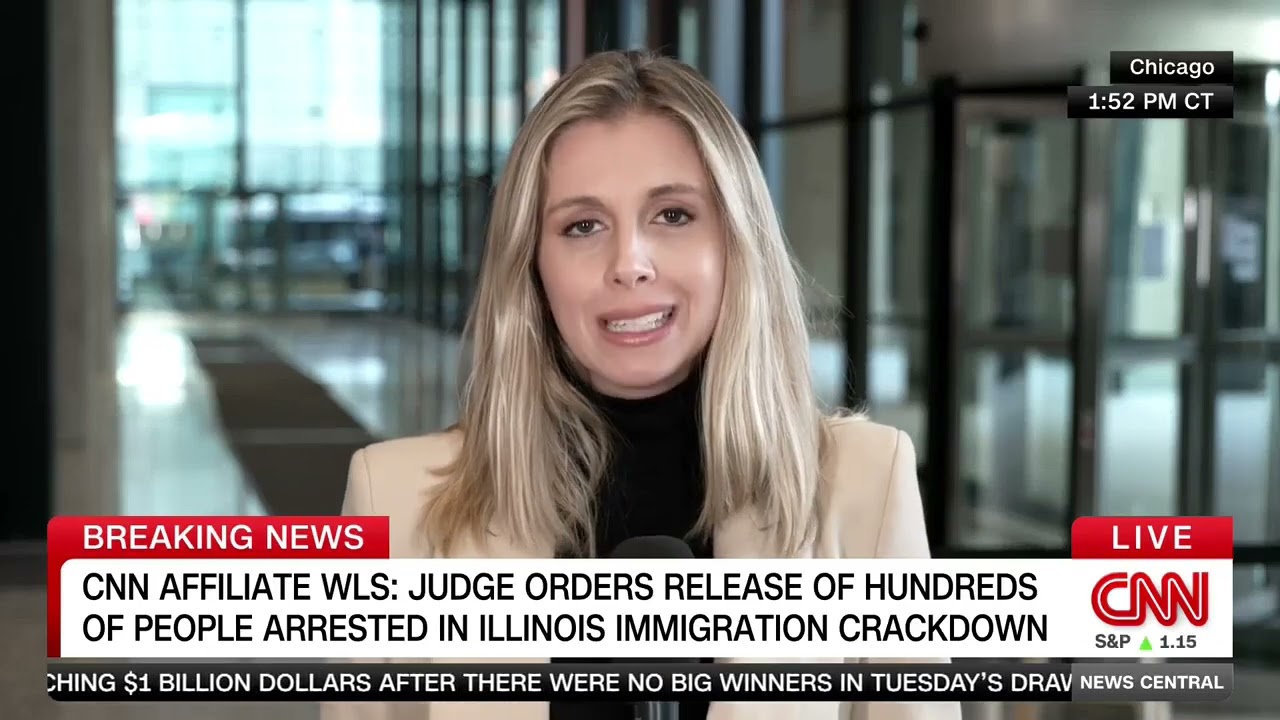 that the decision by U.S. District Judge Jeffrey Cummings (an appointee of former President Joe Biden) was a "major blow" to Trump's mass deportation efforts, while reporter Whitney Wild described the ruling was an "enormous win" for plaintiffs' attorneys suing the administration. She observed that Judge Cummings pointed out that more than 600 people detained across the country "have no deportation orders" and "no criminal history."
"This more practically applies to all 3,000 people who are who have been arrested by ICE and Customs and Border [Protection] between June and October," Wild said. "But most practically speaking, it applies to 615 people who are currently in custody all across the country."
According to Wild, plaintiffs' attorneys believe roughly 1,100 immigrants "simply left voluntarily after they were placed in custody because they just they gave up on their immigration status fight and chose to leave the United States." However, attorney Mark Fleming told CNN affiliate WLS that the ruling proved their argument that a bulk of the administration's arrests of immigrants in Chicago, Illinois this summer and fall — under the direction of Border Patrol Commander Gregory Bovino — were illegal.
"For the last two months, the terrorizing of our neighborhoods, the brutalizing of people here has all been unlawful," Fleming said. "That's what it's going to show. It's going to show that all of this, all of the tactics of Mr. Bovino, all of the tactics of ICE have been unlawful in the vast, vast majority of arrests."
So far, the Department of Homeland Security has not yet said if it will appeal Judge Cummings' decision to the Seventh Circuit U.S. Court of Appeals, though Fleming told WLS that he understood that the Department of Justice was planning to consult with Solicitor General D. John Sauer (one of Trump's former personal attorneys) about whether to file an appeal. However, Wild reported that the ruling may potentially have nationwide implications.
"More broadly, the question is, what does this mean for cases all across the country?" Wild said. "... The attorney for the ACLU told me that she believes that there are other cases across the country that are similar. And so you will start to see more cases end up just like this, with judges simply saying that these people who are in custody, it's completely improper."
---}:
omg an 10 25
CNN Capitol Hill reporter Sarah Ferris reported on Xthat U.S. Secretary of Agriculture Brooke Rollins will not commit to releasing Supplemental Nutrition Assistance Program (SNAP) funds if ordered to do so by a Boston judge overseeing a case against them
Boston's U.S. District Judge Indira Talwani is currently overseeing a legal case involving the government shutdown and SNAP, with the Trump administration arguing that it lacks the authority to use an emergency fund to pay for November SNAP benefits, potentially affecting 42 million Americans.
Talwani expressed skepticism toward the administration's argument during a hearing on Thursday, emphasizing her interpretation of congressional intent to protect people during emergencies. According to the*Washington Post, Talwani indicated she is likely to intervene to ensure food aid continues by ordering the U.S. Department of Agriculture to utilize the available $5.5 billion contingency fund.
Talwani stated that if the government can't cover the full cost, it must find an "equitable way of reducing benefits" rather than suspending them entirely.
Ferris said that CNN senior Capitol Hill producer Ellis Kim asked Rollins "if she will agree to release funds if ordered to do so by Talwani, to which Rollins replied, “We're looking at all the options.”
Aaron Blake, CNN's senior political reporter shared the news on X, saying, "I have a really hard time believing they would resist such an order. Feels like a great way to lose the political battle here."
Daily Kos reporter Emily Singer noted the move would mean the Trump administration is "[fighting] to make sure people aren't fed."
Bulwark MSNBC managing editor Sam Stein explained his understanding of the "administration's position" on the potential ruling.
The Trump administration is arguing "they legally can't release the funds[,] but if a judge tells them that they legally can release the funds they won't necessarily release the funds," Stein wrote on X.
---
---
MMA
Matt Walsh: Trump “has no good choice but to openly defy these activist judges”
10/07/25
---
AN 10 25
A New York Timessurveyof 50 members of the Washington legal establishment show deep pessimism on how President Donald Trump has taken a "wrecking ball" to the legal system.
"What’s happening is anathema to everything we’ve ever stood for in the Department of Justice,” said a former official who served in both Democratic and Republican administrations, including Trump’s first term.
And although 42 of those surveyed—former attorneys general, solicitors general, former U.S. attorneys and retired federal judges from across the country—were previously surveyed before Trump took office for his second term, many did not want to speak on record, because, theTimesexplains, "they’re worried about retribution, for their law firms or their family members, if they draw Trump’s ire."
The new survey, the Times says, "channeled their collectively grim state of mind. All but one of the respondents rated Trump’s second term as a greater or muchgreaterthreat to the rule of law than his first term."
Respondents say this second term is "far worse than they imagined," and all agreed that "Trump and his attorney general, Pam Bondi, have used the Justice Department to go after the president’s political and personal enemies and provide favors to his allies."
Contrasting Trump's first term, during which time safeguards were held because "there were lawyers in the room;" this time is different, the Times reports.
I still think we get through it,” a former official who served in several administrations said, “but I’m less certain of that each passing day.”
Trump'sbullying of law firms has raised deep concern among the group as well, with one former Republican-appointed judge saying, “Whatever happened to the bedrock principle that everyone deserves the best lawyer they can find? My firm is scared to death.”
The firing of the Jan. 6 prosecutors, the resignations over Trump's dismissal of corruption charges against New York Mayor Eric Adams, the conduct of Trump's U.S Pardon Attorney Ed Martin, who promised to smear the reputations of any targets he couldn’t indict, and the indictment of former FBI Director James Comey"corroded the Justice Department in the eyes of our respondents," the Times says.
“It’s all about dismantling the institution,” said the former official who served in multiple administrations. “And the message to everyone in the department is that if you speak up, something could happen that has never happened before. Maybe you’ll only be demoted or fired. But maybe it will be worse. Either way, you’d better bow to the emperor.”
---
an 8 25
Archive searches suggest the White House has scrubbed Sections 9 and 10 pertaining to Habeas Corpus and judicial review of unlawful detention from the official congressional website on the Constitution.
“Does this regime think that by editing the website they can delete these basic rights, or do they just want to make it harder to read about them?” demanded one commenter on Resistbot.
A quick scan of the site's constitutional summaries from Aug. 6 do not match more thorough archived shots of the same page from May. Among missing texts are summaries for Sections 9 and 10. Section 9 contains language pertaining to Habeas Corpus, including: “The Privilege of the Writ of Habeas Corpus shall not be suspended, unless when in Cases of Rebellion or Invasion the public Safety may require it.”
READ MORE: 'Living in a fantasy world': Critics pounce as Trump interview goes off-the-rails
Section 10 outlines the rights (and limitations of rights) of states regarding organizing, particularly organizing against the federal government. “No State shall, without the Consent of Congress, lay any Duty of Tonnage, keep Troops, or Ships of War in time of Peace, enter into any Agreement or Compact with another State, or with a foreign Power, or engage in War, unless actually invaded, or in such imminent Danger as will not admit of delay."
In addition to missing summaries of these Constitutional sections are detailed pages on Section 9 and Section 10. The page for Section 10, on July 15, for example, contained individual notes and entries on that section, including clauses. Today, a user visiting that same address will get a portrait of George Washington and a: “Page Not Found. Sorry, the page you're looking for does not exist” and a link back to the homepage. The same goes for the dedicated page for Section 9. Searches indicate the government site was modified July 17.
“That is not a good sign,” posted one commenter on Blue Sky.
“I don't have enough variations on 'f——' to express my feelings about this. Please help,” said another Blue Sky user.
READ MORE: This new report is a mortal threat to a desperate Trump
Critics say the Trump administration has run up against the Section 9 portion of the Constitution and its Habeas corpus inclusion. Originally imported to the Constitution from English common law, the language was used to ensure the king of England released prisoners when the law did not justify confining them.
Homeland Security Secretary Kristi Noem has claimed during a committee hearing that the constitutional provision is a tool the administration can use in its broader crackdown at the U.S.-Mexico border, claiming it to be “a constitutional right that the president has to be able to remove people from this country and suspend their rights.”
“That’s incorrect,” said Sen. Maggie Hassan (D-N.H), an attorney, who then explained to Noem that it is actually a “legal principle that requires that the government provide a public reason for detaining and imprisoning people.”
VID]
Hassan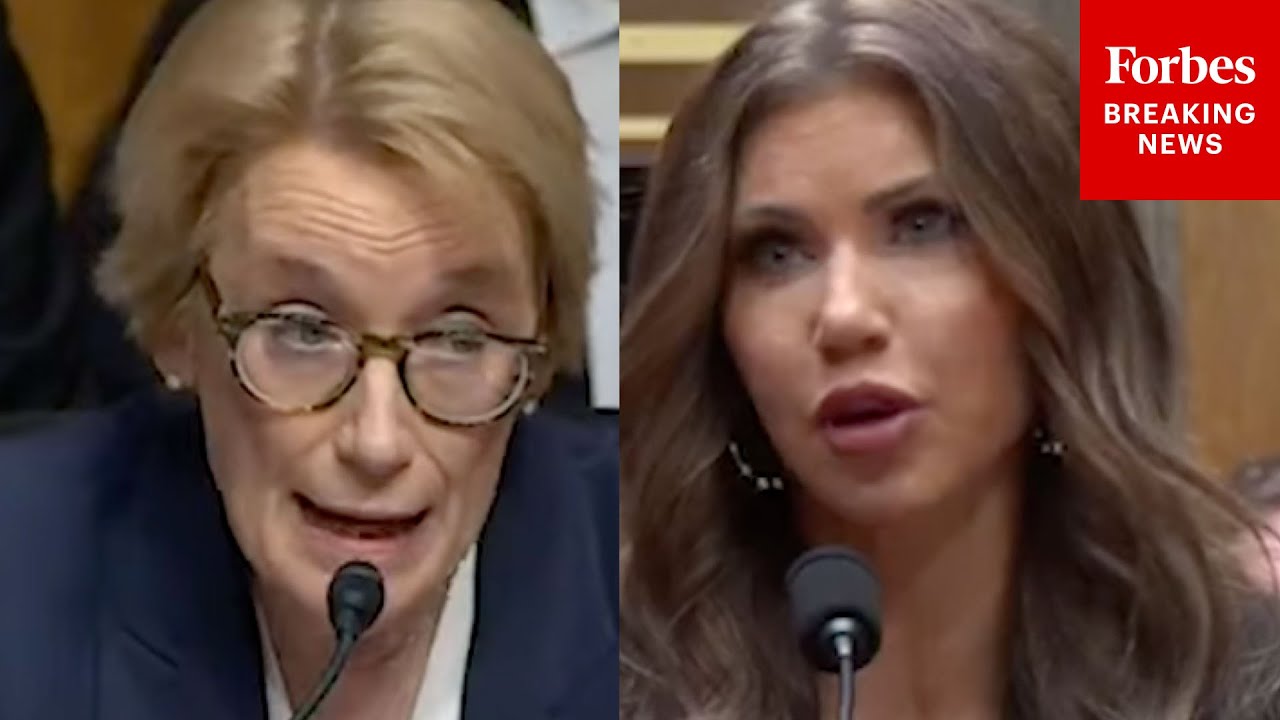 as “the foundational right that separates free societies like America from police states like North Korea.”
Read more: 'Open civil war': Retired federal judge calls Trump a 'tyrant' and MAGA 'anti-rule of law'
The White House did not immediately respond to emails.
---
mma
Right-wing media's campaign against due process for immigrants
Figures on the right falsely claimed that migrants don't -- or shouldn't -- get constitutionally protected rights
Written by Torri Lonergan
Published 08/05/25
The Constitution guarantees due process rights for everyone in the United States, regardless of citizenship status, but as part of their ongoing effort to defend President Donald Trump’s mass deportations, right-wing media have repeatedly and wrongly insisted that immigrants are excluded from this constitutional protection.
Some right-wing media figures have alleged only “nut jobs” believe undocumented immigrants deserve due process, and some have claimed that even legal immigrants “have no rights at all.” Others on the right acknowledged that migrants have rights but cheered at the prospect of taking them away, lamenting that constitutionally enshrined rights like due process and habeas corpus were slowing down mass deportations.
According to the Constitution, immigrants have the right to due process
- Experts explain that all people in the United States, regardless of their immigration or citizenship status, are guaranteed certain fundamental constitutional rights, including due process. PBS News wrote that “Many parts of the Constitution use the term ‘people’ or ‘person’ rather than ‘citizen,’" with Yale Law School professor Cristina Rodriguez explaining “those laws apply to everyone physically on U.S. soil, whether or not they are a citizen.” These rights include due process, which the American Civil Liberties Union notes entitles everyone to “a chance to defend themselves in a fair hearing” and habeas corpus, “the constitutional right that ensures that people have a chance to challenge their imprisonment in front of a judge,” according to the American Immigration Council. PBS News, [6/25/18; American Civil Liberties Union, 5/28/25; American Immigration Council, 5/22/25]
- The Constitution states that Congress can suspend habeas corpus but only “when, in cases of rebellion or invasion, the public safety may require it.” In May, the Trump administration weighed suspending habeas corpus, suggesting that immigration to the United States constitutes an ”invasion." PBS reported that “federal courts around the country” are already “raising questions about whether the country is truly facing an invasion.” PBS News, [5/20/25; American Immigration Council, 5/22/25]
- ## Right-wing media figures falsely claimed immigrants do not have constitutional rights
- Right-wing podcaster and Trump ally Laura Loomer asked, “Who on earth thought that illegal aliens should be entitled to legal representation and rights? These people are not entitled to due process in our country.” Loomer continued, “I don’t even give a shit about all these illegal alien kids.” Rumble, *Loomer Unleashed*, [4/30/25]
- YouTuber Zack Hoyt said, “I don’t think the Constitution applies to illegals.” Hoyt, who goes by Asmongold, said, “I don’t really think that illegals deserve due process, by the way. I don’t think the Constitution applies to illegals.” Hoyt acknowledged that the government could ”get it wrong" when detaining immigrants but said: “There’s people in jail for murder that didn’t commit murder. … Does that mean we shouldn’t put people in jail for murder? It just doesn’t make any sense.” Asmongold, *Asmongold TV*, [6/9/25]
- Fox host Sean Hannity asked, “Why do people have this belief system that you enter the country illegally and then you, quote, ‘automatically have constitutional rights’? You do not, in my view.” Hannity also said, ”Why do so many federal judges believe that the safety and security of all of you comes second to the so-called due process rights of illegal immigrants that broke into this country illegally, broke the law, committed serious crimes?" Fox News, *Hannity*, [5/21/25]
- Hannity has repeatedly referred to the “so-called rights of illegals.” In one example, Hannity said Democrats put “the rights of illegals — so-called rights of illegals — over your safety,” saying Democratic politicians were throwing ”temper tantrums out as ICE is trying to do their job in Los Angeles. They arrested murderers and child molesters, gang members, I mean, some of the worst of the worst. You'd think they would be happy, but they're not." Premiere Radio Networks, *The Sean Hannity Show*, [7/1/25, 7/24/25; Fox News, Hannity, 7/14/25, 7/15/25, 7/22/25]
- On Fox Noticias, former U.S. Citizenship and Immigration Services Director Emilio Gonzalez said immigrants recently deported to and imprisoned in El Salvador — including those who came here legally — “at a certain point … have no rights at all.” Gonzalez said, “They are not residents, they are not citizens. They came to this country under a program which was, if not illegal, it was improper, and under this president it’s simple, crimes like that which we have seen in the past four years will not be permitted.” Fox Deportes, *Fox Noticias*, [3/17/25]
- ## Right-wing media specifically and falsely claimed immigrants don’t have a right to due process
- Former Fox host Jeanine Pirro, currently the U.S. attorney for D.C., said, “The only due process I believe in is a legal way to enter this country.” Pirro said of Trump's deportation of alleged Tren de Aragua gang members to a megaprison in El Salvador: “They are illegal. They are committing crimes, OK? We do not have to have them convicted of a crime to remove them.” Pirro later said the Fifth Amendment, which confers the right to due process, “says nothing about illegals” and “the Supreme Court never said in Abrego Garcia case that due process is required for illegals.” Fox News, *The Five*, [3/17/25, 3/17/25, 5/5/25]
- Right-wing podcaster Barry Ramey complained that “fucking nut jobs” are “making that case” that “Pablo, who entered the country illegally, deserves due process somehow.” U.S. Attorney’s Office District of Columbia, [7/7/23; WarBoys Studios, Lords of War, 7/1/25]
- Fox News contributor Liz Peek said, “I'm so sick of hearing about due process for people who are in our country illegally. They're not citizens. They do not have the due process accorded American citizens.” SlateStone Wealth partner Kenny Polcari added, “The whole due process thing goes — for me — goes right out the window. You're not an American citizen, so you're not entitled to due process when you've come here illegally and you've broken our laws.” Fox Business, *Mornings with Maria*, [4/21/25]
- On Fox, former Immigration and Customs Enforcement agent Victor Avila said, “That section of people that are here in this country illegally, you know what the due process is for them? To be identified and removed immediately.” Fox News, *The Story with Martha MacCallum*, [7/17/25]
- Fox anchor Harris Faulkner said undocumented immigrants should lose their right to due process if they are “caught trying to go after an ICE agent,” adding, “Not that you ever really had it anyway, because you’re not a real U.S. citizen.” Faulkner added, “You broke into the country. You broke our first law.” Fox News, *Outnumbered*, [7/17/25]
- The Daily Wire’s Matt Walsh urged Trump to “ignore” what he called an “illegitimate” Supreme Court order requiring that immigrants be given advanced notice of their deportations as part of their due process rights. Walsh complained, “This is completely bogus. It's illegitimate. It's ridiculous. Trump should ignore it. That's the only answer … The Supreme Court has given their personal opinion that they think, you know, if you're gonna deport an illegal alien, they should get more than 24 hours notice. So that's their personal opinion. Thanks for letting us know, guys. Really interesting. I'm glad you chimed in. Really interesting opinion. Thanks for that. Anyway, let's get back to deporting the illegal aliens.” Politico, [5/16/25; The Daily Wire, The Matt Walsh Show, 5/19/25]
- ## Other times, right-wing media figures said migrants shouldn't have due process, with many arguing the constitutional right is too burdensome
- On his radio show, Sean Hannity argued, “We don't have the capacity to put that many people on trial or give them, quote, the ‘due process’ when we know they're here illegally.” He asked, “What are we gonna have millions and millions of trials in this country? What, 14 million illegals are going to go before a judge and on trial? And who's gonna pay for that?" Premiere Radio Networks, *The Sean Hannity Show*, [5/5/25]
- War Room host Steve Bannon complained, “I think the due process is grossly overstated. It ought to be, get them on a plane and get them the hell out of here." Real America’s Voice, *War Room*, [7/1/25]
- Fox host Brian Kilmeade argued, “It's not practical to think that we can do due process on 8 million people.”He continued, “We can't do it, they don't deserve it. Our system doesn't need to be double burdened.” Kilmeade later reiterated, “We can’t give due process to all of them.” Media Matters, [3/24/25, 3/24/25]
- Fox host Jesse Watters complained, “Foreign terrorists illegally in the country, they can’t get hearings and trials and appeals. We’ll never get any of these bad hombres out of here … It doesn’t belong in the criminal justice system.” He complained that “liberal MS-13 lawyers” are “what slows down mass deportations” and applauded Trump for using his “instincts” to decide who to deport. Weeks earlier, Watters had said, ”If you have a face tattoo and you have criminal convictions in this country and you’re a foreign national and you get picked up, I don't want a lawyer, I don't want an appeal. I want you adios, goodbye." Fox News, *Jesse Watters Primetime*, [6/6/25; Fox News, The Five, 5/19/25]
- Fox Business anchor Cheryl Casone argued only U.S. citizens “deserve” due process rights.Casone said, “These are not American citizens that are being held in this detention facility. None of them are a legal American — a legal American citizen. That's when you deserve due process. I’m sorry.” Fox Business *Mornings with Maria*, [5/12/25]
- Former acting Deputy Homeland Security Secretary Ken Cuccinelli argued, “There’s so much due process in place, and to me and so many other Americans, if you break into this country, effectively, if you break our laws to be here, you shouldn't get that benefit on the way out. And that’s really slowing the president down.” Cuccinelli said the “courts” are an “impediment” to Trump’s mass deportations and we have “a very difficult system for moving these folks out.” Fox News, *Fox & Friends*, [6/4/25]
- Referring to “millions of illegal aliens,” National Review staff writer Caroline Downey asked, “Should Trump have to use due process to export them back? Of course the answer should be no.” Fox Business, *Mornings with Maria*, [5/6/25]
- Former Fox News host Tucker Carlson said, “I'm not that concerned whether someone who broke a law — my law to get into my country and is taking welfare from my pocket gets due process.”Carlson added, ”I am for due process specifically for me. I'm an American citizen." SiriusXM, *The Megyn Kelly Show*, [4/29/25]
- Fox host Todd Piro said: Some “on the left say, ‘Due process!’ … If you have to do a full process, like Joe Biden and his administration wanted for every single illegal, that would take until the dawn of time is over.” Fox Business, *Mornings with Maria*, [5/23/25]
- Podcaster Tim Dillon said, “I think you need some” due process rights for migrants, but “I don't think you need as much as other people think you need, depending on what they've done.” *The Tim Dillon Show*, [5/17/25]
- Article III Project founder Mike Davis argued that accused gang members and terrorists should be given “zero” notice ahead of their deportations.He complained that if immigrants accused of crimes are given notice, “they have a chance to file a habeas petition during that time frame … Who knows how long that will take. Who knows the number of appeals.” Real America’s Voice, *The Charlie Kirk Show*, [5/19/25]
- ## Right-wing media also advocated for suspending habeas corpus for immigrants
- Conservative commentator Rogan O'Handley argued that “we should consider suspending the writ of habeas” so that “we can start to take more drastic actions to deport illegals, especially the cartels, without judicial overview, without the courts getting involved.” Handley, who goes by DC Draino, explained to Steve Bannon, “I would say 10 to 20 million illegal aliens coming into this country counts as an invasion, especially when many of the illegal aliens are coming from hostile adversaries like China, like Ukraine, like … Venezuela, the Tren de Aragua. They're being sent by these governments.” Real America’s Voice, *War Room*, [4/22/25]
- The following month, Bannon argued Trump is “going to have to” suspend habeas corpus, “because these courts are going to continue to try to jam him up.” And later Bannon hailed himself and O’Handley as “the biggest advocates of doing what Lincoln did: start suspending the writ of habeas corpus, put them on an aircraft and get them the hell out of here.” Real America’s Voice, *War Room*, [5/16/25, 5/30/25]
- American Principles Project’s Terry Schilling said, “I think suspending habeas corpus for noncitizens is considered due process. They're getting the process that they're due, right?” YouTube, *Timcast*, [5/10/25]
- Newsmax host Greg Kelly said, “Habeas corpus is great, but I don't think it applies to an illegal alien.” Newsmax, *Greg Kelly Reports*, [7/8/25]
- Right-wing influencer Steven Crowder said “I go back and forth” on suspending habeas corpus but defended those considering it, saying “the reason they’re talking about” this is “a 20 million-large invasion” and “the president and the federal government has authority” to “make sure that citizens are safe from external and internal threats.” Crowder continued, “I think the threat is actually a — I think it’s a smart move to make. I don’t know if they necessarily — I go back and forth … I think for anyone who is an actual, like, affiliation with MS-13, like, yeah. OK great. Yeah. If there's a gray area, you know what, let's play it safe.” YouTube, *Louder with Crowder*, [5/12/25]
- Former congressman and One America News host Matt Gaetz argued that we’re headed toward suspending habeas corpus, calling the move “unavoidable.”Real America’s Voice, *War Room*, [5/14/25]
---
mma 7 25
Fox News scoffed that Andry Hernandez was “just a gay barber” when Trump sent him to a torture prison. Now, Fox ignores reporting that he was sexually assaulted there.
Written by Matt Gertz
Published 08/04/25
Fox News regularly downplayed concerns that the Trump administration’s denial of due process had resulted in immigrants sent in error to a notorious foreign prison, with one host mocking interest in the plight of a man he described as “just a gay barber.” That man, Andry Hernández Romero, said last week that he was beaten by guards, one of whom forced him to perform oral sex, during his 125 days in captivity.
Fox personalities were elated in March when the Trump administration dubiously invoked a rarely utilized wartime authority to deport over 250 Venezuelan immigrants to El Salvador’s Terrorism Confinement Center (CECOT), a megaprison known for its brutal conditions. The network had spent 2024 concocting a bogus narrative about a “migrant crime wave,” and they quickly and uncritically adopted the administration’s justification that it had targeted violent Tren de Aragua gang members for this treatment.
While Fox’s stable of propagandists bleated that the deportees were “the worst of the worst,” CBS News reviewed the names and found that three-quarters had no criminal record in the United States. Indeed, the group included people like Hernández, a gay 32-year-old makeup artist who entered the U.S. legally and passed a preliminary asylum screening. He had no criminal record or removal order but was detained and ultimately shipped to El Salvador over concerns about his wrist tattoos — crowns with the words “Mom” and “Dad” next to them.
Rather than express concerns over the U.S. government using such slight evidence to send people to a foreign prison known for its brutal conditions, Fox hosts ran cover for the administration. They accused critics of sympathizing with “illegal alien gangbangers,” accused them of pushing “false sob stories,” denounced news outlets that “only focused on” the innocent people sent to the torture prison rather than the supposedly guilty ones, and denied the importance of providing due process to determine which group is which.
Fox’s Jesse Watters on Andry Hernández: “It’s just a gay barber”
Perhaps the most disturbing discussion came during the March 31 edition of The Five, when Jessica Tarlov, the panel show’s lone Democrat, drew derision from right-wing co-hosts Jesse Watters and Greg Gutfeld for repeatedly directing the show’s attention to Hernández’s plight.
Video
Citation
From the March 31, 2025, edition of Fox News' The Five
“Time magazine was there when the gay barber from Venezuela who had a crown tattoo that said ‘mom’ was being processed coming into the El Salvadoran — oh, am I boring you again?” Tarlov said at one point. “I'm sorry.”
“No,” Watters replied. “But you've been talking about this gay barber from El Salvador with some stupid tattoo for weeks. Weeks, Jessica.”
“It's just a gay barber,” Watters added.
“He’s not into you,” Gutfeld interjected.
“He's an innocent guy who got swept up in a deportation, and hopefully we get it figured out and straightened out,” Watters continued. “But a lot of people in this country, Jessica, get arrested for things that they didn't do, get falsely accused, falsely convicted.”
“That doesn't mean you stop arresting criminals because one guy was arrested who was innocent,” Watters concluded. “It just means you just try to do it better the next time.”
What we did to Andry Hernández
Four months after that segment, the Trump administration managed to have Hernández returned to Venezuela as part of a prisoner exchange. Unfortunately, the administration didn’t “get it figured out and straightened out” before he was brutalized by guards, one of whom forced his penis into Hernández’s mouth and made him perform oral sex, Hernández subsequently told interviewers.
“Hernandez says the prison was hot and quiet. Guards would drag inmates out of their cells and beat them if they made too much noise,” NPR’s Manuel Rueda reported on July 27. “He slept on a metal plank without a mattress and shared his cell with up to 19 people. There was a toilet in each cell but no walls to separate it from the rest of the room.”
Rueda further reported that, according to Hernández, he was punished with confinement in a smaller cell “after guards caught him bathing outside regulatory hours. He says he was beaten with batons by three wardens in the small room and forced to perform oral sex on one of the guards.”
“In that prison, human rights don't exist, and the guards take pleasure out of seeing others suffer.” Rueda translated Hernández saying.
NBC News likewise reported on July 28 that Hernández said that “one day during his imprisonment he was taken to solitary confinement, where prison staff ‘made me kneel, perform oral sex on one person, while the others groped me and touched my private parts’ and ‘stroked me with their batons.’”
Fox has not reported on Hernández’s account, according to a Media Matters review.
And while Watters had expressed his vague hope for Hernández that “we get it figured out,” The Five is instead focused on issues he apparently finds more important.
---
---
AN 7 25
President Donald Trump is now pushing for the Senate Republican in charge of the committee overseeing the federal courts to get rid of a longstanding tradition that would allow him to more easily prosecute his political opponents.
That's according to a Tuesday article in Courthouse News Service, which reported that Trump has now set his sights on Senate Judiciary Committee chairman Chuck Grassley (R-Iowa). As chair of the powerful committee, Grassley is in a position to do away with the custom of "blue slips," in which senators from states under the jurisdiction of a presidential appointee to a federal judgeship or a U.S. attorney's office can effectively veto a nomination by refusing to turn in blue slips in agreement with the appointment.
One particular example is Sens. Cory Booker (D-N.J.) and Andy Kim (D-N.J.) not submitting blue slips in favor of controversial acting U.S. attorney Alina Habba for the District of New Jersey, who the Trump administration has allowed to remain in her post by exploiting a loophole in the Federal Vacancies Reform Act. In a Truth Social post on Tuesday night, Trump raged against the blue slip system, and called on Grassley to end it so he can ram through a slew of far-right prosecutors in Democratic-run states.
READ MORE:'All power to Trump': Worst modern chief justice John Roberts bashed in scathing editorial
"Democrats like Schumer, Warner, Kaine, Booker, Schiff, and others, SLEAZEBAGS ALL, have an ironclad stoppage of Great Republican Candidates," Trump wrote in his signature style of oddly placed capital letters. "Put simply, the President of the United States will never be permitted to appoint the person of his choice because of an ancient, and probably Unconstitutional, “CUSTOM,” that if you have, even one person in the opposite Party serving in the U.S. Senate, he/she must give consent, thereby completely stopping the opposite Party’s Nomination."
"The only way to beat this Hoax is to appoint a Democrat or, a weak and ineffective Republican," he continued. "Therefore, I would never be able to appoint Great Judges or U.S. Attorneys in California, New York, New Jersey, Illinois, Virginia, and other places, where there is, coincidentally, the highest level of crime and corruption — The places where fantastic people are most needed! ... Chuck, I know you have the Courage to do this, DO IT!"
As Courthouse News Service's Benjamin S. Weiss wrote, Trump gave no evidence that the blue slip system was "probably Unconstitutional," and that the Constitution in fact gives the Senate the power of "advice and consent" regarding presidential nominees. Weiss also noted that Trump's claim that Democrats "openly broke" the blue slip tradition was unfounded.
Democrats have abided by the blue slip system even to their own detriment. In 2023, then-President Joe Biden withdrew the nomination of Scott Colom, whom he had nominated to serve as a U.S. District Judge for the Northern District of Mississippi. Sen. Cindy Hyde-Smith (R-Miss.) refused to return a blue slip for Colom's confirmation, and then-Senate Judiciary Committee chairman Dick Durbin (D-Ill.) refused to abolish the blue slip system to confirm Colom.
READ MORE:'I thought consumers weren't paying?' MAGA rips Josh Hawley over 'out of touch' proposal
Click here to read Courthouse News Service's full report.
---
robt r
an 7 25
The public conversation has become so distorted by the moral squalor of Trump and his lackeys that I fear we’re confusing what’s exciting with what’s important.
“Epsteingate” isexciting. The story excites because Trump seems unable to stop it from growing — and it therefore offers a bit of hope that it will undermine his support or even topple him.
Yet I worry that it’s crowding out other stories that Americans need to know and respond to, such as:
1. Hunger in Gaza has reached new and astonishing levels of desperation, with a third of the population not eating for multiple days in a row, according to the World Food Program.
The number of children dying of malnutrition has risen sharply in recent days. Many are literally starving.
According to Philippe Lazzarini, the commissioner-general of the United Nations Relief and Works Agency:
“People in Gaza are neither dead nor alive, they are walking corpses…. One in every five children is malnourished in Gaza City as cases increase every day. When child malnutrition surges, coping mechanisms fail, access to food & care disappears, famine silently begins to unfold. Most children our teams are seeing are emaciated, weak & at high risk of dying if they don’t get the treatment they urgently need…. Parents are too hungry to care for their children. Those who reach UNRWA clinics don’t have the energy, food, or means to follow medical advice. Families are no longer coping, they are breaking down, unable to survive. Their existence is threatened.”
America is directly implicated in this humanitarian crisis.
Netanyahu is a war criminal. More than 1,000 Palestinians have been killed by Israeli forces since May while trying to get food in the Gaza Strip, mostly near aid sites run by an American contractor.
The United States must stop all military assistance to Israel unless Netanyahu and the Israeli government allow relief organizations to bring immediate humanitarian assistance to Gaza.
2. Federal judges accuse the Trump regime of deliberately defying court orders by being slow to respond, misrepresenting facts in filings, and refusing to take action as ordered by the courts.
In an analysis of 165 court orders filed against the Trump regime, the *The Washington Post*found that federal judges accused it of resisting court orders in at least 57 of those cases — approximately 34 percent.
This story needs far more attention. It’s the clearest evidence yet of the regime’s disregard for the U.S. Constitution.
It should form the basis for impeachment of Trump and his lackeys, and for criminal action against them once they’re out of office.
3. 56,816 people are now being detained by ICE, both in the United States and in El Salvador and other countries where there’s little or no control over the conditions in which they’re being detained.
Over 70 percent have not been convicted of any crime.
---
omg 6 25 an neutered judic on natl injunction
dissent soto and kbj
What the Supreme Court did was far more dangerous than ending birthright citizenship
---
an 7 25
no lnx
One Trump court case will determine whether America will still have a democracy
Sabrina Haake, Raw Story July 26, 2025
Oral arguments were heard this week in Harvard v. Trump’s cross motions for summary judgment. Summary judgment, or “judgment on the papers,” means both sides agree on the facts but disagree on how the law applies to those facts.
Neither Harvard nor the Trump administration dispute that Trump made certain unprecedented written demands to the University, accompanied by unprecedented threats if they refused to comply.
Harvard refused to comply, and sued instead.
Whichever party loses summary judgment will appeal, and the final disposition will likely, eventually, come from the Supreme Court. If the high court’s republican majority further empowers Trump’s edicts under their misguided “unitary executive theory,” our 249 year history of ideological freedoms will come to an end and the nation will yield to Trump’s revenge.
Trump’s pressure campaign against Harvard
The Trump administration, ostensibly seeking to reduce campus antisemitism following widespread protests over Gaza, threatened to withhold billions in federal funding from Harvard, place a lien on University assets, and put academic departments in receivership, unless Harvard agreed to:
Exclusively promote faculty committed to Harvard’s mission and Trump’s viewpoints;
Submit the university to a Trump administration review of “viewpoint diversity;”
Scrutinize any “programs and departments” that might, in Trump’s judgment, fuel ‘antisemitic harassment;’
Submit all faculty to outside review for alleged ‘plagiarism;’
Submit to a comprehensive hiring and review audit conducted by the federal government;
Implement a comprehensive mask ban and suspend anyone who wears a mask;
Report to the federal government on any faculty members who “discriminated against” Jewish or Israeli students;
Screen student applicants to reject those with viewpoints “hostile” to Trump/ Israel’s policies;
Establish outside review for Harvard programs that reflect “ideological capture” ie, programs where classroom messaging does not reflect Trump-supportive dogma;
Diminish the influence of its own professors and faculty over the university; or
Establish “merit based” hiring and admissions policies that pleased the Trump administration.
The oral argument
Oral argument was both testy and basic. The lone DOJ lawyer arguing the motion, Michael Velchik, asserted that the administration “has the power to decide” where it will spend taxpayer money and that, “the government does not want to fund research at institutions that fail to address antisemitism to (the government’s) satisfaction.” According to Velchik, when Harvard refused to go along with Trump’s demands, Trump was free to terminate any and all contracts with the university.
Trump essentially argues that the federal government can terminate or withhold funds under a contract for any reason at all, even if that reason violates free speech, the right of free association, or any other rights protected under First Amendment.
Steven Lehotsky, Harvard’s counsel, countered that Trump’s attempts to control the University, including telling the University what it can teach and how it can teach it, represents Trump’s blatant “and unrepentant” violation of the First Amendment. The Supreme Court has long held viewpoint discrimination to be such a serious violation of the 1st A that it is treated as ‘presumptively unconstitutional.’ Lehotsky argued plainly that, “It’s the constitutional third rail, or it should be, for the government to insist it can engage in viewpoint discrimination.”
Trump has been consistent in his belief that he can punish speech and political conduct he doesn’t like, notwithstanding clear and unequivocal legal precedent to the contrary. He has applied the same strong-arm tactics to boardrooms and corporations, national media outlets, law firms, and, most recently, comedians. If the Roberts court continues to enable him, Trump will extend the same reasoning to imprison or otherwise punish anyone who criticizes him, following the same authoritarian playbook that produced such hits as Nazi Germany, Viktor Orban’s Hungary, and Putin’s Russia.
How does Trump tie withdrawal of medical research funding to the civil rights of Jewish people?
Even if Harvard allowed the expression of antisemitic views on campus—despite a strong Jewish presence among Harvard faculty—there still has to be some nexus, or some connection, between what the government is trying to fix (antisemitism) and the methods it uses to fix it. The judge went to the heart of this concept when she asked Trump’s counsel to explain the relationship between antisemitism and cutting off unrelated cancer research funding, noting that Trump is “not taking away grants from labs that have been antisemitic.”
An amicus brief filed in the case by Jewish scholars also points out that Trump routinely uses “antisemitism” as a ruse to attack freedom of speech, freedom of thought, and freedom of association. As noted in their amici brief, many Jewish scholars reject the notion that being Jewish “requires adherence to a specific conception of Zionism or support for the Israeli government or its policies and practices.”
Judge Burroughs noted that if Trump, or any federal administration, could punish a university without due process simply because they don’t like their politics, or their message, or the substance of their curriculum, the constitutional consequences would be “staggering.”
The outcome of Harvard v. Trump will determine whether we still have a democracy
Harvard v. Trump asks the most fundamental questions one can ask about the relationship between the government and the governed. Under the First Amendment, can the federal government control what is taught in the classroom and what is said on campus at various universities? Can the federal government withhold federal funds if it doesn’t like what it hears, or doesn’t agree with the viewpoints expressed?
If the answer is no, then our Constitution stands. Trump will join a 249 year line-up of presidents who have to grin and bear it when students call them ugly names and protest their policies. Who knows, Trump might even someday learn why the framers made free speech and association the very first amendment to the Constitution.
But if the answer is yes, the First Amendment will fall under the Roberts court, and there’s no reason to believe any other Constitutional protection will stand. Trump will forcibly insert his right-wing ideology onto campuses, boardrooms, and legacy media nationwide. That ideology will serve a madman’s lust for power and revenge, and America’s democracy will cease to exist.
Sabrina Haake is a columnist and 25+ year federal trial attorney specializing in 1st and 14th A defense. Her Substack, The Haake Take, is free.
---
---
an 7 25
On Tuesday, a federal judge issued a 128-page ruling striking down President Donald Trump's ban on asylum applications for immigrants crossing the Southern border of the United States that he issued earlier this year via executive order. Some of Trump's most outspoken supporters are furious over the decision.
U.S. District Judge Randolph Moss — who former President Barack Obama appointed to the District of Columbia in 2014 — ruled that Trump's asylum ban violated the Immigration and Naturalization Act (INA) and was an illegal attempt to install an "extra-statutory, extra-regulatory regime for repatriating or removing individuals from the United States." He added that "nothing in the INA or the Constitution grants the President or his delegees the sweeping authority asserted in the Proclamation and implementing guidance."
According to Politico legal correspondent Kyle Cheney, Judge Moss also designated asylum seekers as a protected class. This would appear to insulate his ruling from the recent Supreme Court of the United States (SCOTUS) decision that prevented lower court judges from issuing nationwide injunctions.
READ MORE:'Can anyone spell recession?' Trump slammed as jobs report stuns economists
Moss' decision was met with widespread outrage by Trump supporters on social media. MAGA influencer Gunther Eagleman characterized Moss' ruling as "ordering President Trump to reopen the border," adding: "Ignore this political HACK!" Charlie Kirk, who is the founder of far-right group Turning Point USA, also blasted the decision in a post to his X account.
"There are a lot of conservatives who recklessly call for judicial rulings they don't like to be ignored. I have fought against that; it would be hugely destructive to throw out our constitutional balance of powers for the sake of a temper tantrum," Kirk tweeted. "But it is 100% not acceptable for a traitor on the federal bench to side with invaders in abolishing America. Period."
Far-right influencer Chaya Raichik's LibsofTikTok X account, which has more than four million followers, also piled on after Moss' decision was announced. She accused Moss of being an "activist judge who wants to turn the US into a Biden-era open border disaster."
Even though Moss has been a member of the D.C. District Court for more than a decade, his legal career stretches back nearly 40 years, when he was a clerk for U.S. District Judge Pierre Leval (an appointee of Democrat Bill Clinton) in 1986 in the Southern District of New York. He then clerked for SCOTUS Associate Justice John Paul Stevens (an appointee of Republican Gerald Ford) in the late eighties.
READ MORE:Republicans 'facing real general election problems' over Trump Medicaid cuts: ex-GOP rep
Click here to read Moss' full ruling.
---
---
JOE KENT KKK COOK BOOKS TULSI COS
UP FOR MORE IMP CTR TERROR JOB, COS PLACEHOLDER; COOKED BOOKS ON TREN DE A. 5 25 MSNBC CHRIS H
---
Political scientist Adam Bonica describes "the authoritarian script:
- Court rules against leader
- Attack judges as biased/dangerous
- Delegitimize judicial system
- Create permission for threats
- IF NO MASS RESISTANCE → Purge the courts
- IF MASS RESISTANCE → Forced to retreat."2^
Bonica warns, "Every authoritarian who successfully destroyed judicial independence did so because civil society failed to unite in time. The key difference? Whether people mobilized."3^
---
---
an 6 25
U.S. District Judge Kathleen Williams found firebrand Florida Attorney General James Uthmeier in civil contempt Tuesday for defying an April order.
Earlier this year, The Independent reports Williams banned the enforcement of a Florida law making undocumented immigrant travel a misdemeanor while the contested law is being challenged in court. But Uthmeier sent out a notice to Florida law enforcement telling them he personally disagreed with the order, calling it “both wrong on the merits and overbroad on its scope,” according to court documents. The AG added that his office will “continue to press these scope-of-relief arguments in the district court and, as appropriate, in the U.S. Court of Appeals for the Eleventh Circuit.”
Later, in a follow-up memo, Uthmeier told officers he “cannot prevent [them] from enforcing” the challenged laws.
READ MORE: 'Barbarism': Analyst says this new Trump policy proves he was 'never about law and order'
“It is my view that no lawful, legitimate order currently impedes your agencies from continuing to enforce Florida’s new illegal entry and reentry laws,” he wrote.
Weeks later, the court demanded of Uthmeier why he should not be held in contempt or sanctioned over his texts, but the AG claims he hadn’t technically violated William’s order because he does not personally enforce the contested law. That duty falls to officers.
However, while Uthmeier does not act as a grounds enforcement officer, the court determined he did wrongfully adopt the role of interpreting the law as a court magistrate, and decided Uthmeier requires looking after. As part of Williams' new order finding him in contempt, the AG must now file bi-weekly reports “detailing whether any arrests, detentions, or law enforcement actions pursuant to [the challenged laws] have occurred, and if so, how many, when, and by which law enforcement agency.”
While misinterpreting or ducking court orders himself, Uthmeier is not above threatening local law enforcement and sheriffs he feels do not uphold his goals. Earlier this month, Uthmeier sent Broward Sheriff Gregory Tony a letter warning he could be removed from office if he did not overtly agree to help the Trump administration crackdown on immigration.
READ MORE:'Disappoint every Republican': New analysis of Trump's bill debunks GOP's 'main arguments'
“I would hope your statements were mere political posturing, but if not, your expressed positions would constitute a failure of your statutory obligation to utilize ‘the best efforts to support the enforcement of federal immigration law’”, Uthmeier wrote.
A week prior, Tony had informed his local county commission that stretched county resources did not give him the luxury of enforcing immigration, which he felt should be left to the federal government.
“We have other priorities in this community that I’m focused on, and immigration is not one of them, not to dismiss the importance of that,” Tony had said.
Read the full Independent report at this link.
---
MMA
[## Newt Gingrich calls for Congress and Trump to “abolish” federal judges
06/04/25
https://www.mediamatters.org/fox-news/newt-gingrich-calls-congress-and-trump-abolish-federal-judges)
---
---
an 6 25
Since returning to office, Donald Trump has often called the US legal system into question. He has criticised judges as activists, challenged the role of the courts and insisted some firms do free legal work in support of his administration’s causes to make up for working for some of his political opponents.
Meanwhile, Vice-President J.D. Vance has advised US Supreme Court chief justice John Roberts that he ought to be “checking the excesses” of the lower courts.
And Stephen Miller, deputy White House chief of staff, said: “We are living under a judicial tyranny,” after the US Court of International Trade ruled the president didn’t have the power to impose international trade tariffs. Meanwhile, judges are asking for more security to protect them from threats.
Trump’s federal investigations and volley of executive orders (presidential directives that don’t require legislative approval by Congress) have also put enormous pressure on law firms. And a recent report shows that both trust in law firms’ independence, and even the rule of law itself, is perceived as under threat in the US. But what does this mean, and why is it important?
The president has taken action against law firms in two prominent ways:
First, by federal investigation. Specifically, letters to a group of 20 law firms from the Equal Employment Opportunity Commission. These demanded information about their diversity, equality and inclusion (DEI) policies, based on the proposition that any sort of treatment of underrepresented groups that appeared preferential to them in policy, or practice, was unequal treatment for other groups, and, consequently, discriminatory.
Second, the president has passed numerous executive orders introducing punitive measures on specific law firms that previously represented clients opposing his administration, or employed attorneys involved in past investigations against him. His administration has also revoked government contracts and suspended security clearance from buildings. In practice, the orders would prevent attorneys from accessing from where they work, such as courthouses and federal agencies.
In response, some prominent law firms have sought to mitigate the fallout with the Trump administration by entering into agreements with it. These have included pledging US$1 billion (£730,000,000) in pro bono (free) legal services supporting causes aligned with Trump’s agenda.
For example, support for veterans, representing police officers, and antisemitism prevention. Noteworthy is that law firm Paul, Weiss, Rifkind, Wharton & Garrison have now agreed to discontinue certain DEI policies, in addition to committing US$40 million (£29.4 million) in pro bono work for the president’s causes. In response the Trump administration has now lifted restrictions against them. Judges say they are under threat.
More broadly, it has been reported that 70% of the US Justice Department civil rights division’s attorneys are leaving their posts. The mass exodus is believed to be part of attempts to reshape the division into one focused on enforcing executive orders.
The consequences of these developments are that the president’s actions have led to a significant realignment in the legal professions. Some US attorneys have reported that law firms are now more hesitant to engage in pro bono workthat could be viewed as opposing the administration’s policies.
By contrast, some lawyers are now trying to establish independent firms aimed at defending civil servants and challenging federal overreach, ensuring at least some, albeit less resourced, support for underrepresented groups. Trump criticizes judges and legal activists.
Other lawyers have sought legal action against the orders as unconstitutional interference. Some of these have led to success. For example, Perkins Coie challenged theirs and got it struck down. The concern here centred around their representation of Democratic presidential candidate Hillary Clinton. In arriving at the decision, the district judge ruled the president’s actions to be an “overt attempt to suppress and punish certain viewpoints”.
Why this matters
These developments call into question the balance between governmental influence and the independence of lawyers in upholding the rule of law. Lawyers must be impartial in representing their clients in order to effectively represent their interests, and allow the judiciary to fulfil their duty of checks and balances on the government’s decisions.
When unfettered power is wielded by the government, and the law is undermined, scope for monitoring the constitutionality of decision making is compromised.
The rule of law is a foundational principle of western democracies. It means that everyone is subject to the law, including governments. Laws must be applied equally, fairly and consistently, and no one is above them.
In essence, laws govern the nation, not arbitrary decisions by individuals in power. In that sense, following the rule of law helps prevent tyranny, protect people’s rights and liberties, and ensures a stable and predictable society.
In order to deliver these objectives, an independent legal sector is needed. Trump’s actions are a threat to achieving this cornerstone US constitutional principle. Some have gone as far as to suggest that by entering into agreements with Trump, law firms have become subsidiaries of his administration.
A recent study on trust in the rule of law found that Americans’ trust in lawyers was already undermined, even before the second Trump administration.
The results, based on public attitudes in 2024, compared public perceptions in Germany, the Netherlands, Spain, Italy, Norway, the UK and the US. Norway and the UK ranked highest in respect of trust in the rule of law (81% and 74% respectively), and Spain and Italy were least trusted (49% and 43%).
The results for the US are interesting. Around 71% of American respondents stated that they had a high level of trust in the rule of law. Yet the country came third from the bottom under the metric “you feel like you are in good hands in US courts”.
The reasons for this are implied in the responses to the other questions in the survey. The US performed second worst (just behind Spain) in respect of belief that judges could be biased. The US also performed worst of all in the category where the public were asked if lawyers were impartial (just 41% agreed).
In interpreting these results it is important to note that the survey was conducted in 2024, prior to Trump’s second term. But anti-elite and anti-judge rhetoric pointing to arguments for more presidential power and less judicial oversight had already been prominent in the first Trump term, and the 2024 campaign.
The results expose the already fragile nature of trust in the legal sector in the US, and underline how this could be ramped up further after the announcements in recent weeks.
Stephen Clear, Lecturer in Constitutional and Administrative Law, and Public Procurement, *Bangor University
This article is republished from The Conversation under a Creative Commons license. Read the original article.
---
MMA
May 30, 2025, edition of Premiere Radio Networks' The Sean Hannity Show
SEAN HANNITY (HOST): If you can believe you had a federal district judge on Wednesday say that the Trump administration's effort to deport Mahmoud Khalil may be unconstitutional, but I'm sorry, conservative legal experts are not buying -- you're not from this country. Why do you think you have constitutional rights?
This guy was leading these pro-Palestine, anti-Israel activists and protests at Columbia University. An immigration judge said he could be deported, but then a US district judge for New Jersey said that the order is likely to be dismissed as unconstitutionally vague. Again, judge shopping, judicial activism.
---
---
180 CASES?!
AN 6 25
President Donald Trump's economic agenda suffered a setback when, on Wednesday, May 28, the U.S. Court of International Trade blocked most of the tariffs Trump is imposing on the United States' trading partners. The following day, however, a federal appeals court disagreed with that ruling and reinstated the tariffs — at least for the time being.
Trump's allies were quick to rail against the May 28 decision, once again accusing federal judges of failing to respect Trump's executive powers. And the president's critics are responding that the federal courts are not out of line, but rather, are doing what they're supposed to do under the United States' system of checks and balances.
In an article published on May 31, Axios' Sam Baker emphasizes that Trump's "inevitable showdowns" with "the judiciary are only going to get more intense."
READ MORE:'Made a mistake': George Conway points out 'irony' in Trump's attack on Federalist Society
"No modern president has done more in his first 130 days than President Trump — only to have much of it undone, at least temporarily, by the courts," Baker reports. "The big picture: Trump is testing the limits of presidential power at every turn, and the courts are just about the only thing standing in his way…. Judges have issued dozens of orders blocking Trump from doing something he wants to do, and the flood seems to grow every day. The headlines are constant: Judge blocks X, Judge freezes Y, Court allows Z to continue."
Baker continues, "This week's ruling against Trump's tariffs — handed down by the usually sleepy Court of International Trade — was one of the biggest shockwaves yet, striking at the centerpiece of his economic agenda and efforts to exert leverage on the world stage. That ruling was quickly put on ice, temporarily, by an appeals court. But there will be more tariff litigation, and more litigation on just about everything else."
Trump, the Axios reporter notes, is fighting with the federal courts on everything from deportations to mass layoffs of federal government workers.
"To some extent, this is the system working the same way it always works," Baker explains. "The big things presidents do, at least in the modern era, end up in court. Obamacare was a big thing, done by both the president and Congress. It's been before the Supreme Court no less than three times.
READ MORE:'Part of you dies a little': MAGA-supporting FBI official admits he hates his job
Baker adds, "Forgiving student loans and trying to impose COVID vaccine mandates were, for better or worse, big things President (Joe) Biden attempted. The Supreme Court said both were too big. Trump has made no bones about wanting to go as big as possible, all the time, on everything."
READ MORE:Supreme Court at severe disadvantage in dealing with Trump's 'shocking' behavior: expert
*Read the full Axios article at this link.
---
an 6 25
Conservative Peter Wehner, now 64, was a speechwriter in the administrations of three Republican presidents: Ronald Reagan, George H.W. Bush and George W. Bush. But Wehner's relationship with the Republican Party started to go sour when, in January 2016, he wrote a New York Times op-ed headlined, "Why I Will Never Vote for Donald Trump." And unlike all the prominent Republicans who were major Trump critics in 2016 but went on to become strong supporters — a group that includes now-Secretary of State Marco Rubio, Sen. Ted Cruz (R-Texas), Rep. Elise Stefanik (R-New York) and now-Vice President JD Vance — Wehner has remained firmly in the Never Trump camp.
In a scathing article published by The Atlantic on May 31, Wehner describes Trump's second administration as a "thugocracy" that defies "constitutional conservatism."
"Not too long ago," Wehner explains, "many Republicans proudly referred to themselves as 'constitutional conservatives.' They believed in the rule of law; in limiting the power of government, especially the federal government; in protecting individual liberty; and in checks and balances and the separation of powers…. One of the reasons Roe v. Wade was viewed as a travesty by conservatives is that they believed the 1973 Supreme Court decision twisted the Constitution to invent a 'right to privacy' in order to legalize abortion. The decision, they felt, was driven by a desired outcome rather than a rigorous analysis of legal precedent or constitutional text, which is why it’s hard to think of a more anti-conservative figure than President Donald Trump or a more anti-conservative movement than MAGA."
READ MORE: 'Made a mistake': George Conway points out 'irony' in Trump's attack on Federalist Society
Wehner adds, "Trump and his supporters evince a disdain for laws, procedures, and the Constitution. They want to empower the federal government in order to turn it into an instrument of brute force that can be used to reward allies and destroy opponents."
The Never Trump conservative cites a variety of ways in which Trump is rejecting "constitutional conservatism" during his second presidency.
"Trump and his administration have abolished agencies and imposed sweeping tariffs even when they don't have the legal authority to do so," Wehner observes. "They are deporting people without due process. Top aides are floating the idea of suspending the writ of habeas corpus, one of the most important constitutional protections against unlawful detention. Judges, who are the target of threats from the president, fear for their safety. So do the very few Republicans who are willing to assert their independence from Trump."
Wehner continues, "In one of his first official acts, Trump granted clemency to more than 1500 people charged in connection with the violent attack on the Capitol on January 6, 2021, including those convicted of seditious conspiracy. The president and his family are engaging in a level of corruption that was previously unfathomable. And he and his administration have shown no qualms about using the federal government to target private companies, law firms, and universities; suing news organizations for baseless reasons; and ordering criminal probes into former administration officials who criticized Trump. The Trump Administration is a thugocracy, and the Republican Party he controls supports him each step of the way. Almost every principle to which Republicans once professed fealty has been jettisoned. The party is now devoted to the abuse of power and to vengeance."
READ MORE:'Part of you dies a little': MAGA-supporting FBI official admits he hates his job
*Peter Wehner's full article is available at this link (subscription required).
===
---
an 6 25
One of our highest priorities in this darkness must be to protect the people who are doing the most right now to push back against Trump’s tyranny: our judiciary.
In some 180 judicial rulings so far, federal judges have at least temporarily stopped Trump from (1) deporting and/or imprisoning people without due process, (2) firing federal workers and closing agencies and departments without congressional approval, (3) forcing law firms to not represent people or causes Trump dislikes, (4) forcing universities, their faculties, and their students not to say or write things Trump dislikes, and (5) imposing worldwide tariffs without congressional authority.
Most of these court rulings have been temporary until the merits of the cases are fully heard, but increasingly they’re final decisions.
The Trump regime is appealing many of them. A few will almost certainly end up in the Supreme Court.
Our laws and the Constitution allow a president to contest such rulings in these ways.
But Trump and his lackeys are also using a second tactic: trying to undermine public confidence in the judiciary — even inviting threats to the safety of judges and seeking to intimidate them.
Last week, Trump on social media rebuked what he called “USA HATING JUDGES WHO SUFFER FROM AN IDEOLOGY THAT IS SICK.”
On Thursday, Stephen Miller, Trump’s deputy chief of staff, wrote on social media that the decision by a three-judge panel of the U.S. trade court striking down Trump’s tariffs as exceeding his authority was a “judicial coup.”
Miller added: “We are living under a judicial tyranny.”
Miller then reposted photos of the three trade court judges. (Two of the judges, incidentally, were Republican appointees, one named to the bench by Trump.)
Karoline Leavitt, the White House press secretary, told reporters that the judges had “brazenly abused their judicial power,” seeking to “usurp the authority of President Trump to stop him from carrying out the mandate that the American people gave him.”
This is dangerous nonsense. As J. Michael Luttig, a conservative retired federal appeals court judge, says:
“This was a planned war that [Trump] had been planning since he lost the last election. From Day 1, the president, the vice president and then eventually his entire Cabinet have been attacking the courts and the judiciary because they knew to a certainty that the courts would strike down his initiatives.”
It should be no surprise that personal threats against the safety of federal judges have risen dramatically since Trump took office.
Data compiled by the U.S. Marshals Service shows that in the five-month period leading up to March 1 of this year, 80 individual judges had received threats.
Then, over the next six weeks, an additional 162 judges received threats.
That spike coincides with increasingly harsh rhetoric — often from Trump himself — against judges who have ruled against the regime.
What should be done to protect our judges?
1. The simplest solution would be for Trump and his White House lackeys to avoid such vitriol in the first place.The problem is, they won’t. So:
2. Chief Justice John Roberts must strongly rebuke Trump, Miller, Leavitt, and any other members of the Trump regime who use inflammatory language against federal judges. Roberts should say that there is no place in our constitutional system of government for accusations by an administration of “USA hating judges,” “judicial tyranny,” or “usurping” presidential authority.
He should explain why administrations must respect checks and balances built into the Constitution, why judges must be fearless and independent in their roles, and why such accusations by an administration against the judicial branch are dangerous. He should also signal that he will continuously speak out whenever the president or his White House violates these norms.
3. The Judicial Conference of the United States — the national policymaking body for the federal courts — must also speak out strongly against such provocations.
4. Congress must increase the number of marshals assigned to protect judges, boost funding for courthouse security, and strengthen legislation to shield judges’ home addresses from public view. Roberts and the Judicial Conference should demand these, and the speaker of the House and majority leader of the Senate must agree to seek them.
5. What canyoudo?
— Call the Supreme Court and leave a message for Chief Justice John Roberts that he must speak up against Trump’s attacks on judges. Here’s how you can reach the Supreme Court: Call the general information phone 202-479-3000, or public information office 202-479-3211 (press 1 when calling this number), or write: Chambers of Justice John Roberts, Chief Justice of the Supreme Court, 1 First Street NE, Washington, D.C., 20543.
— Call the Federal Judicial Center and leave a message saying that the chief justice must speak out against the Trump regime’s efforts to intimidate the courts with threats and that judges need more protection. The phone number is 202-502-4000. Address is Federal Judicial Center, Thurgood Marshall Federal Judiciary Building, One Columbus Circle NE, Washington, D.C., 20002-8003.
— Tell your members of Congress they must protect our judges by increasing the number of marshals assigned to protect them, boosting funding for courthouse security, and shielding judges’ home addresses from public view. Congressional switchboard: 202-224-3121.
— Whenever you hear anyone criticize the federal courts, explain their critical role in our system of government.
— You can also express your gratitude for our judges. More than 30 retired judges have formed a group known as “Keep Our Republic’s Article III Coalition” to defend the independence of the court system and advocate for sitting judges. You can donate to them here.
Never underestimate the power of the people, especially at a time like this. We must make our voices heard.
NOW READ:'Unhinged elephant in the room': Jim Acosta warns Trump is 'spiraling further into incoherency'
---
---
an 5 25
In a Thursday, May 29 post on X, formerly Twitter, President Donald Trump's White House adviser, Stephen Miller, angrily wrote, "We are living under a judicial tyranny." Miller's post was in response to a U.S. Court of International Trade ruling that blocks — at least temporarily — most of the tariffs Trump is imposing on the United States' trading partners.
But Miller isn't the only MAGA Republican who is using the phrase "judicial tyranny" to attack federal judges who are blocking Trump's executive orders. Trump and his MAGA allies, from U.S. Attorney General Pam Bondi to Vice President JD Vance, claim that federal courts are failing to respect the president's executive powers — and Trump's critics are responding that in fact, the courts are playing the role they are supposed to play in the United States' system of checks and balances.
In an article published by the conservative website The Bulwark on May 30, attorney Paul Rosenzweig — a former U.S. Department of Homeland Security (DHS) official — lays out the flaws and contradictions of the "judicial tyranny" arguments coming from Trump and his MAGA allies.
READ MORE: QAnon follower gets 3 years for threatening to ‘execute’ AZ governor Katie Hobbs
"Trump wants you to think that he is the victim of district court judges gone crazy enjoining his actions," Rosenzweig explains. "To make that case, he also wants you to think that what is happening to him is the same thing that happened to (former President Joe) Biden's policies — district court judges interfering with executive prerogative. But that's just not the case. And diving into the facts makes it clear that this argument really isn't about universal injunctions — cases where a district court judge grants interim equitable relief that applies across the entire country."
Rosenzweig continues, " The argument is really about forum-shopping and judicial gerrymandering…. The facts on the ground are that the universal injunctions against Trump are truly universal. As of today, more than 20 different federal district court judges have issued injunctive relief in at least 180 different cases. And the number goes up with every passing day. There is no good evidence that Trump's opponents are forum-shopping — bringing cases before courts where there is the greatest expectation of having judges who will rule in their favor."
MAGA Republicans, Rosenzweig stresses, have a long history of seeking "universal injunctions" against Democratic policies they don't like — including far-right Texas Attorney General Ken Paxton.
"By March 2023," the former DHS official observes, "Paxton's office had filed 28 lawsuits against the Biden Administration in federal district courts in Texas; of those, 18 were filed in single-judge divisions, including Judge Matthew Kacsmaryk's division and a single-judge division held by another Trump appointee, Judge Drew Tipton…. In a world in which we could have confidence in the good faith of an administration and a presumption as to its regularity of operation, universal injunctions would be a little-used safety-valve check on executive authority. But today, we live in a different world — one where MAGA gamesmanship and judicial forum-shopping were instrumental in frustrating various Biden initiatives."
READ MORE:Behind the half-baked arguments flailing bully Trump uses to attack public media
Rosenzweig adds, "Now that the shoe is on the other foot, it seems quite possible that the Court will depower judicial opposition in the service of conservative policy."
READ MORE:Inside Ron Johnson's barrage of baffling lies
*Paul Rosenzweig's full article for The Bulwark is available at this link.
---
AN 5 25
MAGA is outraged today after a three-judge panel struck down the brunt of President Donald Trump’s "Liberation Day" tariffs. The panel ruled that the tariffs Trump imposed under the International Economic Emergency Powers Act (IEEPA) were "unlawful” and that the power to impose tariffs lies with Congress. The three-judge panel also ruled that the president cannot usurp the power of Congress in this matter by invoking an emergency.
The panel from the Court of International Trade consists of judges appointed by Ronald Reagan, Barack Obama and Donald Trump.
Nevertheless, right-wing influencer Charlie Kirk called the people behind the ruling “activist judges.”
“What is even the point of having a president?!” Kirk posted. “FACT CHECK: While the Constitution grants Congress the power to impose tariffs, Congress delegated much of that power to the Executive Branch in the Trade Expansion Act of 1962, which allows for adjustments to tariff rates without needing Congressional action. Courts have given the executive branch broad authority to negotiate trade, that is until now.”
READ MORE: 'Everyone is afraid to tell him': Trump brutally mocked following 'meltdown' with reporter
“Judicial activism strikes again,” posted another X user, who was quick to point out that the three judge panel ruled from a “New York-based Court.” “Three unelected judges apparently wield more power than the President of the United States.”
Most of the negative reactions decried the corruption of “activist” or “unelected” judges.
“The federal court’s decision to block Trump’s tariffs exposes judicial overreach at its worst,” wrote X user Jesse Cohen. “Unelected judges overriding executive authority to protect globalist interests? Classic D.C. swamp behavior.”
“OMG, THE JUDICIAL TAKEOVER IS ALMOST COMPLETE!” wrote right-wing podcaster Mark Levin.
READ MORE: Donald Trump finally faces his reckoning
But while reaction from MAGA accounts burned with anger, other business-minded conservative accounts said either nothing or accepted the ruling with composure.
The X account of best-selling author Dave Ramsey, who built a prolific career on offering financial advice had nothing to say about the judicial panel decision.
Other pro-business accounts, including ruby-red Republican strategist Russ Latino, asked audiences to see the upside of the ruling.
“A few positives: 1. Your daughter can have more than 2 dolls. 2. Small businesses in your community that rely on imports, with tight margins, may not have to declare bankruptcy. 3. One day, when someone you don’t like is in the Oval Office, their power will be limited,” Latino posted.
---
:{:{ PP}:
The Trump Administration’s Legal Battle to Cast Immigration as an “Invasion” — ProPublica
The Trump administration is using the claim that immigrants have “invaded” the country to justify possibly suspending habeas corpus, part of the constitutional right to due process. A faction of the far right has been building this case for years.
When top Trump adviser Stephen Miller threatened on May 9 that the administration is “actively looking at” suspending habeas corpus in response to an “invasion” from undocumented immigrants, he was operating on a fringe legal theory that a right-wing faction has been working to legitimize for more than a decade.
“The Constitution is clear — and that of course is the supreme law of the land — that the privilege of the writ of habeas corpus can be suspended in a time of invasion,” Miller said earlier this month in response to a question about Trump’s threat to suspend habeas corpus, the legal right of a prisoner to challenge their detention. Days after Miller’s remarks, Homeland Security Secretary Kristi Noem issued the same warning when a member of a House panel asked her if the number of illegal border crossings meets the threshold for suspending the right. “I’m not a constitutional lawyer,” Noem said. “But I believe it does.”
Hard-liners have referred to immigrants as “invaders” as long as the U.S. has had immigration. By 2022, invasion rhetoric, which had previously been relegated to white nationalist circles, had become such a staple of Republican campaign ads that most of the public agreed an invasion of the U.S. via the southern border was underway.
Now, however, the claim that the U.S. is under invasion has become the legal linchpin of President Donald Trump’s sweeping anti-immigrant campaign.
The claim is Trump’s central justification for invoking the Alien Enemies Act to deport roughly140 Venezuelans to CECOT, the Salvadoran megaprison, without due process. (The administration cited different legal authority for the remaining deportees.) The Trump administration contends they are members of a gang, Tren de Aragua, that Venezuelan President Nicolás Maduro is directing to infiltrate and operate in the United States. Lawyers and families of many of the deportees have presented evidence the prisoners are not even members of Tren de Aragua.
The contention is also the throughline of Trump’s day one executive order “Protecting the American People Against Invasion.” That document calls for the expansion of immigration removal proceedings without court hearings and for legal attacks against sanctuary jurisdictions, places that refuse to commit local resources to immigration enforcement.
So far, no court has bought the idea that the U.S. is truly under invasion, as defined by the Constitution or the Alien Enemies Act, on the handful of occasions the government has used the argument to justify supercharged immigration enforcement. Four federal judges, including one Trump appointee, have said the situation Trump describes fails to meet the definition of an invasion. Tren de Aragua “may well be engaged in narcotics trafficking, but that is a criminal matter, not an invasion or predatory incursion,” U.S. District Judge Alvin Hellerstein wrote. Indeed, Trump’s own intelligence agencies found that Maduro is not directing the gang. The Supreme Court has not ruled on the question but froze any more deportations without due process on May 16.
The Trump legal push has been in the works for years. After Trump left the White House, two of his loyalists, former Homeland Security official Ken Cuccinelli and his now-two-time budget chief Russell Vought, quietly built a consensus for the invasion legal theory among state Republican officials and ultimately helped persuade Texas to give it a test run in court.
Most legal scholars reject the idea that the wave of undocumented immigration fits the original definition of what an invasion is, but they worry nonetheless. When U.S. District Judge Stephanie L. Haines, a Trump appointee, issued a preliminary ruling earlier this month that allowed Trump to invoke the Alien Enemies Act, she did not label immigrants “invaders.” Instead, she proposed that Tren de Aragua was “the modern equivalent of a pirate or a robber.”
If the Supreme Court ultimately takes up the invasion question, a ruling like Haines’ offers a blueprint for sidestepping the issue while giving Trump what he wants, or for embracing the invasion theory wholesale, legal scholars said.
“All this really comes down to the issue of whether the United States Supreme Court is going to allow a president to behave essentially as an autocratic dictator if he’s prepared to make entirely fictitious factual declarations that trigger monarchical power,” said Frank Bowman, a legal historian and professor emeritus at the University of Missouri School of Law.
Under the Constitution, if the United States is invaded, Congress has the power to call up the militia and can allow the suspension of habeas corpus, the constitutional right that is the core of due process. The states, which are normally forbidden from unilaterally engaging in war, can do so according to the Constitution if they are “actually invaded.”
The Alien Enemies Act, an 18th century wartime law enacted during a naval conflict with France, also rests on the definition of an invasion. It allows the president to expel “aliens” during “any invasion or predatory incursion … by any foreign nation or government.” It has only ever been invoked three times, during the War of 1812 and World Wars I and II.
Habeas corpus has likewise been suspended only a handful of times in the Constitution’s nearly 240-year history, including during Reconstruction, to put down violent rebellions in the South by the Ku Klux Klan; in 1905, to suppress the Moro uprising against U.S. control of the Philippines; and in Hawaii after Pearl Harbor in order to place Japanese Americans under martial law. In each of these cases, the executive branch acted after receiving permission from Congress.
An exception was in 1861, when President Abraham Lincoln unilaterally suspended habeas corpus at the outbreak of the Civil War. This provoked a direct confrontation with Supreme Court Chief Justice Roger Taney, who ruled that only Congress was empowered to take such an extraordinary step. Congress later papered over the conflict by voting to give Lincoln the authority for the war’s duration.
Today, nearly every historian and constitutional scholar is in agreement that, when it comes to suspending habeas, Congress has the power to decide if the conditions are met.
“The Constitution does not vest this power in the President,” future Supreme Court Justice Amy Coney Barrett wrote in 2014. “Scholars and courts have overwhelmingly endorsed the position that, Lincoln’s unilateral suspensions of the writ notwithstanding, the Constitution gives Congress the exclusive authority to decide when the predicates specified by the Suspension Clause are satisfied.” Even then, the Constitution only allows Congress to act in extreme circumstances — “when in Cases of Rebellion or Invasion the public Safety may require it.”
Ilya Somin, a law professor at George Mason University who has closely followed these arguments, argues there is virtually no evidence that the drafters of the Constitution thought of an “invasion” as anything other than the kind of organized incursion that would traditionally spark a war.
“The original meaning of ‘invasion’ in the Constitution is actually what sort of the average normal person would think it means,” Somin said. “As James Madison put it, invasion is an operation of war. What Vladimir Putin did to Ukraine, that’s an invasion. What Hamas did to Israel, that’s an invasion. On the other hand, illegal migration, or drug smuggling, or ordinary crime — that’s not an invasion.”
In 1994, Florida Democratic Gov. Lawton Chiles Jr. filed the first modern-day lawsuit arguing otherwise. The Haitian and Cuban refugee crises had spawned a new wave of anti-immigration sentiment, and hard-liners accused the federal government of owing states billions for handling immigrants’ supposed crimes and welfare claims. Chiles, who died in 1998, took the concept one step further. He filed a $1.5 billion suit claiming the U.S. had violated the section of the Constitution stating the federal government “shall protect each [state] against Invasion.”
Federal courts slapped down his lawsuit — and a spate of copycat suits from Arizona, California, New York and New Jersey — and the legal case for calling immigration an invasion died out.
In the late 2000s, a group of far-right voices began to revive this approach. Ken Cuccinelli was among the first and most strident. He was an early member of State Legislators for Legal Immigration, part of a powerful network of anti-immigration groups that pioneered efforts like ending birthright citizenship. The organization contended that immigrants were “foreign invaders” as described in the Constitution.
Cuccinelli evangelized for the theory as he rose from a state legislator to an official in Trump’s first Department of Homeland Security.
“Under war powers, there’s no due process,” Cuccinelli told Breitbart radio shortly before his appointment in the first Trump administration. “They can literally just line their National Guard up with, presumably with riot gear like they would if they had a civil disturbance, and turn people back at the border. … You just point them back across the river and let them swim for it.”
Cuccinelli got traction after Trump’s reelection loss. He joined a think tank Vought had founded as its immigration point man. During his time in the first Trump administration, Vought became frustrated that the president’s goals were frequently thwarted. He founded the Center for Renewing America, dedicated to a sweeping vision of remaking the government and society — what ultimately became Project 2025.
In remarks to a private audience at his think tank in 2023, Vought, who is now Trump’s budget chief and the intellectual force behind Trump’s unprecedented executive power grab, said he specifically championed the term “invasion” because it “unlocked” extraordinary presidential powers.
“One of the reasons why we were very, so insistent about coming up with the whole notion of the border being an ‘invasion’ because there were Constitutional authorities that were a part of being able to call it an invasion,” Vought said. Documented and ProPublica obtained videos of Vought’s speech last year. Vought and Cuccinelli did not respond to requests for comment.
In 2021 and 2022, Cuccinelli, with Vought’s help, mounted press conferences and privately urged Gov. Doug Ducey of Arizona and Gov. Greg Abbott of Texas to proclaim that their states were being invaded.
After Arizona’s then-attorney general, Mark Brnovich, released a legal opinion in February 2022 proclaiming violent cartels had “actually invaded” and opened the door for Ducey to deploy the state’s National Guard, Vought bragged to his audience that he and Cuccinelli had personally provided draft language for the opinion. In a previous email to ProPublica, Brnovich acknowledged speaking to Cuccinelli but said his opinion was “drafted and written by hard working attorneys (including myself) in our office.”
Ducey never acted on the invasion theory. But Abbott was more receptive. He invoked the state’s war powers, citing the “actually invaded” clause, in a 2022 open letter to President Joe Biden. “Two years of inaction on your part now leave Texas with no choice,” he wrote. Andrew Mahaleris, a spokesperson for Abbott, said the governor “declared an invasion due to the Biden Administration’s repeated failures in upholding its constitutional duty to secure the border and defend states.”
Abbott ordered the banks of the Rio Grande river to be strung with razor wire and a shallow section to be obstructed by a 1,000-foot string of man-sized buoys and blades and signed a law, S.B. 4, giving state authorities the power to deport undocumented immigrants.
When the Justice Department sued, Abbott’s administration argued in legal briefs that its actions were justified in part because his state was under “invasion.” Twenty-three Republican attorneys general filed a brief in agreement.
“In both scope and effect, the wave of illegal migrants pouring across the border is like an invasion,” their brief read. “The Constitution’s text, the principle of sovereignty in the federal design, and the broader constitutional structure all support the conclusion that the States have a robust right to engage in self-defense. Contained within that right is presumptively acts to repel invasion.”
Texas’ invasion argument did not prevail. The 5th Circuit has blocked S.B. 4., and a lower court and a three-judge panel skewered Abbott’s constitutional argument in the buoy case. In 2024, the full 5th Circuit ruled under another law that Abbott was entitled to leave the floating barriers in place. It avoided ruling on Texas’ invasion claim altogether — but not without one judge dissenting. Trump appointee James Ho argued courts have no ability to second-guess executives about which threats rise to the level of an invasion and justify military action.
In his speech, Vought credited “the massive take-up rate” of the invasion legal theory to his and Cuccinelli’s behind-the-scenes efforts. Now the concept is being taken seriously by the president’s top advisers as they threaten to upend a core civil liberty.
“The definition of ‘invasion’ has broad implications for civil liberties — that’s pretty obvious,” Somin said. “They’re trying to use this as a tool to get around constitutional and other legal constraints on deportation and exclusion that would otherwise exist. But they also want to use it to undermine civil liberties” for U.S. citizens.
Molly Redden is covering legal affairs and how the second Trump administration is attempting to reshape the legal system. You can send her tips at molly.redden@propublica.org or via Signal at mollyredden.14.
---
---
mma
May 21, 2025, edition of Newsmax's Chris Plante: The Right Squad
:{:{CHRIS PLANTE (HOST): Vice President of the United States JD Vance says it's time for the American people to get what we voted for, an administration that protects American sovereignty. I believe we voted for that. In an interview with, of all people, The New York Times—why would you do that? They've got a columnist there, Ross Douthat is his alleged name. And JD Vance, vice president, says you cannot have a country where the American people keep on electing immigration enforcement and the courts tell the American people they're not allowed to have what they voted for. }:
That's where we are right now, JD Vance said. He continues talking to Ross Douthat, The New York Times. Success to me is that we have established a set of rules and principles that the courts are comfortable with, and that we have the infrastructure that that allows us to deport large numbers of illegal aliens, because illegal aliens are illegal. When large numbers of illegal aliens come into the country. But I think whether we're able to get there is a function, of course, of our efforts, but also the courts themselves, JD Vance said. And the vice president continued, I think that you are saying, and I know this is inflammatory, but I think you are seeing and an effort by the courts to quite literally overturn the will of the American people.}:
And honestly, I think we're seeing that at every turn, aren't we? With some Biden appointee or Obama appointee and even Clinton appointees overturning the executive branch, which was just voted into office by 77 million Americans. And it's — you know, this is — it smells like 1861 around here.
TONY SHAFFER (GUEST): Are you against the administrative state, Chris? How dare you? How dare you, sir? It's insane that we have people who are not elected who somehow believe that they can use whatever loophole. And I'm not a lawyer, but I pretended to be one in front of the Iowa Supreme Court one time. And that's a story for another day. And I got away with it. It was legal. But I think that's the issue that the legality of these rulings — and I heard Judge Napolitano earlier on the network today talk about, you know, well, they're taught in law school that that that basically any ruling has to equally apply across the board. But the problem is, this: no judge actually was elected by all the people of the United States, and therefore his actions have been outweighed — basically inappropriate level of influence over this fact. So I think he's right. And I think Congress — it's time for Congress to do something to limit the power of the judges.
---
---
MMA
05/19/25
---
---
MMA GRAB
05/19/25 6:35 PM EDT
- ### Alex Jones says Kash Patel and Dan Bongino are “making fools out of themselves” over Jeffrey Epstein
05/19/25
05/19/25 3:10 PM EDT
05/19/25 10:08 AM EDT
05/16/25 6:04 PM EDT
05/16/25 5:05 PM EDT
05/16/25 2:52 PM EDT
05/16/25 2:43 PM EDT
05/16/25 2:42 PM EDT
:{:{05/16/25}:
:{:{05/16/25}:
05/16/25 10:45 AM EDT
05/16/25 9:09 AM EDT
05/16/25 9:04 AM EDT
05/15/25 6:12 PM EDT
05/15/25 5:59 PM EDT
05/15/25 5:10 PM EDT
05/15/25 1:01 PM EDT
05/15/25 9:56 AM EDT
05/14/25
---
OMFG
MMA
05/12/25
05/12/25
05/12/25
:{:{05/12/25}:
May 12, 2025, edition of Real America's Voice's War Room
STEVE BANNON (HOST): This hurtling towards a constitutional crisis, which we are hurtling towards, it must be resolved by the end of June. When the Supreme Court leaves for the summer, they're not back until October. This cannot fester over the summer. This issue, particularly about the deportations.
Something else, I believe certain members of Congress should be arrested this afternoon for their activities on this situation up in Newark. The mayor was already arrested.
I think Stephen Miller, as we started here on the show with Rogan O'Handley, DC Draino, to talk about the suspension of the writ of habeas corpus like President Lincoln did during the Civil War, that this is something that has to be on the table.
I believe that this is going to be even a bigger part of the controversy. I think it's gonna become part of the conversation. I know Stephen Miller and the crack team over there, he's deputy White House counsel — chief of staff for policy, I think Stephen and his team are all over this. Remember Stephen ran America First Law, which is outstanding, did so much of the great work.
This is the convergence of the crises, right? You have the constitutional crisis on the mass deportations and really President Trump's power under Article 2. The judge in San Francisco on Friday said he doesn't have the ability to either cut costs of personnel at 21 separate federal agencies, so the whole Article 2 powers of the president now being challenged by, let's face it, radical Marxist — neo-Marxist, a judicial supremacists in the federal judiciary, it's got to be taken care of.
They asked me at the Financial Times situation on Saturday night, what happens to the Supreme Court's rules? I said, hey, we're going to see at the time. It's that open a question.
---
===--
an 5 25 LUTTIG
former GOP judge explains how Trump intends to 'flood the zone' to 'overwhelm' the courts
---
AN 5 25
Top White House adviser Stephen Miller recently suggested President Donald Trump is actively considering suspending the writ of habeas corpus to “take care of the illegal immigration problem.”
"The Constitution is clear … that the privilege of the writ of habeas corpus can be suspended in a time of invasion,” Miller said. “So that’s an option we’re actively looking at. Look, a lot of it depends on whether the courts do the right thing or not.”
But the Dispatch reports John Yoo, a former clerk to Supreme Court justice Clarence Thomas, said Miller’s argument “wouldn’t apply to a case of immigration at all.”
READ MORE: When the sleeping giant awakens, Trump will be toast
The Bush Justice Department lawyer, who drafted several memos in 2002 authorizing the CIA to commit torture at the height of the U.S. war with Iraq, went on to say, “There’s zero chance that that would fly in the courts.”
Yoo is “not in the least embarrassed by the condemnation of his peers” for his expansionist views on presidential powers, including the right of the White House to commit U.S. adversaries to waterboarding. But he remains confident the courts would not bend on this particular expansionist claim.
However, Miller’s statement may also contain a veiled threat to judges: “A lot of it depends on whether the courts do the right thing or not,” Miller said. Later, that statement was followed by the highly publicized arrest of a Milwaukee County Circuit Court judge for allegedly interfering with the collection of an immigrant by ICE forces.
In addition, it is a threat potentially wrapped with the insulating layer of a complicit Congress, writes Dispatch Senior Editor John McCormack.
READ MORE:The other shoe drops: Deals with Trump are already backfiring on top law firms
Yoo insists Trump suspending habeas corpus would provide “plausible grounds for impeachment” considering Trump would be arguably arrogating “the powers of another branch at a time when the provision doesn’t even apply.” But the Dispatch reports the reaction from Congressional Republican Party members to Miller’s claim is “muted, at best.”
Sen. Rand Paul (R-Ky.) was the only Republican senator to forcefully speak out against Miller’s comments, calling it “a terrible idea.” Other GOP Senators declared, “we’d have to find out more,” like Sen. Lisa Murkowski (R-Alaska), or “I don’t think so,” like Sen. Mike Rounds (R-S.D.).
“A lack of enthusiastic support from congressional Republicans is, of course, far from the kind of threat that might actually deter Trump from an unprecedented assault on civil liberties,” the Dispatch writes. “If Trump doesn’t fear the courts or Congress, might anything else constrain him?”
“It also depends on whether other officers of the government choose to obey the president’s order,” Yoo told The Dispatch. “… [D]oes the president really want to raise doubts about the military’s willingness to follow the commander in chief?”
Read the full Dispatch report here.
---
an 5 25
Educator Ross Rosenfeld tells The New Republic that Trump is exploiting so-called “emergency” powers to create a permanent dictatorship.
“The office of dictator was created in the early Roman Republic, when it granted a single person — a prominent and trusted citizen — immense power in times of emergency,” writes Rosenfeld.
And of course this power was exploited by the likes of Roman general Sulla, who used that legislative procedure to entrench himself as dictator for life. Julius Caesar later used it to permanently bring an end of the Roman Republic and mire it in a series of dictatorships.
READ MORE: 'Doesn't have a clue': GOP congressman buries Marjorie Taylor Greene in heated exchange
“A couple of millennia later, and half a world away, Donald Trump is taking steps in that direction,” he said, courtesy of complicity and courts.
Woodrow Wilson was the first president to formally declare a national emergency and use this additional power to prepare the nation for World War I. FDR issued three national emergency proclamations, two related to World War II. Then, in 1976, Congress passed the National Emergencies Act (NEA) giving presidents broad emergency powers. It originally included a check on that authority by reining in an emergency declaration through a vote, but the Supreme Court overturned that check in the 1983. Presidents soon made emergency declarations a well-worn tool in the White House toolbox.
Ronald Reagan used the NEA six times during his eight years in office. Bill Clinton used it 18 times. George W. Bush declared an emergency 14 times against foreign entities related to terrorism, as did Barack Obama. But since retaking office, Trump has “declared eight national emergencies in just a few short months.”
“He’s used the NEA to militarize the Southern border against ‘invasion’ and to enact tariffs against the entire world,” writes Rosenfeld. “He declared a national energy emergency, even though no such emergency exists, so that he can push through more fossil fuel permits.”
Read more:'Be quiet!' Inside the 5 most explosive moments from Kristi Noem's 'laughable' testimony
Trump coupled his NEA “emergencies” with the 1798 Alien Enemies Act to violate the due process rights of undocumented immigrants “and sentence them to a lifetime of detention in El Salvador.” Trump has considered using the 1807 Insurrection Act to use American troops to deal with a "rebellion" within U.S. borders. Presidential advisor even considered suspending habeas corpus for undocumented immigrants, depriving them of any due process rights, in defiance of the Constitution.
Suspending habeas corpus is easier with “a Congress controlled by a feeble, impotent Republican Party,” Rosenfeld said. After all, when the Roman Senate suspended due process procedures for Gaius Gracchus they conveniently “shielded themselves from any responsibility for actions taken during the crisis.”
Rahm Emmanuel once said “Never let a crisis go to waste,” and Rosenfeld says Trump and Miller have exploited “Rahm’s rule” to craft a rule of governance that deliberately creates “a continual state of crisis and turmoil, allowing the president to assume expansive emergency powers.”
READ MORE:'None of that is true': RFK Jr. gets repeatedly fact-checked to his face in tense hearing
“Crises lend themselves to authoritarian rule, and often in the aftermath it’s extraordinarily difficult to return to republican government,” Rosenfeld warns.
But what commonly comes after a dictator is another dictator, and Americans made a mistake in “putting a fascist back in office after his first attempt to overthrow the government."
Read the full TNR report here.
---
---
an 525
President Donald Trump's critics, both left and right, often use the word "unprecedented" to describe his actions. No previous president in U.S. history — not even Richard Nixon — contemplated deporting U.S. citizens to foreign prisons or took aggressive action against law firms for having clients he didn't like.
They typically mean "unprecedented" in the United States, not unprecedented elsewhere.
In an article published by The Atlantic on May 14, Andrew O'Donohue — a political scientist at Harvard University in Cambridge, Massachusetts — warns that Trump is employing a legal strategy used by despots in other countries.
:{:{READ MORE:'Dangerous and disgraceful': Michigan Republican busted for 'racist statements'}:
"Donald Trump’s attacks on the courts lack recent precedent in the United States," O'Donohue explains, "but they follow a clear pattern seen in backsliding democracies around the world. In many countries, when political leaders challenge the courts, the end result isn't merely a win in a single policy dispute. These attacks have a deeper, more destructive effect: They systematically weaken the courts as a check on the executive's power — opening the door for governments to abuse that power to target opponents and endanger democracy."
The Harvard political science expert continues, "This fight takes place both inside and, importantly, outside the courtroom, in the arena of the public’s opinion. Even though citizens generally agree that governments should obey court orders, several would-be authoritarians — such as those in Turkey, Mexico, and El Salvador — have managed to defy the courts, while keeping the public on their side.
O'Donohue describes the "pattern" he has "studied" in "democratic backsliding globally" as "court-baiting."
"To understand this dynamic, consider a textbook example from Turkey," O'Donohue writes. "When Turkey’s long-serving leader, Recep Tayyip Erdoğan, first rose to power in 2003, he initially faced powerful constraints from the judiciary. Whereas Erdoğan's party was religiously conservative, Turkey's courts were staunchly secular and issued dozens of decisions during Erdoğan’s first term to limit the government's sway over historically secular state institutions. To take down the judiciary, Erdoğan used the court-baiting playbook."
READ MORE:'Soft spot for despots': How conservative intellectuals set the stage for Trump
O'Donohue continues, "He proposed a constitutional amendment perfectly designed to galvanize public support — and trigger a showdown with the judiciary. In Turkey, the courts had repeatedly upheld a ban that prevented Muslim women from wearing the Islamic headscarf at universities in the name of upholding the constitution’s strict commitment to secularism."
Trump, O'Donohue argues, is using the "court-baiting playbook" in a similar fashion to Erdoğan in Turkey — and the goal is an "erosion of checks and balances."
"The experiences of other democracies offer a warning: Court-baiting starts by expanding executive power on a popular issue," O'Donohue writes, "but it can end with an unconstrained executive who destroys the cherished institutions of a free society."
*Andrew O'Donohue's full article for The Atlantic is available at this link (subscription required).
---
an 525
White House Deputy Chief of Staff for Policy Stephen Miller says the White House is “actively” examining suspending habeas corpus, a constitutional protection that supports the right to due process. Critics, including legal experts, reacted strongly, with some noting that this right has only been suspended in the United States four times.
“Well, the Constitution is clear, and that, of course, is the supreme law of the land—that the privilege of the writ of habeas corpus can be suspended in a time of invasion,” Miller, the architect of Trump’s child and family separation policy during his first term, told reporters on Friday.
“So I would say that’s an option we’re actively looking at,” Miller declared, before attacking the judicial branch.
“Look, a lot of it depends on whether the courts do the right thing or not.”
READ MORE: ‘Bystander’ Trump Keeps Saying ‘I Don’t Know’ — Critics Ask ‘Who’s in Charge?’
Habeas corpus is a cornerstone of Western democracies, with roots tracing back to the Magna Carta of 1215, which first established the principle that no person could be imprisoned arbitrarily by the king.
Miller, who has no law degree and is not an attorney, went on to give reporters his understanding of constitutional law.
“So,” Miller concluded, “it’s not just the courts aren’t just at war with the executive branch, the courts are at war with these radical judges, with the legislative branch as well, too,” he opined.
“So all of that will inform the choice of the president ultimately makes, yes.”
Critics blasted the extreme suggestion that President Donald Trump has the authority to suspend habeas corpus—Congress does—and that he would attempt to do so when there is no invasion or rebellion, prerequisites mandated by the Constitution.
“Habeas corpus has been suspended only 4 times,” wrote The Washington Post’s Aaron Blake. 1) Civil War 2) When Congress authorized it to combat Ku Klux Klan vigilantism during Reconstruction 3) In the Philippines during a 1905 insurrection 4) In Hawaii after Pearl Harbor.”
“The President lacks the power to suspend habeas corpus under Article II. That power is exclusive to Congress under Article I,” explained civil rights attorney Patrick Jaicomo.
READ MORE: ‘Barely Literate’: Education Secretary’s ‘Deranged’ Letter Gets Major Red Ink Corrections
“Too bad he never went to law school and doesn’t understand the law,” remarked Professor of Law Joyce Vance, the well-known MSNBC legal analyst and former U.S. Attorney.
“Suspending habeas corpus,” noted The Atlantic’s James Surowiecki, “would suspend the right for everyone, not just for undocumented people. So what Stephen Miller is saying here is that Trump is thinking about asserting the right to throw Americans in prison while giving them no opportunity to use the courts to get out.”
“The U.S. Constitution guarantees due process to everyone within the United States, not just citizens. They’re inventing a fake ‘invasion’ to call for an emergency and give themselves more power,” added political strategist Max Flugrath, Communications Director at Fair Fight Action.
“Don’t even think about it,” remarked U.S. Senator Ed Markey (D-MA).
The well-known attorney George Conway, saying it “can’t be overstated,” called Miller “deeply, deeply disturbed.”
“Suspending habeas corpus. Let that sink in,” commented The Lincoln Project.
Former Democratic National Committee chairman Jaime Harrison described Miller’s threatening remarks as “dictatorial b——.”
Watch the video below or at this link.
---
NO LNX
A new low even for MAGA – but they're about to go lower
REUTERS/Rebecca Cook
Sabrina Haake, Raw Story May 05, 2025
Last week, Trump held a campaign-style rally on the campus of Macomb Community College in Warren, Michigan. To the delight of his MAGA fans, he trotted out the same personal grievances he’s been serving up since 2015.
Despite achieving fewer legislative accomplishments during his first 100 days than any president since the 1950s, Trump told his adoring crowd that he had “accomplished more in three months than most administrations accomplished in four years or eight years.”
If aiding the enemy, defying court orders, and taking a chainsaw to federal services are “accomplishments,” then Trump is accomplished indeed.
MAGA delights in Trump’s cruelty
After his usual braggadocio, Trump pivoted to video recordings of abject cruelty. Behind the podium, Trump displayed large screen videos of the inhumane treatment of helpless migrants he deported to El Salvador's notorious gulag, CECOT. He brayed, still without evidence, “The worst of the worst are being sent to a no-nonsense prison in El Salvador… watch this!”
“This” was a series of video clips showing hundreds of men he has imprisoned without due process, without a hearing, and without credible evidence that they committed any crime. “This” was a video showing men brutally bent over, having their heads shaved bare, and forcibly shoved into concentration camp-style cages that sleep 75 to 80. “This” was Trump priming his already violence-prone base into a bloodthirsty frenzy, as they exploded in raucous approval of his inhumanity, thundering, "USA! USA! USA!"
According to an affidavit from the Human Rights Watch, prisoners held in CECOT are denied communication with the outside, and only appear before courts in online hearings, often in groups of several hundred detainees at the same time. The Salvadoran government calls them “terrorists” who “will never leave” the prison.
El Salvador, governed by a man who controls the media and calls himself a “cool” dictator, denies human rights groups access to its prisons, and allows journalists to visit only under highly staged circumstances. In videos produced during these visits, prison authorities brag about men held in completely dark solitary confinement cells.
Trump’s stochastic violence against judges
Trump also used the rally to showcase his continued attack on judges, whom he called “communist radical left judges,” claiming they are trying to ‘seize his power.’ Nodding to the courts’ inability to enforce their own orders, Trump warned the world: “Nothing will stop me.”
Secretary of State Marco Rubio concurs. At least week’s cabinet meeting, to which Trump invited the media, each cabinet member tried to out-flatter the next person by praising Trump. Seated to Trump’s right, Rubio announced that questions regarding Kilmar Abrego Garcia, a Maryland man sent in error to El Salvador — specifically, what steps the White House was taking to facilitate his return — were off limits to the media. “I’ll never tell you that, and you know who else I’ll never tell?” Rubio jeered.
“A judge,” he answered himself, “because the conduct of our foreign policy belongs to the president of the United States.”
Due process is not a matter of foreign policy
Vice President J.D. Vance also describes the rule of law with sarcastic bombast. He has slammed critics, including federal judges, for “weeping over the lack of due process.”
The Fifth Amendment protects all persons, not just US citizens. It guarantees that no person shall “be deprived of life, liberty or property, without due process of law;” it does not say, ‘no citizens.’ Trump, Rubio, Attorney General Pam Bondi and Vance act as if they’ve never heard of it, despite its storied American history. Trying to assume the role of the courts in deciding what the law is, they keep declaring, falsely, that their abuse of immigrants is about “foreign policy.” It isn’t. It’s about the US Constitution, the lynchpin of democracy, without which we don’t have one.
After the Supreme Court ruled 9-0 that Trump must facilitate Garcia’s return from El Salvador, Trump took to social media to turn a legal block into a PR strategy. He wrote that he is “being stymied at every turn by even the U.S. Supreme Court…which seemingly doesn’t want me to send violent criminals and terrorists back to Venezuela… If we don’t get these criminals out of our Country, we are not going to have a Country any longer.”
Revealing his complete ignorance of how legal immigration works, he added, “We cannot give everyone a trial, because to do so would take, without exaggeration, 200 years. We would need hundreds of thousands of trials for the hundreds of thousands of Illegals we are sending out of the Country. Such a thing is not possible to do…MAGA!”
It’s as if, despite tanking last year’s border bill just so he could campaign on it, he’s never actually considered that processing immigrants requires paperwork.
VP Vance, who knows better, says it’s up to Trump—and himself— to decide what due process is, and what it requires. “To say the administration must observe “due process” is to beg the question: what process is due is a function of our resources, the public interest, the status of the accused, the proposed punishment, and so many other factors.” No. It isn’t. It’s not up to Vance and Trump’s discretion because the Fifth and 14th Amendments, and well established precedent, mapped out what due process requires — notice, a hearing, and an opportunity to be heard — decades ago.
Trump is a symptom, not a cause
It’s a sick disease of the mind, this urge to oppress others for power, but Trump didn’t invent it. Neither did Hitler, Mao Zedong, or Stalin. It’s been there since we stopped living in tune with the earth, and started living in our heads. It’s our collective fall from grace, a phenomenon worsened exponentially by social media.
Watching our experiment stumble brings deep personal anguish, like watching someone you love destroy themselves. You’d give your own life to help, but they have to save themselves.
A minority of Americans- 23%- approve of what Trump is doing and would loudly cheer “USA!!” at videos of human suffering. These are the same people who used to applaud public lynchings; before that, they salivated at public stonings, witch burnings and Caligula’s public displays of torture. It seems they will always be with us; the only positive is that there are far more of us than there are of them.
ALSO READ: Trump is a troll – but this 'ugly' selfie demands a damning response
Sabrina Haake is a 25+ year federal trial attorney specializing in 1st and 14th A defense. Her columns are or have been published in Alternet, Chicago Tribune, MSN, Out South Florida, Raw Story, Salon, Smart News, State Affairs, and Windy City Times. Her Substack, The Haake Take, is free.
---
---
Alex Jones: “I think it's way more dangerous Trump saying we're looking to deporting citizens to El Salvador. Now, that's unconstitutional, and that is really bad.” 04/28/25 MMA
---
---
an 5 25 the conv
In the most non-controversial and basic sense, the rule of law means formal legality. The law binds citizens and governments. When it comes to nation states, law is enacted by democratically elected legislatures; legal statutes are openly available and sufficiently clear to follow. State actions can be judicially reviewed for compliance with a constitution.
In its more ambitious conceptualization, the rule of law can also be understood to include substantive human rights and equity. In Canada, The Constitution Act of 1982 references the rule of law in its preamble.
The modern Canadian iteration of the rule of law — which includes substantive ideas about human rights as well as Indigenous treaty rights — is based on liberal ideas shared by many countries, including, historically, the United States. What distinguishes a rule-of-law state from an authoritarian one to a large extent is whether state actions can be judicially reviewed for compliance with a constitution.
Although rule of law scholars debate the parameters of the concept of the rule of law, few would debate that what is happening during U.S. President Donald Trump’s second term presents anything other than a wholesale attack on the rule of law both domestically in the U.S and internationally.
I am a rule of law researcher, educator and lawyer. Since Trump was elected to his first term in 2016, I’ve relied on American scholars, from a variety of disciplines, to understand what is happening.
These include two prominent Yale professors, philosopher Jason Stanley and historian Timothy Snynder, both of whom have recently announced they’re moving to the Munk School of Global Affairs at the University of Toronto.
Authoritarian impulse
In their scholarship, Stanley and Snyder have sought to explain the authoritarian impulses of the first Trump administration and how to resist it.
Stanley’s father, a German Jew who fled Germany for America in 1939, carries the remembrance of fascism.
Both Stanley and Snyder explore the similarities between what is occurring in Trump’s America, Viktor Orban’s Hungary, Vladimir Putin’s Russia, Xi Jinping’s China and, equally chillingly, between Trump’s America and Adolf Hitler’s Germany. Even prior to the first Trump presidency, Stanley already asked in his 2015 book, How Propoganda Works, whether the U.S., “the world’s oldest liberal democracy,” might already have become a liberal democracy “in name only?”
Examination of propaganda, rhetoric
In his 2018 book, The Road to Unfreedom: Russia, Europe, America, Snyder described Trump as a “sado-populist, whose policies were designed to hurt the most vulnerable people of his own electorate.”
Stanley’s focus on propaganda and rhetoric were especially useful for framing the politics of Trump.
Similarly, Snyder’s focus on the similarities between Trump and other authoritarian leaders, through their attachment to extreme illiberal ideologies, helped frame public discourse in the U.S. during the first Trump presidency. “Illiberal” does not imply conservative in opposition to “being liberal” (with the resonance of “leftist”); rather, it denotes a repudiation of liberal democracy, in the words of political scientist Thomas J. Main.
Both Stanley and Snyder are on the public record explaining their decision to immigrate to Canada, on the basis that they can no longer continue their scholarly activities in an American university, even a premier one like Yale. Jason Stanley speaks with Amanpour and Company.
Improper interference
This is an admission by important thinkers that civil society, intellectuals and critical scholars, in particular, are under assault.
It comes as no surprise given other developments. Trump’s executive orders, threats to some university funding and crackdowns on activists and academics — as well as the attempted deportations of those without U.S. citizenship — have used the idea of combatting campus antisemitism as cover for an attack on free expression, academic independence and student activism.
From my perspective as a Jewish person, a post-secondary teacher and as someone with a legal education, all of these developments have hit hard, especially alongside accounts of some of America’s most prestigious law firms caving to improper interference by the Trump administration.
What ‘fascism’ means
In the introduction to his bestselling 2020 book, How Fascism Works, Stanley wrote: “In recent years, multiple countries across the world have been overtaken by a certain kind of far-right nationalism; the list includes Russia, Hungary, Poland, India, Turkey and the United States.”
He explains the choice of the word “fascism” to speak about each of these countries, despite their differences of degree and context:
“I have chosen the label ‘fascism’ for ultra nationalism of some variety (ethnic, religious, cultural), with the nation represented in the person of an authoritarian leader who speaks on its behalf. As Donald Trump declared in his Republican National Convention speech in July 2016, ‘I am your voice.’”
In his similarly bestselling book, On Tyranny, published in 2017, Snyder wrote: “To abandon facts is to abandon freedom. If nothing is true, then no one can criticize power, because there is not basis upon which to do so. If nothing is true, then all is spectacle. The biggest wallet pays for the most blinding lights.”
Now that Trump is back in office, Stanley and Snyder, as well as Snyder’s Yale colleague and spouse, Marie Shore, the celebrated author of The Ukrainian Night, are leaving Yale for Canada with good reason. Author Timothy Snyder speaks about Democracy and the Risk of Tyranny with Public Policy Forum.
Shared mutual concern
While the departure of a handful of prominent academics is hardly a trend, it raises questions about whether there will be an accelerated academic “brain drain”, or more American students in Canada.
As a Canadian, I would like to say America’s loss is our gain, and I wish these scholars well. I am also aware that narratives of flight to Canada as refuge have historically bolstered national myths while obscuring Canadian inequities. My hope is that Canadians will not observe the arrival of U.S. scholars with smugness, but instead with shared concern.
We should not be blind to this unique moment in which Canada is called to revisit why we care about Canada and keep watch on the rule of law. Yet, we must also recognize our own profound historical blind spots.
For example, while an overt threat to sovereignty is new for some Canadians, it is nothing new for Canada’s Indigenous Peoples. Today it’s important to understand the distinctively Canadian importance of Indigenous law to any reaffirmation of the rule of law tradition in Canada in the 21st century.
Too much cynicism might prevent us from acknowledging the importance of these three scholars’ decisions to leave their country and come to ours at this particular time in history. However, my hope is also that we are also inspired by their considerable truth-telling skills to demand Canada also do better.
Jeffrey B. Meyers, Instructor, Legal Studies and Criminology, *Kwantlen Polytechnic University
This article is republished from The Conversation under a Creative Commons license. Read the original article.
---
---
2 kids one with cancer?
[## Ben Shapiro defends the Trump administration after a judge noted a two-year-old US citizen may have been removed from the country with “no meaningful process” 04/28/25
---
1st q to dc draino
an 4 25
With the Trump administration making space in the press briefing room for right-wing podcasters and other conservative "new media" content creators, viewers of briefings since President Donald Trump took office have seen his press secretary field questions about the Ukrainian president's clothing during an Oval Office meeting, compliments about Trump's "fitness plan," and attacks on reporters who have long reported from the White House.
On Monday, the first question of the briefing was derided by one Democratic politician as "absolute insanity," as right-wing commentator and influencer Rogan O'Handley—also known by the handle "DC Draino"—was given the floor to ask whether Trump will suspend the writ of habeas corpus in order to circumvent several judges' rulings and "start shipping out" undocumented immigrants without due process.
"Can you please let us know if and when the Trump administration is planning to suspend the writ of habeas corpus to circumvent these radical judges?" asked O'Handley after accusing federal judges of "thwarting [Trump's] agenda with an unprecedented number of national injunctions."
O'Handley shared some familiar right-wing talking points—saying federal judges have provided "more due process to violent MS-13 and Tren de Aragua illegal aliens than they did for U.S. citizens who peacefully protested on January 6"—as he suggested the administration should abandon the legal principle under which people who are detained are permitted to challenge their imprisonment in court.
"You have got to be kidding me," wrote Sara McGee, a Democrat running for the Texas House of Representatives.
His question came amid escalating attacks by Republicans and the administration on judges who have ruled against the White House. A Republican congressman said last month that Chief Judge James Boasberg of the U.S. District Court in Washington, D.C. should be impeached for issuing an order against Trump's invocation of the Alien Enemies Act to expel hundreds of undocumented immigrants to El Salvador. Last week, the FBI arrested Milwaukee County Circuit Judge Hannah Dugan for allegedly helping a migrant evade arrest by escorting him out of her courtroom.
Aaron Reichlin-Melnick, a senior fellow with the American Immigration Council, noted that O'Handley and press secretary Karoline Leavitt also repeatedly cited at least one statistic that was "completely made up"—that the Biden administration allowed 15 million undocumented immigrants into the United States—as they suggested Trump should take legal steps to force all of them out of the country without the input of the judicial system.
The undocumented population in the U.S. in 2023 was 11.7 million, according to the Center for Migration Studies, down from the peak of 12 million, which was reached in 2008.
"They've been pushing this on the right for about a week now," said Reichlin-Melnick of the push to suspend habeas corpus for undocumented immigrants. "Anyone advocating for suspending the writ of habeas corpus because they don't like due process is spitting on the legacy of those who fought and died for this country and our Constitution."
Leavitt responded to O'Handley's question by saying while she has "not heard such discussions take place... the president and the entire administration are certainly open to all legal and constitutional remedies" to continue expelling people from the United States.
Several cases of undocumented immigrants who have been sent to El Salvador's notorious Terrorism Confinement Center have made national headlines in recent weeks, including that of Maryland resident Kilmar Abrego Garcia; Merwil Gutiérrez, a 19-year-old who federal agents acknowledged was not who they were looking for during a raid; and Andry Hernandez Romero, a makeup artist who was accused of being a gang member solely because he had tattoos.
O'Handley's suggestion that the bedrock legal principle be suspended for undocumented immigrants—hundreds of whom have already been forced out of the country without due process—came ahead of Trump's scheduled signing of two new immigration-related executive orders.
One would direct the departments of Justice and Homeland Security to publish a list of sanctuary cities and states—those where local law enforcement are directed not to cooperate with Immigration and Customs Enforcement as it seeks to arrest undocumented immigrants.
The other, Leavitt said, would "unleash America's law enforcement to pursue criminals." The New York Postreported that the order would be related to providing local police agencies with military equipment and legal support for officers accused of wrongdoing.
Watch the segment below or at this link:
---
---
AN 4 25
Smart, progressive women pose a serious threat to MAGA supremacy. Just ask Elon Musk, who wasted millions of dollars in Wisconsin trying to win a seat on the state Supreme Court for MAGA candidate Brad Schimel, only to watch Susan Crawford clean Schimel’s clock.
From his first presidential campaign against Hillary Clinton in 2016, “Lock her up!” has been Donald Trump’s battle cry. Restoring the greatness of a white, male-dominated America apparently requires menacing displays of dominance over women in positions of authority. Who can forget Trump acting like a stalker, invading Clinton’s personal space and looming behind her during a 2016 debate?
On Friday, a few weeks after MAGA lost its bid to disempower the progressive female majority on the Wisconsin Supreme Court, the Trump administration sent federal agents to arrest Hannah Dugan at the Milwaukee County Courthouse. Trump’s attorney general and the man he chose to lead the FBI gleefully posted pictures of Dugan’s “perp walk” in handcuffs, crowing about this unprecedented assault on the dignity and authority of a judge and the sovereignty of local courts.
On Tuesday, the Wisconsin Supreme Court suspended Dugan. “In order to uphold the public’s confidence in the courts of this state during the pendency of the criminal proceeding against Judge Dugan, we conclude, on our own motion, that it is in the public interest that she be temporarily relieved of her official duties,” the state’s highest court said in a two-page letter ordering Judge Dugan “temporarily prohibited from exercising the powers of a circuit court judge.”
It’s a perplexing decision. It didn’t arise from any complaint; the Court acted on its own. And Dugan had already been relieved of her duties while she focuses on her defense by the chief judge in Milwaukee, who assigned her calendar to other judges to cover.
Worse, the suspension gives the impression that the federal charges against Dugan are indeed serious. But that impression is not supported by the only evidence the government has produced.
The justification for Dugan’s arrest, laid out in a federal criminal complaint, is that she impeded federal law enforcement agents when she objected to ICE disrupting her court’s proceedings and ushered the man they came to arrest out a side door. The defendant, Eduardo Flores-Ruiz, who was appearing before Dugan on a misdemeanor battery charge unrelated to his immigration status, exited into the public hallway where the agents were waiting for him. Then they followed him outside and made their arrest — unimpeded.
Fox News claimed Dugan concealed Flores-Ruiz in a jury room. But that assertion is contradicted by the sworn testimony in the government’s own criminal complaint.
The complaint features breathlessly sexist descriptions of Dugan appearing “visibly angry” and “walking quickly,” as if that were evidence of wrongdoing. But any actual wrongdoing is hard to pinpoint.
“Whatever you think of the actual conduct the complaint alleges,” says Dean Strang, a law professor at Loyola University Chicago School of Law and a long-time Wisconsin criminal defense lawyer, “there is a real question about whether there’s even arguably any federal crime here.”
The government’s behavior, meanwhile, is “extraordinarily atypical,” for a nonviolent, nondrug charge involving someone who is not a flight risk, says Strang.
The handcuffs, the public arrest at Dugan’s workplace, the media circus — none of it was normal, or justified. Then Trump’s Attorney General Pam Bondi and FBI Director Kash Patel began posting pictures of Dugan in handcuffs on social media to brag about it.
“So what is it they are trying to do?” asks Strang. His conclusion: “Humiliate and terrify, not just her but every other judge in the country.”
The bigger issue here, beyond an unprecedented, public display of dominance and intimidation by the Trump administration, is that, in turning federal law enforcement into an arm of his personal, vengeance-themed reality show, Trump is running roughshod over the constitutional principle of federalism, which respects the sovereignty of the states, the integrity of the courts and public safety. Scaring defendants, witnesses and victims away from making court appearances makes it harder to administer justice and makes all of us less safe.
But you’d never know that to listen to Republican state officials, who are championing federal agents barging into courts, schools and churches, forgetting everything they ever said about local control and states’ rights. In a letter released Tuesday, Assembly Republicans led by Speaker Robin Vos sent a letter to Gov. Tony Evers, declaring “our caucus believes it is imperative that our laws reflect the need for local law enforcement to comply with these efforts.”
Republicans accuse Evers of issuing guidance to state officials that impedes federal ICE raids.
“Unfortunately, recent events in Milwaukee have underscored the importance for our state to legislate and enforce compliance with federal immigration law,” their letter declares, citing Dugan’s arrest.
The Republicans demand that Evers rescind guidance telling state agencies that they need not answer questions, hand over files, or allow ICE to enter non-public areas without a warrant.
Capitulating to an administration that has admitted to deporting U.S. citizens and defied court orders to effect the return of a man it admits was mistakenly sent to a Salvadoran prison is a terrible idea. Big law firms that agreed to drop clients and offer free legal work to appease the Trump administration have eroded trust in the law. Authoritarian undermining of our legal system is a grave danger.
The least the most timid among us can do is insist that the federal government follow the law before caving in. That’s what Dugan did, when she asked if the agents who came to her courtroom to arrest Flores-Ruiz had a judicial warrant. They did not. Nor do they have proof that Dugan herself broke any laws.
The last thing we need right now is more capitulation to MAGA bullying. Stand strong.
GET THE MORNING HEADLINES. SUBSCRIBE
Wisconsin Examiner is part of States Newsroom, a nonprofit news network supported by grants and a coalition of donors as a 501c(3) public charity. Wisconsin Examiner maintains editorial independence. Contact Editor Ruth Conniff for questions: info@wisconsinexaminer.com.
---
---
NO LNX
Only one thing is going to stand in Trump's way — and he knows it
Thom Hartmann April 28, 2025
It didn’t happen in some shadowy back alley or under the cover of night.
It happened in broad daylight — in the heart of an American courthouse.
Federal agents, acting without even the decency of a signed warrant, stormed into Judge Hannah Dugan’s courtroom on Friday morning and dragged her away like a common criminal. No warning. No legal process. No respect for the law she had spent a lifetime upholding.
But they made sure the cameras were there, so America could see what they were doing. Because this was not about justice. This was about terror.
This was a warning shot aimed directly at the beating heart of America’s judiciary:
“Fall in line — or you’re next.”
In that moment, the world’s oldest democracy lurched closer to the edge of authoritarian rule. In that moment, America became a little less free — and a lot more like the nightmare Vladimir Putin always hoped we’d become.
The FBI arrested Judge Hannah Dugan last Friday without even having a legal arrest warrant; this is as outrageous and police-state illegal as an administration can get.
And Pam Bondi’s performance Friday — after her federal agents swarm-raided this county judge — wasn’t staged for the general public.
The real audience was a very small, select group: America’s judges.
Their message is very simple: “P--- us off, judges, and you could end up in prison, too.”
Trump has already pacified the Article I branch of government — Congress — and now he’s in the process of pacifying the Article III branch, the Judiciary.
There are only 3 branches to our government: cowing both Congress and the nation’s Judiciary will leave only the president in charge of the entire country under all circumstances in all ways.
Nothing and nobody else will be able to stop him, short of a military coup (and he’s already decapitated the senior leadership of the military) or unending demonstrations in the streets (demonstrators who may soon face live ammunition).
That is called dictatorship. Real dictatorship. Vladimir Putin-style dictatorship where you are punished for the smallest deviation from orthodoxy and can find yourself in prison or sued into bankruptcy if you dare speak out in public.
It appears more and more every day that Putin is Trump’s mentor, if not his handler. Trump is doing everything he can, with help from a South African billionaire, to destroy the historic American infrastructure (which has been an example for the world for 250 years) and turn us into the newest member of the dictators club, joining Russia, China, Saudi Arabia, Belarus, Hungary, North Korea, and the rest of the fascist and authoritarian world.
To get there, now that they’ve pacified every single Republican member of Congress (most recently, Don Bacon criticized Trump’s schizophrenic tariffs; a day later he started talking about retiring), they only have to seize control of the Judiciary, and then nothing except We The People will stand in their way.
Nothing. Will. Stand. In. Trump’s. Way. Except We The People. And he knows it.
Look at the striking parallels between Putin’s strategies and Trump’s actions:
From installing Trump’s loyalists in the military and the federal police agencies of the Department of Justice and FBI, to his open threats against freedom of the press, to the GOP’s efforts to rig elections and purge voters, Trump’s subversion of US democracy looks eerily familiar.
He’s taking pages directly from the autocrat’s handbook.
Trump has openly quoted and praised autocrats like Putin and Hungarian strongman Viktor Orbán, who has presented his leadership in speeches to the GOP and CPAC as a model of an “illiberal” state.
Trump’s not hiding his admiration for dictators; he’s flaunting it. And now he’s putting the final stages of their script into action.
Trump’s movement toward authoritarianism follows “a known playbook. It’s unfolded in many other countries,” as journalist Anne Applebaum notes. “These are democratically elected leaders who characterize themselves or describe themselves as deserving of no opposition. So I am the true Hungarian, or I am the only real American.”
In a mere matter of weeks into his presidency, Applebaum says, Trump and his allies “have managed to push America into that space somewhere between (no longer) democracy and full-scale autocracy.”
The speed is shocking, but it shouldn’t be surprising. It only took Hitler 53 days to completely end democracy in Germany. Others, like Lukashenko, Orbán, Putin, Mussolini, Duterte, El-Sisi, and Erdoğan took longer (none longer than two years), but you could argue that Trump has been working at this project for 9 years now.
Harvard professor Steven Levitsky, who studies how democracies slip into authoritarianism, warns that we’re heading toward what experts call “competitive authoritarianism”: regimes that “constitutionally continue to be democracies” with regular elections and legal opposition, but where “systematic abuse of power tilts the playing field against the opposition.”
Make no mistake about what’s happening: Trump and his allies are methodically working through a four-step process to establish complete autocratic control, which will turn America into a one-man dictatorship.
- Terrorize Congress: Trump’s already largely succeeded here. Republican lawmakers now march in lockstep with his agenda, afraid to oppose him even when their consciences scream otherwise. The V-Dem Institute already warns that Trump’s actions are “extremely worrying” for American democracy.
- Terrorize the Media: Trump has, as The Washington Post writes, “relentlessly attacked the free press, another pillar that allows democracies to stand above authoritarian regimes,” as political scientists have noted. “He has echoed the worst dictators in history, calling journalists the ‘enemy of the people.’” With help from Elon Musk and other billionaires, he’s creating a media and social media environment where truth itself is under assault. And last week his administration threatened to arrest journalists and charge them with treason, an offense for which they could be executed.
- Terrorize Judges and Lawyers: What we witnessed Friday with the raid on a county judge and the arrest of a retired judge earlier in the week is just the beginning. The final step in this process will be intimidating the Supreme Court, and if Trump’s minions can first terrorize the entire federal judiciary, it will be much easier to terrorize members of the Court itself, just like Putin and Orbán have done. This follows dangerous cracks in democracy’s pillars that experts have been warning about.
- Terrorize Citizens: Once the above institutions are captured and there’s no more Constitutional opposition to Trump, the final phase begins: crushing individual dissent through fear, persecution, and potentially violence. This is the playbook Malcolm Nance detailed in his work analyzing Putin’s strategies to undermine American democracy and has already started against immigrants and student visa holders. If history tells us anything, American citizens will be next.
Most of this is already in place; time is running out fast.
Trump and his fellow fascists know their time is running out because elections are coming in a handful of months and their popularity is already crashing. They are at maximum power right now, and it is already beginning to decline.
This is another reason why they are pushing so hard to frighten judges, so they can implement the final destruction of any Constitutionally-based opposition to Trump’s one-man rule.
If Trump can consolidate authoritarian rule as quickly as some other historical dictators did, the complete (albeit hopefully temporary) end of American democracy could happen very rapidly, possibly even in the next few weeks or months. The window for action is closing fast.
But there’s still hope, because we’re still We The People. As long as our protest movement continues to grow and demand a stop to the damage Trump and Musk are doing to our democratic republic, we may be able to slow or even stop this anti-American cabal and reclaim our republic.
Our protesting in the streets and reaching out to legislators may encourage resistance within the media and courts, and might even inspire a handful of Republicans to stand against this wannabe dictator.
When democratic institutions fail, the last line of defense has always been citizens willing to take to the streets. Ukraine provides the most powerful recent example of how a determined populace can rescue democracy from Russian-inspired authoritarianism.
During Ukraine’s Euromaidan protests in 2014, over half a million people joined demonstrations in Kyiv to defend democracy against creeping authoritarianism. Those protests ultimately ended Viktor Yanukovych’s Russia-backed puppet regime (and kicked out its Russian-funded American advisor, Paul Manafort, who later became Trump’s 2016 campaign manager) and became known as the Revolution of Dignity.
Ukrainians stood firm in the streets despite violence and intimidation, and their courage changed history.
Ukraine’s later Orange Revolution similarly empowered ordinary citizens to engage in mass protests, with some lasting continously more than two weeks. This peaceful revolution successfully defended Ukraine’s democratic aspirations against Russian influence and showed the world that people power can overcome autocratic manipulation.
Putin fears democracy, particularly at his doorstep like in Ukraine and the Baltic states. He knows that democracy is contagious, and any spread near Russia, he believes, poses an existential threat to his autocratic rule. That’s why he invaded Ukraine, and that’s why he spent millions on social media trolls to support Trump’s election and his assault on our democratic institutions.
As Ukrainian historian Hanna Perekhoda warns, “If we let Russian authoritarians win, it will mean that the authoritarian forces also in our countries, in the U.S., for example, will grow stronger.”
If this assault on the Courts (and the implied intimidation of all judges including those on the Supreme Court) succeeds, and the media continues to bow down, the only thing left will be us in the streets.
The time for half-measures, “very strong letters,” and polite political disagreement has passed. We are watching in real-time as our 250-year experiment in democracy is being dismantled by a would-be dictator taking his cues from — or, at least, modeling his presidency on — Vladimir Putin.
This is not hyperbole. This is not partisan exaggeration. This is the stark reality facing our nation today. Fascism and dictatorship are at our doorstep.
Just last week, it was reported that Trump has now deported three American citizens, including a child taking cancer therapy.
Not content to just pull student visas and ask them to leave the country, Trump’s goons have been imprisoning students for writing OpEd articles for weeks. And now they’re show-arresting judges.
The arrest of Judge Dugan is not an isolated incident; it’s part a broader strategy to intimidate the judiciary and consolidate power.
When judges are arrested for upholding the principles of due process, the very foundation of democracy is at risk. This moment demands vigilance and action from all who value the rule of law.
The preservation of our democratic institutions depends on our collective response to such unprecedented challenges.
Buckle up, America. Democracy itself is on the line, and if the courts fall, we’ll be its last defenders.
NOW READ: Behind the 60-year Republican plot to destroy American democracy
---